CF said:
Quote:
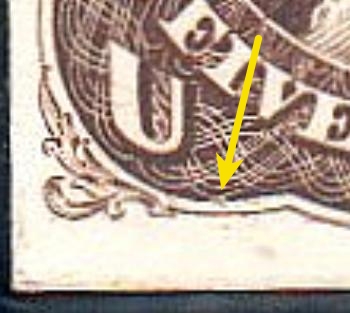
Scott 105 can be identified by a small notch in the bottom of the Vignette to the right of the "U". It is described starting on page 37 of Brookman Volume II in the chapter about the 5 cent stamp of the 1861 issue. The "notch" is not mentioned in Stamp Smarter.
BC added:
Quote:
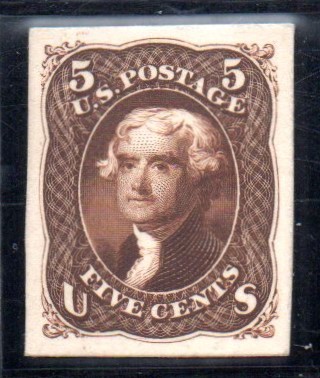
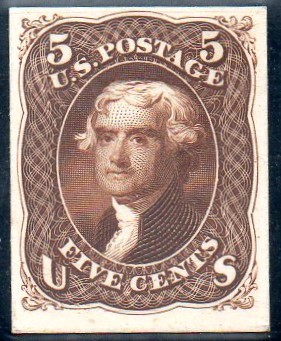
Clark is correct about the notch, however, be aware that the plate proof also has the notch. The notch is not a guarantee that it is a genuine Scott 105, but is needed to be a genuine Scott 105.
Since this is not an area of principal study for me, I'd like to make sure I have the facts straight on this. Scott does not go into this kind of detail in its cover description for distinguishing the re-issues of 1875, which it does note were produced by the National BNCo from their earlier product of these stamp designs. In his mention of this detail Brookman attributes its discovery to CeDora J. Hanus, and illustrates it photographically but with very little real discussion. Otherwise, in telling us about each of the different 5c stamps of the 1860s Brookman notes merely that they were all printed from the same plate, plate 17. Yet, what Ms Hanus discovered as a consistent quality on all the 5c re-issues, and only the 5c
re-issues, appears to be in essence a relief break. Moreover, she had also observed another point of distinction between the original issues and the re-issue for this stamp. This concerns the disposition of a dot of color between the inner and outer frame lines in the upper right corner on line with the crossbar of the numeral "5". All the originals have it, but the reissues do not. Could it be that the reissues were made from a new plate which had been entered from a common new relief on a transfer roll; a relief which had these differences from the original/earlier relief?
Of course! And the pictures and captions (if not the main text) in Brookman do tell that story. The re-issues of 1875 were printed from National plate #58, a new plate they created for the re-issues. That would explain why all the card proofs have the character of the reissue, insamuch as they did not begin to be produced until 1879 by the American BNCo using plates they had
inherited from their consolidation affiliates. One expects the card proofs to have come from the latest plates that saw regular production earlier, in this case the reissues plate.
But Bill had not said "card proofs" he had said "plate proofs" so I decided to look at my set of plate proofs on India paper. Since plate proofs on India may have been pulled and archived at any time the stamp was in production, one might expect the greater preponderance of such proofs to come from the original issue printings. So I expected the India plate proof to look like the earlier issue. But no, it was a match for the reissue. Okay, how is this handled in the proof section in Scott?
For plate proofs on India Scott lists the 76P3, but gives no listings for any of the other stamps of this design. The 5c buff is listed for die proofs, but that covers it for the 5c of 1861. So from this it would seem that original plate proofs of the issue of 1861-68 are seldom seen if they are seen at all. But the plate proofs on India for this design as listed all hail from the reissue plate #58 and so are technically not 76P3 but rather 105P3, though not identified as such. One would expect then that any original 5c plate proofs pulled prior to the reissues must be howling rarities, if they were archived at all.
Is that pretty much the picture?





 Posted 09/22/2019 9:26 pm