Quandry solved, but for Rod and anyone else interested in non-stamp stuff:
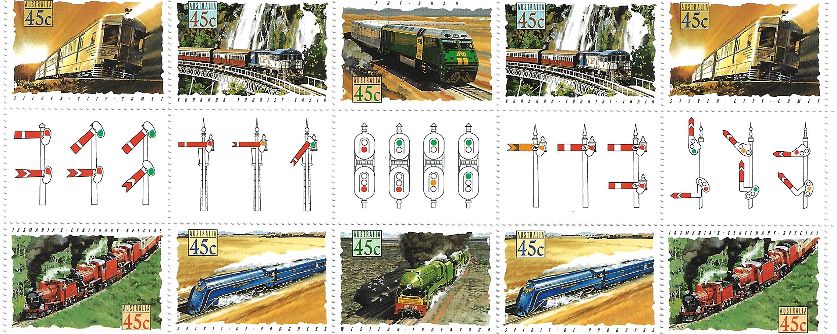
To prevent collisions, lengths of track are divided into sections called blocks. Permission to enter a block is controlled by signals, themselves run by a human controller far away, though detectors on the track can/will change signals to red after a train passes.
The semaphore arm pivots on the pole to predetermined points. The kidney bean-shaped part opposite holds colored lenses over an otherwise white light and moves to provide the same signal as the arm. Why so redundant? In fog, heavy rain or dust storms, a driver (US: engineer) might be able to see the light only. With very bright sun, the semaphore arm would be more visible than the light.

The first signal is obviously STOP. The top shows the status of the block immediately in front of the train, the one below it shows the status of the block beyond that. Note the different arm shapes to emphasize the difference. With permission either by a human controller or by rule, the driver can stop and then advance into the block but knows that he/she must stop before the next block.
Long freight trains cannot stop on a dime, therefore this 2 signal system gives advance warning on what to expect farther ahead.
The second signal has different interpretations depending on region/railroad. It can be a caution (where max speed is at a lower limit) or "proceed" with an indeterminate status in the block beyond that.
The third is "proceed" through the block and the next.

First: stop, with just one signal showing only the status of the block in front of the train.
Second: yellow caution, a different type of signal from above with a different semaphore style.
Third: the only other indication of the signal above, green/proceed
The odd lines shown around the pole are a ladder and stand in back for a signal maintainer to work from.

Lights only here. Positions of lights as described earlier, again with the top one for the block in front and the one below for the block after that.

First: a special signal type with semaphore arm in different colors, set to caution. Unknown what this type is used for. Anyone?
Second and third: stop signals as noted earlier. Different style poles may mean a different railroad/region.

Again, different poles probably means a different railroad/region. The signal style is quite different from the others shown earlier, with 3 different light colors and different semaphore arm positions, except for stop.
This only very basic stuff so don't go stealing a train just yet. There can be other lights placed in different places on a pole, plus signs/plates telling drivers how to interpret signals further. There are US systems that are basically similar but are now lights only. We're supposed to be going to all GPS. Somehow. Someday.





 Posted 10/16/2019 1:07 pm