|
This page may contain links that result in small commissions to keep this free site up and running.

Welcome Guest! Registering and/or logging in will remove the anchor (bottom) ads. It's Free!
To participate in the forum you must log in or register.
| Author |
 Replies: 14 / Views: 2,036 Replies: 14 / Views: 2,036 |
|
|
Pillar Of The Community
United States
733 Posts |
|
|
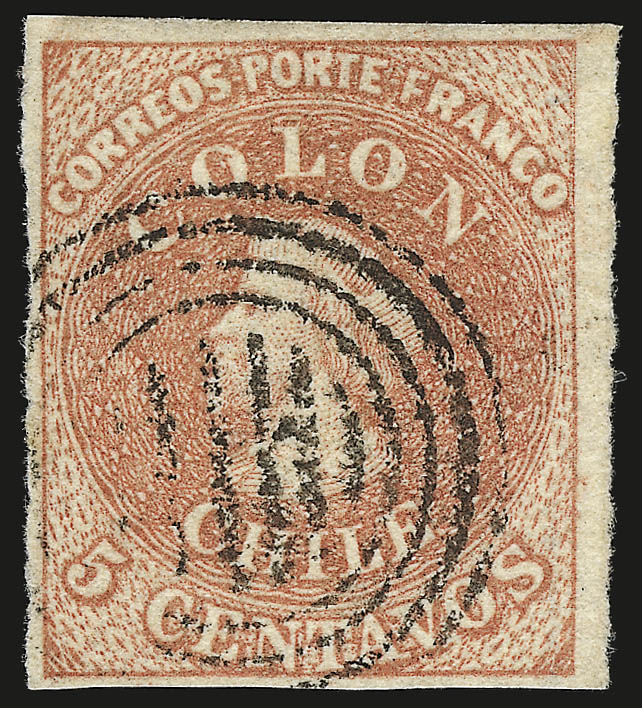
This is not a very easy issue to id, especially using only Scott Classic catalog, but I believe this to be Scott 7f (Santiago 1854 litho print, deep red) with reversed watermark. Does anyone's catalog list watermark varieties on this issues? It is actually looks brighter and sharper in person than on the scan. But looking at the scan I'm starting to doubt this as an 1854 print. Much more certain now that this is second Santiago printing   |
|
Send note to Staff
|
| Edited by danko - 12/15/2019 4:53 pm |
|
|
|
|
Pillar Of The Community
France, Metropolitan
3756 Posts |
|
|
Pillar Of The Community
United States
7106 Posts |
|
|
Great site, perf12.  I was simply going to add that Yvert mentions reversed watermarks on all issues through 1867, and gives 9- and 10mm measurements, but that's hardly necessary now. |
Send note to Staff 
|
|
|
Pillar Of The Community
United States
733 Posts |
|
|
perf 12 Thank you very much. Great link. It looks like that reversed watermark is quite common with these stamps. Also, comparing my stamp to first, second and litho Santiago printings, I believe I have 1856-1862 printing, Scott #9. I sought based on the note in the Scott, Second printing would be lot more blurred. Mine is probably early printing, and looks like vermilion shade in person. Here is the quick comparison I made for Secon, First and Litho printings.  |
|
Send note to Staff
|
|
|
Pillar Of The Community
United States
733 Posts |
|
|
A side question.
Scott list these stamps as Engraved, and for me the test for engraved stamps was using foil. This stamp did not leave any impression on the foil except for irregularities in paper, this is why I assumed that this is a lithographed stamp.
Does this mean that foil test will not work on all engraved stamps, or there is something else I'm missing here. |
|
Send note to Staff
|
|
|
Pillar Of The Community
France, Metropolitan
3756 Posts |
|
|
All engraved stamps leave a trace on the foil.If your stamps does not leave a trace that is because it is a Litho printing. It may be from the Lithographic issue (The only one) by Gillet on July 1854.If so; they are very scarce. Some further reading; http://f660b8feb5396b87e648727b5bf1...complete.pdf_________________________________________________________________________________ Below taken from Siegal Auction Galleries june 5 2008 THE LITHOGRAPHS PRINTED BY GILLET Chile's postal reform law authorizing the first postage stamps went into effect on July 1, 1853, and the first issue was engraved and printed by the British firm of Perkins, Bacon & Company. Stamps were not actually distributed through post offices, but were sold by estancos, local agents who were in charge of government monopolies on products such as salt, tobacco and playing cards (Blank, p. 10). The demand for stamps was greater than expected, and supplies from Perkins Bacon were running low by the end of 1853. The government, unable to arrange its own printing operation in time, turned to two local printers, N. Desmadryl and H. Gillet of Santiago. Desmadryl was a renowned engraver and printer, and his prints from the steel plates furnished by Perkins Bacon were so skillfully executed, the impressions are arguably superior to the London prints. However, because Desmadryl was too busy with his regular business to meet the government's demands for more stamps, the next order was given to Gillet, whose skills and experience were in lithography, not recess-printing. Gillet tried to print from the engraved plates, but his inks and technique were ill-suited for the task. Consequently, Gillet's recess-printed stamps were of poor quality, but the watermarked paper provided by the government was so carefully controlled, Gillet eventually had to turn over the unsatisfactory recess-printed stamps. Faced with his own failure to produce quality impressions from engraved plates, Gillet decided to switch to lithography, a printing method that was generally not favored by the government, and certainly was never authorized. Using transfer paper, Gillet made a lithographic stone plate of 240 subjects, the number required to fill up the sheet of tightly-controlled watermarked security paper. Based on research by Gerhard Blank, we know that at least two stones were made; one from a single transfer of 240 subjects, which resulted in numerous transfer flaws, and another built up from multiple transfers, which allowed for greater control in transferring the designs. The rarity of examples of the transfer flaws indicates that the stone made from the single 240-subject transfer was not used to print many sheets. Gillet's Lithographs were so finely printed that they were considered to be engraved for almost fifty years. In 1898 the first report of the Lithographs was published by John N. Luff. The "squeeze" varieties were brought to Perkins Bacon in England for analysis, and it was confirmed that such flaws could only occur in stamps printed by lithography. Thus, Gillet's "switch" finally came to light, and a major new classic imperforate issue was born. Experts have determined that only 500 sheets of Lithograph stamps were printed. Multiples in strip form are rare, and only three blocks are known. All three are presented in this sale, including the block of fourteen on cover.
https://stampauctionnetwork.com/y/9...ockIntro.pdfhttps://siegelauctions.com/lots.php...7&page_no=19_____________________________________________________________________________________ Your stamp may be the color "Rose" like lot no.116 ?? https://siegelauctions.com/lots.php...7&page_no=17 |
|
Send note to Staff
|
| Edited by perf12 - 12/15/2019 6:14 pm |
|
|
Pillar Of The Community
United States
733 Posts |
|
|
perf 12
Thanks a lot for additional info. You are a wealth of information, it always surprises me, how one person can accumulate and remember all this knowledge.
That was I always thought, that engraved stamps will leave impression of portions of the design on the foil. No matter how hard I try with this one, all I'm getting is a blotchy relief of the paper. It looks like the paper they were printed on is not smooth.
However, my example does not look like any litho examples.
Sorry, I didn't see the second link.
You know what, maybe you are right and it is lithographed. |
|
Send note to Staff
|
| Edited by danko - 12/15/2019 6:23 pm |
|
|
Pillar Of The Community
United States
3224 Posts |
|
|
Actually, the watermark on yours is the right way around. Scott doesn't say but the convention is that they are right way around when viewed from the front. Gibbons does say that, Michel specifies their watermarks illustrations are views from the back.
Another test is to use a magnifier (10x or less) and light the stamp at an angle from the side to check if the printing is raised above the surface. If so, it's engraved/recess printed. I think I see raised portions around "COLON". Litho printing would be flat against the paper (at this magnification). Per above, this can be one of the harder designs to tell engraved vs. litho apart. |
|
Send note to Staff
|
|
|
Pillar Of The Community
United States
733 Posts |
|
|
hy-brasil
Thanks for additional info. My Scott pictures them right way around, but they usually picture watermarks as viewed from the back, opposite to Gibbons, so I thought that the one I have is a reversed.
I took 20x magnifier and looked at stamps from 1867 and 1877 printings, and I clearly see raised ink on those stamps. However, the one in question only shows irregular relief of the uneven paper covering entire stamp, so it is a little harder to say if any portions of the ink is raised, but it looks like it is not, just some thicker spots due to heavier ink buildup.
So, maybe it is lithographed. |
|
Send note to Staff
|
|
|
Pillar Of The Community
United States
733 Posts |
|
|
New Member
South Africa
2 Posts |
|
|
i read a note somewhere that the Desmadryl printings have charecteristic dots of colour over "Colons nose". If anyone has a desmadryl print that they are certain of, could you please post an enlarged picture of the nose with the charectaristic dots of colour, because I don't know what they are talking about.
Many thanks
|
|
Send note to Staff
|
|
|
Moderator

United States
12330 Posts |
|
|
Pillar Of The Community
Netherlands
6644 Posts |
|
|
New Member
South Africa
2 Posts |
|
|
Hi. Yes.
I also have a slightly more detailed description which I translated (via ChatGTP) from the Chile Filatelico issue 3 of November 1929, set out below.
Sadly I am a novice at Chile, so I also have questions about the watermark of the first Perkins Bacon issues. Can Iask here or leave it for another thread ?
___
From the 1929 article as translated by me.
5 cents by Desmadryl - 360,000 stamps of this value were printed by Desmadryl on the dates already mentioned. The first color found on dated covers is the chestnut brown (Stanley No. 5) and within this No. 5 of Stanley, we place the hazel, which is the rich chestnut brown of the English. This color is very rare and the stamp itself is the best-printed of all the stamps I am addressing. Mr. Phillips speaks of having one of these on a cover dated January 10, 1854, which I cannot explain since the stamps were first sent out on the 28th of that month. If there were more such stamps on covers before January 28, then a printing made before the 28th would be possible.
Regarding the Desmadryl stamps, there were only 5 sheets, which were for trial purposes. I find it curious that Doctor A, who has already been copied, stated that he was supposed to deliver 995 sheets, and yet he was paid for printing 1000 sheets. All of these 5-cent Desmadryl stamps have fine striped paper, and the gum is slightly bluish, leaving the paper completely yellow when the gum is removed.
Within this run, there is a batch that appears to have been printed by Gillet, and they are the first ones that were made when Desmadryl received the plate back from Gillet and used it without cleaning it. These stamps, printed in Desmadryl ink, seem to have been made by Gillet due to their impression, but with different ink.
The last runs by Desmadryl are of a pale reddish-brown color that is the most abundant. It is in this color that examples are known with double impressions, which are not due to paper movement but to having been placed twice on the plate.
Mr. Phillips speaks of a break that he noticed in this run, which he has seen in several different examples. The break starts from the marginal stamp on the left side, goes through the middle of the C in Correos, the first O in Colon, the base of the L, and the second O in Colon, to continue through the C in Franco to the second stamp, where it passes through the middle of the L in Colon and the upper part of the C in Franco. This defect must be a result of the heating to which the plate was subjected in order to obtain good impressions
|
|
Send note to Staff
|
|
|
Pillar Of The Community
United States
1028 Posts |
|
|
I'm sure I've asked this before, but has anyone done plating studies on these issues? I have a binder full of 5c that points out many different plate varieties, but I'd like to try and pin those down to plate, print and position... |
|
Send note to Staff
|
|
| |
Replies: 14 / Views: 2,036 |
|
|
To participate in the forum you must log in or register. | |
 Transvaal Postal History Help Earliest Stamp With In-Design Date? My First Stamps Help Newbie.help With Stamp Identification (J29) Inherited These Stamps, Are They Genuine? APS Membership Discount Metropex Stamp Show: Roseville, Minnesota October 23-24 Weird Covers, 1885,1886, And 1982 For Users Of Two-Post Blue International Albums What Is Your Experience With Binders. New Member Posting Image Of Avatar, Front And Back Of U2 Cut Square, Market Value Or References? Working On An Offline Collection George Washington 3 Cent 1861 With Print On The Back Hello From The Netherlands - New Member Then And Now, From Old Postcards New Member Wanting To Add An Avatar Sparks Auction Fees? 163 VF Nyfm Vertically Ribbed 163 XF Quartered Cork, Labeled Jumbo 136 VF Quadruple Split H Grill Nashville Philatelic Society-Your Invitation To Our Auction Night Meeting Monday, October 26, 2026 Nashville Philatelic Society-Your Invitation To Our Meeting Monday, October 19, 2026 Christmas Around The World 2026 C.e. In The Large Queen Cancel A More Condensed Album Page Experiment. US Scott #3 Postmarked Or Fake? Transvaal Postal History Help Earliest Stamp With In-Design Date? My First Stamps Help Newbie.help With Stamp Identification (J29) Inherited These Stamps, Are They Genuine? APS Membership Discount Metropex Stamp Show: Roseville, Minnesota October 23-24 Weird Covers, 1885,1886, And 1982 For Users Of Two-Post Blue International Albums What Is Your Experience With Binders. New Member Posting Image Of Avatar, Front And Back Of U2 Cut Square, Market Value Or References? Working On An Offline Collection George Washington 3 Cent 1861 With Print On The Back Hello From The Netherlands - New Member Then And Now, From Old Postcards New Member Wanting To Add An Avatar Sparks Auction Fees? 163 VF Nyfm Vertically Ribbed 163 XF Quartered Cork, Labeled Jumbo 136 VF Quadruple Split H Grill Nashville Philatelic Society-Your Invitation To Our Auction Night Meeting Monday, October 26, 2026 Nashville Philatelic Society-Your Invitation To Our Meeting Monday, October 19, 2026 Christmas Around The World 2026 C.e. In The Large Queen Cancel A More Condensed Album Page Experiment. US Scott #3 Postmarked Or Fake?
Disclaimer: While a tremendous amount of effort goes into ensuring the accuracy of the information contained in this site, Stamp Community assumes no liability for errors. Copyright 2005 - 2026 Stamp Community Family - All rights reserved worldwide. Use of any images or content on this website without prior written permission of Stamp Community or the original lender is strictly prohibited.
Privacy Policy / Terms of Use Advertise Here |
| Stamp Community Forum |
© 2007 - 2026 Stamp Community Forums |
| It took 0.23 seconds to lick this stamp. |
 |
|
|
|


 Posted 12/15/2019 3:30 pm