There are no hard and fast rules. There is no magic formula. Visible faults are more likely to impact the value and marketability of a stamp than unseen ones, e.g., a thin may be more acceptable than a crease or short/pulled perfs.
It also depends on what you collect. For example, as a cancel or plate variety specialist, or looking for specific usages on document or cover, if a stamp has a very rare cancel or plate variety, the faults are far more secondary than if I were a "fill in the album spot" collector. That doesn't mean that I don't factor the faults into my consideration of how much I'm willing to pay, but just because a stamp has faults, even major ones, it doesn't necessarily mean that I will pass it by.
Another case is if it is a stamp that I could not otherwise afford. For some of the revenue stamps with catalog values in the 4- to 5-figure range, obtaining a sound example just isn't an option. Add to that factor potentially also wanting a particular cancel, and one is forced to make choices.
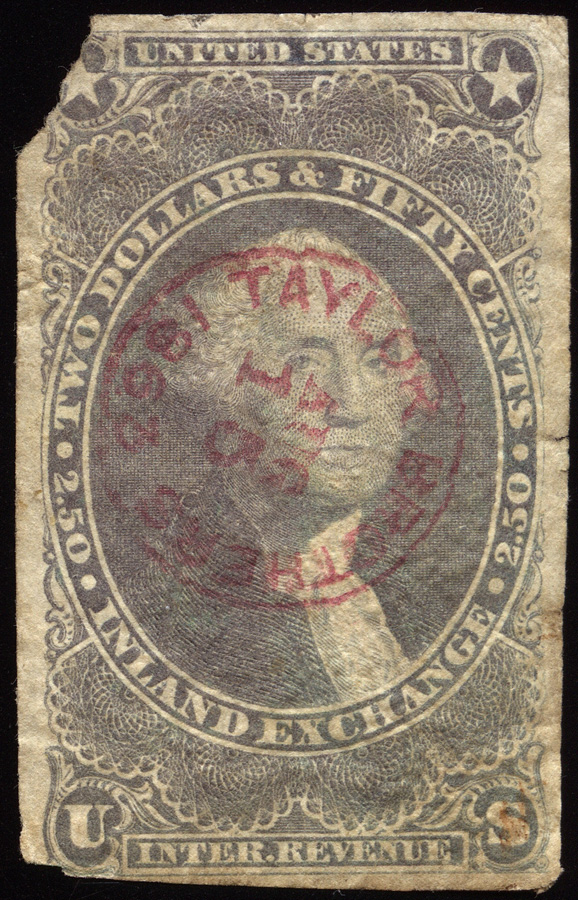
If a stamp has otherwise redeeming characteristics, I will acquire a stamp even with multiple major faults. The stamp below is an example I have shown before. To the condition purist, it will give them convulsions, as it has multiple major faults. Scott #R84a catalogs $12,000 and is frequently faked. This example is not only 100% genuine, but it is the only example I have ever seen or even seen record of, with a red handstamp cancel.
To the investor or high-grade collector, this stamp would never be acceptable, but for me as a cancel collector, it's perfect... it has "character".






 Posted 12/17/2019 2:21 pm


 As to line 9 I am guessing he meant discounting 80-90% of the value.





