| Author |
 Replies: 7 / Views: 1,391 Replies: 7 / Views: 1,391 |
|
|
Valued Member
United States
7 Posts |
|
|
Hello, this stamp is 10 1/2 x 11, my catalogue shows this series starting this perf# with the 17c??? Thank you in advance for any help, Dave 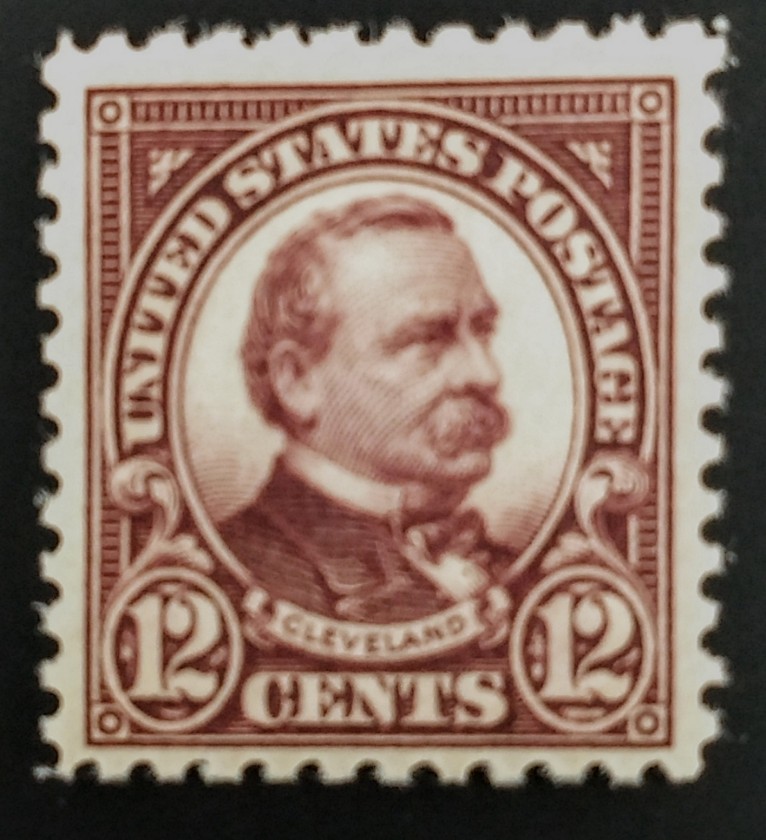 |
|
Send note to Staff
|
|
|
|
|
Pillar Of The Community

United States
1498 Posts |
|
|
Not sure what you are asking. The 11x10.5 rotary press stamps appear in two separate areas of the Scott catalogue. The low denominations, 1 thru 10 cent (Scott 632-642), appear first. These were issued in 1926-28 with the exception of the 9-cent (1931). The higher denominations, 11 thru 50 cent (Scott 692-701), were all issued in 1931. At a guess, Scott did not leave sufficient room in their numbering scheme for the entire set … and chose not to renumber all of the stamps that were issued between 1928 & 1931. Your 12-cent is Scott 693.
Added: Forgot about Scott 653, the 0.5 cent Nathan Hale. It was issued in 1929. So the entire series appears in 3 parts, 632-642, 653 & 692-701.
Added: There are three large groups of sheet stamps of this design.
(1) Flat plate perf 11 … Scott 551-573, 622-623 (the 13 & 17 cent designs appeared later than the 0.5 cent thru $5 designs.
(2) Flat plate perf 10 … Scott 581-591, 1 thru 10 cents.
(3) Rotary press perf 11x10.5 … Scott 632-642, 653, 692-701. Denominations as noted earlier.
Hope the answer to your intended question lies somewhere in the above. |
Send note to Staff 
|
| Edited by JLLebbert - 01/05/2020 6:28 pm |
|
|
Valued Member
United States
7 Posts |
|
|
I figured it would be something simple, thank you and my apologies for the late post, Dave
|
|
Send note to Staff
|
|
|
Pillar Of The Community
United States
853 Posts |
|
|
I suspect part of the issue is the phrasing of the question as, in effect, perf 10 1/2 x 11 starts with the 17c?"
If you look right above that in the Scott catalog, you'll see the listing of several in the same rotary press series with perf 11 x 10 1/2. Among those is the 12 cent Cleveland, design A167.
Your album might make this clearer, but the perforation in the case of a so-called compound perforation, is given as the scaling of the top (or bottom) first, going laterally from side to side, then the scale for the side of the stamp, measured vertically. Which is why JLLebbert notes your 693 as 11x10 1/2 following Scott, rather than calling it 10 1/2 x 11.
If your catalogue is a Scott specialized, toward the front is a sort of index by design where the A167 will be called out as either Scott#564 or 693 with the listings together on one line and the next line. While this section might appear redundant to the body of the catalog, that section is very helpful as an index when trying to identify a given stamp.
The Scott 564 which came out in 1923 is perforated at 11 x 11 which is just referred to as perf 11.
Looks like a nice stamp, Dave. it takes a bit of work to really know your catalog, especially when there are many appearances of the same design over many years....
- Jonathan |
|
Send note to Staff
|
| Edited by jleb1979 - 01/05/2020 6:42 pm |
|
|
Pillar Of The Community
United States
1498 Posts |
|
|
Think Jonathan opened my eyes a bit as to the reason for your original question. The Scott catalogue does list 10.5x11 immediately above the 17-cent Scott 697. For the rotary press stamps of this series, the low values (1-15 cent) are perf 11x10.5 while the high values (17-50 cent) are perf 10.5x11. The low values are all vertical designs while the high are horizontal designs. The short edge of the stamps are all perf 11 while the long edges are all perf 10.5. As Jonathan indicated, for compound perfs the horizontal gauge is given first, the vertical second. While you don't see it with U.S. stamps (except the rare errors created during the perf 11 to perf 10 switchover), it is possible for all 4 sides to have different perf gauges … in which case the values would be given as TxRxBxL (Top,Right,Bottom,Left). A U.S. example would be 586d with the bottom edge perf 10 … the perfs for this stamp would be given as 11x11x10x11.
John
Added: In case you think the top edge measures 10.5, I assure you that you are wrong. For a stamp this size, you can usually count the number of perforations across the top & get the right perf gauge … in this case 11. I think the vertical edge of your stamp measures 10.5, but I can't be completely sure. If the long edge really does measure 11 (your stamp is 11x11), then your stamp is a flat plate 564. You can also check the reverse side of your stamp for "setoff" … ink left on the gum side when sheets were left stacked while drying. If there is setoff, the stamp is flat plate … if not, it is probably rotary press. |
|
Send note to Staff
|
| Edited by JLLebbert - 01/05/2020 9:37 pm |
|
|
Valued Member
United States
7 Posts |
|
|
Thank you for your time and your explanation. Dave
Any thoughts on the 596?
|
|
Send note to Staff
|
| Edited by Dave65 - 01/05/2020 10:20 pm |
|
|
Pillar Of The Community
United States
1498 Posts |
|
|
I saw no info about 596. The only thing I would add is that the odds of finding a 596 are significantly less than winning a multi-million dollar lottery. Hence it would make more sense to play the lottery than search for such a stamp. Especially since the CV for a 596 is also significantly less (in the neighborhood of $150K). According to my 2018 catalogue, there were 15 known copies at that time. |
|
Send note to Staff
|
|
|
Pillar Of The Community
United States
1414 Posts |
|
|
The top and bottom perforations would be aligned if the stamp was from a rotary press printing. They are not aligned. |
|
Send note to Staff
|
|
| |
Replies: 7 / Views: 1,391 |
|



 Posted 01/05/2020 5:25 pm


