SPERATI AUTOBIOGRAPHY
I was born in Pistoia (Italy) on October 14, 1884. My father, who had fought in all campaigns against Austria, was Colonel retired on the same date and became the owner of a mineral factory, for which I was predestined To be the accountant. I had three brothers, and each of them hoped to take part in the factory's businesses.
My father spent most of his life in the Navy and, lacking business experience, was forced to part with the factory. From then on everything changed. One of my brothers joined the Navy, another was a photographer and the third was a stamp merchant. I owe the foundation of La Philatelia d'Art to the last two. In 1892 the stamp merchant was also the owner and editor of La San Marino, one of the first philatelic newspapers.
I continued without interruption my accounting studies at the "Institute Technique de Bolonie", but the greatest interest my free time was working with my brother in his study with the chemicals he used.
When I was 15, one day, walking through Bologna, I saw in a bookshop 12 volumes of Dr. Selmi's L 'Encyclopedia di Chimica at the ridiculous price of 50 lira. I left the 2 liras in my pocket and ran home to count my savings. Almost 6 lira. I explained the situation to my mother, trying to make her understand that with these books I could study, invent and make money and thus I got the Encyclopedia. I had found my vocation: Chemistry. Once the Bologna house almost burned experimenting with phosphorus and carbon sulfate.
My brother added an annex to his photo studio to dedicate it to graphic art. There he worked in heliography and photographic contact making postcards and illustrations of books. In all those processes in which chemistry played an important role I helped my brother enthusiastically.
I followed him to Turin where he had a lot of success establishing two graphic arts work shops, La Fotocelere and L 'Argentografica, where I undertook research work on my own calculations in order to refine some processes. Thus I acquired knowledge of engraving, lithography, photography, heliography and some aspects of chemistry.
For a casual circumstance, I was able to acquire knowledge of "paper", which I owe to one of my cousins, the "Commendatore Floridi", which I owned in Guarcino (Italy), whose location was the mayor, 'a paper mill.
One year I was invited to spend the holidays at home and, taking advantage of the opportunity, I spent time at the factory, where I spent most of the day taking notes.
My knowledge of the paper was increasing, from the preparation of cleaning to the appearance of the leaves. But in my mind a curious tendency had been revealed since my early years: the passion for imitation. It made my brothers see the exact way that I was able to imitate the signatures of my father and my mother.
At the Pistoia school - when I was about 10 years old - we had a teacher who, as a method of giving good grades, gave the student a small rectangle of paper with his signature. Some students, seeing the ability I had to imitate their signature, asked me to do it for them on pieces of paper, which were accepted without hitting.
Lover of chemistry, graphic arts and imitation, these are my weaknesses that, coming into contact with philately, were inevitably destined to lead me to Philatelie d'Art.
I said "coming into contact with philately", and why? As I said, I had an older brother, now deceased, who had been in the stamp market. One day, this brother, aware of my interests and talents, persuaded me to reproduce some San Marino stamps, which were his specialty. I was not able to refuse, being curious at the same time to discover if these three factors could be put into practice and convince.
I used engraving and lithography at the same time and the results were only passable, but it was the first step in the art of imitation.
My brother had a trial in Italy from which he was acquitted. That, however, was his business and it didn't affect me. My search had been satisfied. That was it.
Since then my enemies - playing with the name of my family - tried to imply that I was guilty of fakes in Italy, when I had never intervened in them.
I was even forced to follow a legal procedure to proceed against two newspapers and force them to correct their statements about me.
Since the first of these imitations of San Marino, my self-esteem had awakened to discover if it was possible to improve them with my knowledge of Graphic Arts.
In 1909, going to Paris in order to announce my brother's products, I met many philatelists and, as a curious thing, I asked for their opinion on some imitations he had done and carried with me.
One of them left me an authentic seal and told me that, when I had free time, I entertained myself by imitating him and showing him the result. I did it like that.
I saw that philatelist later and he told me that he had sent my imitation to a well-known expert, M. Their, from Berlin, who had returned it signed.
As a result of this I made my plan. I started a project to obtain documentation on the experts' inability to discover my imitations, be they professional experts or merchants, to offer my products as "art work", on the condition that the opinion of the experts is justified.
To achieve my ambition, I spent more than forty years during which I dedicated all my free time (from other occupations, business trips and business in Paris), allowing me to improve my Philatelie d'Art.
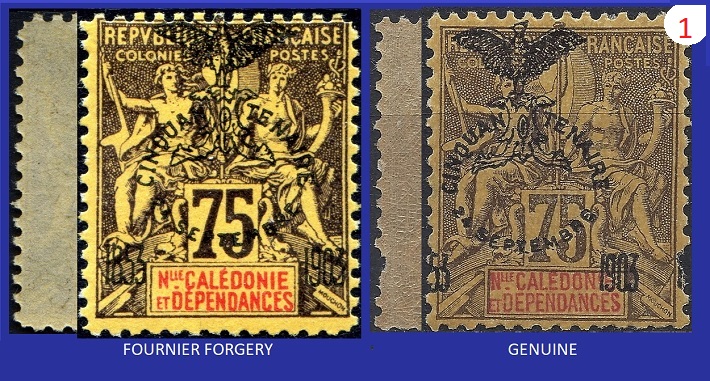
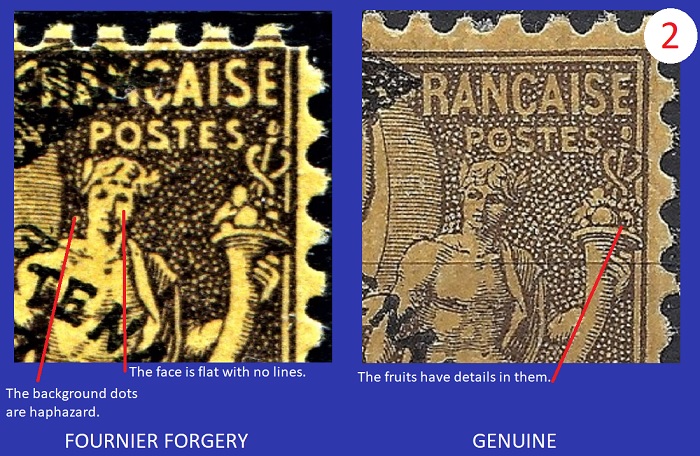
He had succeeded: A Gold Book containing hundreds * of guaranteed imitations, ** or guarantee certificates of experts and expert committees from France and abroad were the proof. So far everything was fine, but it was necessary to make myself known.
My two trials that I provoked, one in Chambery, where I defeated a famous criminologist, and the other in Paris, provided the media.
Following the two trials, newspapers, magazines, etc., on five continents, published my skills, my campaign against experts and my business.
Thanks to this propaganda, Philatelie d'Art, becomes better known, and currently no advanced specialist in the world ignores that Philatelie d'Art is linked to the name of Jean de Sperati. |





 Posted 01/22/2020 4:31 pm