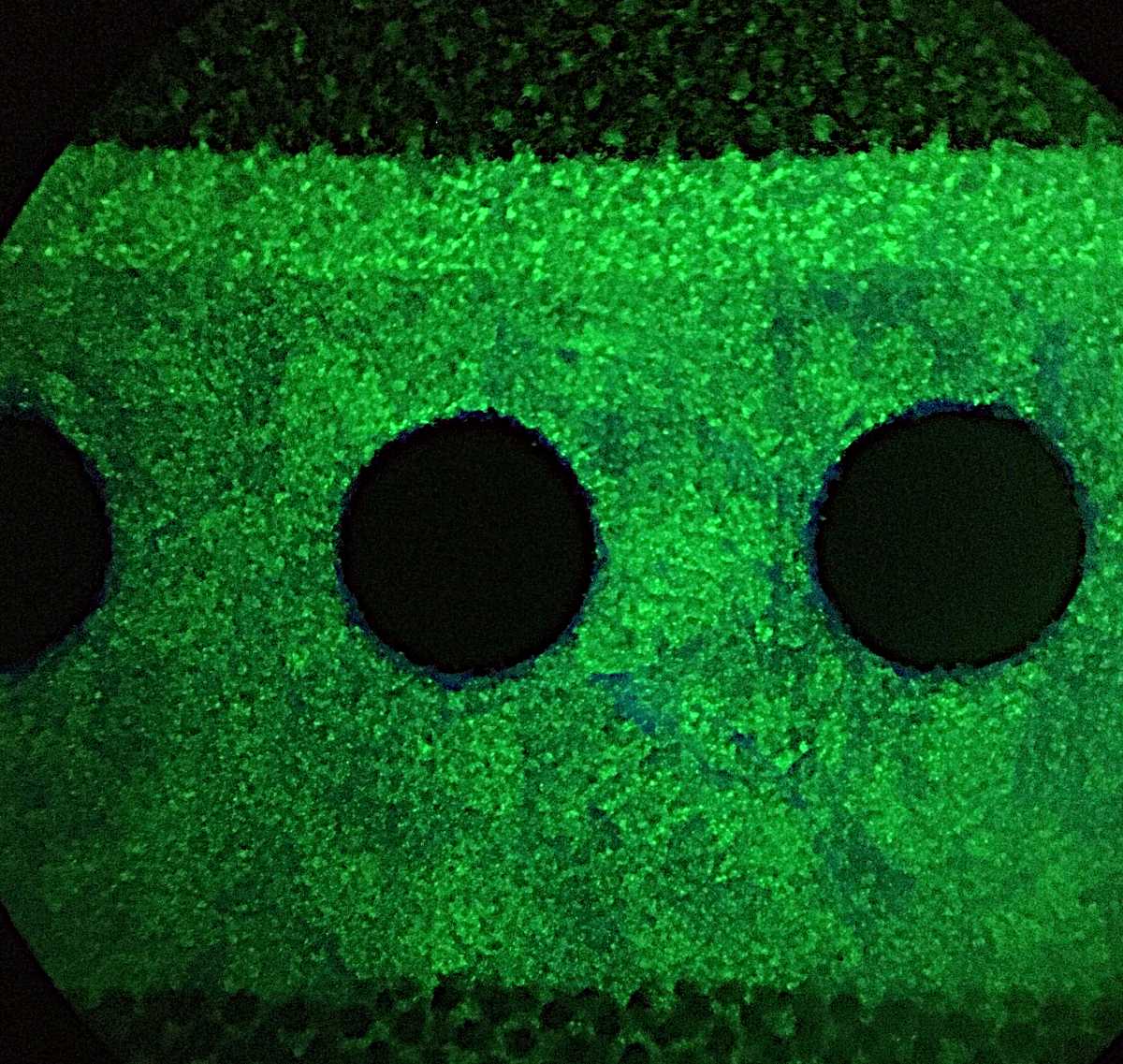
More pictures. I hadn't looked at these under the microscope before so it has been very interesting. Having done so, in all cases no matter which variety of 2785-2788, if there is a block tag it is printed under the ink. Since the ink is printed on top this method can't be used to determine if the block tag exists on 2786-2787.
Here are some closeups of a 2788 with bright block tag.
Closeup of a dark area showing dark ink. Tagging not visible on top as a normal overall tagged stamp which would have bright speckles of taggant.

Section of lettering more clearly showing black "IT" is on top. You can see edge of block tag near top of image.

Top of "T" magnified even more. While it looks like there could be taggant on top of ink in this image, that is not the case. The dark ink dots aren't solidly printed leaving gaps.

Close up views of several 2786 with cross hatch pattern.
Bright cross hatch pattern easily visible. Fuzziness on bottom of letters is shadowing from taking the picture and not tagging.

Cross hatch is fairly light but still visible.

This is where it gets interesting. To eyeonwall's original question if I understand it correctly. My conclusion is a Type 2 could easily be misidentified as a Type 1. In the image below traces of the cross hatch are clearly visible on this 2786 under higher magnification. I have highlighted the block tag traces between the red lines.

I examined many that appeared to have no block and in many of the cases I could identify traces of the block tag under higher magnification. These traces are typically a slight edge as show above. There were also many where I could not readily find a tagging trace edge. Looking at the edges is the only way I see to check for block tag.
Based on what I have seen it begs the question is the Type 1 Gene identified and Type 1a I added really just freak varieties. Meaning they should have had the cross hatch pattern but appear not to for various manufacturing reasons.





 Posted 03/24/2020 10:15 pm