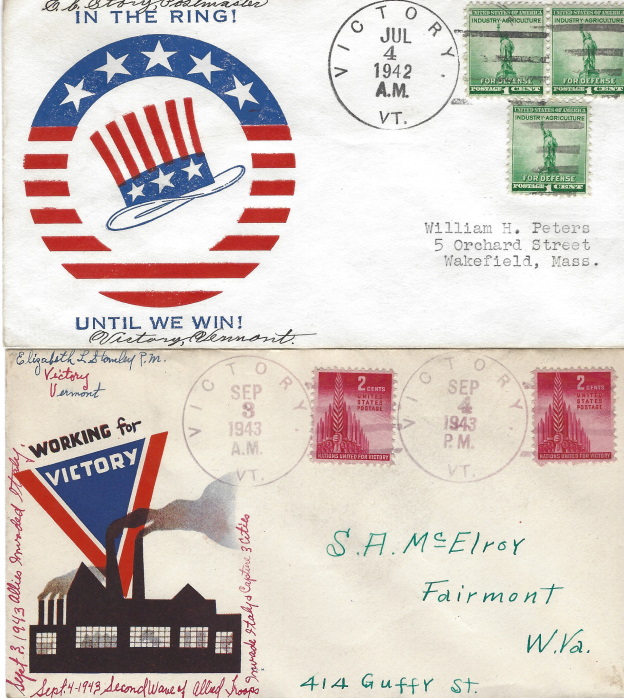
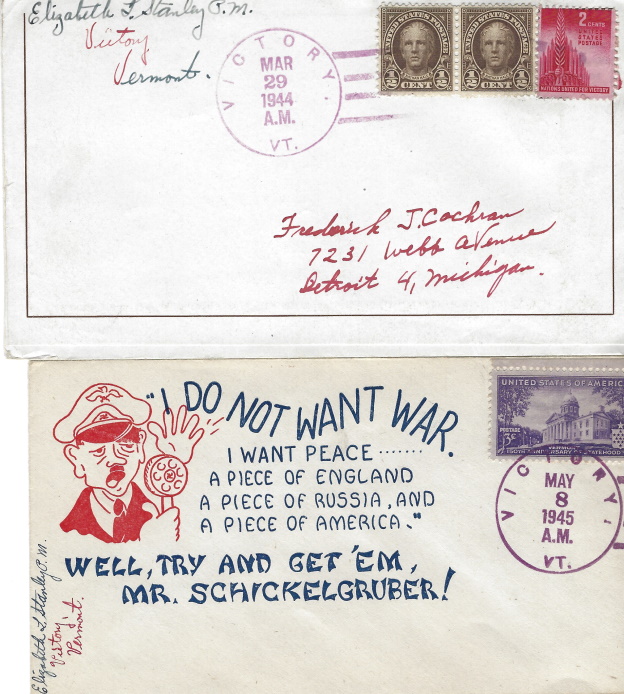
New thread to show what I've come up with comparing Victory, VT covers. There are four covers I'm working with, the first one a 1942 signed by P.M. Story, and the next three, 1943-1945, signed by P.M. Stanley. I'll post images of the covers in the next post.
Here's a systematic comparison of the overlays, both year to year, and for 1943 v. 1942, 1944 v. 1942, and 1945 v. 1942:

The year to year changes are on the left, the changes over time on the right. Year to year, the overlays line up close enough to suggest the same device was used. But over time, we see changes emerging. I am now leaning to the view that the changes can be explained by age and use of the same device. For instance, with age and use, the outer circle of the CDS becomes softer and wider, so that by 1945 the 1942 circle appears to be inside the 1945 circle. The flyspeck inside the circle adjacent to the 3rd killer bar, which I would attribute to some imperfection in the base of the handstamp that picks up ink, appears in all the covers, another fact that would support a common device. In the 1942 cover (see next post) there appears to be an irregularity in the height of the outer dial that causes it to pick up ink underneath the "VT." This is present in later years, but is less dramatic, probably owing to softening of the dial so that it picks up more ink in that location over time.
The odd overlay by itself, centered in the second row, is from the 1943 Stanley cover, which contained two postmarks a day apart. The overlay is so close (to be expected) that practically no differences can be noted.
It bears noting insofar as age and use might be factors explaining what we are seeing here, that usage ramped up, probably exponentially, through 1944 and 1945. In late 1943 Linto began getting covers serviced in Victory, VT on a regular basis, which by itself probably doubled the volume of mail being processed before that. Over 1944 and 1945, more and more producers and servicers of WWII patriotics began seeking Victory, VT postmarks. As we get into 1945, usage was especially heavy on VE-Day and the two dates that marked victory over Japan. Of the covers I've used in this analysis, the last is a VE-Day cover signed by Mrs. Stanley. Here is an informative news report of what Mrs. Stanley was faced with on May 8, 1945:

Usage on "this one day" was equivalent to half a year of normal usage.
I put quotes around "this one day" because there may be evidence suggesting that VE-Day postmarks were not all postmarked at the same time. I think that she (or "they" if she had help) didn't get them all processed on May 8, took the 8 slug out the next day to process the May 9 mail, and then placed the 8 slug back in the next day to finish the job. That's a whole 'nother bag of issues to sort out some other time.
Up next, the covers used in this analysis.





 Posted 04/06/2020 08:23 am