From:
Robin Harris
Editor, Unitrade Specialized Catalogue of Canadian Stamps
Time to set the record straight regarding some of the comments presented in this thread.
Firstly, I apologize for any and all mistakes that appear in the Unitrade catalogue. As soon as a mistake is reported it is immediately corrected so that the next edition will have accurate information. To imply that any incorrect data that appears in the catalogue is done on purpose is the farthest thing from the truth. I take great pride in the catalogue and the information that is presented therein and take any kind of mistake very seriously.
I was offered the editorship of the Unitrade catalogue in November of 2004. My first edition was the 2006 edition which had to be ready to go the printer by June of 2005. I had many ambitions for my first catalogue, with dozens of new features added. Many of these new features required gathering
thousands of pieces of data that had not previously appeared in the catalogue. That is no excuse for mistakes, but some did happen.
Here is an illustration of a stamp listing from the 2005 Unitrade (prior to my time) and the 2006 Unitrade (my first) which shows just a bit of what was new and therefore required gathering data:
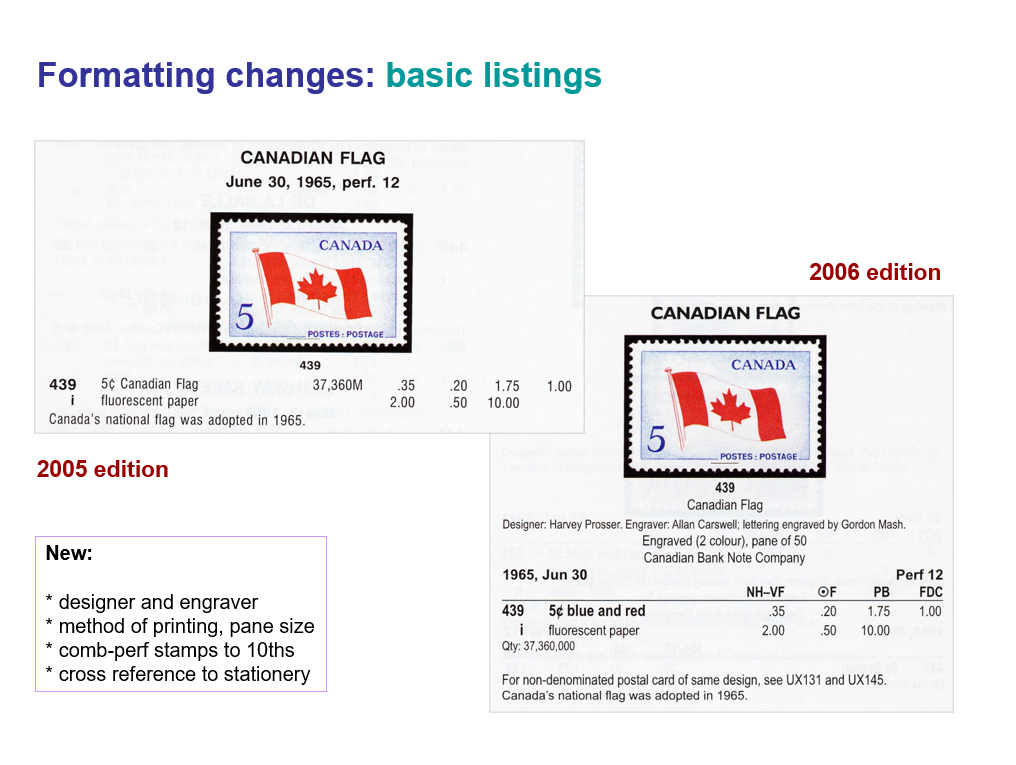
The entire catalogue was laid out from scratch using Adobe InDesign (previous versions were done in Corel Ventura). Did some mistakes make it into the catalogue? Of course. Was I happy with that? Of course not.
The perforation mistakes that Robert (wert) has pointed out in this thread have been around since that 2006 edition, some 14 years ago. It is interesting that these mistakes have not been spotted before.
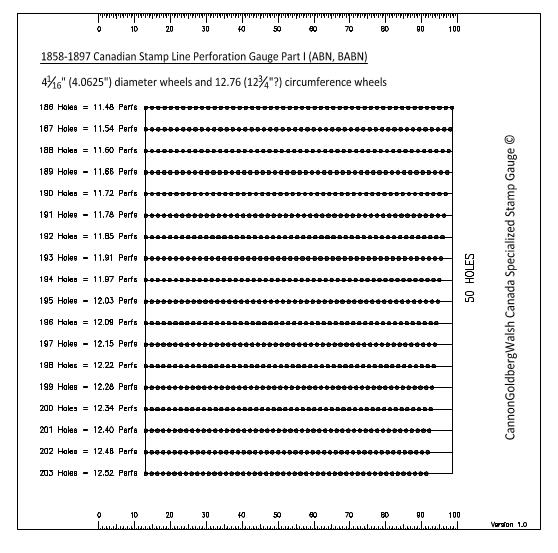
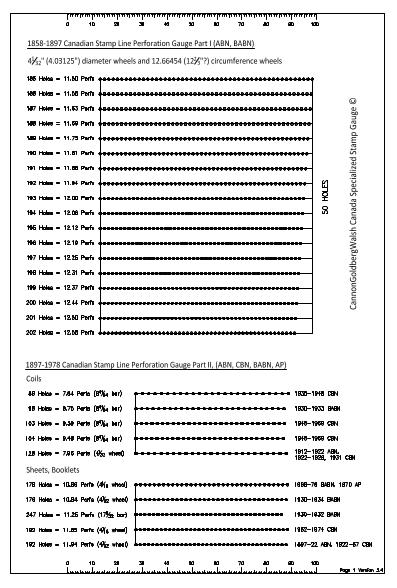
Before we look at the specific items that have been reported in this thread, firstly, how does one determine the perforation of a stamp? The quickest method of course, and the one used by most people is via a perforation gauge. However, the most
accurate method is to use the mathematical formula:
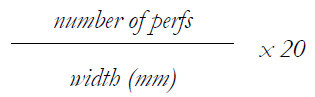
The formula method though, requires counting all of the perforations and then do some mathematical calculations; a very time consuming process.
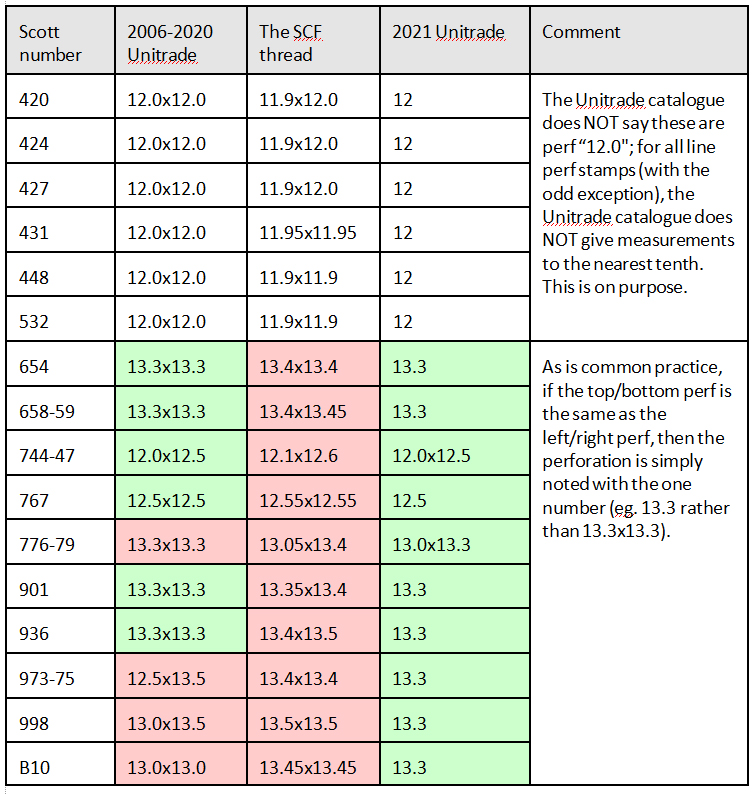
Here is a chart showing the stamps of concern found in this thread. I have shown the perforation noted in the 2006 through 2020 Unitrade catalogues, Robert's determination of the perforation, and the perforation that will appear in the 2021 Unitrade (using the mathematical formula shown above).
I have highlighted the cells in red where a mistake has been made, and green where the corrected perforation is given.
What is the bottom line from the perforation data presented in the thread here on
The Stamp Community Forum?
All of the comb-perf stamp measurements presented by Robert are incorrect. The 2006 through 2020 Unitrade catalogues do have four out of the ten issues showing and incorrect perf measurement; all four have been corrected for the 2021 edition.
What about the Library and Archives Canada (LAC) perforation that has been referred to as a comparison to Unitrade?
I believe that the data presented by LAC is that found in the product announcement brochures produced by
Canada Post. These were originally called PS14s; they are now called Details magazines.
Canada Post has never given the exact perforation measurements of stamps in their announcements that I am aware of - only an approximation.
Any use of LAC perforation data for comparison purposes should never be done!
As noted by some in this thread: why not contact the editor directly? Good question and one I shake my head at when I see misinformation about the Unitrade catalogue being presented in online forums such as this one.
I look forward to receiving e-mails directly from other collectors. My e-mail is given in my introduction of every Unitrade catalogue - I wish more collectors read the introduction!
Please, if you spot a mistake in the Unitrade catalogue, contact me directly. It will be corrected immediately and appear in the next edition. As an aside, the 2021 Unitrade will be completed by the end of June 2020, just two months away.
Robin Harris
unitrade@adminware.ca





 Posted 04/29/2020 6:04 pm