| Author |
 Replies: 25 / Views: 3,183 Replies: 25 / Views: 3,183 |
|
Pillar Of The Community
United States
2230 Posts |
|
|
While studying plate markings on Hawaii's 1894-99 two-cent stamp (Scott #75), I realized that extra guide dots likely were caused by accidental impact of the side-point tool on the printing plate during the transfer process. I'm wondering if this could be why multiple guide dots appear on some U.S. 1851-57 3-cent imperforate stamps. The The U.S. Philatelic Classics Society publication; The 1851 Issue of United States Stamps: A Sesquicentennial Retrospective, presented a new theory explaining how the guide dots were used to lay down the plates. The document states; "A device called a "side point" was fastened alongside the transfer roll, around the mandrel (see Figure 10 and Figure 11). The siderographer would drop the tip of the side point into the guide dot. This assured that the transfer roll was in the correct position to transfer the entry to the plate."   The guide dot for the Hawaii stamps is located near the center of the W of HAWAII. Here is Hawaii Scott #75, and three examples of extraneous dots near the guide dot. The extraneous dots are typically smaller than the guide dot, but sometimes they are very similar in size:   Extra indentations on the plate could have occurred when the worker entered a new guide dot to correct the placement of the initial dot. However, the preponderance of extra dots close to guide dots on Hawaii Scott #75 impressions suggests that most of them resulted from accidental indentations made on the plate by the side-point tool when the transfer roll was lowered during the plate manufacturing process. In other words, the guide point missed its target. Extra dots on the U.S. 1851-57 3-cent imperforate stamps are not as common as they are on the Hawaii stamps. This may be because the guide dot for the Hawaii stamp was in the middle of the W in HAWAII, while the guide dots on the US 1851-57 imperforates were near the corner of the stamp design. So guide dots or extraneous dots on the 3-cent imperforate plates could have been obliterated by the relief on the transfer roll, or by the frame-line recutting process. Here are some examples of double dots on Scott #10A and #11A:  I'd appreciate any discussion on this topic. Reference: The 1851 Issue of United States Stamps: A Sesquicentennial Retrospective, edited by Hubert Skinner and Charles Peterson, The U.S. Philatelic Classics Society, Inc., New Orleans, Louisiana, 2006. |
|
Send note to Staff
|
|
|
|
|
Pillar Of The Community
United States
1820 Posts |
|
|
Interesting thought. I had always assumed the multiple guide dots on some of the the US 1851-57 issues were due to originally incorrect placement subsequently corrected. It seems to me that on the One-Cent stamp at least where there is more than one guide dot the dots are pretty much the same size (in one case, 45R1L, there are three guide dots). |
Send note to Staff 
|
| Edited by dudley - 04/26/2020 6:04 pm |
|
|
Bedrock Of The Community
Australia
38679 Posts |
|
|
That made interesting reading.
Personally, I find it hard to see the pointing tool making marks on the steel,
I would have thought it be loosened and moved out of the way after positioning.
To get a pointing tool mark in the steel, that would have occurred under extreme pressure, and in the middle of the "W"?
Happy to be corrected or informed.
|
|
Send note to Staff
|
|
|
Pillar Of The Community
United States
2230 Posts |
|
|
Thanks for the feedback, dudley and rod222. I, too, presume the pointing tool would have been rotated away from the plate after setting of the transfer roll. Perhaps the siderographer failed to rotate it away occasionally, and proceeded to apply pressure to the transfer press for the rocking of the transfer roll. Regarding the dots being in the middle of the W on the Hawaii stamps, this happens to be where the guide dots appear on this issue. I made the following image for a document I'm writing to illustrate how the guide dots were used on the Hawaii plate. When the side point was mounted next to the transfer roll for the 1894 Hawaii 2-cent stamp, the point was 4 mm below the center of the bottom frame line of the relief on the transfer roll. Each guide dot on the plate was used to position the transfer roll for the entry at the position above. The guide dots on the plate controlling the entries in the first nine horizontal rows of each pane are represented by dots printed in the W of HAWAII on the stamps from rows two through ten.  |
|
Send note to Staff
|
|
|
Bedrock Of The Community
Australia
38679 Posts |
|
|
I'll dig out Easton's Book on stamp production, see if anything written there. This is all new to me, the pointing tool. I have mixed feelings, one being the point on the tool would be damaged if the pressure on the transfer roller increased and rocked. Then again, I suppose with soft steel, one can engrave it with a burin. Interesting stuff. Further.......How can the pointing tool, mark where the impression of the stamp is? The pointing tool cannot be under the master die when rolling. Surely the pointing tool mark must appear in the selvedge. Consider this. If the pointing tool was not rotated out of the way the mark made by the pointing tool would not be a pin prick, it would be a "line" when the roller was rocked. Early Transfer roller. 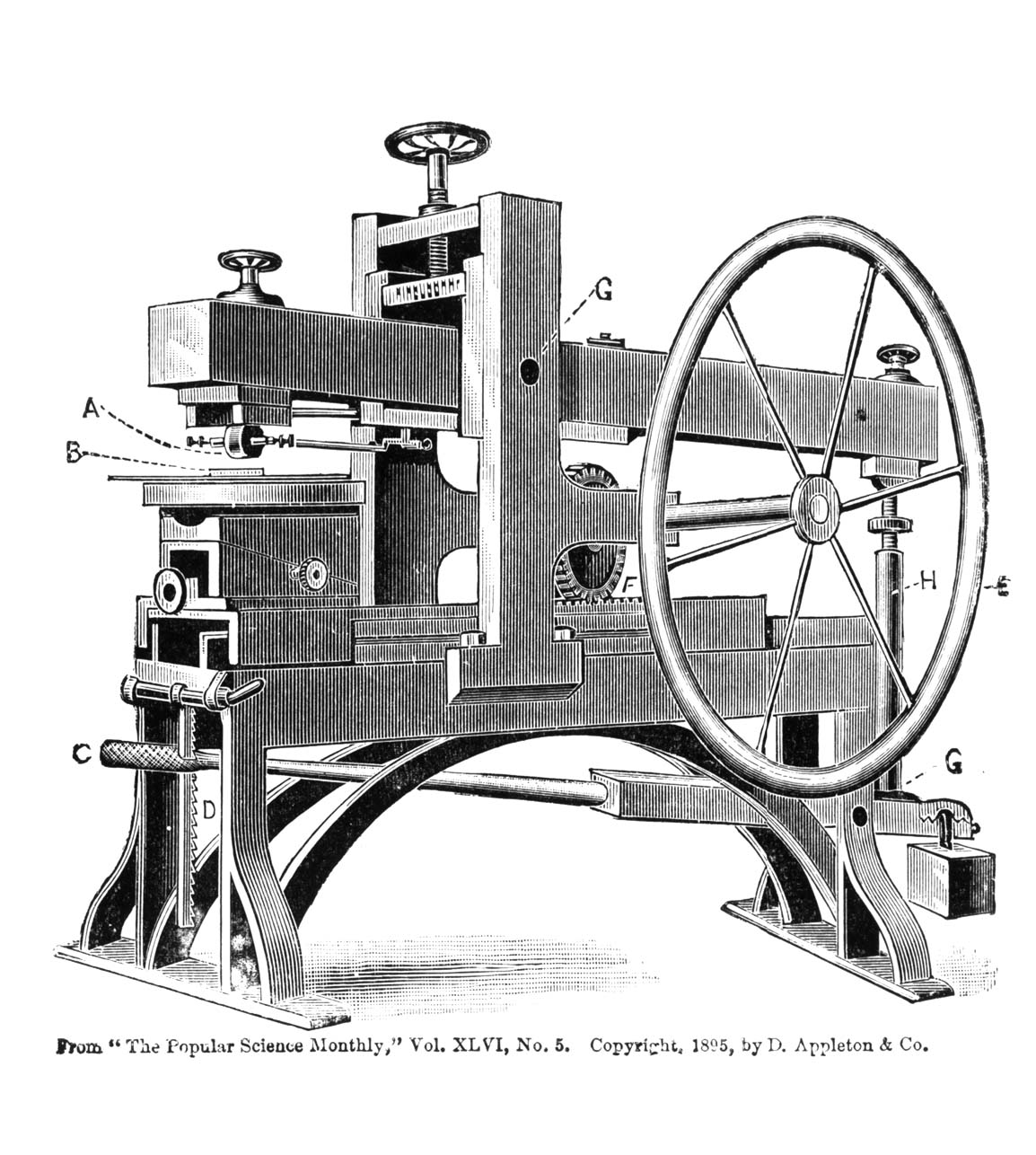 |
|
Send note to Staff
|
| Edited by rod222 - 04/26/2020 9:32 pm |
|
|
Bedrock Of The Community
Australia
38679 Posts |
|
|
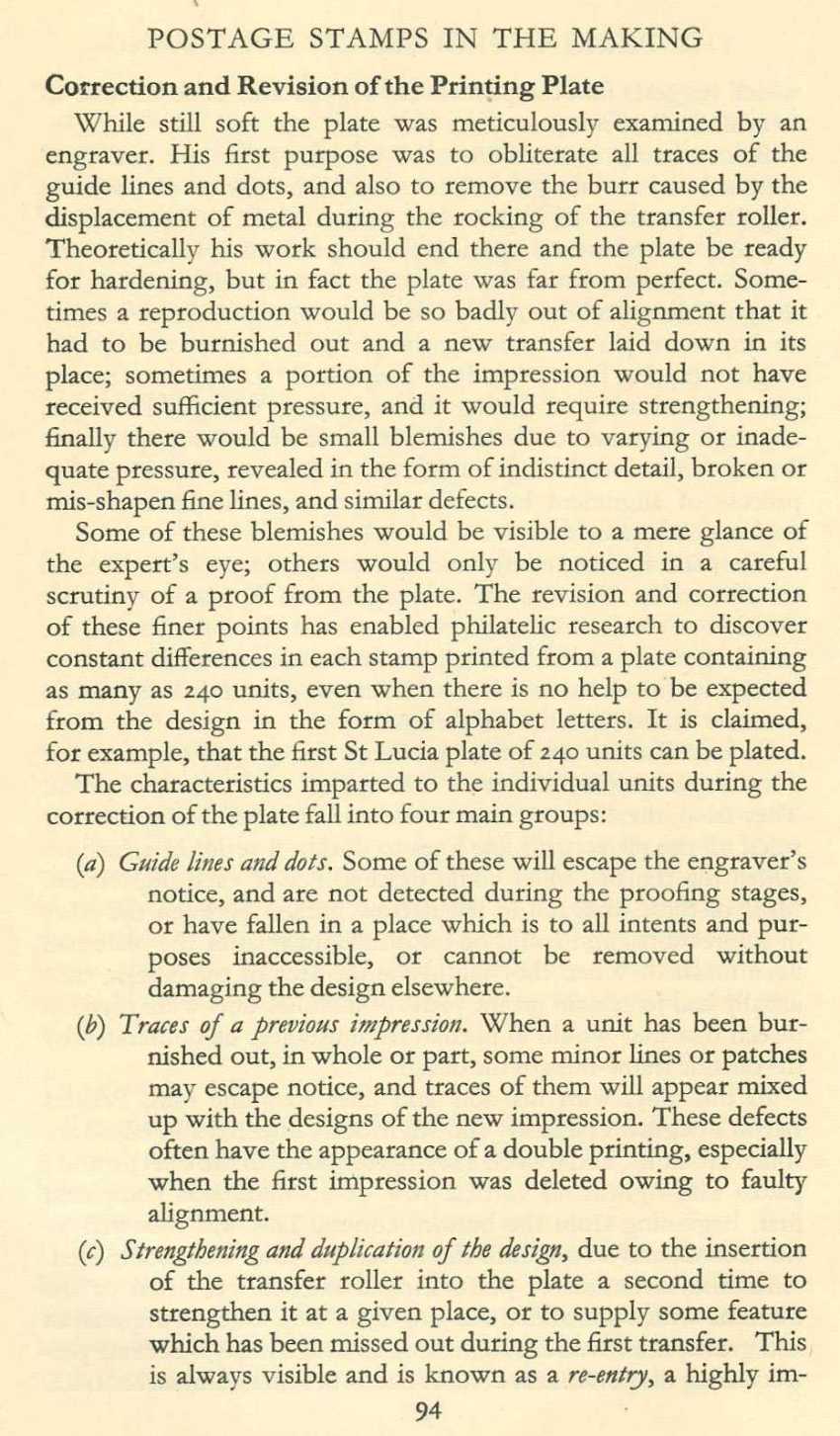
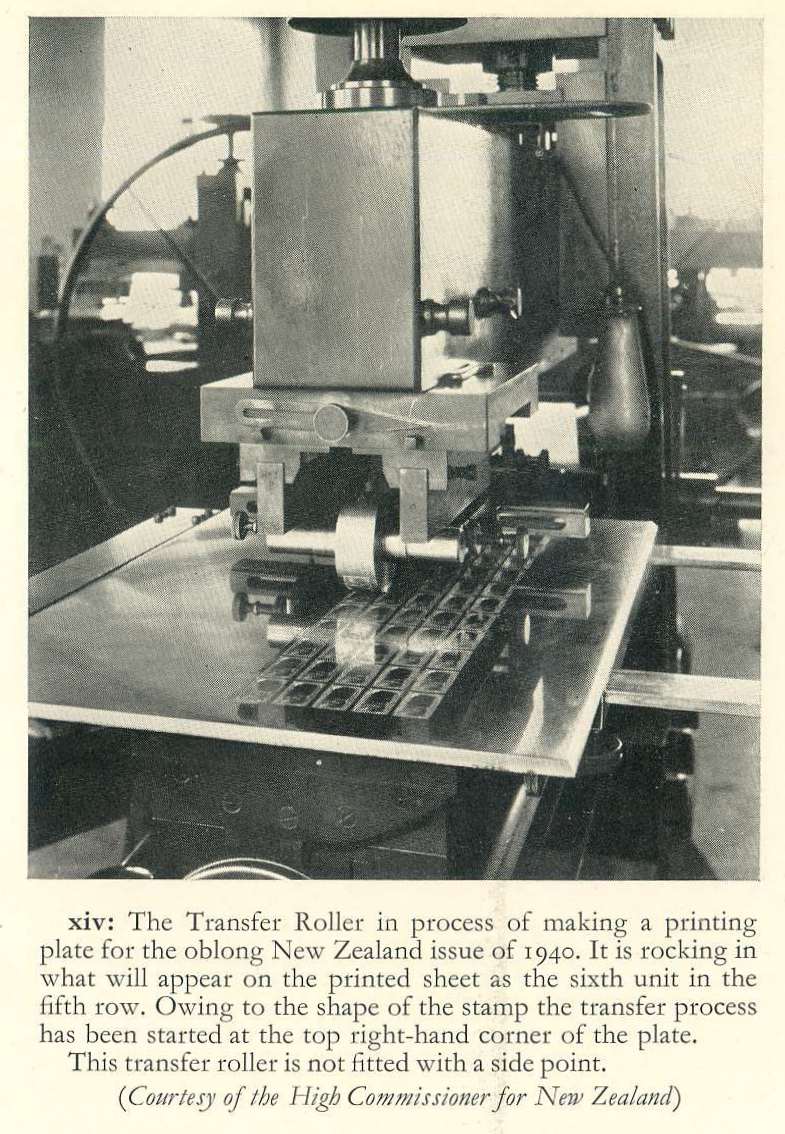
From "Postage Stamps in the Making" (Melville / Easton)
Pointing tool not mentioned thus far.
However, the problems of aligning and spacing impressions precisely, could not be solved on a machine as the Perkins Process of engraving.
It suggests the guide lines and dots, for the siderographer, were punched / drawn in the plate, and removed afterwards.
Where they have not been removed successfully, assists the Philatelist to reconstruct plating positions.
I'll continue browsing.........
|
|
Send note to Staff
|
|
|
Pillar Of The Community
United States
2230 Posts |
|
|
Quote:
How can the pointing tool, mark where the impression of the stamp is? The pointing tool cannot be under the master die when rolling. Surely the pointing tool mark must appear in the selvedge. Once the transfer roll picked up the image from the die and was hardened, the die was was set aside, and not used in the laying down of the plate. Fifty guide dots were tooled into the plate for the Hawaii stamps for each of four panes of 50 stamps. The pair of stamps shown in my example above is representative of a top row stamp and a second row stamp. The guide dot in the bottom stamp controlled the placement of the transfer roll for the entry at the position above. As the following illustration shows, the guide dots for the tenth row of stamps appear in the margin selvedge below. Thus, no guide dots appear at top-row positions.  |
|
Send note to Staff
|
|
|
Bedrock Of The Community
Australia
38679 Posts |
|
|
Pillar Of The Community
United States
2230 Posts |
|
|
Thanks for posting the book excerpt, rod222. It provides excellent insight into the quality control process for early plate manufacture. |
|
Send note to Staff
|
|
|
Bedrock Of The Community
Australia
38679 Posts |
|
|
"The Side Point"Note: Images employed, as copying text here, loses formatting. More to follow............. 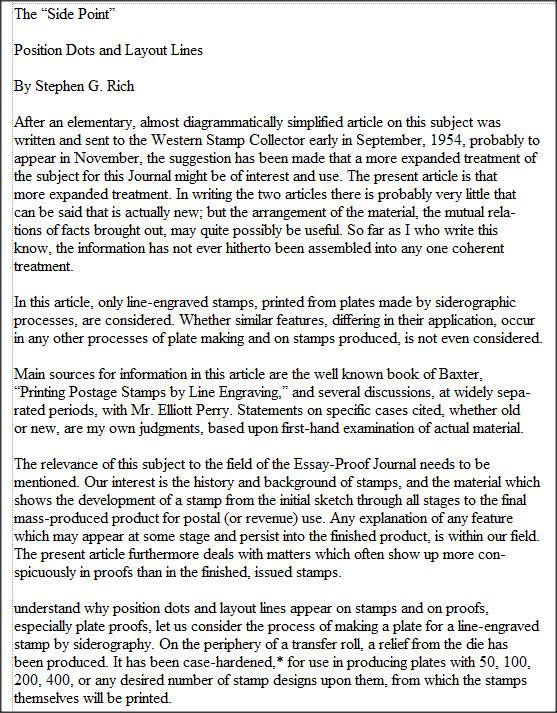 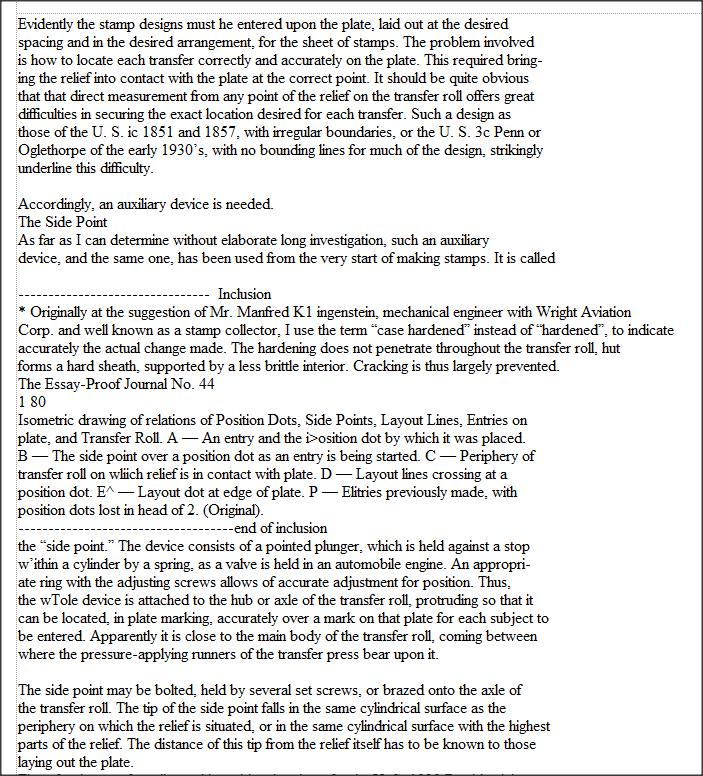 |
|
Send note to Staff
|
| Edited by rod222 - 04/26/2020 11:43 pm |
|
|
Bedrock Of The Community
Australia
38679 Posts |
|
|
Bedrock Of The Community
Australia
38679 Posts |
|
|
Full text here (for those members, adept at searching Google, maybe we can get a *.pdf)  The Essay - proof Journal 1954 Number 44  |
|
Send note to Staff
|
|
|
Pillar Of The Community
United States
3532 Posts |
|
|
You're getting which guide dot was used to position the transfer roll confused.
The guide dot 'inside' a position was not used to guide entry of that position.
For example - most plates of this era were entered first, via position 10R. There is no guide dot at the top right of 10R. The dot that guided this entry appears to the top right of position 9R, and so on.
No time right now for more, but hopefully, this clarifies your issue. |
|
Send note to Staff
|
|
|
Pillar Of The Community
United States
2230 Posts |
|
|
Rod222,
Thanks for finding and posting the very informative Stephen Rich side point article.
It's a tough read, but what I got from it is that the pointer was mounted in a cylinder with a spring, much like a pen point in a retractable pen. The operator would adjust the point so that it was even with the highest point of the relief on the transfer roll, then immobilize it by tightening a screw.
Presumably, the point would be retracted after it was dropped into the notch in the plate and the relief on the transfer roll was held against the plate by the transfer press.
What is uncertain (to me), is whether the operator failed to retract the point before entering some positions, or whether he left the point extended intentionally in some places for some reason.
If the side point was left in the extended position, I would think the point would keep dropping into the notch like a cog in a wheel (not scratching the plate) as the transfer roll rocked back and forth. |
|
Send note to Staff
|
| Edited by Classic Coins - 04/27/2020 11:59 am |
|
|
Pillar Of The Community
United States
2230 Posts |
|
|
Bedrock Of The Community
Australia
38679 Posts |
|
|
Quote:
Scroll down on this page to see the PDF link in the right column:
Fabulous! Thanks a bunch. Really look forward to reading, esp. with the illustrations. It's been an interesting journey thus far. Observation: Your original side point image, may have began the confusion? If that device was bolted to the mandrel, then it would rotate, naturally. Do you thing the pointer in that image, has a spring involved in the protruding rod? I imagined it initially as just a solid rod, which initiated my curiosity. |
|
Send note to Staff
|
| Edited by rod222 - 04/27/2020 5:47 pm |
|
|
Replies: 25 / Views: 3,183 |
|




 Posted 04/26/2020 2:09 pm