Thank you, canadian, for your comments. The closest I can get to the patent by Jacob Perkins is the transcription of it on pages 84 and 85 of "Postage Stamps in the Making" by Fred Melville, 1916. Melville discusses Perkins' process of decarbonating (his term) steel to soften it for engraving. Melville says:
"Although the method was first described in England by Mr. Joseph C. Dyer, of Boston, Mass., when in London in 1810 (Specification No. 3385), along with other inventions stated to be the result of many years' labour, perseverance, and study by Jacob Perkins we give Perkins' own (and later) description of the method by which he treated the steel:"
Melville goes on to quote directly from Perkins' patent and I will give just the first part of that quote as it is quite long.
"In order to decarbonate the surfaces of cast-steel plates, cylinders or dies, by which they are rendered much softer and fit for transferring or engraving designs thereon, I find that pure iron filings, divested of all foreign or extraneous matters, produce the softest decarbonated surface, and therefore I use iron filings as pure and as free from rust as I can obtain them. I also carefully exclude all carbonaceous matter, and any substance from which carbon can be obtained. The stratum of decarbonated steel should not be too thick for transferring fine and delicate engravings; for instance not more than three times the depth of the engraving. The surface of the steel may be decarbonated to any required thickness. To decarbonate it to a proper thickness for fine engravings I expose it for four hours to a white heat, enclosed in a cast-iron boxwith a well-closed lid. The sides of the cast-iron box I make at least three-quarters of an inch in thickness, and at least a thickness of half an inch of pure iron filings should cover or surround the cast-steel surface to be decarbonated. The box should be suffered to cool very slowly, which may be effected by shutting off all access of air to the furnace, and covering it with a layer of six or eight inches in thickness of fine cinders. Each side of the steel plate, sylinder, or die, must be equally decarbonated, to prevent it from springing or warping in hardening. I also find it much the safest way to heat the plates, cylinders, or dies, in a vertical position. I make use of good cast steel in preference to any other sort of steel for the purpose of making plates, cylinders, circular or other dies, and more especially when such plates, cylinders or dies are intended to be decarbonated. For the reason given above, the steel is decarbonated solely for the purpose of rendering it sufficiently soft for receiving any impression intended to be made thereon. It is, therefore, necessary that any piece of steel, whether in the shape of an engraved plate or a cylinder or a die, with engraved or other figures upon its surface, should be again carbonated or reconverted into steel capable of being hardened."
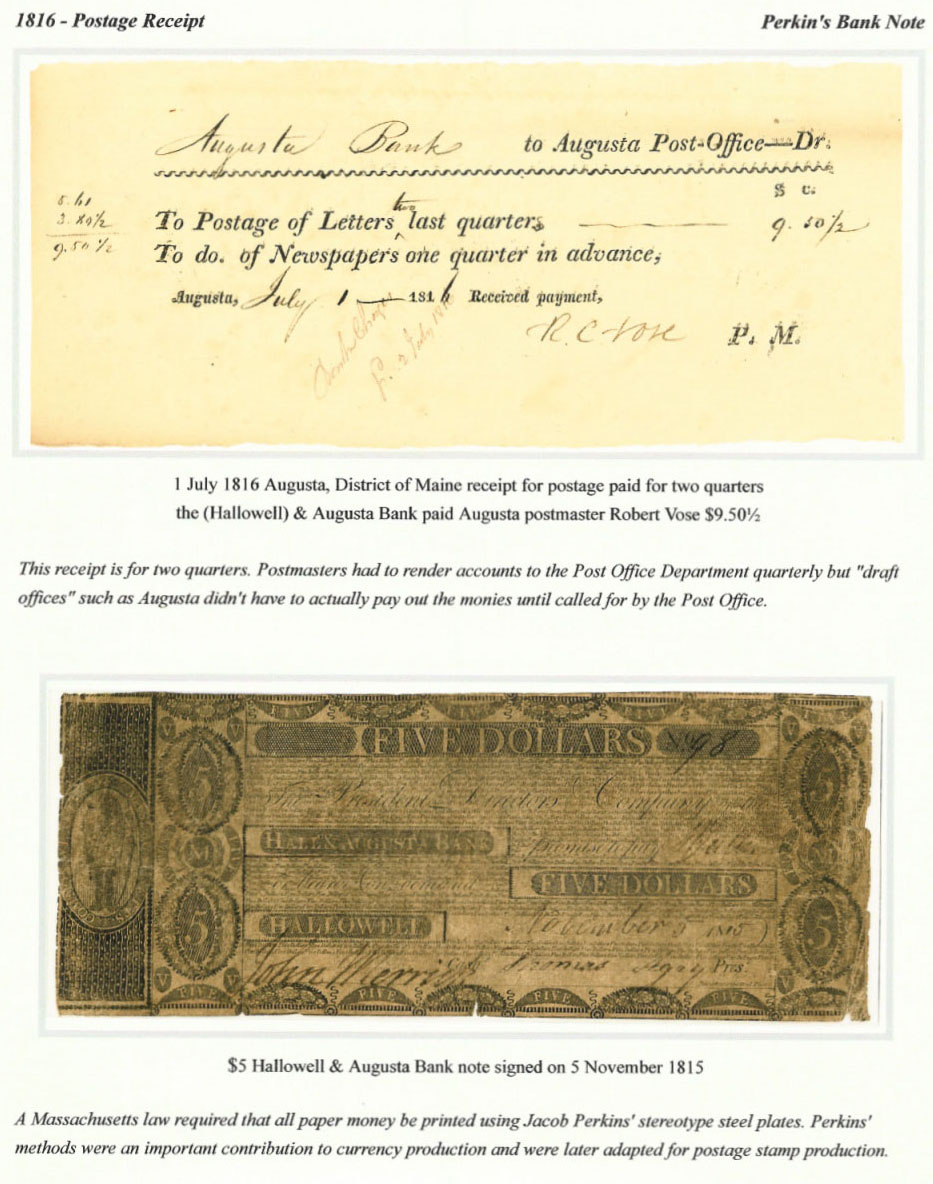
So in Perkins' own words, that was his invention whereby artists could engrave steel as readily as copper, after it had been softened, or "decarbonated".
There are six illustrations attached to this original patent, but they are not covered in Melville's book.
I also note the comments about the supply of steel by John Sellers and I will see what I can find about him.
From Melville's book, here is a photo of where Perkins must have carried out all these wonderful processes.





 Posted 05/10/2020 05:06 am