| Author |
 Replies: 3,825 / Views: 255,668 Replies: 3,825 / Views: 255,668 |
|
|
|
Pillar Of The Community
United States
3532 Posts |
|
|
Welcome Harper. Its nice to hear that you are studying the Neinken book. There is a lot of great information in there.
The transfer roll #1 reliefs are on pages 53-55, and, yes - study them very carefully. Get to know the differences really well, and that allows you to eliminate many positions on a plate by reducing your search to only entries that correspond to the relief in question.
Yes, the stamps on your cover are relief "A". |
Send note to Staff 
|
|
|
Pillar Of The Community
United States
3532 Posts |
|
|
Also study the plate layout+distribution of the reliefs on the plate. For plate 1E see Neinken page 66.
The tops of the stamps beneath are clearly B reliefs. The tops of B's are notably different than either A or T. Above B you often find an A but you could also see another B. See page 66. You don't see T's directly above B's. Your stamps bottom ornaments are shorter than those on a B. Much of plating involves eliminating what it cannot be.
I hope this answers your questions. |
|
Send note to Staff
|
|
|
Pillar Of The Community
United States
939 Posts |
|
|
Interesting 3 cent, lots going on in the lower right quadrant of this 77R5L. Double Transfer in the lower right rosette, LRDB and lower right frame line. 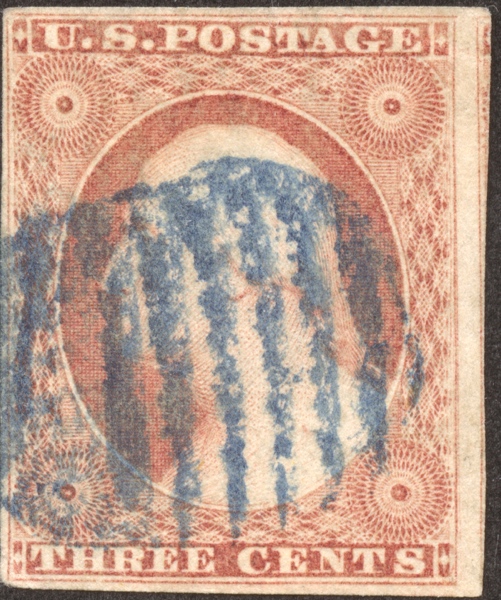  Also trying to identify the cancel. Looking in Simpson's there's not really an identical image. Any assistance in id'ing the cancel would be appreciated. Thanks. |
|
Send note to Staff
|
|
|
Pillar Of The Community
United States
637 Posts |
|
|
Hi Moyock13 --
Agree your stamp is a striking example of a DT -- nice!
On the cancel -- best I can tell, I think it is multiple strikes of a simple blue circular grid. That said, I agree that it looks unusual in that the outer edge does not look "round" in some areas -- and is missing in others -- but I think this is likely due to the cancelling device striking the cover at an angle?
Regards // ioagoa |
|
Send note to Staff
|
| Edited by ioagoa - 11/16/2021 1:32 pm |
|
|
Pillar Of The Community
United States
939 Posts |
|
|
Hi ioagoa, I think your assessment about the cancel is correct. It just looked different, almost oval.
It is a pretty neat DT!
Thanks. |
|
Send note to Staff
|
|
|
Pillar Of The Community
United States
939 Posts |
|
|
Looking for conformation on a plating position. I have this 3 cent plated as 1L1i, but Chase calls out both UL and UR guide dots. I only see the UR guide dot. Please take look. Thanks. 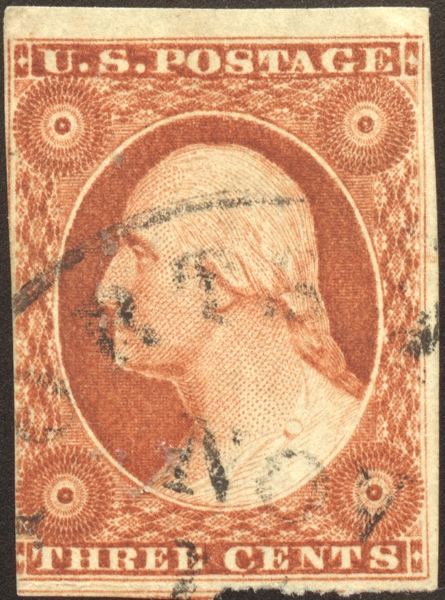 |
|
Send note to Staff
|
|
|
Pillar Of The Community
United States
1341 Posts |
|
|
An upper left or lower left guide dot would be a distance off of the stamp like the image shown. 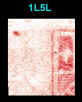 |
|
Send note to Staff
|
| Edited by jaxom100 - 11/17/2021 09:28 am |
|
|
Pillar Of The Community
United States
637 Posts |
|
|
Hi Moyock13 --
Thank you for responding to my DM request for a high resolution scan of your tentative 1L1i stamp.
I agree that your stamp is 1L1i -- Scott #10A -- inner line recut at right only.
These 1E / 1i stamps are tough -- as the only difference between the two states of the plate is re-entry -- (as there was no additional recutting when plate 1E was re-worked into plate 1i) -- and to make things even more challenging -- the impact of differences in inking, impression, and plate wear are often important factors that need to be considered when determining if a stamp was printed from the Early or Inter state of the plate.
In the case of position 1L -- it started off as a B relief on the Early state of the plate -- but was re-entered with an A relief on the Inter state -- and consequently, what we end up with is an "A relief with B influence" (versus a pure A relief).
In any event, I compared your stamp against a number of confirmed copies of both 1L1i and 1L1E -- and evidence of re-entry is clearly seen on your stamp -- especially where the recut lines weaken and/or get "fuzzy" for the lower half of the RIL and at various segments along the RFL in comparison to copies from 1E. There are other telltale signs of re-entry as well -- and I am confident that your stamp is from the intermediate state of the plate -- and despite its missing LFL is a solid match for 1L1i in all regards.
Regards // ioagoa
|
|
Send note to Staff
|
|
|
Pillar Of The Community
United States
939 Posts |
|
|
jaxom 100 - thanks for the picture of the ULGD on the 1L1i
ioagoa, thank you for taking a look and confirming my plating. There is a satisfaction in getting one right. =) |
|
Send note to Staff
|
|
|
Valued Member
United States
178 Posts |
|
|
So, this is my favorite forum on SCF and I thank the experts for sharing their knowledge with those of us who are lacking in the plating area. I attempted to plate this one - I came up with 25L1e. What say you? Keep up the good work....greg 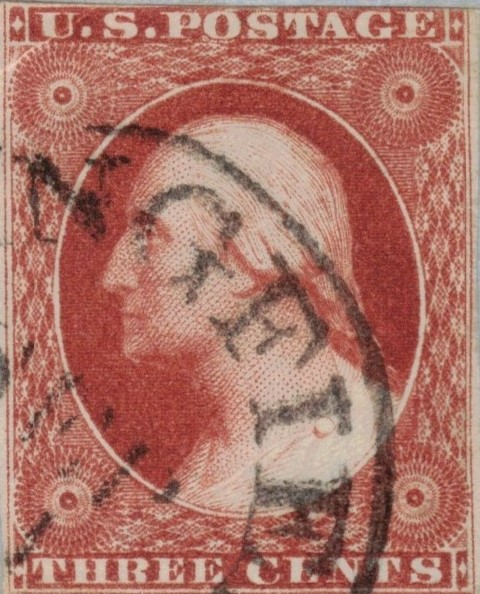 |
|
Send note to Staff
|
|
|
Pillar Of The Community
United States
637 Posts |
|
|
Hi tgswanner --
I have not looked at your 25L1E candidate yet -- but when it comes to stamps from plates 1E and 1i -- in most all cases, I need to work off a 1200 dpi scan -- not so much to determine the position -- but to determine the state of the plate.
As I mentioned in a prior post -- These 1E / 1i stamps can be tough -- as the only difference between the two states of the plate is re-entry -- (as there was no additional recutting when plate 1E was re-worked into plate 1i) -- and to make things even more challenging -- the impact of differences in inking, impression, and plate wear are often important factors that need to be considered when determining if a stamp was printed from the Early or Inter state of the plate.
If you would be able to send me a 1200 dpi scan via the SCF private messaging utility, I will take a look and let you know what I think about your stamp. Alternatively, you could email a 1200 dpi scan to Don Denman (site Administrator), as he previously offered to post scans exceeding the SCF size limit -- which might be the best alternative -- as once on SCF the scan can be downloaded by other platers as well.
Regards // ioagoa
|
|
Send note to Staff
|
|
|
Moderator

United States
12330 Posts |
|
|
Pillar Of The Community
United States
637 Posts |
|
|
Hi tgswanner --
Thank you for sending Don 1200 dpi scans of your "25L1E candidate" -- and thank you Don for uploading them to SCF!
I have compared your stamp to multiple copies of position 25L1 from both the Early and Inter states of plate 1 -- and in my opinion, your stamp is from the Intermediate state of the plate -- so position 25L1i.
As I noted in my two most recent posts -- but worth repeating here -- these 1E / 1i stamps can be tough -- as the only difference between the two states of the plate is re-entry -- (as there was no additional recutting when plate 1E was re-worked into plate 1i) -- and to make things even more challenging -- the impact of differences in inking, impression, and plate wear are often important factors that need to be considered when determining if a stamp was printed from the Early or Inter state of the plate.
Regarding differences in states (i.e., Early versus Inter), one important aspect is what a re-entry does to existing recut lines. On 1E, for instance, FL's and many inner lines were recut after the design was initially rocked in from the transfer roll. If you think of these as various 'V' cuts into the plate (made with a graver), the wider (and deeper) the cut was, the more ink the grooves hold.
These recut grooves are deeper into the plate than the transferred design. As the plate wears, both get weaker, and the recuts tend to stand out more from the normal design. (As an aside, you really see this on the 1854-1855 worn plate printings from plate 1 late.)
Now, what happens to the recut lines when the transfer roll re-enters the normal design? The recut lines tend to get a little pressed out. Some become quite faint. Additionally the original (weak) FL's are again impressed into the plate, often not quite lining up with those lines recut initially, and thus often resulting in some fuzziness and/or doubling of the FL's. As another aside -- you really see this on Plates 10 and 11, the 26A stamps, where there was a third re-entry (i.e., no re-cutting done on the Inter and Late states after the Early state).
Your stamp has 2 vertical lines recut in the ULT -- which, in comparison to confirmed copies of position 25L1 from the Early state of the plate clearly appear to have been "pressed out" by re-entry. If you go to the StampSmarter database -- there is a very nice example of position 25L1E that you can use for comparison with your stamp. Upon close study, in comparison to the StampSmarter copy of 25L1E, the 2 vertical lines recut in the ULT on your stamp are "fuzzy", a teeny bit closer together (i.e., "pressed out"), and even appear a teeny bit shorter versus those on the Early state of the plate.
Another telltale sign of re-entry on your stamp is the size of the outer ring of rosette dots in the ULR, primarily those opposite the LFL and the hypotenuse of the ULT (in other words, from the 9:00 to the 12:00 position) -- which as a result of the design not being perfectly lined up when the position was re-entered, many times appear "fatter" on the Inter state of the plate versus the Early state. Again, if you compare your stamp to the StampSmarter copy of 25L1E, you can see this.
In addition to the 2 lines in the ULT and the ULR outer ring of dots, there is other subtle evidence of re-entry as well -- and if I were plating this stamp for one of the expertizing organizations, my opinion is that it is position 25L1i.
Nice stamp by the way -- and thanks for showing it.
Regards // ioagoa
edited to fix minor typos
|
|
Send note to Staff
|
| Edited by ioagoa - 11/19/2021 01:22 am |
|
|
Pillar Of The Community
United States
1341 Posts |
|
|
Greg, I would like your permission to add your 25L1i to the Stamp Smarter database.
|
|
Send note to Staff
|
|
|
Valued Member
United States
178 Posts |
|
|
Yes. By all means add to the database. Thanks for the breakdown IOAGOA. I had looked at both the 1e and 1i and honestly, I didn't see the differences you are pointing out. I now have to wonder how many 1i stamps are out there listed as 1e. We all appreciate your insight and willingness to share your knowledge. |
|
Send note to Staff
|
|
|
Replies: 3,825 / Views: 255,668 |
|




 Posted 11/14/2021 11:55 am


