| Author |
 Replies: 3,825 / Views: 255,663 Replies: 3,825 / Views: 255,663 |
|
|
|
Pillar Of The Community
United States
637 Posts |
|
|
Hi Harper1249 --
YES -- you nailed it correctly -- 74L2L -- great work!
Regards // ioagoa |
Send note to Staff 
|
| Edited by ioagoa - 11/09/2021 10:27 pm |
|
|
Valued Member

United States
327 Posts |
|
|
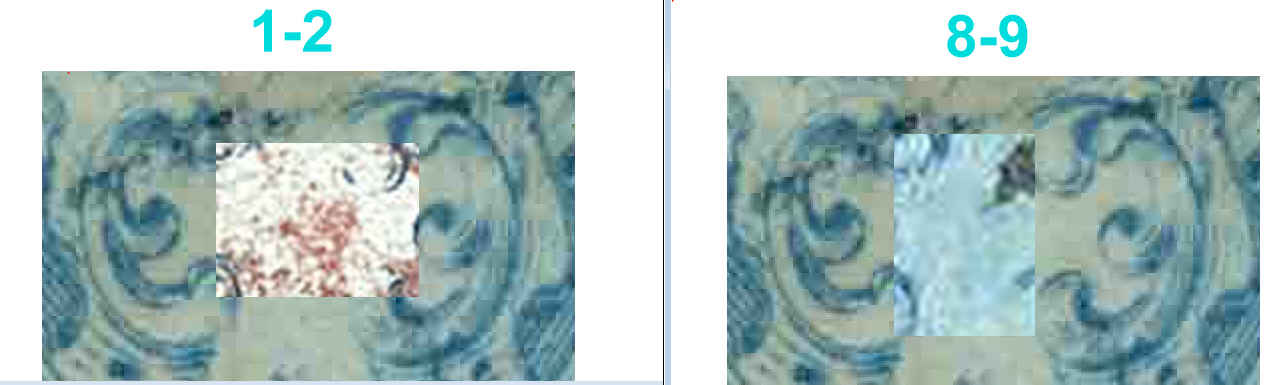
Thanks for the help. Interestingly, stampplating.com's database shows 74L2L as not having the single line cut in the upper left triangle. So when using the wizard it wasn't showing 74L2L as potential candidate. The guide dot was the biggest help in narrowing down the options. I saw the dot and thought it was to small, maybe just a bit of ink. Guess I'll just assume they guide dots moving forward and go from there. Well, on to the next one. Thank you again for sharing your expertise on plating.
Regards, Stephen |
|
Send note to Staff
|
|
|
Pillar Of The Community
United States
637 Posts |
|
|
Hi Harper1249 --
You are welcome.
Regarding your comment about StampPlating.com not classifying position 74L2L as a 1 line recut in the ULT -- I am pretty sure that is because when plate 2E became plate 2L -- all of the positions were re-entered -- and because of the extensive re-entry, the recut lines often show much less distinctly on the late state of the plate.
More specifically, Chase lists 3 positions where bits of the recutting found on the early state of the plate have disappeared completely -- and he also provides a listing of those positions (which includes 74L2L) where the recutting on the early state of the plate became more or less badly blurred -- and in some cases so as to hardly be distinguishable on the late state. (Reference page 97 of the 1942 edition of the Chase book which you can download for free from the USPCS.org website).
Also, if you look at a set of the Chase photos for plate 2 Late -- you will see that for a many of the recut references, Chase put an "x" next to the position number to indicate those positions where the recutting on the late state of the plate became badly blurred or indistinguishable -- and I believe that StampPlating.com did not tag any of these "x" positions as noted by Chase as recut varieties in their database for that reason. That said, for each of these "x" positions, StampPlating.com did insert a comment for the position stating such to alert the user to the impact of re-entry when 2E became 2L -- although the Plating Wizard does not have a filter in this regard. As an aside -- although I might be wrong on this -- but I am pretty sure that Chase did not include these "x" positions in his recut table where he presented the number of positions for each identified recut variety on a "plate by plate" basis -- and consequently, StampPlating.com conformed to Chase in this regard for purposes of the Plating Wizard.
Your 74L2L stamp happens to shows the 1 vertical line recut in the ULT quite well -- but not all copes will -- as the range of clarity of the recut varieties for the "x" positions noted in the Chase book is quite often a combination of inking, impression, and plate wear.
Bottom line -- if you have a stamp that you think might be from plate 2 late -- and you are unsure about a recut variety -- you will want to check the Chase book and / or Chase photos for a cross reference of the positions where the extensive re-entry process resulted in badly burred lines. And, FYI -- the book is much more comprehensive than the photos for this purpose -- for example -- the marginal recut references on the Chase photos for plate 2L don't list any of the 1 line ULT recuts because there was not enough space in the margins -- so you need to go to the book to see that list.
Welcome to the joys and frustrations of plating! But do not give up -- as with more experience you will be able to more readily spot things like this -- and we need more platers -- and there are a number of platers here on SCF who are always happy to help.
Looking forward to seeing your next plating.
Regards // ioagoa
|
|
Send note to Staff
|
|
|
Pillar Of The Community
United States
1341 Posts |
|
|
Are you attempting to plate the 1c Franklin strip as well? I have some ideas on that one. |
|
Send note to Staff
|
|
|
Valued Member
United States
327 Posts |
|
|
I haven't dove into plating the strip of 1c Franklins yet, but would love to hear your ideas. |
|
Send note to Staff
|
|
|
Pillar Of The Community
United States
1341 Posts |
|
|
Pillar Of The Community
United States
2555 Posts |
|
|
You need to be able to see the forest and the trees. The stamps are guaranteed to be from Plate 1E. |
|
Send note to Staff
|
|
|
Pillar Of The Community
United States
3532 Posts |
|
|
At the risk of putting myself in the middle here  (ducks), I will elaborate slightly on Winston's comment by saying that this cover is a postal use from April of 1852. The only 1c plate in use at that point in time was plate 1E. The Plate 1L EKU is in June of '52. The Plate 2 EKU historically has been December of 1855. That's just way too late. I might have heard that it had advanced into November, but there is no way that this cover is from 1855. This is a good example of a case where some postal history, cancellation and overall knowledge can be a big help in narrowing things down. It does look like a 1E item to me, and let me suggest that you take a look at columns 5R, 6R and 7R of plate 1-early. As an example, compare Siegel sale 1002, lot 3689, which is a 55-57R1E strip. Look at the alignment only, of the stamps -- I think its a perfect match for this strip. https://siegelauctions.com/lots.php...002-lot-3689What I mean by that is I think this strip is one of: 15-17R1E, 35-37R1E, 55-57R1E or 75-77R1E. I will leave the final plating exercise to you, but I'm pretty sure. |
|
Send note to Staff
|
|
|
Pillar Of The Community
United States
3532 Posts |
|
|
I don't see anything particularly odd or anything to me that would be a red-flag about the cover. Of course I haven't seen it in person, but off-hand it "looks" likely to be legitimate. According to the Stampless cover catalog - https://d2jf3tgwe889fp.cloudfront.n...sylvania.pdfThat Philadelphia CDS is known: Quote:
PHILADELPHIA/PA.(1851 -53;34;PAID,10;Blue) In other words - not known after 1853. For an April month for a Plate 2 stamp, it would have to be at earliest, 1856. Additionally, and now I'm speaking empirically, and without facts, but just based on what I think I've observed over the years --- I think the bluish hue to the cover is found much more often on earlier covers of the 1850s rather than later ones. I've seen a lot of 1851 and 1852 covers with that bluish hue to the paper in the cover, while as one gets later in the 1850s, I don't "think" I see that much, if at all. I may be mistaken -- but that is my initial reaction for what its worth. |
|
Send note to Staff
|
|
|
Pillar Of The Community
United States
3532 Posts |
|
|
Also the cancellations have reasonable skips to them from cover to stamp. |
|
Send note to Staff
|
|
|
Pillar Of The Community
United States
1341 Posts |
|
|
I did some checking and rechecking on the alignment. This time I did a vertical as well as horizontal alignment check. It appears that Columns 5-7 right on plate one early do match. For this exercise I used a row from the full sheet of plate 1 late as the column spacing did not change. I apologize Winston. I think my error was in not doing a vertical alignment test to verify exact image height.  As far as plating it further, we would need a clearer image. Too much pixilization with the current image. |
|
Send note to Staff
|
| Edited by jaxom100 - 11/11/2021 3:54 pm |
|
|
Pillar Of The Community
United States
3532 Posts |
|
|
Quote:
vertical as well as horizontal alignment check Correct, both are necessary. The two really wide columns are the ones we've been discussing: 5-6R1 (E and L) 1-2L2 Both of these columns are > 1mm in width, and really jump out sometimes when looking at a single with a large margin, or a multiple. This can really help eliminate positions to look at. |
|
Send note to Staff
|
|
|
Valued Member
United States
327 Posts |
|
|
I find this discussion fascinating and I'm now neck deep in Nienkin's book and determined to get a better understanding of why you all are recommending these positions. I can post higher resolution images of specific areas if it would be helpful. Thank you again for the information and for sharing your knowledge on the subject.
|
|
Send note to Staff
|
|
|
Valued Member
Norway
451 Posts |
|
|
I don't see evidence of a double transfer on the left stamp, so that would eliminate 15-17R1E, and the right plume of the right sided stamp appears too short for it to be 77R1E. That leaves 35-37R1E or 55-57R1E. The frame line under the "C" of "CENT" is weak, but not any more so than the left and right stamps, so perhaps that favors 35-37R1E. |
|
Send note to Staff
|
| Edited by widglo46 - 11/13/2021 8:02 pm |
|
|
Valued Member
United States
327 Posts |
|
|
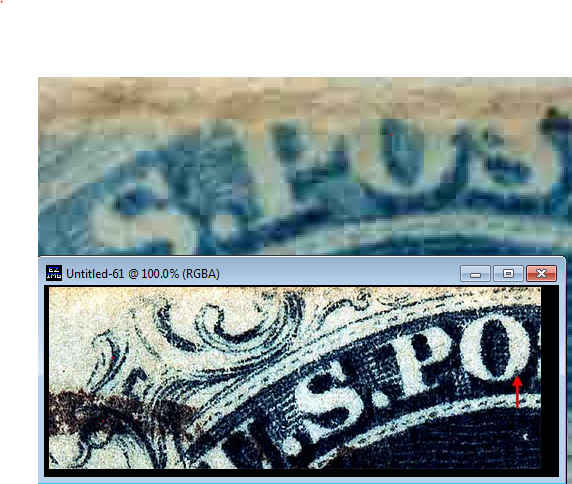
Txstamp, you point to the 2nd, 4th, 6th and 8th horizontal rows on the right pane of Plate 1E as the place I should look. This would suggest the strip of three are Relief A. Help me out with how you determine the Relief type. Assuming I didn't have Txstamps recommendation and I just looking at the stamps I have the following observations: 1. The tops of these stamps are for the most part missing but we do have the tops of the stamps on the vertical row below. The right top ornaments on this lower row appear to be almost complete. This would imply that this lower row was Relief B. 2. The bottom right plumes on the 1st and 3rd (2nd obscured) stamps are "short" and incomplete. This would indicate the 3 stamps being Relief A 3. There appear to be no guide dots on any of the three stamps. This also points the three stamps being Relief A. Conclusion: The strip of three is Relief A Apologize if this seems trivial, but I'm wanting to know if I'm looking at the right things to determine the Relief correctly. Attaching a closeup of the far right stamp. I like looking at the negative image, so i've included that as well.   Adding images of the top half.   |
|
Send note to Staff
|
| Edited by Harper1249 - 11/13/2021 1:39 pm |
|
|
Replies: 3,825 / Views: 255,663 |
|



 Posted 11/09/2021 10:27 pm