| Author |
 Replies: 3,825 / Views: 255,695 Replies: 3,825 / Views: 255,695 |
|
|
|
Pillar Of The Community
United States
3532 Posts |
|
|
Pillar Of The Community

United States
1838 Posts |
|
|
I thought so, but figured worth asking - so many misidentified stamps, the brain starts to hurt. |
Send note to Staff 
|
|
|
Pillar Of The Community
United States
2230 Posts |
|
|
I acquired this stamp in a bulk lot over 20 years ago, and immediately recognized it as a 3-cent imperforate with perforations added. I set it apart from my 3-cent imperforate collection in a glassine full of miscellaneous stamps. This week I stumbled across it, and finally plated it to 56R3. It's a pretty nice printing. The culprit who perforated it left a hanging chad at lower right that is roughly torn in half, pretty much an impossibility if the stamp was perforated first then torn from the rest of the sheet.   |
|
Send note to Staff
|
|
|
Valued Member
United States
327 Posts |
|
|
Here is the latest one I am working on. 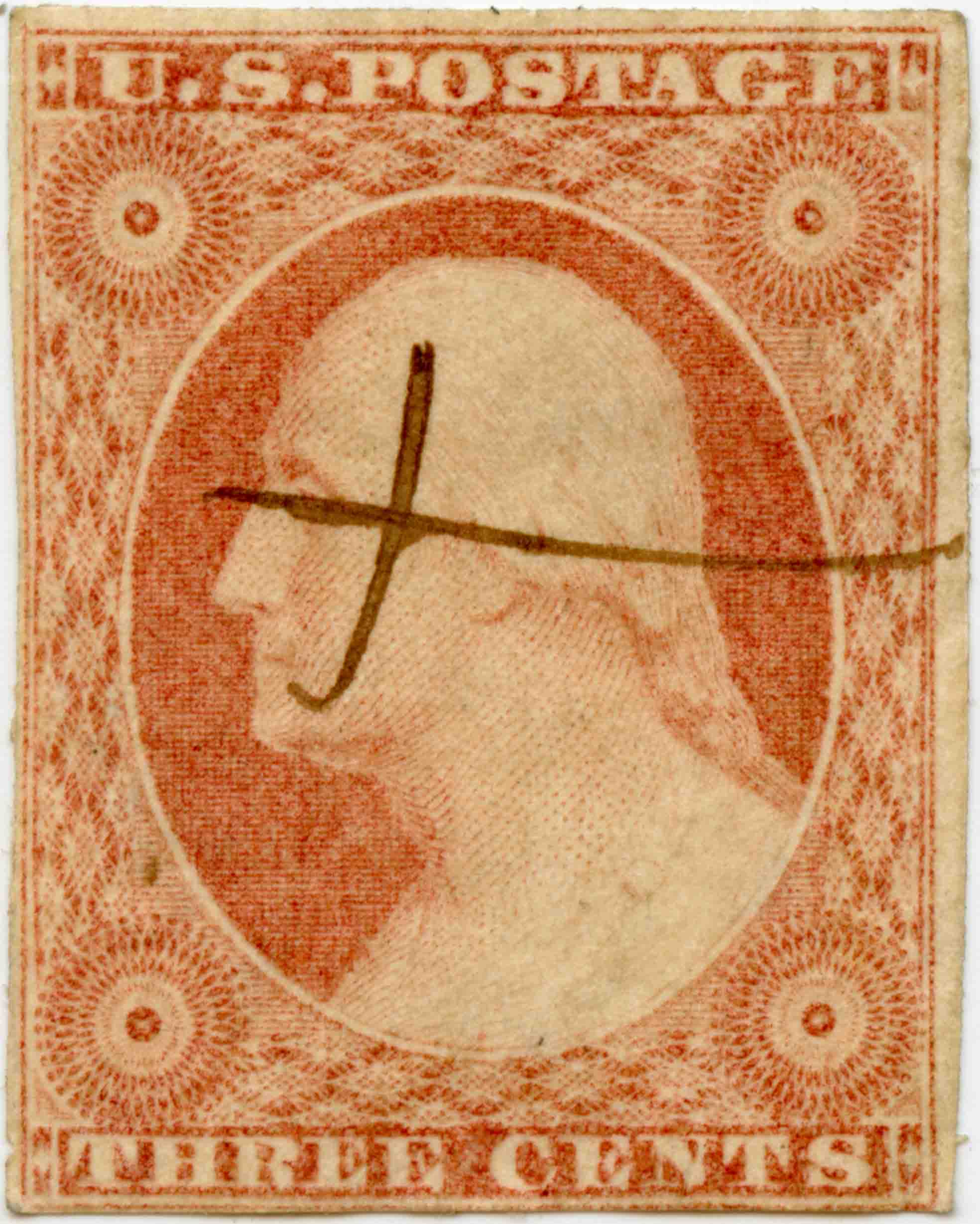 - Relief B - URDB gouged - ULT has one line recut - TLB recut - 2 inner lines - LR guide dot (although not where I originally thought) URDB being gouged out led me to start looking on Plate 1L. The best candidate so far is 83R1L. Comparison of compressed images of 83R1L is below. I think my stamp matches up well with the Chase image. 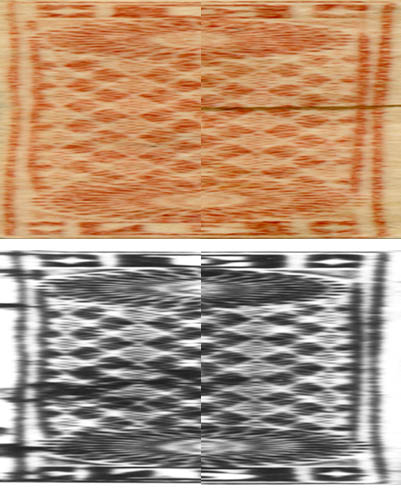 |
|
Send note to Staff
|
|
|
Valued Member
United States
327 Posts |
|
|
Why would someone add perforations to that stamp? Its like vandalizing a piece of art. |
|
Send note to Staff
|
|
|
Pillar Of The Community
United States
637 Posts |
|
|
Hi Harper1249 -- Quote:
Why would someone add perforations to that stamp? It's like vandalizing a piece of art. Dishonest operator for the most part -- Scott 2021 catalog value for a Scott #11A -- $15 Scott 2021 catalog value for a Scott #25A -- $850 By adding bogus perfs, the faker was probably hoping to pass off a Scott #11A as if a #25A -- profit multiplier roughly 57x (i.e., $850/$15). Regards // ioagoa |
|
Send note to Staff
|
|
|
Pillar Of The Community
United States
637 Posts |
|
|
Hi Harper1249 -- Quote:
The best candidate so far is 83R1L. I confirmed your 83R1L plating as correct. And your analysis of the factors relevant to the "process of elimination" is spot on as well. Great job on this one -- Nicely done! As an aside -- if you use compressed scans to narrow down a short list of candidates -- you should still check all of the other plating characteristics anyway before finalizing the position to make sure that everything else matches up. Over time, you will find that plate 1L is a very interesting plate -- as many of these plate 1L stamps -- even those that are seemingly simple -- can sometimes be difficult to plate -- as the plate was in service for a very long time -- (from Oct 1851 to March 1855) -- and given the differences in plate wear, inking, and impression over that roughly 3 1/2 year time span -- sometimes stamps from the same position can appear very different. Regards // ioagoa PS -- Curious as to the settings you use when scanning stamps for SCF -- as your scans always are sharp and clear despite the SCF file size limitation. I can tell from the "jpg properties" of your 83R1L scan that it is at 2400 dpi and with a quality factor of 64 (i.e., meaning 36% compression). So far anyway, I have been able to plate most of your stamps off the SCF scans without having to ask for 1200 dpi, minimally compressed scans (i.e., meaning jpg quality of no less than 84). Again, curious what type of scanner you are using and the settings you use when saving files for SCF posting purposes? edited only for typo fix |
|
Send note to Staff
|
| Edited by ioagoa - 12/11/2021 11:09 pm |
|
|
Pillar Of The Community
United States
939 Posts |
|
|
Classic Coins, I read something a while back discussing "Chicago Perforations". So, I googled Chicago Stamp Perforations and came up with this from a Siegel Auction in 2016, (sale 1133, lot 72).
"The origin of the Chicago perforation was revealed in an article published by Jerome S. Wagshal in the Chronicle 130 (May 1986). To briefly summarize Mr. Wagshal's revelations, the inventor of the machine used to create the Chicago Perf stamps was Dr. Elijah W. Hadley, a Chicago dentist. He probably constructed the machine in 1854. Over a two-year period, beginning in November 1854, Dr. Hadley's device was offered for sale to the Post Office Department thru R. K. Swift, a prominent Chicago banker and businessman. The distinctive 12-1/2 gauge Chicago Perf was applied to sheets of the 1c and 3c 1851 Issue.
Four examples are recorded of the 3c Chicago perf used from outside of Chicago. Two are on cover, from Rosedale Wis. and New York City, respectively, and were offered in Part 3 of our Jerome S. Wagshal sale in 2010 (sale 996, lots 3185-3186). This stamp also comes from the Wagshal collection. The fourth example, from Boston, resides in an important West Coast collection." |
|
Send note to Staff
|
| Edited by Moyock13 - 12/12/2021 07:07 am |
|
|
Pillar Of The Community
United States
939 Posts |
|
|
Valued Member
United States
327 Posts |
|
|
Ioagoa, thanks for the confirmation of 83R1L. I use an Epson V550 Photo flat bed scanner. I usually scan the stamp at 2400 dpi and save it in the TIF format. I then us Adobe Photoshop to view/edit/manipulate the image. When creating an image for SCF that involves just a stamp I usually am able to just save a copy of the image in the jpeg format. When saving as a jpeg, Photoshop allows me to adjust the "image quality" (low to high) until I achieve a file size that is less than 250kb. I suspect Photoshop is adjusting image quality for better compression although I have found the resulting jpegs retain most of their clarity and sharpness. Perhaps it is 2400 dpi that I am starting out with that gives Photoshop more pixels/data to work with when compressing the image. Hope this answers your question.
Regards, Stephen
|
|
Send note to Staff
|
|
|
Pillar Of The Community
United States
637 Posts |
|
|
Hi Harper 1249 --
Thank you for the insight into how you make the scans of your single stamps for SCF.
I use an Epson V600 -- which is pretty much the same as an Epson V550 for purposes of the type of scanning we are doing. I also use Adobe PhotoShop Elements (a scaled down version of the full PhotoShop software) for image manipulation, editing, etc.
That said -- Up till now, for SCF posting purposes, I have scanned everything as a 1200 dpi jpg -- using the Epson software provided with the scanner -- then I use Irfanview (a free program that I learned about here on SCF) to re-size / re-save the file for SCF purposes.
FYI -- Irfanview has a really simple utility which allows me to simply set a maximum file size -- and hit the "save" button -- with the Irfanview software essentially making the "decisions" about which elements of the file to compromise in the process.
Never thought about saving my initial scan as a 2400 dpi tif -- and re-sizing in PhotoShop Elements. I am going to give your SCF scanning technique a try next time.
Thanks again for sharing your SCF scanning technique.
Regards // ioagoa
edited to fix typo only |
|
Send note to Staff
|
| Edited by ioagoa - 12/12/2021 11:36 am |
|
|
Moderator

United States
12330 Posts |
|
|
There are two primary imaging things at play, the resolution size ( width and height in pixels) and the 'optimization' (compression) of the image. The file extension (TIFF/JPG/BMP/GIF etc.) nothing to do with the resolution. File size is changed by changing the compression (optimizing) the image. Virtually every graphics application can 'save as' and offers a way to change the quality (or compression level) of the image. The JPG file format is popular because the compression levels it supports (TIF is typically uncompressed and results in very large file sizes). Note that 'compression' or 'optimization' algorithms are not all the same. There are countless free (open source) compression algorithms floating around that many graphics apps take advantage of; so an app like Irfanview is not going to have as good an algorithm as a paid for app like Photoshop. Briefly, image compression algorithms largely analyze and compress a color image by combining 'similar color pixels' and can often reduce the number of colors in an image significantly. For an image like a 3 Cent, which does not have a lot of colors compared to something like a nature photograph, the compression can be greater without impacting the 'eye appeal' or having human eyes notice the change. Don https://stampsmarter.org/features/C..._Images.html |
|
Send note to Staff
|
|
|
|
Pillar Of The Community
United States
637 Posts |
|
|
Hi Don --
Thanks for your insights on scanning -- and for the StampSmarter link (which I just read).
I am thinking that next time I make a scan for SCF -- I will first make a 2400 dpi jpg scan (versus 1200 dpi) using my Epson V600 -- and then will use Adobe PhotoShop Elements which I paid for (versus Irfanview which was free) to compress the jpg image to =< 250kb for SCF.
Might need to experiment a little bit -- but all I can say for now is that Harper's scans are some of the best I have seen for being roughly 200kb - 250kb in size.
Thanks again for the imaging info -- which was easy to follow -- as we are mostly stamp collectors -- not graphic artists -- much appreciated.
Regards // ioagoa
|
|
Send note to Staff
|
|
|
Pillar Of The Community
United States
2230 Posts |
|
|
Hi Moyock13,
Thanks for posting the bit about the origin of the "Chicago Perforations" from the 2016 Siegel Auction.
I know you weren't suggesting that the perforations on the stamp I posted were Chicago perfs, but after reading your post, I read Jerome S. Wagshal's outstanding USPCS Chronicle 130 article, where he reported solving the mystery of the origin of the first perforated stamps to appear in the United States.
I also read Wilson Hulme's article titled The Chicago Perforations in USPCS Chronicles 174 and 175. In Chronicle 174 (May 1997) Wilson wrote:
Today they are listed in Scott's Specialized Catalogue under #11 "Perf. 10-1/2, unofficial," but this is misleading as the gauge is irregular. One can get different results from within a joined block due to this irregularity. Care must be taken when checking with a perforation gauge. The items I have checked range from 10.9 to 11.1, with an average close to 11.0. I have found no item that measures 10-1/2, despite the catalog listing. A more descriptive listing might be "Perforated about 11, unofficial."
The current Scott catalog lists one perforated variety as; Perf. about 11, unofficial, and another variety as Perf. 12-1/2, unofficial. So apparently Wilson's work resulted in a change of description for the first variety in the Scott catalog.
The perforations on the #11A that I posted above measure 15-1/2.
Edit: Added italics |
|
Send note to Staff
|
| Edited by Classic Coins - 12/12/2021 5:01 pm |
|
|
Pillar Of The Community
United States
939 Posts |
|
|
Replies: 3,825 / Views: 255,695 |
|




 Posted 12/10/2021 1:40 pm