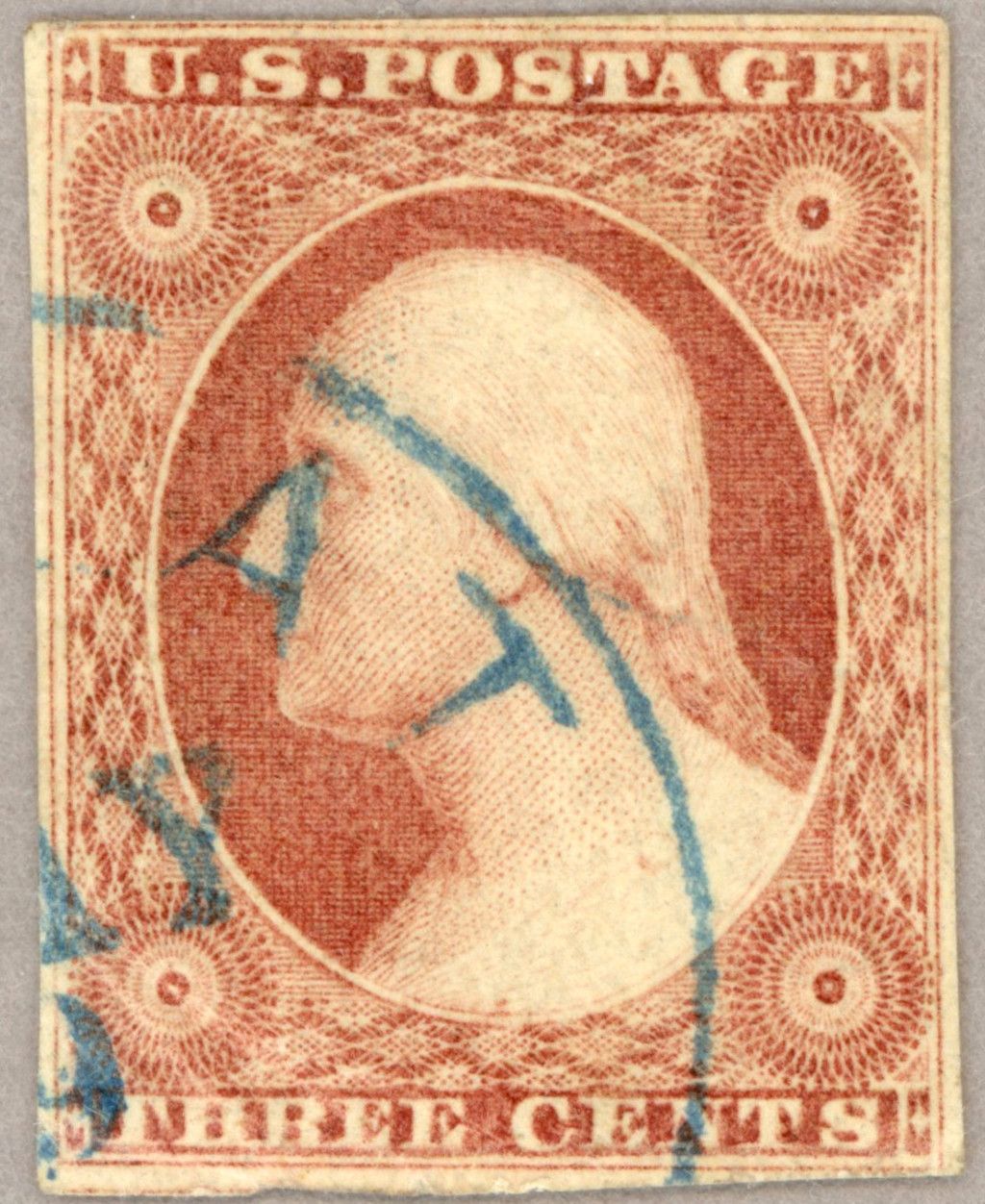
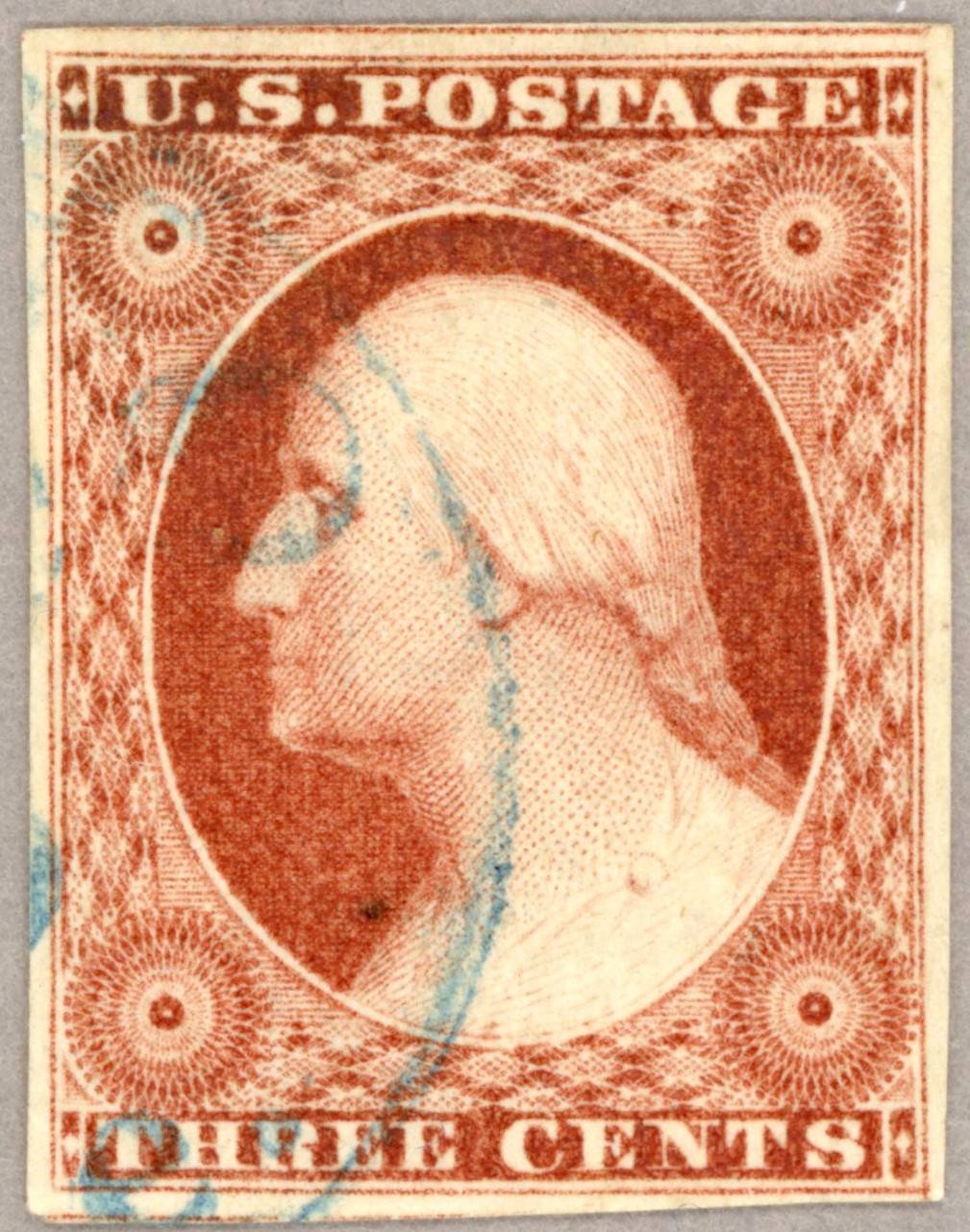
Thanks Harper. I feel pretty good about it.
The stamp previously uploaded is on this cover.
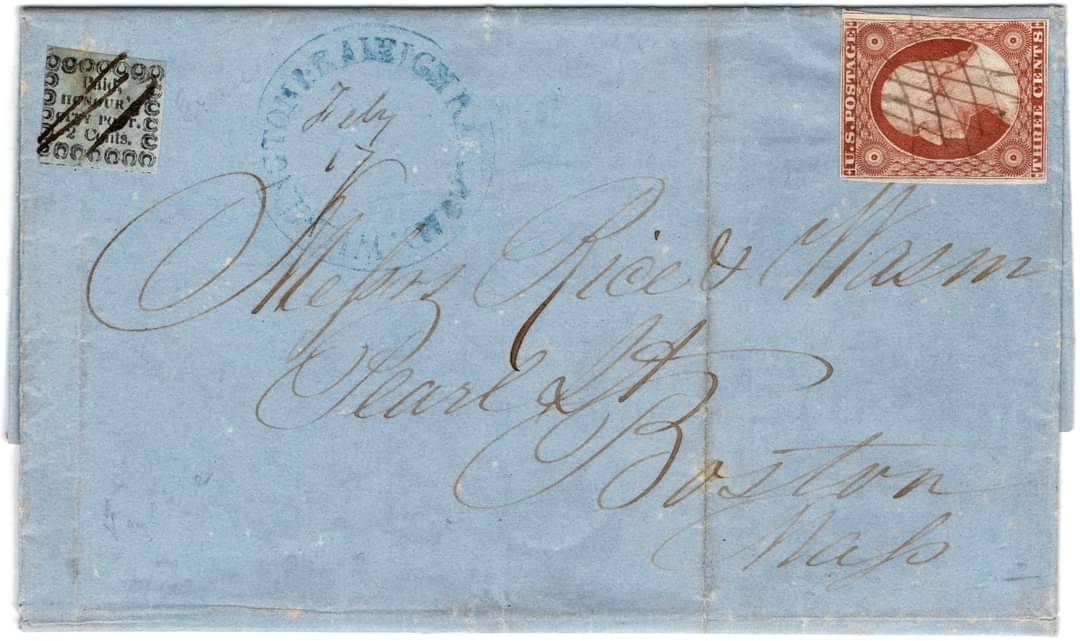
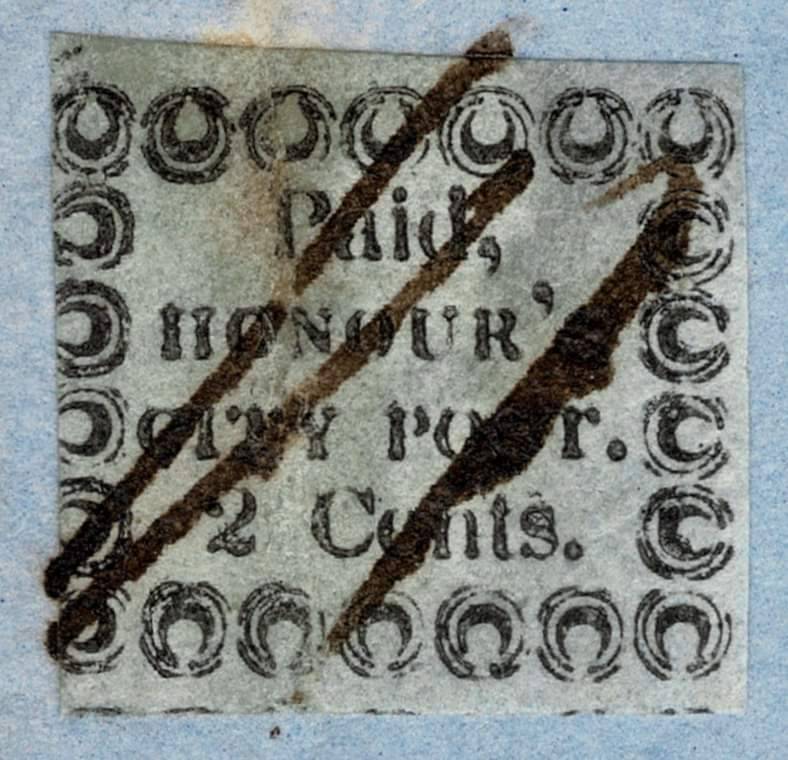
Described thus:
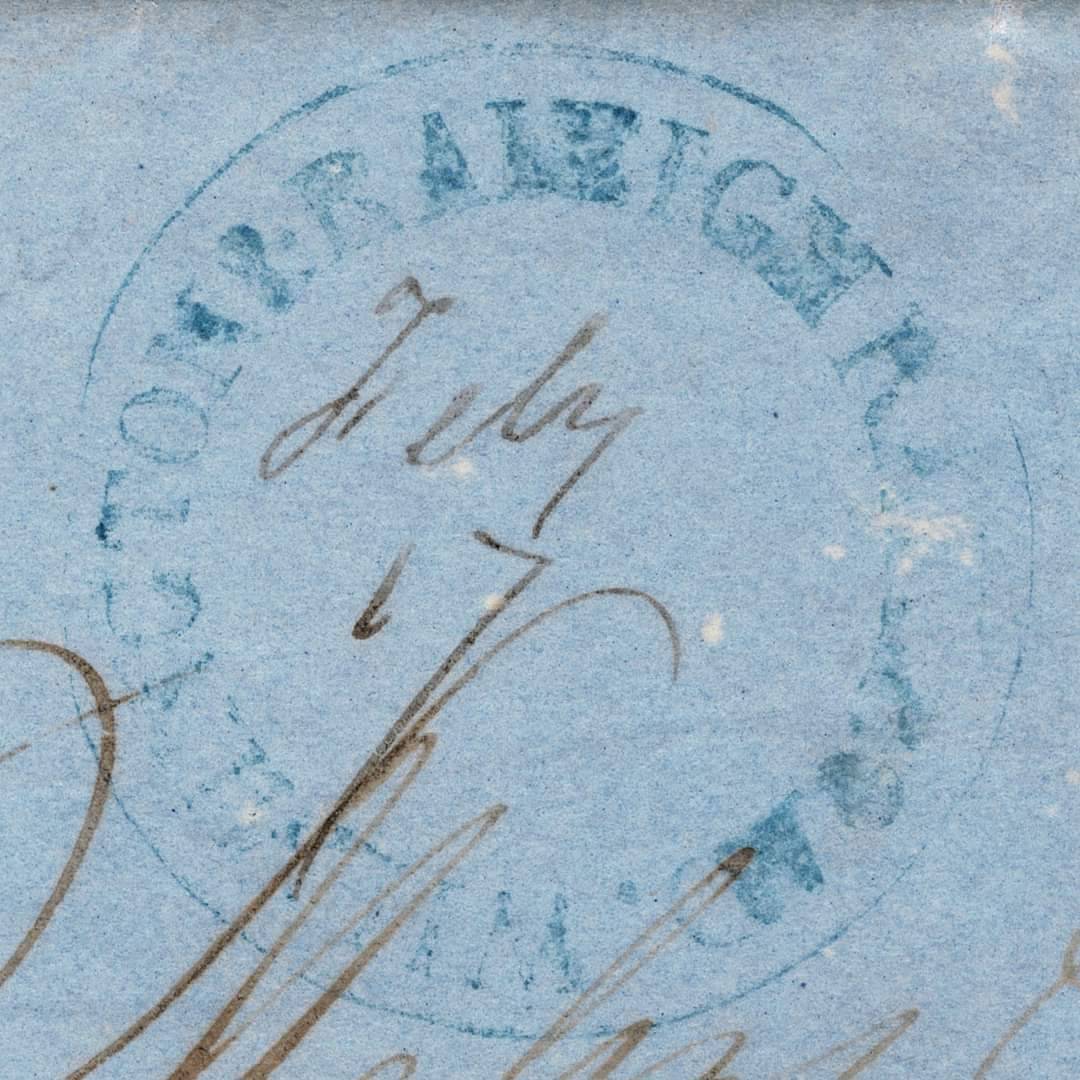
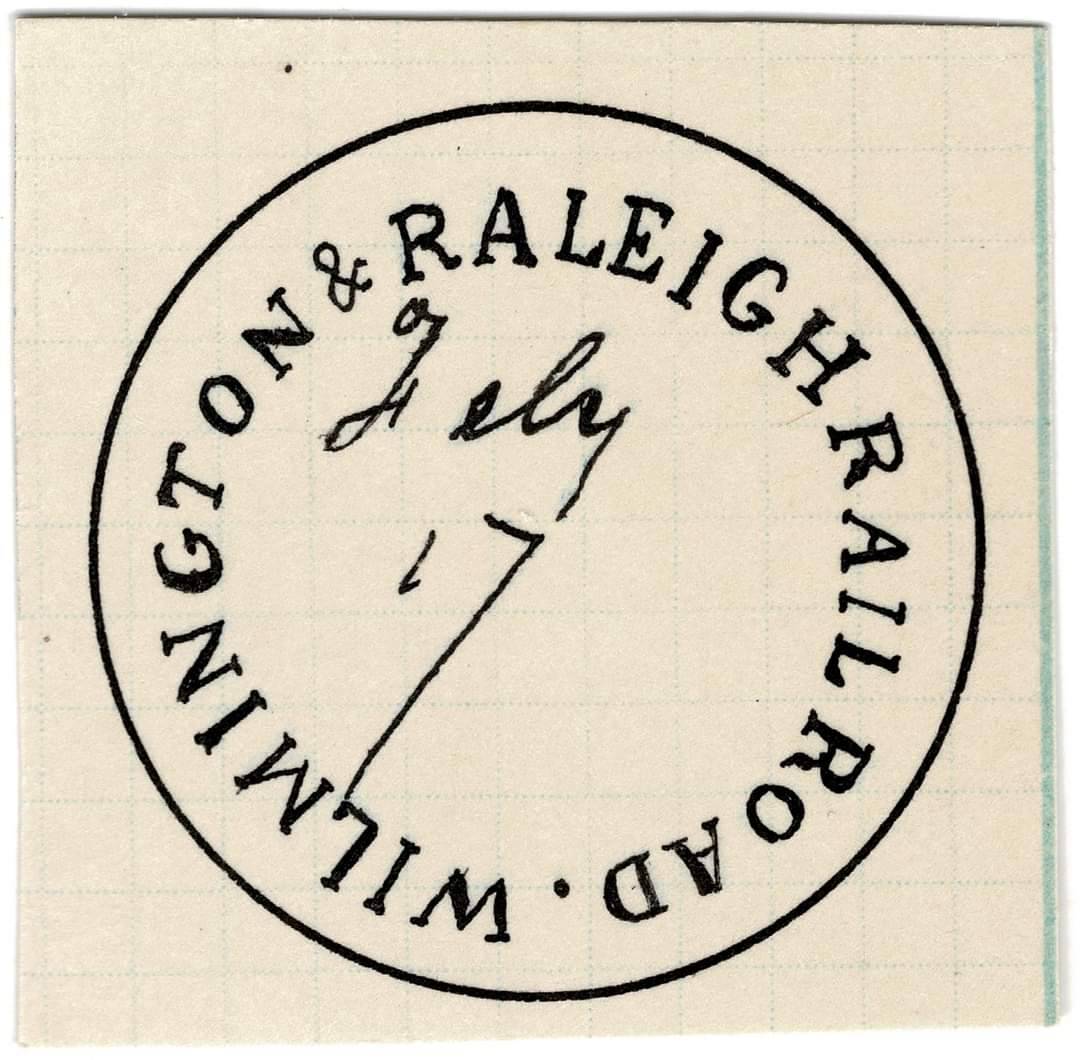
Charleston, S.C., Honour's City Express, 1851-58, 2¢ black on bluish. Position 1. Margins full to in at left, tied by manuscript cancels on ca. 1851 folded letter to Boston, Mass., in combination with four margin 1851, 3¢ Orange Brown (10A) manuscript canceled, blue "Wilmington & Raleigh Railroad" route agent cds with manuscript "Feby 17" date; couple vertical file folds with one affecting carrier stamp, F.-V.F., ex-Remele, Abt and Golden.
Scott Nos. 4LB8 & #10A
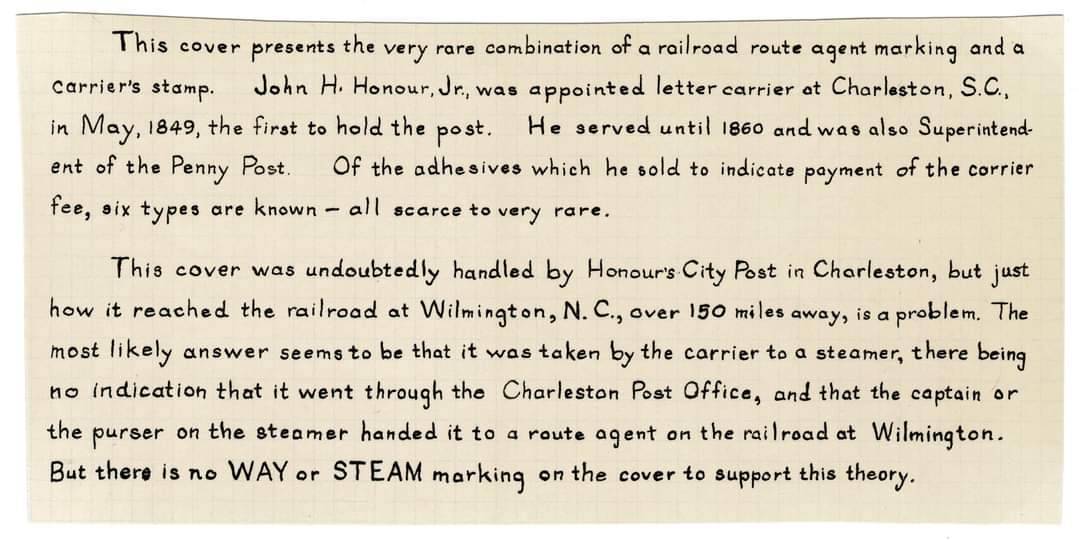
A RARE USAGE OF THE 2¢ HONOUR'S CITY EXPRESS ISSUE ON BLUISH ON COVER CARRIED TO THE AGENT OF THE WILMINGTON & RALEIGH RAILROAD.
It is believed that this cover was taken by the carrier to a steamer bound for Wilmington as there is no indication that it went through the Charleston post office.
Writeup on the Honour's Carrier Stamp by Honour's City Post
By Larry Lyons (THE PENNY POST/ Vol. 15 No. 4 / October 2007)
Available here:
https://www.pennypost.org/pdf/penny...st200710.pdf There are six different designs comprising the Honour's City Post adhesives. Four of these designs were printed in two colors producing ten Scott listed stamps. In addition there is one confirmed unlisted color of one design giving us a total of eleven different adhesives. The Honour's City Post stamps are known with more printing errors and varieties than any other carrier or local stamp. In all there are seven Scott listed varieties of the various Honour's City Post adhesives. See Figure 2 for the six Honour's City Post designs.
The focus of this article will be to determine the correct order of issue of the eleven different adhesives. A census study will be presented with an analysis. The study will show the probable earliest and latest dates of each of the adhesives and the known quantities of the various adhesives. A study of the adhesive varieties will also be presented. First, a brief history of this carrier.
History of the Honour's City Post
Charleston's carrier department was announced in an advertisement, which appeared in the May 9, 1849 issue of the Charleston Mercury. The announcement was made by Dr. John H. Honour who was the superintendent of the Charleston Carrier Department. Honour was a letter carrier from the 1849 inception date until his retirement in 1860. Honour's brother-in-law was engaged at the onset to assist him. His name was E.J. Kingman. They separated in 1851 dividing the carrier business of Charleston between them.'
The Carrier Fee
The 20 carrier fee in Charleston applied to all categories of letters: intra-eity, to the mails, and from the mails. Large valentines were charged two or three times the regular fee. There are several examples of Charleston carrier stamps used on mail received from other post offices. The 20 fee for delivering a letter from the
Charleston Post Office to a local resident could be prepaid by the correspondent outside the city, using stamps purchased from the carrier department.^ The cover shown in Figure 1 is evidence of mail received from another post office and delivered in Charleston by Honour's City Post.
The Printers
Honour's brother-in-law, E. J. Kingman recalled that "some" of the Honour's stamps were printed by A. J. Burke and "some" by Harper & Caloo.
The First Honour's Design
E.J. Kingman recalled that the first Honour's oval stamp design (see Figure 2) was printed from a "stamp or die cut" that was "abandoned" and replaced with stamps made from "ordinary type". Scott Trepel has pointed out that the Honour's die was probably copied from the then-current Eagle & Globe stamp used by Boyd's
City Express of New York City.^ The name "Honour's City Express Post" on Honour's first design does not appear in any contemporary ads or on any subsequently issued stamps. The name "Honour's City Post" appears on four subsequently issued stamp designs and appears in all the contemporary ads. The name of this carrier is therefore "Honour's City Post" and the Scott Specialized Catalogue should be changed to show the correct company name.
Figure 3 shows the Boyd's City express stamp design type IV which was used to make the black on green 20L4 stamp in 1845 and the black on gold 20L5 stamp in 1847. The blank oval at the center of the Honour's stamp suggests that the Charleston engraver was unable to timely engrave the Eagle & Globe and could not obtain a stock die. Note the "2" and the lettering is quite similar to the Boyd's stamp design.
The earliest known Honour's covers are those with the first design. The earliest known usage is a May 24, 1849 cover with a black on yellow 4LB2 adhesive. This date is only 15 days after the initial advertisement which announced the start of Charleston's carrier department. The second known earliest usage of the first design is a cover dated July 14, 1849 with a black on brown rose adhesive 4LB1. The third earliest known usage is a cover dated July 18, 1849 with a black on yellow 4LB2 adhesive.
There are only three recorded covers with the black on yellow 4LB2 adhesive and three genuine covers with the black on rose 4LB1 adhesive. This is a very small sample group from which to draw any conclusions. Based on the EKU cover having a black on yellow adhesive, 4LB2, some students will conclude that this color adhesive was issued first. The two July 1849 covers having an adhesive of each color certainly indicated that both colors were in use simultaneously. One example of a black on rose, 4LB1, adhesive exists on a piece with a date of August 6, 1849. A cover dated January 24, 1851, has a black on rose 4LB1 adhesive which did not originate on that cover. This is therefore a used cut-to-shape single. One other used cut-to-shape black on rose, 4LB1 adhesive exists and one unused cut-toshape example exists. The total recorded examples of the black on rose 4LB1 stamp is seven with three being on cover, one on a piece and three singles.
Besides the three recorded examples of the black on yellow, 4LB2, adhesive on cover there is one recorded cut-to-shape single. One adhesive of each color is known on covers in combination with a tencent 1847 General Issue adhesive. These two covers have been included in the census counts stated above.
The Second Honour's Design
The second Honour's design (see Figure 2) listed in the Scott Specialized Catalogue can be attributed and limited to the year 1854. It will be easily demonstrated that the third and fourth designs preceded the use of the second Honour's design and the Scott Specialized Catalogue should be revised to list the designs in the correct order of issue and with the corrected usage periods concluded in this article. We do not recommend a change in the Scott numbers already in use.
There are eleven recorded covers with the 4LB3 adhesive of which two are "fronts" only. In addition, there are two covers with used singles, one with a "did not originate" opinion and one with a "decline opinion" from the Philatelic Foundation. There is also a cover with a "did not originate" opinion which has an unused 4LB3 adhesive. A used single on piece is also certified and recorded. The total number of recorded adhesives is therefore sixteen. The number of recorded off cover adhesives is only four with one being unused and three being used. The unused single is not listed in the Scott Specialized Catalogue.
The Third Honour's Design
The third Honour's design listed in the Scott Specialized Catalogue was issued in two different colors. The 4LB5 stamp has black ink on bluish pelure paper and the 4LB7 stamp has black ink on yellow paper. It will be easily shown that these two stamps are listed in the reverse order of their issuance.
My census of the two stamps comprising the third Honour's design is the first recorded census for each of these adhesives. I record 12 covers with the black on yellow adhesive 4LB7, plus two covers which have received decline opinions from the Philatelic Foundation. The 12 recorded covers are dated between October 2, 1849 and April 12, 1850. I record ten covers with black ink on bluish pelure paper, 4LB5. The earliest usage is probably June 12, 1850 and the latest usage is probably February 9, 1852. It is clear that the black on bluish pelure adhesive, 4LB5, was issued after the black on yellow, 4LB7 adhesive. The 4LB7 stamp should be Scott listed on cover untied.
There is one recorded unique example of the black on bluish pelure stamp with "Cents" misspelled "Cents", 4LB5a, and there is also one recorded unique example of the black on yellow stamp on cover with "Cents" misspelled as "Cents", 4LB7a.
The third Honour's design clearly preceded the second Honour's design which wasn't issued until 1854.
The Fourth Honour's Design
The fourth Honour's design is the design which received the most use. The black on bluish adhesive, 4LB8, (comma after "Paid,"), is the most common adhesive of all the Honour's stamps. 1 would estimate that at least 150 covers exist with the 4LB8 adhesive. Many of these covers are not year dated and this is problematic; however, 1 was able to track 48 covers which were year dated with the
following results:
Year # Covers
1851 24
1852 12
1853 11
1854 1
Two of the 1851 covers are from January and the 1854 cover is dated May 2, 1854. Based on this study 1 would conclude that the usage period for the 4LB8 adhesive was January 1851 thru May 1854. There is one cover, ex-Hollowbush, dated December 7, 1858 which probably led a previous student to believe a usage period of 1851-1858 which is what is indicated in the Scott Specialized Catalogue. I believe the contemporary period to be 1851-1854. The second Honour's design 4LB3, has an EKU of April 2, 1854 and this indicates to me that the second design immediately followed the 4LB8 adhesive. The one 4LB8 cover used on May 2, 1854 is an out-of-town to Charleston usage. This date is quite conceivable and
understandable.
A stamp with a fourth Honour's design was issued with a period after "Paid." (4LB8a). A study of 12 dated covers of this type indicate a usage period of December 17, 1850 to April 26, 1851 for the 4LB8a adhesives. A previous student indicated that "pelure paper stamps are from a first setting with wide space between
the stamps and a period after "Paid". These would include the 4LB8a stamps and the 4LB9 stamp. There is an unlisted stamp on pink pelure paper on a cover dated January 6, 1851. This cover has a Philatelic Foundation certificate indicating it is genuine. In the Kuphal sale held at the Siegel Auction Galleries on November 15-
16, 2006, this cover was Lot 1187. The auction description states "we guarantee this stamp to be on pelure paper (with pink color) without a time limit." This was formerly 4LB10 and should be reinstated in the Scott Specialized Catalogue based on the PF certification. There are two known examples, both on cover.
Position 2 of the black on bluish paper stamps contains a spelling error. In this position the word "Cents" is spelled "Cens". This position error has been given the Scott Specialized Catalogue sublisting of 4LB8b. I have recorded at least seven dated covers with this misspelling subtype. The dates of the covers span the years 1851-1854, mimicking the basic 4LB8 period of usage 1 have indicated. A progressive breakdown of the position 2; 4LB8b adhesive was presented in the Golden sale and is repeated here. See Figure 4. This author records only two examples of the black on bluish pelure adhesive, 4LB9.
The Fifth Honour's Design
The basic adhesive of the fifth Honour's design is the black on bluish 4LB11. In my census 1 record 20 covers with the 4LB11 stamp. It is my belief that this stamp first saw use in the summer of 1855 (probably July, 1855) and remained in use for less than a year (to perhaps March of 1856). The 4LB12 stamp of the fifth design is black ink-on bluish pelure paper. About six single stamps are recorded and no cover has ever-been recorded.
The Sixth Honour's Design
The sixth Honour's design is the black ink on bluish paper, 4 LB 13. This stamp has a period after "Post." I record about 13 covers in my census. The dates on the covers seem to indicate a usage period of June 1857 to November 1858. One pair of stamps is known off cover. This stamp is scarce off cover and I guesstimate
about 10 known examples. If you have a 4LB13 stamp in your collection please let me know. A scan would be useful.
There are two varieties of the sixth Honour's design and both are listed in the Scott Specialized Catalogue. The first variety has a comma after "Paid," and a period after Post." This is 4LB13a. I record three known examples with no known examples on cover. One of the examples has been torn in half and rejoined. The
second variety has no period after "Post" and is listed as 4LB13b. Only a single unique example is recorded.
This write-up came with this cover and is probably Remele's handwriting on the railroad maps in his work, "United States Railroad Postmarks 1837 to 1861" Remele, C. W.
Published by U.S. Philatelic Classics soc., 1958





 Posted 02/27/2024 8:47 pm