| Author |
 Replies: 3,821 / Views: 252,947 Replies: 3,821 / Views: 252,947 |
|
|
|
Pillar Of The Community
United States
2230 Posts |
|
|
This January 8th cover with an unusual line-and-bar Utica New York CDS was posted in 1852 or 1853 judging from the brownish carmine color of the stamps. The cover is addressed to Charlemagne Tower (April 18, 1809 – July 25, 1889), A Pennsylvania lawyer and businessman, in Pottsville PA. Carroll Chase wrote his plating marks on the front indicating the stamps are from positions 48R1L and 98R1L. He wrote some notes about the cover on the back that I haven't fully deciphered yet, but they read in part: Two very fine copies '52 shades used (???) Right stamp is a shift. See lower label. Odd postmark.As most students of the 1851-57 3-cent issue know, Carroll Chase wrote distinctive capital Rs, which typically were very rounded with a wide gap in the middle.   |
Send note to Staff 
|
|
|
Pillar Of The Community
United States
6664 Posts |
|
|
Impulse buys from a rainy day watching SAN auctions  Nice example of position 97L1L showing the double transfer  And one for the "To be plated "pile  |
|
Send note to Staff
|
|
|
Valued Member

United States
327 Posts |
|
|
Plated this one this morning to 4R6. A nice example showing the shifted transfer in the rosettes and label blocks. 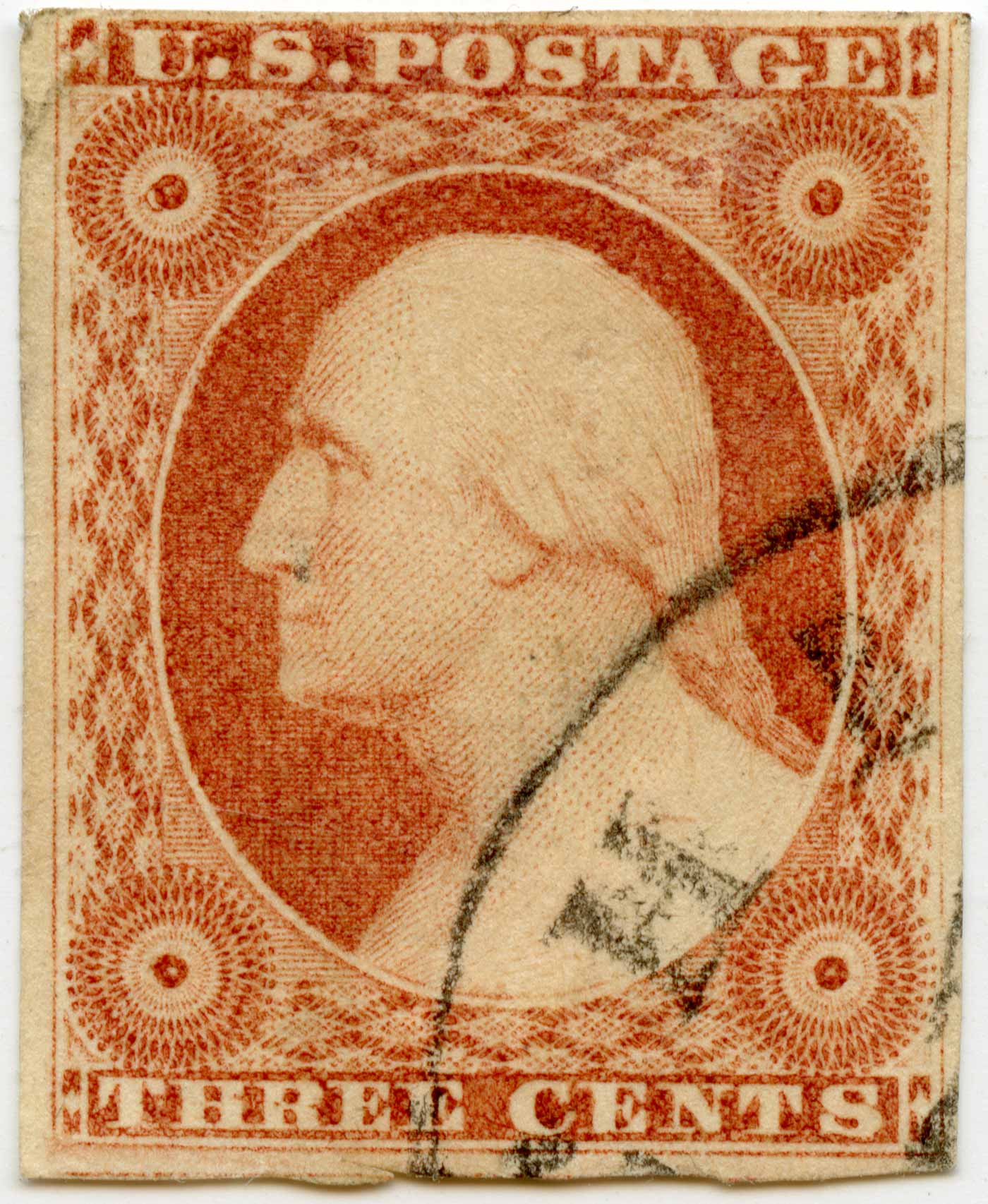 |
|
Send note to Staff
|
|
|
Pillar Of The Community
United States
2230 Posts |
|
|
That's a nice example of the 4R6 shifted transfer, Harper1249! Thanks for showing it. |
|
Send note to Staff
|
|
|
Pillar Of The Community
1312 Posts |
|
|
Quote:
Impulse buys from a rainy day watching SAN auctions
Nice example of position 97L1L showing the double transfer
2 pretty stamps. Question- what denotes the double transfer. New to this. Tks! |
|
Send note to Staff
|
All the best… |
|
|
Pillar Of The Community
United States
2230 Posts |
|
|
Hi, Stamps4Life, I'm not sure if you saw the double transfer on Harper1249's stamp. If you look at the center of the top rosettes, you can see the some of the doubling there. The designs for the 1851-57 3-cent issue were transferred from a transfer roll to the plate using the top-row guide dots to help place the transfer roll. The drawing below illustrates the arrangement of reliefs on the transfer roll for this issue. So on a typical 3-cent plate, the top row has C-reliefs, the second row has A-reliefs, and the third row has B-reliefs. The transfer roll drawing also depicts a side-point, a pointer aligned with the top of the C-relief that was intended to be placed into the guide dots incised into the plate at regular intervals. After the top three rows of designs were entered into the plate from the transfer roll, the siderographer placed the bottom of the C-relief on the transfer roll into one of the previously-entered third-row designs to get the transfer roll properly aligned, then he rocked only the A- and B-reliefs from the transfer roll into the fourth and fifth rows of the plate. This is called a "guide reliefing entry process" in the Sesquicentennial document linked below. Double transfers, also called shifts, occurred when the transfer roll either A) shifted out of place while rocking in one of the new entries or B) was over-rocked, resulting in part of one of the previously entered designs being entered again from a different relief on the transfer roll than the first time. You can download the free document titled The 1851 Issue of United States Stamps: a Sesquicentennial Retrospective at the below link. It describes in great detail how the 1851-57 plates were constructed. https://www.uspcs.org/wp-content/up...CS_and_B.pdf *minor edit for clarity |
|
Send note to Staff
|
| Edited by Classic Coins - 11/19/2024 1:49 pm |
|
|
Pillar Of The Community
United States
2230 Posts |
|
|
Stamps4Life,
Regarding the double transfer on stallzer's 97L1L, if you look at the O in ONE on that stamp, you can see a major shift of the O on the white oval above. Other doubling can be seen elsewhere in and above the ONE CENT label. |
|
Send note to Staff
|
|
|
Valued Member
United States
327 Posts |
|
|
Greetings all. I'm seeking confirmation on my plating of this stamp. I am coming up with 31L5L but Chase, Lund and StampSmarter examples aren't clear enough for me to feel certain i've got the right position. It looks like this position has a doubling of the left out frame line along the bottom third which is clearer on some of the examples but not so much on mine. Bowing out of framelines near upper left rosette and bowing in of outer frameline near lower right rosette look similar. Thanks in advance. Harper1249 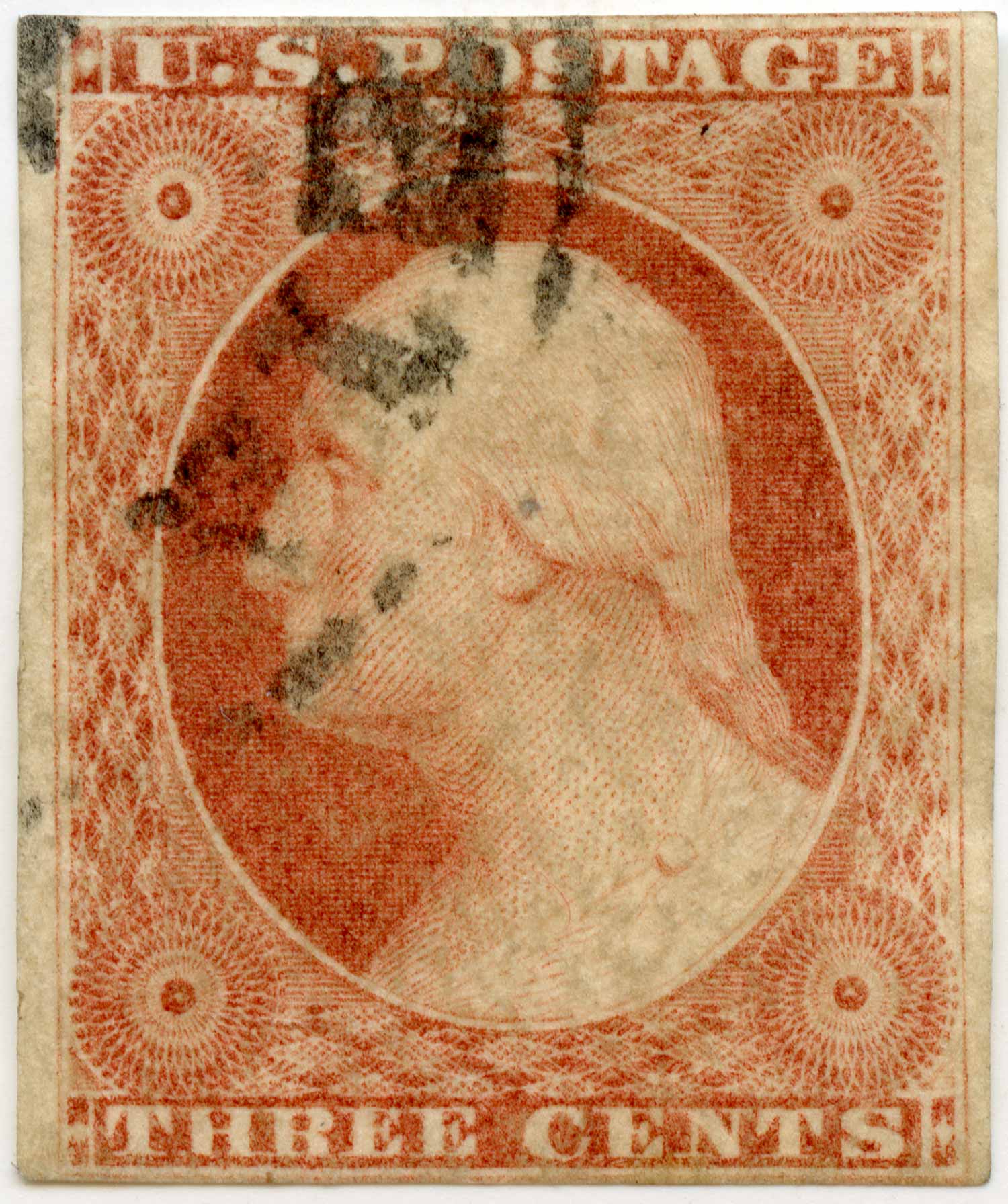 |
|
Send note to Staff
|
|
|
Pillar Of The Community
United States
636 Posts |
|
|
Hi Harper --
I studied your tentative 31L5L -- and despite the differences you noted in your SCF post -- I am 100% confident that you plated it correctly.
FYI -- I basically "re-plated" the stamp from scratch -- as if I did not know the plate position. With those weak IL's, the stamp has to be from plate 5L -- and I eliminated every other A relief on the plate -- leaving 31L5L as the one and only match.
I also sent scans of all my reference copies to ClassisCoins and he further confirmed the plating vis-a-vis a compression analysis (Thank You Classic).
I believe that the differences you noted on your SCF post are due to variations in inking, impression, and plate wear among the various reference copies available.
Great job on plating this difficult patient -- nicely done!
One additional comment about this position --
Chase notes that position 31L5L has a minor crack -- which he (Chase) describes on page 60 of his book as follows:
..."31L5L shows what is probably a tiny "v" shaped crack at its lower left corner. It starts from the LFL about a third of a millimeter above its lower end, runs directly to the left for about a millimeter, and then runs back almost squarely southeast, stopping in the white space between this stamp and the one below"...
FWIW -- I cannot clearly see this so-called crack on any of the reference copies available to me? That said -- on a few of the copies -- I can see what looks like a very faint portion of the so-called crack running horizontally across the LFL where Chase describes -- but none of the copies show the supposed "southeast" leg of the "v" that runs into the white space between the stamp below?
If anybody out there has a copy of 31L5L showing the crack as described by Chase, I would love to see a scan.
Regards // ioagoa
|
|
Send note to Staff
|
| Edited by ioagoa - 11/23/2024 1:33 pm |
|
|
Valued Member
United States
327 Posts |
|
|
Thank you Ioagoa and ClassicCoins for taking the time to look at this one and confirm its position. It is very much appreciated.
Regards,
Harper1249 |
|
Send note to Staff
|
|
|
Pillar Of The Community
United States
6664 Posts |
|
|
An Impulse buy from auction watching.... I liked the covers due to the penmanship and overall look. Same sender / recipient This pair was labeled 69-70 L3   And this pair I believe is labeled 9-10 L0 ? *Edit* Is the TWS initials Tracy W Simpson?   |
|
Send note to Staff
|
| Edited by stallzer - 11/26/2024 6:25 pm |
|
|
Pillar Of The Community
1312 Posts |
|
|
Pillar Of The Community
United States
2230 Posts |
|
|
Thanks for showing the very nice covers, stallzer. That's a very interesting "Three Rows" pair on the 1 November cover! Attractive handwriting is always nice to see on old postal history items like yours. Seeing street addresses on covers of this period is unusual. |
|
Send note to Staff
|
|
|
Pillar Of The Community
United States
2230 Posts |
|
|
Happy Thanksgiving, U.S. members! Here are two plate 1 late stamps, both from position 3L1L, illustrating some of the extremes from that plate. The color of the stamp on the left is "Early 1852 Claret." The earliest use of a stamp from plate 1L was on October 6, 1851, and the earliest use of the Early 1852 Claret color was on November 11, 1851. W. Wilson Hulme II and Dr. Wilbur F. Amonette wrote in Chronicle issue 206, that most of the Early 1852 Claret printings must have been made in January or February of 1852. So the stamp on the left almost certainly was printed during the first six months of plate 1L's service. The stamp on the right was printed in orange red, a color that appeared just four months before plate 1L was retired in March, 1855. Plate 1L was badly worn and dirty at the time, resulting in poor print quality like with this example. The inking of the most heavily gouged-out portions of the design in the upper-right corner are more much more pronounced than on the early printing. The recutting of the right inner line on this position ends notably far from the upper-right triangle, about three rosette dots below the outer dot at the 3-o'clock position of the rosette. There is a faint line extending above the end of the recut right inner line that I assess to be from the original entry, not from recutting.  Sources: U.S. Philatelic Classics Society Chronicle magazine issue 206 U.S. Philatelic Classics Society Chronicle magazine issue 266 |
|
Send note to Staff
|
|
|
Pillar Of The Community
United States
6664 Posts |
|
|
Quote:
That's a very interesting "Three Rows" pair on the 1 November cover! I saw that marking. Can you expand on what the "Three rows" means? |
|
Send note to Staff
|
|
|
Replies: 3,821 / Views: 252,947 |
|




 Posted 11/08/2024 2:48 pm


