Quote:
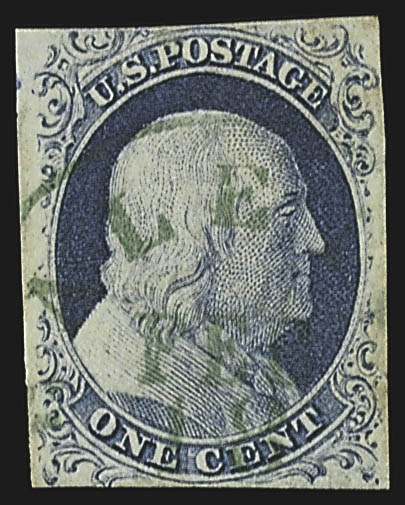
as a novice in plating anything it's interesting to me to know how someone determines a plate number. Can you explain how you determined that CC's finger print stamp is plated to 51L2L?
Hi Moyock --
Basically it is a brute force process of elimination -- in the case of this stamp it went something like this --
-- color and impression does not look OB -- so that tentatively eliminates plates 1E, 1i, 2E, 5E, and 0.
-- stamp has 2 recut inner lines -- so that eliminates plates 4, 6, 7, and 8.
-- stamp does not have a gouged upper right diamond block -- so that eliminates all but 2 positions on plate 1L -- both of which are B reliefs -- and this one is an A relief -- so plate 1L is thus eliminated.
-- based on my experience, the recut inner lines look too strong for plate 5L -- so that narrows it down to either plate 2L or 3.
-- again, stamp is an A relief -- so that eliminates all B and C reliefs.
-- now we get down hunting through all A reliefs on plates 2L and 3 -- which means we first need to identify something about the stamp that is distinctive -- such that we can quickly look at a reference copy or the Chase photos and either eliminate each possibility as we go -- or mark it as a "maybe" for further detailed review -- or in some instances, depending on the distinctive plating characteristics identified, the position can be instantly nailed down.
-- For this stamp, I noted two distinguishing features for my brute force exercise. First -- that the left inner line (LIL) ran up unusually far -- touching at least 4 or 5 dots of the upper left rosette. Second -- that the LIL bent sharply toward the left frame line at its lower end.
-- Using the two distinctive features noted above -- it did not take me long to land on 51L2L. Once there I checked every other possible plating characteristic to nail down the position -- and there are many. For example -- the relationships of the left and right frame lines to their respective inner lines, the relationship of the top and bottom frame lines to their respective label blocks, the relative strength and weakness of the recut frame lines and inner lines, the touch points where the inner line tips hit the respective rosette dots, the spacing between the diamond blocks and the frame lines, the spacing between the rosettes and their respective frame lines, the intersection of the frame lines at the 4 corners, and there are others as well.
In the case of this stamp, every possible characteristic was a solid match to the Chase photo and my confirmed reference copies of 51L2L.
If you are serious about learning how to plate -- you definitely need a copy of the Chase book (or you can download the free electronic version on the USPCS website). Also, the website "stampplating.com", developed by Bryan O'Doherty, is a great resource to help you get started in your plating endeavors.
I can tell you that plating can be really frustrating at times -- especially when no inner line A reliefs that do not have any guide dots or recut varieties are involved -- but it is very satisfying when you nail a position. We need more platers for the hobby and it is always nice to see collectors who want to take a deeper dive into the world of plating.
Apologies for the long post -- but I hope this helps a little -- as I could easily write a book on this subject.
Regards // ioagoa



 Replies: 3,821 / Views: 252,865

 Posted 06/12/2020 10:56 pm