Quote:
Can you or anyone else outline the best way to go about trying to figure out the plate?
Hi Stamps4Life --
First -- allow me to qualify this entire post by saying that while I consider myself to be fairly knowledgeable with regard to the 3-cent type III and type IV issues of 1857–1860 (i.e., Scott #26 and #26A) -- I am no where near the "expert level".
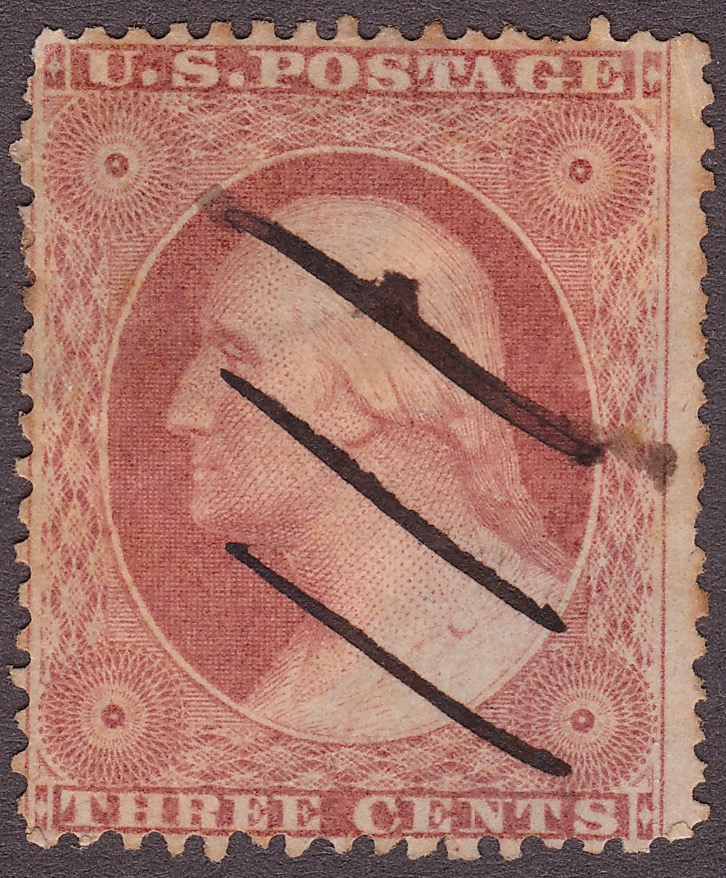
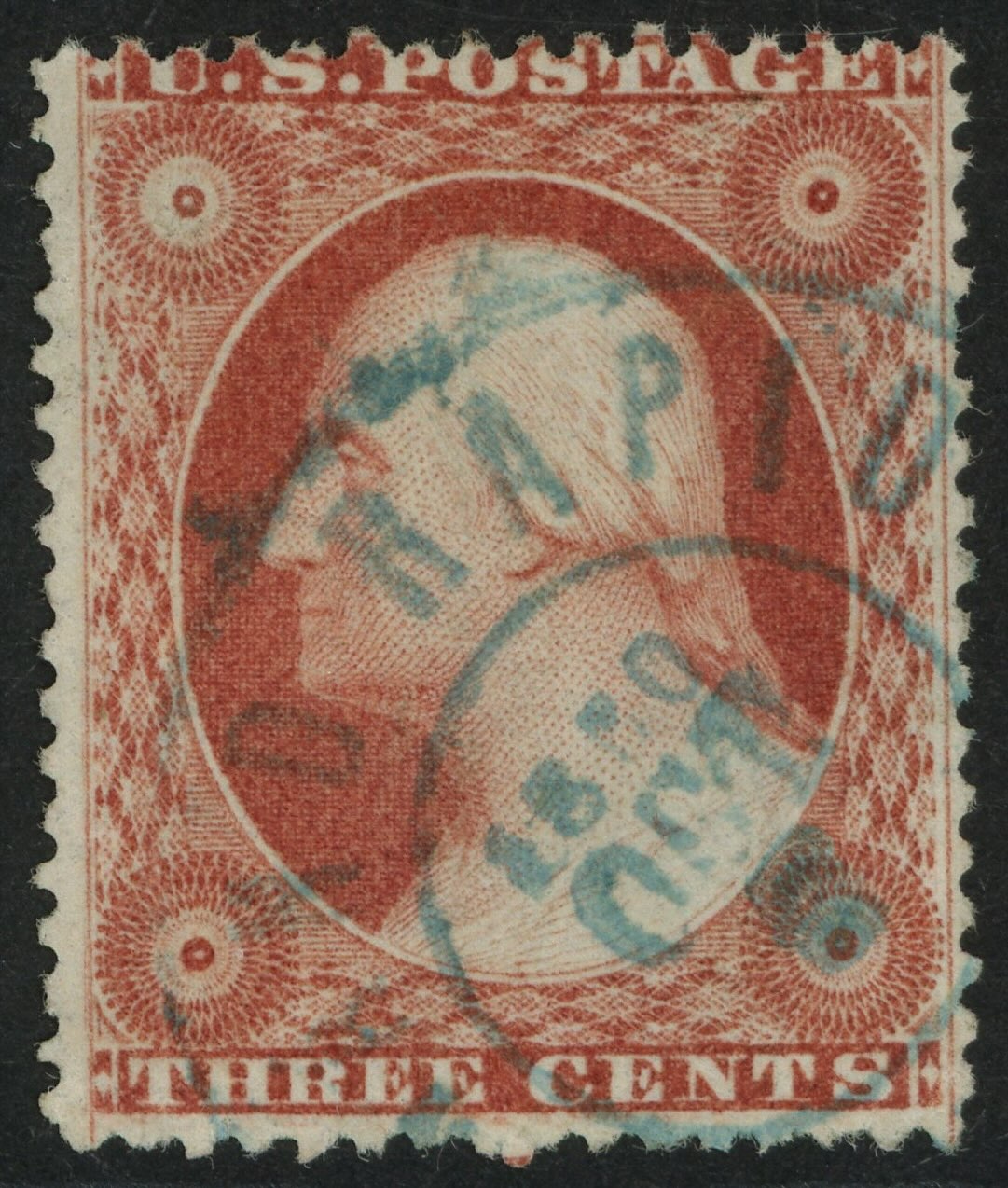
That said -- I personally do not know how to begin to figure the plate from which your stamp came -- other than to repeat what Philazilla had already stated -- that based on the straight (and apparent continuous) side frame lines, your stamp looks like a type III, Scott #26 -- which means that it is not from either plate 10 or plate 11 -- (which are the 2 plates that produced the type IV, Scott #26A stamps).
Unfortunately, many of these type III, Scott #26 stamps cannot be plated because no individually unique identifying characteristics exist. Also, for those plates that have been reconstructed (or partially reconstructed) -- unlike the imperforate 3c issue of 1851 for which there exists a central repository of information, there is no similar resource that I am aware of for the 1857–1860 perforated Scott #26 and #26A stamps.
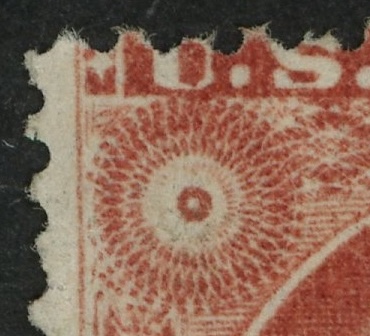
FYI -- The side frame lines on the type IV, Scott #26A plates were recut freehand on a stamp-by-stamp basis. This is why we typically see a break in the frame lines between stamps -- and also why we see bends and curves in the recut side frame lines (i.e., similar to the bends and curves seen on the 1851 imperforate issues -- Scott #'s 10, 10A, 11, and 11A). Generally speaking -- It is these bends and curves in the frame lines in relation to the other design elements of the stamp that enable them to be plated.
Conversely, on the type III, Scott #26 stamps, the side frame lines were recut using a straight edge guide in one continuous swoop from the top of the plate to the bottom. Consequently, unless the patient stamp has a guide dot, flaw, captured imprint, double transfer, or some other distinctive characteristic -- in many cases they cannot be plated.
And not to complicate the issue any further -- but there are few plates that are known as "hybrid plates" -- (for example plate 15) -- where Toppan Carpenter (the firm producing the stamps) started to recut the side frame lines stamp-by-stamp -- but midway through the recutting production process decided to make a change and finish off the recutting with the straight edge guide approach -- (which is why we see lots of doubled frame lines on that particular plate).
In any event, there were 2 plates used to produce the type IV, Scott #26A stamps -- and there were 18 plates used to produce the type III, Scott #26 stamps. More specifically:
Plates 10 and 11 (i.e., the type IV, Scott #26A plates) each exist in 3 states -- namely Early, Intermediate, and Late -- and with the only difference between each state being due to re-entry. If you consider each state of the plate as if it were a separate plate -- that makes 6 plates for the Scott #26A stamps.
Plate 9 -- and plates 12 through 28 inclusive produced the type III, Scott #26 stamps -- and 2 of these plates (i.e., plate 9 and plate 'Z') -- exist in two states -- namely Early and Late. Again, if you consider each state of the plate as if it were a separate plate -- that makes 20 plates for the Scott #26 stamps).
Now you are probably wondering what the heck is plate 'Z'. This is one of the so-called "alpha plates' -- where Dr. Chase was unable to match up stamps he was plating to the plate's number -- so he assigned letters as placeholders until he was able to figure out the numbering. I may be wrong on this -- but I believe that the associated numbering of some of the alpha plates has never been determined.
As you can see, you are scratching the tip of an iceberg when it comes to the subject under discussion.
If you have an interest, I would suggest first downloading the Chase book from the link in my prior post -- and if you wanted to do an even deeper dive, I would search through the Chronicle articles on the United States Philatelic Classics Society (USPCS) website.
The link to the Chronicle search page of the USPCS website is here:
https://www.uspcs.org/resource-cent...e-chronicle/I believe that if you are not a member, that you can search and read everything except for articles published in the last 5 years.
Between the Chase book and the Chronicle articles there is a ton of information about these stamps -- and you can dive in as deep as you want. On the other hand -- if all you want to know is the Scott #, I think we have answered that for you. Speaking for myself, I do not have the expertise to begin figuring the plate from which your stamp came -- other than to say it looks like a type III, Scott #26 to me.
Maybe there are some other experts out there who can weigh in?
Regards // ioagoa





 Posted 02/27/2025 11:39 pm