Stamp Community Family of Web Sites
Thousands of stamps, consistently graded, competitively priced and hundreds of in-depth blog posts to read


Stamp Community Forum
 
Username:
Password:
Save Password
Forgot your Password?

This page may contain links that result in small commissions to keep this free site up and running.

Welcome Guest! Registering and/or logging in will remove the anchor (bottom) ads. It's Free!

Help Identifying 1¢ Franklin

 
To participate in the forum you must log in or register.
Author Previous TopicReplies: 6 / Views: 940Next Topic  
Valued Member

78 Posts
Posted 06/24/2020   11:53 pm  Show Profile Bookmark this topic Add hac5x3 to your friends list Get a Link to this Message
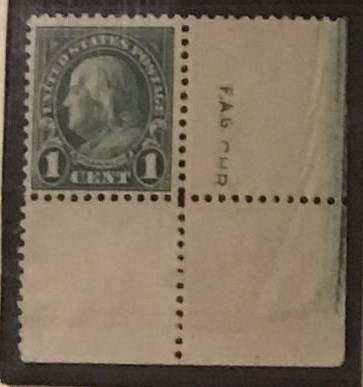
New to collecting, so please bear that in mind.

The first variety (#552) was issued in 1923 and has a perforation guage of 11 all the way around.

The second variety (#581) was issued in 1922 and has a perforation guage of 10 all the way around.

The third variety (#632) was issued in 1927 and has a perforation guage 11 at the sides and perf guage 10½ on the top and bottom.

When I count the perforations on this stamp I am seeing 12 vertical and 11 horizontal (?).

Am I counting wrong? Any help would be appreciated.

Send note to Staff

Valued Member
78 Posts
Posted 06/25/2020   12:17 am  Show Profile Bookmark this reply Add hac5x3 to your friends list  Get a Link to this Reply
Just one other thing. There are green specs of ink on the back of the stamp, leading me to believe it's a flat plate printing and a 552.
Send note to Staff  Go to Top of Page
Pillar Of The Community
United States
810 Posts
Posted 06/25/2020   12:51 am  Show Profile Bookmark this reply Add Philazilla to your friends list  Get a Link to this Reply
"Perf 10" Means there are 10 perforations per 2 cm. You do not count perfs. You need a perforation gauge to measure perforations. You should buy one if you plan to collect stamps, but you can also print one out Your stamp looks like a perf 11. I love those sideographer initials!
Send note to Staff  Go to Top of Page
Valued Member
78 Posts
Posted 06/25/2020   03:52 am  Show Profile Bookmark this reply Add hac5x3 to your friends list  Get a Link to this Reply
Thanks. You reply was like an epiphany. I agree, the double sideographer initials are pretty cool.
Send note to Staff  Go to Top of Page
Pillar Of The Community
United States
6664 Posts
Posted 06/25/2020   07:02 am  Show Profile Bookmark this reply Add stallzer to your friends list  Get a Link to this Reply
If there is green ink on the back you are correct on the flat plate printing. That's a great piece.
Send note to Staff  Go to Top of Page
Bedrock Of The Community
United States
10798 Posts
Posted 06/25/2020   07:09 am  Show Profile Bookmark this reply Add revcollector to your friends list  Get a Link to this Reply
The size and position of the sheet margins give it away as a flat plate stamp. No rotary stamp ever had margins like this on two sides. Also the initials.
Send note to Staff  Go to Top of Page
Edited by revcollector - 06/25/2020 07:10 am
Pillar Of The Community
6349 Posts
Posted 06/25/2020   09:15 am  Show Profile Bookmark this reply Add John Becker to your friends list  Get a Link to this Reply
hac5x3, you are mostly on track and your post shows you have done your homework very well as a beginner.

As pointed out by others, perforations are gauged, not counted.

Perforations are listed in the catalog with the rate of the top/bottom, then the sides, thus the "third variety" you mention in your original post would be 11 x 10.5 instead. This issue of stamps can be confusing in the catalog with both vertical and horizontal stamps. They are going to be 11 along the short edge and 10.5 along the long edge.

The initials: Plates of this era will typically have 2 sets of initials, the sideographer in the lower left corner and the plate finisher in the lower right. Your stamp shows two plate finishers F.A.G. (Frank A. Green) and C.H.R. (Charles H. Roll). The February 1969 issue of "The United States Specialist" published by the Bureau Issues Association (Now the Unites States Stamp Society), has a substantial list of the initials and the corresponding names, from which this ID is taken. They add considerably to the value.
Send note to Staff  Go to Top of Page
  Previous TopicReplies: 6 / Views: 940Next Topic  
 
To participate in the forum you must log in or register.

Go to Top of Page

Disclaimer: While a tremendous amount of effort goes into ensuring the accuracy of the information contained in this site, Stamp Community assumes no liability for errors. Copyright 2005 - 2026 Stamp Community Family - All rights reserved worldwide. Use of any images or content on this website without prior written permission of Stamp Community or the original lender is strictly prohibited.
Privacy Policy / Terms of Use    Advertise Here
Stamp Community Forum © 2007 - 2026 Stamp Community Forums
It took 0.15 seconds to lick this stamp. Powered By: Snitz Forums 2000 Version 3.4.05
