| Author |
 Replies: 64 / Views: 4,399 Replies: 64 / Views: 4,399 |
|
|
|
Moderator

United States
12330 Posts |
|
|
Another thing to consider on this listing, it had been listed for at least 5-6 months (click on 'revisions' in the listing). This means that it had a significant amount of time for others to consider this lot. This also had significance when it came to making your offer. 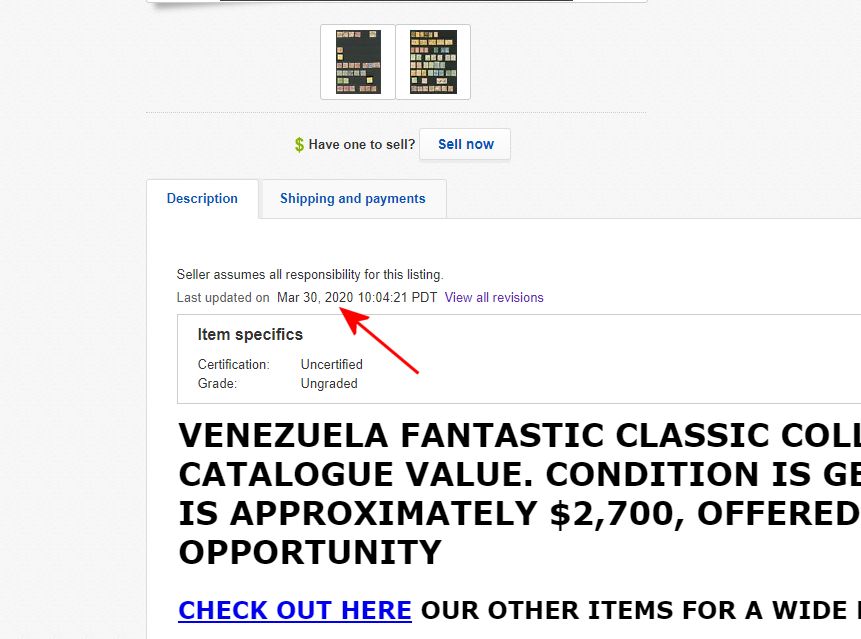 Don |
Send note to Staff 
|
|
|
Valued Member
United States
175 Posts |
|
|
Thanks, Don. I'm learning so much because of this purchase. This is turning into a thread rich with sage advice.
FYI, I offered less than half of the asking price and was surprised when it was accepted.
Another thing that I've learned - the forgeries are really popular, sometimes more so than the real thing! I'm clearly labeling them as such in my collection, but I wonder if I should have a minuscule rubber stamp made that says "faux" to stamp on the backs of these. I know that was a common practice in the past, but is it still acceptable or is it considered bad form to permanently alter these? I'm a bit of a stickler for making sure that my Philatelic material is protected while in my care.
You know this is why this hobby is so fascinating - always something new to learn. It never gets boring. These forums are a godsend for disseminating information. Hopefully these are archived for future collectors as a research source. |
|
Send note to Staff
|
| Edited by philatelia7 - 07/26/2020 10:24 am |
|
|
Rest in Peace
United States
652 Posts |
|
|
I am late to this party, but I think an important question is what is the catalogue value of the items that you consider genuine? If the answer is $2,700 then the seller was being fair (IMO). If the value of the genuine items is dramatically less than the posted catalogue value then you certainly have a reason for return. |
|
Send note to Staff
|
|
|
Pillar Of The Community
United States
1162 Posts |
|
|
I agree with Mr. Crowe - what would YOU say is the CV? If there is time to ask, then this is an area where asking a few questions before buying may have shed some light on the subject. I have been there - it can be awfully tempting to hit the Buy It Now button while it is still unsold. I have little knowledge of Venezuelan forgeries - would they even be discernible when photo'ed on a page full of stamps?? I would doubt it, but I don't know.
I bought a USA 9X1 from a well-known auction house a few years ago and sent it off for a cert (on extension) and it came back as a Sperati forgery. The auction house gave me a hard time afterwards, saying, "It's a Sperati! It has significant value on its own!" I didn't want it because it was worthless (it wasn't), but because that was not what was advertised, and not what I was in the market for. When asking for my refund, they balked at refunding the Buyer's Fee and then the Cert Fee (all of which was spelled out in their terms) because, "This won't make the consignor very happy." I told them to sell it as a Sperati, with a cert, for nearly the same amount of $$$, to someone who wants a Sperati, and charge THEM the Buyer's Fee that they should refund to me. It happened that way, but it was like pulling teeth.
Philatelia7 - if you feel that you got your value when you bought this lot, be happy with it. If you are accepting of the forgeries (after all, they DO have value, and would probably make great examples when displayed next to the originals), then more power to you! As to how you should approach such a situation in the future, that is hard to say. Some sellers are more than accomodating with making the customer feel good, and others get a mean streak when you even suggest the possibility of an 'oversight'. If I feel slighted, I tend to simply ask for a refund - no need for accusatory words - and see where that gets me. A rotten attitude gets a seller on my personal DO NOT BUY list that I keep. I have bought from sellers that have made honest efforts to make things right on earlier purchases. Anybody can make a mistake - to me, how they react to that tells me very quickly whether I will do more business with them or not. |
|
Send note to Staff
|
|
|
Pillar Of The Community
Australia
3299 Posts |
|
|
Quote:
but I wonder if I should have a minuscule rubber stamp made that says "faux" to stamp on the backs of these. I know that was a common practice in the past, but is it still acceptable or is it considered bad form to permanently alter these? I'm a bit of a stickler for making sure that my Philatelic material is protected while in my care. For modern fakes, I'd write or stamp something on the reverse. For classic forgeries I wouldn't, but that's just me. |
|
Send note to Staff
|
|
|
Valued Member
United States
175 Posts |
|
|
My original question was not about the price of the lot, but as so many seem focused on the money, to answer the question about the catalog value, rest assured that it is NOT a problem because that is really not of primary interest to me. Catalog values are often fantasy numbers after all. Even if those were included in the quoted value, the price I paid would still be very reasonable. I made an offer MUCH less than the buy it now price and it was accepted - I did NOT pay the original BIN price so I feel that the agreed upon price was quite fair. I only asked the dealer if the forgeries were included in the calculations because I wanted to know if he was aware that the lot contained so many forgeries.
My question, as I wrote in my initial post, is not about the money, it is about whether a dealer has an ethical responsibility to note fakes, flaws and so on in a lot description. |
|
Send note to Staff
|
| Edited by philatelia7 - 07/27/2020 3:47 pm |
|
|
Bedrock Of The Community
12766 Posts |
|
|
Pillar Of The Community
United States
8611 Posts |
|
|
We need to step back and understand the general accepted policy that all auction firms and most dealers in this business work by ------ Fakes and forgeries are expected in all collections,bulk lots and any large lot that no dealer or seller can reasonable be required to check each and every stamp. .
That is the normal way it has been done for the past 100 years . |
|
Send note to Staff
|
|
|
Valued Member
United States
175 Posts |
|
|
That's exactly my question - at what point should condition and authenticity be noted? For one stamp? Three stamps? Ten? How severe of a fault should be noted and so on.
And yes lot descriptions do affect sale prices, but money falls somewhat outside the scope of this query.
|
|
Send note to Staff
|
|
|
Pillar Of The Community
6364 Posts |
|
|
I agree with the direction Floortrader takes. Consider ... A collector or dealer breaks up a Big Blue album, keeps their specialty areas and offers the remainders as country lots. These offerings are the areas they know far less about, do not have the specialty literature, etc. They do not have the experience, time or expertise. There can be no "requirement". The key is to become a knowledgeable buyer. If one is going into deep water, then learn to swim or expect to swallow some water. |
|
Send note to Staff
|
|
|
Pillar Of The Community
France, Metropolitan
3756 Posts |
|
|
There are many forgeries in that lot.Many multiples. Just looking on the line of stamps of the arms issue 1862: G=Genuine 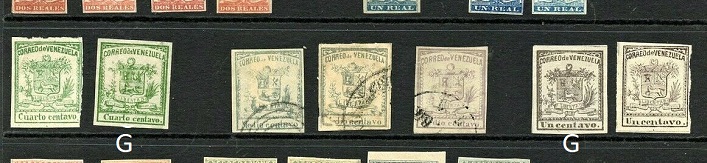 |
|
Send note to Staff
|
|
|
Valued Member
United States
175 Posts |
|
|
Very true! I agree completely that large lots cannot be expected to be scanned for every fake and flaw - that is absolutely untenable and would increase costs to bring a lot to market which invariably would be passed on to the buyer.
Knowledge is power, but some things you can't see. How about this scenario - a large collection is badly stuck down. Should that be mentioned in the description? It would be a bit silly to expect every buyer to ask if every lot is stuck down. Can you imagine what a waste of time that would be for the dealers? Most buyers assume the dealer includes that information.
Or the lot appears to be all MNH because all the stamps are in mounts, but in fact they all have heavy hinge remnants. Should that be mentioned?
But for the sake of discussion, what about small lots fewer than a dozen stamps. Should a conscientious dealer assiduously state condition for lots of that nature?
And no one has mentioned that the more expensive the stamp, the more important the issue becomes, true?
These are the things I was hoping to discuss. What is adequate? What is accepted practice?
|
|
Send note to Staff
|
| Edited by philatelia7 - 07/27/2020 5:32 pm |
|
|
Moderator
United States
12330 Posts |
|
|
Quote:
…There can be no "requirement"… philatelia7 originally asked about the ethics of misrepresentation in the listing ('catalog value'). I am not a lawyer and I think that consumer laws differ by state but there are requirements in consumer law. From a consumer law firm titled "What Are the Six Conditions of Fraudulent Misrepresentation?" https://www.weisberglawoffices.com/...lent-misrep/ "Fraudulent misrepresentation is the most serious form of misrepresentation and, therefore, the most difficult to prove. In business disputes, fraudulent misrepresentation can lead to major financial losses and for consumers it can mean being cheated out of receiving a good or service they have otherwise been promised. To prove fraudulent misrepresentation has occurred, six conditions must be met." They go on to list these criteria; 1. A representation was made 2. The claim was false 3. The claim was known to be false 4. The plaintiff relied on the information 5. Made with the intention of influencing the plaintiff 6. The plaintiff suffered a material loss Several of these misrepresentation requirements were met but I imagine that the 'intent' (claim was known to be false) would not be provable in this case. But in my opinion the listing contained a misrepresentation when it promoted a 'catalog value'. As I previously mentioned, making this kind of nebulous claim (without calling out which catalog, what year catalog, etc.) opens the door for a bad transaction and unhappy customers. I think that buyers should avoid any listing with this kind of meaningless puffery. This kind of inane verbiage must work (along with 'post office fresh') since it appears in so many listings. Don |
|
Send note to Staff
|
|
|
Bedrock Of The Community
12766 Posts |
|
|
It depends if you are talking about ebay or an actual dealer or auction house. An auction house that is listing a Country large lot of substance is going to take a solid look at it. Why? Because they have a reputation that goes beyond meaningless feedback. They want competition, repeat customers, no headaches dealing with return arguments, chargebacks on consignors with associated fee issues and the list goes on. It boils down to what the Terms and Conditions stipulate and whether the house is willing to bend those T&C's. And a real auction house is not going to start a substantial Indian States collection built over decades at 99 cents. You have to pay up for the real deal. If you think that you are going to score $2700 in genuine fault free material for pennies on the dollar you are kidding yourself. Most auction houses advise "inspect" in their boilerplate as well in each lot description for a reason. Put the onus upon you. Kelleher, Siegel, Cherrystone etc. cannot possibly examine every lot in a collection. They can do a pretty good flyover and give a good description but the analysis is up to the buyer. If the collection is a very meaty US they might put more effort into it but the deal is that: Any stamps that are worthy of being sold on their own merits will be pulled and lotted separately. |
|
Send note to Staff
|
|
|
Pillar Of The Community
United States
1162 Posts |
|
|
I used to work for an auction house, and part of our terms stated something like, "lots with 9 or more stamps may not be returned". This was a fairly standard boilerplate condition that most other houses also worked with. As with any terms, though, it was up to the company as to whether they stuck to that condition or not. There were cases when a set of, say, 20 stamps had a stamp with a fault and the return and refund were accepted. Occasionally, we would accept back a collection if the description missed something fairly major - like stamps stuck down, or one of the listed sets was missing, etc. I believe I worked for a reputable company, and they wanted their customers to be happy - a happy customer is a repeat customer. On the flip-side, there were definitely 'problem' clients and we would stick to the letter of the T&C's if that customer was being unreasonable. We lost a few 'problem' customers that way. Oh well.
Honestly, you are taking a chance with any large lot. I don't know that there are any ethics code to cover what you are asking. A good seller would accept a return. A bad seller will deposit your payment and think he has done the right thing. As for mentioning the forgeries, it would be nice to have it mentioned. In the end, you cannot expect the 20-50 word description to hit all the problem areas. If these forgeries for Venezuela are fairly common, perhaps you should EXPECT them to be in such a lot, even if not mentioned. I know that when I buy a large lot with early USA, I expect faults on most of the earlies, and especially on the more valuable ones. |
|
Send note to Staff
|
|
|
Replies: 64 / Views: 4,399 |
|




 Posted 07/26/2020 09:53 am


