| Author |
 Replies: 25 / Views: 3,176 Replies: 25 / Views: 3,176 |
|
Valued Member
China
314 Posts |
|
|
|
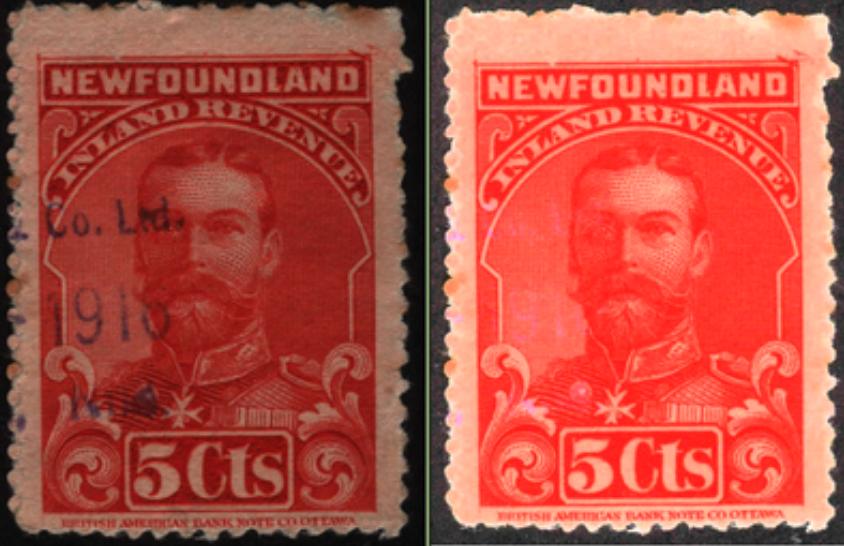
I am finding this stamp to be quite elusive. I was talking to a dealer online and he said that this stamp does not actually exist. The ones I have seen sold online did not come with certificates (which is suggested in my catalogue). My current catalogue is from 2012 and I don't have access to the newest one (I am trapped in China). Does anyone know anything about this stamp? Has its status changed?
|
|
Send note to Staff
|
|
|
|
|
Pillar Of The Community
Canada
1401 Posts |
|
|
Rest in Peace
7742 Posts |
|
|
TomSwift....BlackJag is correct...No updates on the Unitrade 124b...Only is states "" Certificates Recommended to Verify Shade"" Robert    |
Send note to Staff 
|
| Edited by wert - 08/11/2020 5:21 pm |
|
|
Valued Member
China
314 Posts |
|
|
Valued Member
Canada
382 Posts |
|
|
Hello TomSwift The Prussian Blue is an interesting stamp that, until recently, was confirmed by a visual comparison with a specimen that someone had agreed was PB. With the addition of the VSC6000 to our Expertization program at the Greene Foundation, we are now able to produce a 'scientific' comparison. I have been working on this project for a couple of years and have created a model that works for the Greene Foundation. By preparing a spectrographic analysis of a number of stamps and comparing to various philatelic colour guides and Pantone colour chips, I have been able to create an analytic profile that is unique to the samples previously identified as Prussian Blue. The following graph displays some of the profiles for 'blue' stamps including non Prussian Blue examples of Newfoundland #124. The Prussian Blue samples are the two bottom curves in the 400 to 500 nm range. It can be seen that the colour profile is distinctly different from the other shades of blue.  In seeking to have my work peer reviewed by the scientific community, I have been involved with a respected Professor of Physics who replicated my work and confirmed its validity. At the same time, using a nuclear analysis of the ink he was able to show that the Prussian Blue differs from the other samples of #124 only in the size of the particles of the pigment in the ink. Since philately is an optical hobby and considering that most collectors do not have analytical tools costing more than $100,000, we are informally agreeing that the process employed by the Greene Foundation is acceptably accurate. Whether the collector chooses to agree with or findings or not is strictly up to the collector. I hope to publish a paper on this subject sometime in the next year and will put it on the Greene Foundation website. To this end, collectors will know how a submission will be examined and will have some basis upon which to make their own judgements. Conclusion: The spectrographic analysis of stamp colours continues to be an inexact science and collecting on the basis of colours listed in the various catalogues should be done at one's own risk. Garfield Portch Vincent Graves Greene Philatelic Research Foundation |
|
Send note to Staff
|
|
|
Pillar Of The Community
Canada
1416 Posts |
|
|
Garfield,
I'd be interested to see a similar comparison/analysis for Canada # 19 which is listed as Blue, slate Blue and Prussian Blue. Given the difference in perforation between the colour variations, this would provide an additional reference/check point. |
|
Send note to Staff
|
|
|
Valued Member
Canada
382 Posts |
|
|
Hi Gilles
Do you have examples of the #19 in the colours you mention? If so, I would be happy to undertake a spectrographic analysis of them and provide you with a printout similar to that shown above. Contact me directly and we can make some arrangement to get the stamps to me for examination.
Garfield |
|
Send note to Staff
|
|
|
Valued Member
China
314 Posts |
|
|
Thanks Garfield. Didn't realize these kinds of things were so technical. Makes my paper Gibbons colour Gauge look like a children's toy. |
|
Send note to Staff
|
|
|
Valued Member
Canada
382 Posts |
|
|
Tom you have just hit the nail on the head. The introduction of technology and the analytical approach to philately is a real game changer. I must admit, however, that we are also creating issues that never existed before. We can now measure aspects of stamps to 0.01 mm accuracy but who really cares unless everyone can measure to that accuracy. I have also developed a perforation chart that is accurate to 2 decimals. We have magnification of up to 165X but find that anything beyond 30X is pretty meaningless. We are analysing colours in terms of nanometers. This stuff is well beyond the capabilities of the average collector who works at home with a 10X glass and a plastic scale or gauge.
I need to admit that I am now really spoiled by having unlimited access to the VSC6000 at the Greene Foundation. I also find that my analysis of stamps goes somewhat overboard - but that is part of the process of being a member of an Expert Committee.
GJP |
|
Send note to Staff
|
|
|
Pillar Of The Community
3860 Posts |
|
|
Valued Member
135 Posts |
|
|
I have found three different copies in the last 5 years. The first one had a BPA certificate signed by Robson Lowe. Got this in a British auction. Showed it too a few members on the Greene Foundation, and I was asked to send it in, with the BPA certificate, to get it re-certified. The next one, I found it in an old collection, found in a dealers box. Bought the whole set, and sent the stamp to the Foundation to be certified, and it came back with an intact clean ticket. Both these copies were mint OG and hinged. The final copy I purchased from John Jamieson of the Saskatoon Stamp Centre. Again, it came with a Greene Certificate, but this time it was MNHVF, and it is currently in my collection. Saw a copy at City Stamp Montreal. Have also seen them at auctions that Maresch has held and at the Eastern. But again you need a certificate. They are out there, it just takes sometime to find them. Good luck. |
|
Send note to Staff
|
|
|
Rest in Peace
7742 Posts |
|
|
Pillar Of The Community
New Zealand
731 Posts |
|
|
Great topic--and this extends way beyond this one stamp. My thoughts (being a long time Newfoundland collector, I have this and most of the color and aniline variants, I have attended the presentations by Judge and Portch and even tried to buy a device like the one Greene has. (too expensive).
1. I bought one of these color variants in 2012 from reputable source. At the time, it was "common knowledge" and I have a cert.
2. Gportch and Judge are independently and collaborative on to a tectonic truth : IMHO, this stamp MAY not exist as we knew it. I would be very cautious at buying one. (Even with an old Lowe certificate). We need to remember that with the latest tools and science, we can learn things way beyond what "experts" used in 1960 (Gibbons color wheel and other examples). No disrespect intended--its just the difference between a sailor using the stars and maps to sail in 1880 versus GPS satellites today. Again - Fantail : no disrespect intended on your 3 certificated versions, but I am now dubious of their veracity (and I have one!)
3. It is possible the "prussian blue" is not a different shade but simply larger globs (laymen term). My opinion based on the emerging data. I could be wrong but again, I think one should be cautious in this area until the science settles more.
4. I am not asserting that valid color variants to not exist--they do. Just be cautious at some of these grey area ones.
Lastly, this applies across all stamps not just Newfoundland, so yeah more to come.
|
|
Send note to Staff
|
|
|
Rest in Peace
7742 Posts |
|
|
Quote:
I am not asserting that valid color variants to not exist--they do. Just be cautious at some of these grey area ones. Tommy makes a good point...Remember, ink for the Prussian Blue stamp was mixed 1919..{101 years ago}...Printers back then did not control colours to the extreme..They were created by a putty knife on a metal surface..{as I did years ago in printing class at high school}. When a run for the day was stopped because of time running out, the machine was cleaned ready for the run to be continued the following day...The next day the printer would return to the table to mix the paint again with a puddy knife..It was impossible over 100 years ago to mix the exact same colours..{i know from experience}..Hey, even today with the technology available, it is almost impossible to match the previous days colours. Robert  |
|
Send note to Staff
|
|
|
Valued Member
Canada
382 Posts |
|
|
Thanks Tommy
Richard Judge and I have been working together for some time. I did my original work and then sent it to him along with the stamps I used from the Greene Foundation reference collection. Without explaining all the science and processes Richard first replicated my work and confirmed its accuracy. From the viewpoint of optical physics we were on the same page. Richard then applied nuclear physics to the same stamps and proved that the 'Prussian Blue' is no different than the regular blue (other than the size of the pigment particles) and I do not disagree with his findings.
Because the philatelic community uses 'Eyeball 101' for determining colours, the Greene Foundation will continue to certify according to our established optical standards but collectors need to exercise discretion and caution when obtaining colour varieties.
GJP |
|
Send note to Staff
|
|
|
Valued Member
China
314 Posts |
|
|
Very interesting information. I am going to fill the hole in my stamp album with another 124 and if anyone asks, I will claim
"Sure the colour is different! Can't you tell?"
Thanks again. |
|
Send note to Staff
|
|
|
Replies: 25 / Views: 3,176 |
|




 Posted 08/11/2020 10:37 am