| Author |
 Replies: 7 / Views: 1,359 Replies: 7 / Views: 1,359 |
|
|
Valued Member
United States
22 Posts |
|
|
|
|
Pillar Of The Community

United States
853 Posts |
|
|
Those look like some nice postcards.
From your post, I gather that the binder has been upright, on a shelf like a book I would suppose. So in the plastic pockets, as they are arranged, the bottom two cards are vertical and the top one is horizontal. Correct? And this is a new development with old cards.
In this situation, the card in the top pocket has support along the long dimension and is only of a short relative height. The cards in the bottom two pockets are supported only across their short dimensions, and have a relatively larger weight pressing down.
You might stack all the pages laying flat, and see if this begins to correct things. Archivists tend to prefer to store papers flat, as they will sag when confronted with gravity, unless there is a countervailing force from the side to hold them closely (as with a firmly closed book with substantial covers tightly pressing in on the pages). If there is some humidity present it makes the paper more pliable and less structurally resistant to load too.
I am not sure you can do this by just laying the binder on its back or front. You may want to take the pages out, and lay them flat atop each other in a nice stack and look at it again periodically over the next month or two to see if the situation is improved. If the humidity where you are is now lower than when you started the binder, it may take some time now for the paper fibers to "relax" and sag back to their flat position.
I gradually corrected a fairly severe "sag" of some stereo-cards I came into which had been kept on a shelf in a book-like box. The cardstock of these was fairly stiff material. I stored them flat, with a small weight atop them. Gravity gently -- and slowly -- took care of the issue over about two years. But that was a severe case.
|
Send note to Staff 
|
|
|
Valued Member
United States
22 Posts |
|
|
That was very informative! Thank you!
Also, I was thinking that another slight issue would be that the metal ring portion in the middle is quite thick and the pages don't quite lay flat even when the binder is flat. What do you think? |
|
Send note to Staff
|
|
|
Pillar Of The Community
United States
853 Posts |
|
|
I do think the structure of the binders might be an issue even if laid flat on the back, Spartcom. Your side view makes it look as though you might want a backing board in between the back cover of the binder and the last plastic page to level out the pages. Getting to be a lot of adjustments. |
|
Send note to Staff
|
|
|
Pillar Of The Community
6364 Posts |
|
|
The archival pages you show are fine, however, I would suggest using pages with 4 pockets so that the cards "complete" the page and supply rigidity to the page: 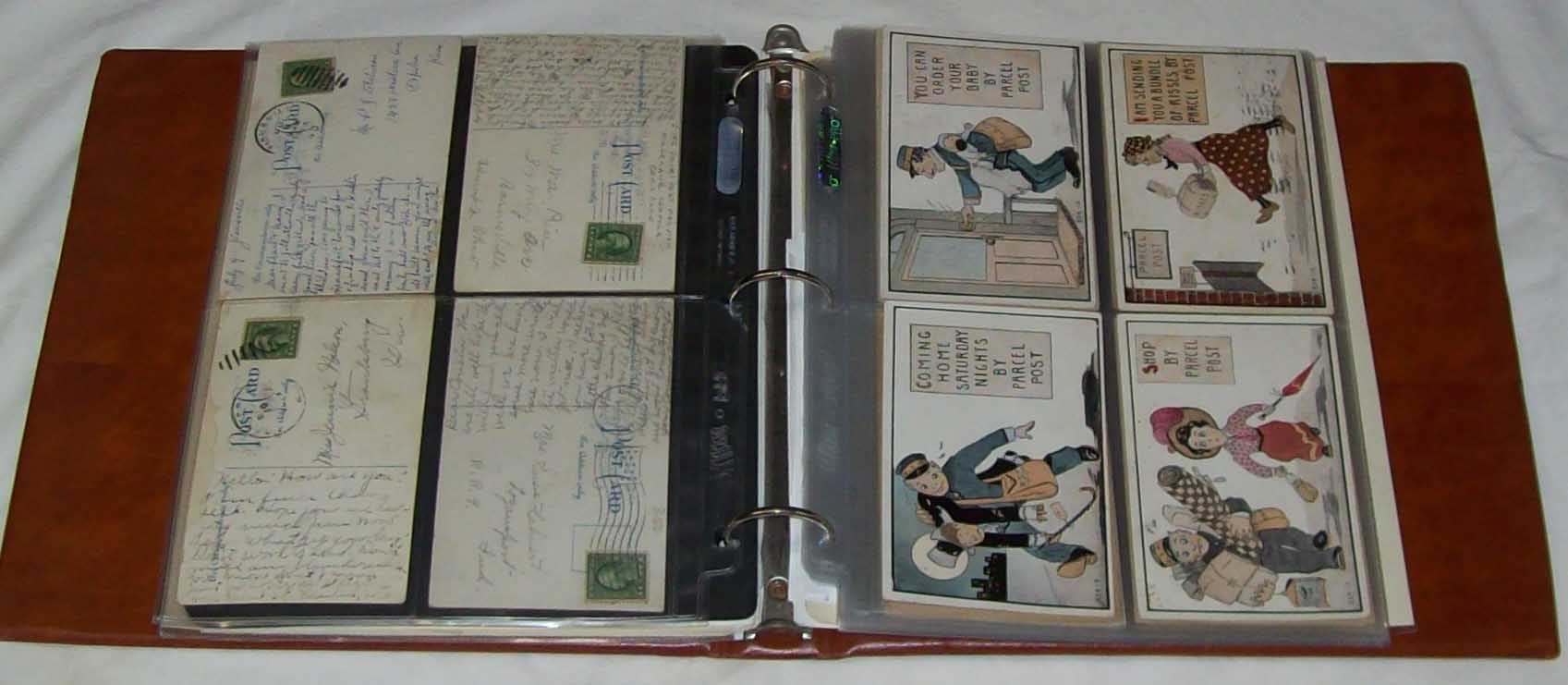 I would store them vertically and use a binder which is the correct size for the contents. |
|
Send note to Staff
|
|
|
Valued Member
United States
22 Posts |
|
|
Pillar Of The Community
6364 Posts |
|
|
Nothing very great to add, but the binder is a very inexpensive generic 3-ring binder - in this case used to accumulate items on a specific topic in a mix of stock, vario, and postcard pages with interspersed pages of notes. I usually prefer the D-ring style binders. The 4-pocket pages were the primary point of my image.
I do have a sheet of thin corrugated (from a Priority mail box) at the front and back to shield the binder contents from the vinyl of the binder and provide some additional stability. Cut to 9"x11" if I recall. |
|
Send note to Staff
|
|
|
Pillar Of The Community
1366 Posts |
|
|
Nice collection of cards you have there.
Binders with those enormously talll rectangular rings are pretty much designed to hold stacks of invoices more than collectibles. They make it very hard to turn the pages which have to be literally lifted up and over the top of the rings, a not very pleasant experience you do over and over again. I know some binders like this are sold for stamp collectors, including this one by Lighthouse, but I've found them really unpleasant to use except for basic storage of material I don't look at much. Better are rings with a straight edge on one side, called "D rings" or use round ring binders which work nearly as well, making the pages easier to turn.
I always use more binders rather than less since putting so many pagers into one binder makes it really heavy. I prefer to be able to actually lift each binder with one hand, rather than weight-lifting it every time I pick it up. My preferences may not be yours, of course. I had one of these LH binders which the giant rectangular rings for awhile, but I got so tired of its enormous weight and the huge rings that made turning pages so slow, that I just threw it away. Take that, Lighthouse!
I imagine some better method of "clamping" the pages together would prevent the curling of the cards. Or maybe it's the pages which bend a little. I use Vario stock pages which don't seem to curve like that. My preferred method is to use 3-pocket pages and put one card or cover in each pocket, so using both sides I get six per page. They do cover each other up a little, but I stagger them from side to side enough that this doesn't seem to be a problem. The pages are heavy enough and stiff enough to hold everything flat. I only put maybe a dozen pages into each binder, so no binder is very heavy. I find it's more fun to look at things in smaller, more manageable binders than in giant, heavy binders. |
|
Send note to Staff
|
| Edited by DrewM - 12/08/2020 03:26 am |
|
| |
Replies: 7 / Views: 1,359 |
|



 Posted 12/06/2020 01:35 am


