Stamp Community Family of Web Sites
Thousands of stamps, consistently graded, competitively priced and hundreds of in-depth blog posts to read


Stamp Community Forum
 
Username:
Password:
Save Password
Forgot your Password?

This page may contain links that result in small commissions to keep this free site up and running.

Welcome Guest! Registering and/or logging in will remove the anchor (bottom) ads. It's Free!

Fake Or Forgery In My Collection?

Previous Page
 
To participate in the forum you must log in or register.
Author Previous TopicReplies: 25 / Views: 2,457Next Topic
Page: of 2
Bedrock Of The Community
12555 Posts
Posted 12/27/2020   8:02 pm  Show Profile Bookmark this reply Add rogdcam to your friends list  Get a Link to this Reply
Philately seems a bit confused.
Send note to Staff  Go to Top of Page
Bedrock Of The Community
12555 Posts
Posted 12/27/2020   8:08 pm  Show Profile Bookmark this reply Add rogdcam to your friends list  Get a Link to this Reply
Forgery: A fraudulent copy of a genuine stamp, overprint or postmark - usually done to deceive collectors

Forgery: A completely fraudulent reproduction of a postage stamp. There are two general types of forgeries: those intended to defraud the postal authorities (see also Counterfeit), and those intended to defraud the collectors (see also Bogus).

Bogus: A fictitious stamp like label created for sale to collectors. Bogus issues include labels for nonexistent countries, nonexistent values appended to regularly issued sets and issues for nations or similar entities without postal systems

Fake: A stamp, cover or cancel that has been altered or concocted to appeal to a collector. In a broad sense, fakes include repairs, reperforations and regummed stamps, as well as painted-in cancels, bogus cancels or counterfeit markings. Sometimes entire covers are faked.

Forgery is the word used to refer to those stamps that are produced to defraud collectors (or accurately known to be forgeries) and the government issuing these stamps (accurately branded as counterfeits)

Fakes is a word used to designate alterations of certain genuine stamps to make it look real. These are those cancels, added perforations, clipped perforations, alterations in the stamp designs and overprints.
Send note to Staff  Go to Top of Page
Bedrock Of The Community
United States
10605 Posts
Posted 12/27/2020   8:38 pm  Show Profile Bookmark this reply Add revcollector to your friends list  Get a Link to this Reply
It all depends on where (which country, which philatelic site) the info is coming from. My experience for 60+ years is that forgeries are to defraud collectors, and counterfeits are to defraud governments. "Fake" is used to describe alterations, from added cancels to added or removed perfs, to changes in designs by addition or subtraction. Reprints are made from original plates, and reproductions are made from new plates.
Send note to Staff  Go to Top of Page
Bedrock Of The Community
12555 Posts
Posted 12/27/2020   9:22 pm  Show Profile Bookmark this reply Add rogdcam to your friends list  Get a Link to this Reply
"It all depends" makes my point that there is really no standard definition which is universally accepted. My examples above come from Linn's, the Philatelic Foundation and the APS. There are many others that contradict and cross over each other. potato-potato
Send note to Staff  Go to Top of Page
Bedrock Of The Community
United States
10605 Posts
Posted 12/27/2020   9:39 pm  Show Profile Bookmark this reply Add revcollector to your friends list  Get a Link to this Reply
That is hardly surprising given the wide variance in the levels of philatelic interest among collectors, and the differences in what type of collector each of those organizations is trying to reach.
Send note to Staff  Go to Top of Page
Moderator
1589 Posts
Posted 12/28/2020   05:10 am  Show Profile Bookmark this reply Add blcjr to your friends list  Get a Link to this Reply
Slightly tangential, but related: is a backdated "favor cancel" a fake or a forgery? It is made with a genuine device by a postal employee, so it doesn't seem to be a forgery. And I am not sure it is correct to call it a "fake" either since it was made with a genuine device, though there may be no other or better way to describe it. If there is, I would like to hear it. Intent to deceive or defraud is surely part of the equation. While often intended to create something to deceive or defraud others, a lot of backdated philatelic covers simply stayed in the possession of the person who requested the "favor cancel" at least during their lifetime. In the world of philatelic contrivances, the terminology gets even more confused.

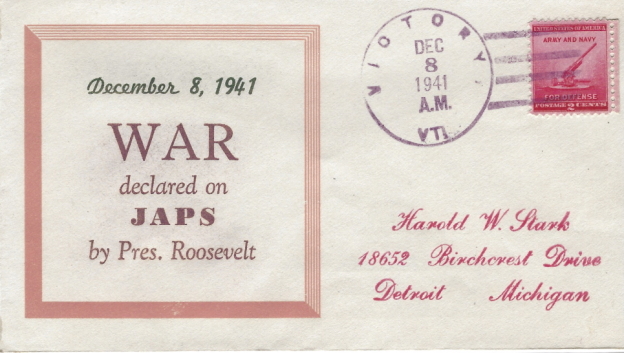
Here's a concrete example, from the world of WWII patriotic covers:
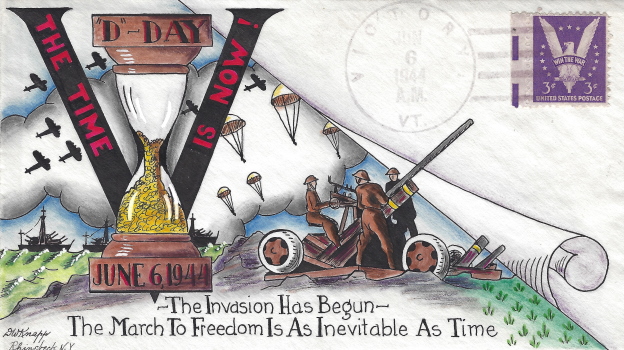

Both of these are backdated, the first by a few weeks, and the second by several years. The second was created with a clear intent to deceive, and thus defraud. Knapp was not seeking to deceive anyone, nor defraud them (she sold her covers for $2.50!), but was simply creating a piece of art in which a backdated cancel was a part. I just find it hard to call either one of these a "fake" or "forgery." I would call the second (a Linto cover) a fraud or hoax, while the first one is simply a favor cancel not unlike modern FDCs in which the first day of issue cancel is usually never cancelled on the first day, or even in the city designated in the postmark.

In the world of philatelic creations (or contrivances, as some prefer to call them) the terminology gets even more fuzzy, as they are fake, but real.
Send note to Staff  Go to Top of Page
Edited by blcjr - 12/28/2020 05:12 am
Bedrock Of The Community
United States
10605 Posts
Posted 12/28/2020   08:43 am  Show Profile Bookmark this reply Add revcollector to your friends list  Get a Link to this Reply
They are not specifically fakes or forgeries. They are event covers, which are all philatelic creations to begin with. It just happens that one is very popular and worth real money and the other is not. Lets face it, How many FDC's are actually cancelled on that day? There is no way to know unless they were simply used by the public that day. There is no way to prove when those Artcraft covers were actually cancelled.
BTW, $2.50 in 1944 was not so cheap.
If you want to compare the value of a $2.50 Commodity in 1944 there are four choices. In 2019 the relative:
real price of that commodity is $36.30
real value in consumption of that commodity is $72.30
labor value of that commodity is $70.70 (using the unskilled wage) or $77.10 (using production worker compensation)
income value of that commodity is $101.00
economic share of that commodity is $239.00
Send note to Staff  Go to Top of Page
Pillar Of The Community
United States
1565 Posts
Posted 12/28/2020   10:54 am  Show Profile Bookmark this reply Add Climber Steve to your friends list  Get a Link to this Reply
This year, there has been a lengthy discussion on the other SCF message board regarding the Victory cancellations.
Send note to Staff  Go to Top of Page
Moderator
1589 Posts
Posted 12/29/2020   08:47 am  Show Profile Bookmark this reply Add blcjr to your friends list  Get a Link to this Reply
revcollector,

You wrote: "They are not specifically fakes or forgeries. They are event covers, which are all philatelic creations to begin with.

I understand what you are saying, and while they are widely recognized as philatelic creations (some use the term "contrivances") I don't think your view that they are not "fakes or forgeries" is widely shared. In Lawrence Sherman's 1999 edition of his catalog of WWII patriotic covers, he dedicates a section on Victory, VT, headed "Weeds in the Victory Garden" in which he uses the terms "fakers," "fakery" and "fakes." Naval ship covers are philatelic creations as well, and the Universal Ship Cancellation Society dedicated a series on "Naval Covers Fakes, Forgeries and Frauds" (https://www.uscs.org/cover-collecti...-and-frauds/).

I think the matter goes to what is considered normative with respect to the creation of various philatelic covers, and that it is well known that those norms can be violated. The key is whether there is an intent to defraud. My problem is finding the right way to express this when talking about philatelic covers. Strictly speaking, a backdated cover is neither a fake or forgery (if struck with a genuine handstamp) but it can be intended to defraud. I would label such covers as philatelic hoaxes.

I apologize if anyone thinks I'm hijacking the thread. I realize that the original topic was stamps (and what is said about them could apply to postal history via stamps on cover), and not philatelic creations. I was just wondering if there any thoughts about how these terms would apply in that context. There are "fakes" and "forgeries" in every aspect of "stamp collecting." It is just that applying the terminology to event covers or philatelic creations raises some questions for me.

So, revcollector, thanks for the thoughts. And the stats on what $2.50 was worth in 1944 were informative.

Basil
Send note to Staff  Go to Top of Page
Pillar Of The Community
United States
2830 Posts
Posted 01/01/2021   3:32 pm  Show Profile Bookmark this reply Add shermae to your friends list  Get a Link to this Reply
Thanks very much for the help in trying to understand cinderella vs. fantasy. I think it will take some practice...
Send note to Staff  Go to Top of Page
Page: of 2 Previous TopicReplies: 25 / Views: 2,457Next Topic  
Previous Page
 
To participate in the forum you must log in or register.

Go to Top of Page

Disclaimer: While a tremendous amount of effort goes into ensuring the accuracy of the information contained in this site, Stamp Community assumes no liability for errors. Copyright 2005 - 2026 Stamp Community Family - All rights reserved worldwide. Use of any images or content on this website without prior written permission of Stamp Community or the original lender is strictly prohibited.
Privacy Policy / Terms of Use    Advertise Here
Stamp Community Forum © 2007 - 2026 Stamp Community Forums
It took 0.2 seconds to lick this stamp. Powered By: Snitz Forums 2000 Version 3.4.05