| Author |
 Replies: 35 / Views: 3,922 Replies: 35 / Views: 3,922 |
|
Pillar Of The Community

United States
1838 Posts |
|
|
|
In a collection I recently purchased there is a stamp identified as a 63b - dark blue. It was a dealer stock and in general the identifications have been solid.
It's dark, but I often see wide variations in the 1861 1c so I don't know. Is there any good way to identify one if I don't have a certified copy to hand? Is it only a color difference or are there any other clues? I haven't posted an image because I doubt that be very revealing as scan colors vary etc. But I will if there is a good reason for it. Thanks in advance.
|
|
Send note to Staff
|
|
|
|
|
Pillar Of The Community
United States
1360 Posts |
|
|
Hi,
A couple years ago, if you look back in the archives, there were some posts on the 1c 1861, and some of Rich Drews' material was posted showing all of the different varieties of 63, along with 63a and 63b.
Either way, probably should submit this one for a cert.....
Thanks, Ray |
Send note to Staff 
|
|
|
Pillar Of The Community
United States
2555 Posts |
|
|
 always... no shortcuts allowed :) You really should have some sort of reference for color varieties. |
|
Send note to Staff
|
|
|
Pillar Of The Community
United States
1838 Posts |
|
|
This particular stamp is a Fine centered used stamp with a small thin. If it was XF or fault free I'd certainly send it in for a cert. Will have to think about whether it is worth it in this case. I'll see if I can find some material in the archive. Here's a scan, because if Sinclair asks, I obey. The one on the left is the stamp in question. The other is there for contrast. 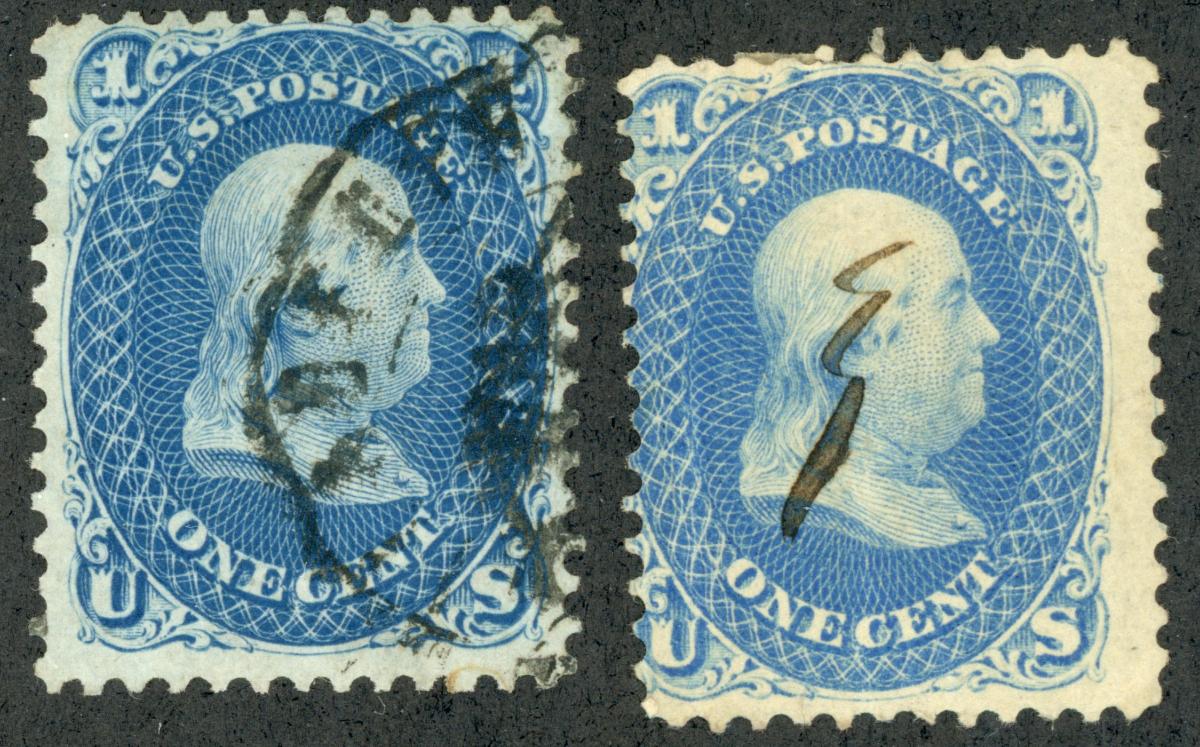 |
|
Send note to Staff
|
|
|
Bedrock Of The Community
12772 Posts |
|
|
Rlsny - Your stamp is far too bright. The 63b is a darkish blue about which an argument was made at one time to change to Indigo when describing. 63b looks like the Premier Gravure issues: 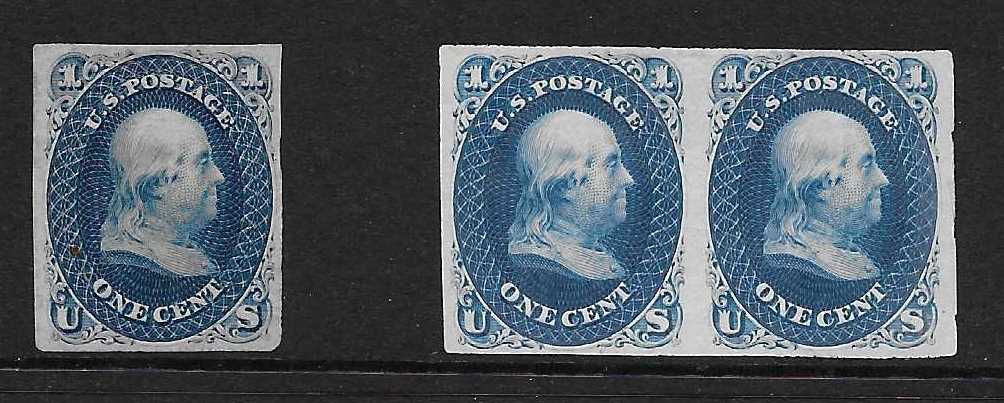 |
|
Send note to Staff
|
| Edited by rogdcam - 01/03/2021 7:05 pm |
|
|
Pillar Of The Community
United States
1838 Posts |
|
|
Pillar Of The Community
United States
2555 Posts |
|
|
Yeah, I don't think it would pass the test but even my scans look a little on the bright side. Here is an image that I have posted before. The 63b is in the lower right. 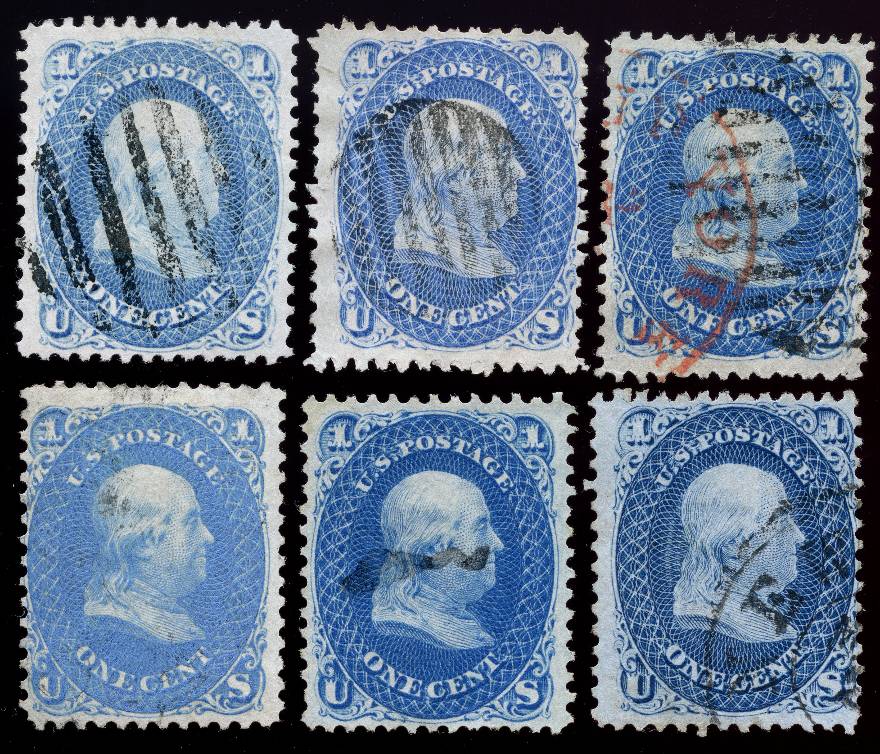 |
|
Send note to Staff
|
|
|
Pillar Of The Community
United States
1838 Posts |
|
|
And there is the problem with computer images. Well, maybe I'll keep it aside for awhile before giving it away in a bargain basket. |
|
Send note to Staff
|
|
|
Pillar Of The Community
1367 Posts |
|
|
In identifying shades and color differences, seeing a stamp alone can be unclear. What's "Indian red" is hard to know for sure, and what's "dark" blue to one person is not so dark to another. But seen next to contrasting shades of stamps, color differences stand out much better.
To help do this, I copy and paste images of U.S. (and some other country's) stamps for my own reference. I list the key catalogue numbers and paste a good stamp image below each one. I realize computer monitors change color shades somewhat, but if all are seen on the same computer monitor, it still makes the differences pretty clear. Images can also easily be enlarged, so with particularly clear images I get a better view of key details than even the catalogue can provide. The future of stamp catalogues, I'd guess. |
|
Send note to Staff
|
| Edited by DrewM - 01/04/2021 03:17 am |
|
|
Pillar Of The Community
United States
1838 Posts |
|
|
Taking the stamp out and holding it near the screen it is clear that the actual stamp is significantly darker than it appears on my screen. So that leaves the question pretty much where I started. I think Sinclair's comment about really needed a reference is the winner here. In other words, I think the only way I'll be sure is if I get it certed. I'm sure it would sell much better with a cert anyway. Probably the only real answer here. Thanks all for your comments. |
|
Send note to Staff
|
|
|
Bedrock Of The Community
12772 Posts |
|
|
Moderator

United States
12330 Posts |
|
|
Taste is another totally subjective perception like color vision. If you got 25 people to taste the same pot of chili, what would the chances be that all 25 described the taste the same way?
But put that aside...say you send the stamp to 25 people so they had it in hand, what are the chances of the ambient lighting being the same for all 25 people? Color is reflected light waves bouncing off the surface of an object. So the stamp will appear one color in direct natural sunlight and another in indirect daylight, a different color in fluorescent light, different again in LED light, different in incandescent lighting, and different again under the glow of a 1800s gas light.
And we have not yet begun to discuss how how the digital images are generated and then finally how the digit image is being displayed on different devices.
In my opinion a person would have to build a great reference collection, spend years developing their color eye and experience, and spent time understanding and controlling their ambient lighting environment before they could accurately use color to ID many of these subtle color variations. Or you can send it to someone who has done this and pay them for their opinion.
Don |
|
Send note to Staff
|
|
|
Pillar Of The Community
United States
1838 Posts |
|
|
Quote:
I think that you really want it to be a 63b. Of course, but I have serious doubts that it is, thus why I asked in the first place. I give about a 35% chance of certing 63b. Enough that I won't throw in the towel quite yet. |
|
Send note to Staff
|
|
|
Bedrock Of The Community
12772 Posts |
|
|
I look forward to seeing the cert result and hope that it is as well. Best of luck! |
|
Send note to Staff
|
|
|
Pillar Of The Community
United States
2555 Posts |
|
|
Don, if those 25 people had good reference collections or even the same reference collection in front of them at the same time, lighting would become far less important. The 63b color is not really all that difficult to identify. The difficult part is deciding when the color you are looking is no longer dark blue but something close. That is a somewhat arbitrary point and is heavily subject to opinion. |
|
Send note to Staff
|
|
|
Moderator
United States
12330 Posts |
|
|
Quote:
… if those 25 people had good reference collections or even the same reference collection in front of them at the same time, lighting would become far less important… There are several things at work here. If the point is about being able to detect deltas between the hues in a reference collection, then I agree that that lighting is less important. I think that there could be a general consensus in saying, 'this stamp and this stamp are different'. But if the exercise is about detecting the actual hue/color of a stamp, then lighting is critical. I won't republish here the science of how we perceive colors and how wavelengths of light are reflected; but anyone who is interested in colors can research it themselves. Here is a good place to start https://www.xrite.com/blog/color-perception-part-1In this article the first paragraph says Quote:
When it comes to the way we see color, our eyes can be deceived. This is partially caused by our humble brain, which is managing vast amount of information and processing it the best it can. It can also be related to genetics and the environment; we all see color a little differently. But above all, LIGHT has biggest impact on the colors we see. Don |
|
Send note to Staff
|
|
|
Replies: 35 / Views: 3,922 |
|




 Posted 01/03/2021 3:23 pm


