|
This page may contain links that result in small commissions to keep this free site up and running.

Welcome Guest! Registering and/or logging in will remove the anchor (bottom) ads. It's Free!
To participate in the forum you must log in or register.
| Author |
 Replies: 49 / Views: 4,016 Replies: 49 / Views: 4,016 |
|
|
|
Pillar Of The Community

United States
853 Posts |
|
|
Thank you, Rogdcam, for posting this. Clearly of interest to a number of us as it presents at least two issues to ponder. On the matter of a change in grade over 10 years: I have to assume that this is not a case of an evolving numerical standard. The alternative scenario is pretty bogus. You'd think there would be a standard set and that is that. Unless the standard is established with reference to a population census, and is a statement on the order of "this stamp is better centered than 90% of the known and measured population as of date x." This sort of formulation would allow for cases when sufficient new examples come to light which shift the population enough so that the %age could change. I would be very curious if this were the case. However, all the above posited, there is such as thing as observational error in measurement. So presuming a set numerical standard for grading 90 or 95, there is a certain error between measurement 1 and measurement 2. Even if these measurements were made on the same day, there are observational errors that result in measurements falling above and below "the truth." In this case, the second measurement falls within the standard for a grade 95, whereas the first measurement fell within the range for a grade 90. I consider this a plausible hypothesis, which would be unrelated to the removal of the selvedge. I would like for this to be true, but I sure would like to see the PF explain it. With $1000s riding on these gradings, perhaps a degree o' confidence is warranted. Removal of selvage: I have to say, I rather like selvedge and actually enjoy seeing the orderly layout of my album pages disrupted by imprints, plate numbers, and bits of un-imprinted selvage. For one thing, as mentioned earlier, they can aid in identification ... for example, giving more real estate for viewing watermarks on Washington/Franklins! They also speak to the process of production which I enjoy seeing visually documented, but that is me. Sure, for some stamps the selvedge is not a palpable loss to philately, much less world culture, if removed, and I have removed selvedge from some run-of-the-mill US issues of the 1970s and 80s, I readily admit. But once removed it is gone, so one ought to think hard about future generations of scholars and collectors and be clear about what one is doing for all time. Since we like pictures, here is a plate number on selvedge of a 263 -- no way I'm touching that. 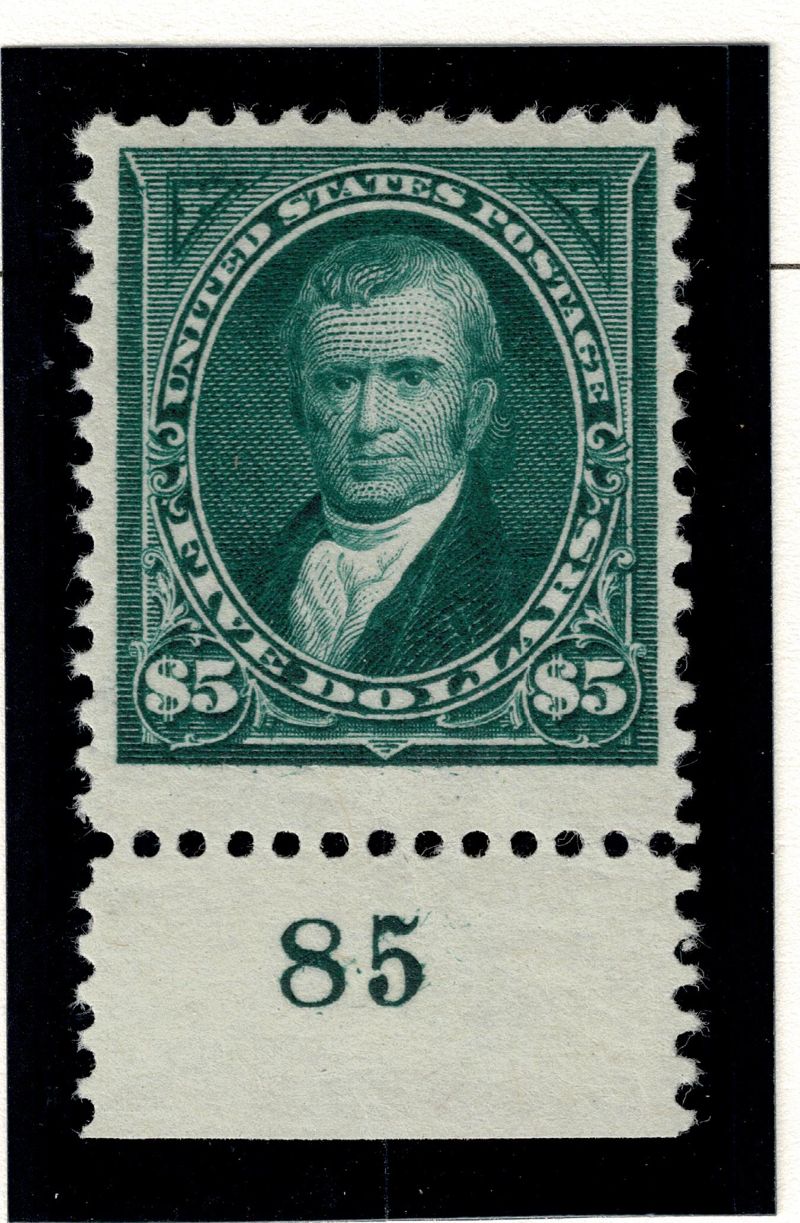 |
Send note to Staff 
|
| Edited by jleb1979 - 02/02/2021 4:23 pm |
|
|
Moderator

United States
12330 Posts |
|
|
I think it is possible to develop a well defined grading criteria and then have humans to follow it. I do agree that this would leave the door slightly open for subjectivity but to a large degree this could be dealt with. Many sports do this (diving, gymnastics, figure skating), many other hobbies do this (i.e. car show judging). But the criteria needs to be public and sent back to the owner with each grading cert. My opinion is that transparency is paramount if the grading industry want to survive.
If I send in a stamp and it comes back with the filled out check list of the criteria; I may disagree with a few of the things but ultimately I feel like I paid for the learning experience. I feel good that someone spent time on my stamp, I can see what I need to look for in the future with that service. Even if I disagree with the judgement I feel I got my money's worth.
I do not buy graded stamp (occasionally by chance in a larger lot) so I guess my opinion is not really important, but that is how I feel.
Don
|
|
Send note to Staff
|
|
|
Pillar Of The Community
United States
1873 Posts |
|
|
No, I am saying that machines are capable of the task if given the data ... that it is not a question of whether the calculating algorithms work, or work fast enough, it is just a matter of assembling the training data. The reference to your 60 years of data was rhetorical, to make the point that if a machine learning classifier was trained on the data you have seen, it would produce equivalent output given a patient. Large scale systems never rely on you or any other single person for data. If 500 philatelists worldwide each enter images and labels for 20 banknote examples in a shared database, then we have a training set to start with. That sort of crowdsourcing (sometimes for hire) is widely used in data science when training data is the problem. The bottom line is that there is nothing algorithmically or computationally different or difficult about stamp grading in terms of AI. This is why data is the new currency. |
|
Send note to Staff
|
|
|
Bedrock Of The Community
United States
10864 Posts |
|
|
I would have to see it to believe it. The centering is easy, but I don't think they could determine all the possible problems or be accurate about which # a stamp is often enough. Twentieth century stamps would be easy (w/f would be simple, assuming they had a way to check watermarks safely), but the nineteenth century..... |
|
Send note to Staff
|
|
|
Bedrock Of The Community
12766 Posts |
|
|
Bedrock Of The Community
United States
10864 Posts |
|
|
Basic recognition is not the problem. It's the lack of judgement; the ability to make decisions based on informed reason. Computers are yes or no, black or white machines. Expertising is frequently not a black or white, yes or no kind of event. I have seen dozens of part perf revenues that could go either way; a computer would simply pick one decision or the other based on it's programming. That decision could easily be wrong. And what about a "no opinion"? Will that happen when the numbers for or against an item are tied? |
|
Send note to Staff
|
|
|
Bedrock Of The Community
12766 Posts |
|
|
It would seem that how balanced the stamp margins are would be the easy part by far. There would need to be set parameters that trigger tie-breaking decisions in the case of a measurement or set of measurements falling on "the line". The real problems are defining the more subjective qualities such as impression, color and gum which are also a part of the grading point system. What constitutes the perfect impression? How was the color judged? Is the gum just a bit toned or a tiny bit dried out in one minimal section? Is there a bent perf tip? If there are no perforations are the margins even or wavy? How would a machine deal with the different plate states of the 1847 issues? Is a stamp just a tad oxidized?
And then the big one in my mind is the "C" word. Cancels. Cancels are factored into a grade and I am baffled as to how those points are determined. Too heavy or poorly placed from an aesthetic POV? I would love to see how a machine learns that.
I am in awe of the conversation taking place in this thread. Great stuff and way above my paygrade when it comes to technology. My microwave still challenges me. But I am intrigued and very open to a machine sitting in judgement. When a whole lot of money rides on a grading number I like the idea of vast cumulative knowledge being brought to bear on an analytical outcome that is as standardized as possible. Unless of course the outcome is disappointing!
|
|
Send note to Staff
|
|
|
Pillar Of The Community
United States
1873 Posts |
|
|
Quote:
the ability to make decisions based on informed reason This is, in fact, exactly what an ML classifier does when trained on a large enough training dataset. Quote:
There would need to be set parameters that trigger tie-breaking decisions in the case of a measurement or set of measurements falling on "the line". You're in luck...in data science this is termed threshold optimization and is the subject of active algorithmic research. It's one of the top areas of study right now. Your point on cancels is well taken and given their infinite variety it could be intractable. But if Apple face recognition knows me regardless of what reading glasses I wear, which it does, after having trained the rec algorithm without wearing any, then maybe it is solvable. Everything else you mention I believe is trainable. |
|
Send note to Staff
|
|
|
Pillar Of The Community
United States
1162 Posts |
|
|
I have bought many a stamp FOR the heavy-ish cancel on it. Paid extra as a matter of fact, because they are aesthetically pleasing. Of course, there are millions of heavily cancelled stamps that I have NOT bought because they were aesthetically UNpleasing. Heavy on one = good. Heavy on another = bad. AND I would bet others would disagree with my assessments. Lots of gray there - and I am not talking about the cancels. If an algorithm were used ONLY for evaluating centering, then I could see that being do-able, today. Spit out a number (to 3 decimal places, if that's what people want) and THEN the philatelist gets involved: Is it faulty? Is it hard, white paper (or any other identifying type of paper)? To me, the 'flick test' is best. Is it a regum, or a reperf? Remember, there are lots of regums and reperfs that have fooled the experts for years - there are all kinds of threads on SCF with examples of such. Is the cancel a 'net-positive', a 'net-negative', or an absolute 'killer'?? The list goes on and on. I suppose someday there may be an Acme Stamp Evaluator Machine (ASEM) that will grade, watermark, UV examine, and do 6 or 8 other processes, and then spit out a proper cert. And The Acme Company may sell a half a dozen of them. My point is: it will be a long time before we will have 'auto-certs' that encompass all aspects of grading/evaluating all the stamps that people want graded/evaluated. In the meantime, I imagine we will have stamps that are (supposedly) on the cusp of a grade, and they may get different grades between submissions. To me, that shows a human is still involved. As an aside, in the case of the stamp that started the thread, I hope the difference in grading is due to some factor OTHER than 'grading creep' - that would be the death knell of graded stamps. On second thought, maybe I SHOULD hope it is 'grading creep'. Quote:
But if Apple face recognition knows me regardless of what reading glasses I wear, which it does, after having trained the rec algorithm without wearing any, then maybe it is solvable. Yes, but can it tell us if you are handsome or not? |
|
Send note to Staff
|
| Edited by mootermutt987 - 02/02/2021 9:10 pm |
|
|
Bedrock Of The Community
12766 Posts |
|
|
The following excerpt from "The Philatelic Foundation Grading Policies and Procedures": Cancellations
One of the main criteria used in determining the grade of a used stamp is how the cancellation affects its overall appearance. The lighter the cancel and the more unobtrusively it falls on the stamp, the more desirable the stamp will be to most collectors. Figure 8 shows a stamp with what would be regarded as a light cancel. Figure 9 shows a stamp with a heavy cancellation that significantly diminishes the visual appeal of the stamp. This stamp would have its grade reduced. Should a stamp bear a fancy cancel (see Figure 10) its grade would not be reduced even though it covers most of the stamp. Furthermore, stamps with fancy cancellations would be considered for an "XQ" "Exceptional Quality" designation. A stamp with a pen cancellation will be graded if the Scott Specialized Catalogue of United States Stamps and Coverslists a separate value for the stamp. However, if there is no catalogue value for the stamp with a pen cancellation, it will not be graded. Fig. 8–A stamp with a light cancel.
http://philatelicfoundation.org/wp-...-booklet.pdf |
|
Send note to Staff
|
|
|
Bedrock Of The Community
United States
10864 Posts |
|
|
To me, grading is a con game perpetrated on a handful of wealthy collectors who don't seem to mind. I wouldn't care at all if it wasn't for the fact of the destruction of so many scarce to rare to unique multiples. So if people want to spend their time programming computers to tell collectors what a nice stamp looks like, that's OK by me. However I suspect that most collectors won't care in the least; they already know what they like, and approximately how much they are willing to spend on what they like.
The re-grading of the item that started this thread is a very rare occurrence that is really only significant for the owner when next the item gets sold. It makes for an interesting discussion, but for most of us it has no real significance. |
|
Send note to Staff
|
|
|
Bedrock Of The Community
12766 Posts |
|
|
Judging by the sheer volume of graded stamps selling at Siegel and other venues it very much has significance. To each their own however.
Just how rare is the occurrence of grades changing Rev? |
|
Send note to Staff
|
|
|
Bedrock Of The Community
United States
10864 Posts |
|
|
This is the first time I have ever seen a grade change after such a long period of time. I have seen occasional grades change when a submitter asks for a second opinion right away, but only very rarely. I have sometimes seen different grades given by different organizations for the same item.
The quantity of graded stamp auctions only proves that they are often not as scarce as the sellers like to pretend. And it is still a relatively limited market; how many collectors are realistically going to spend hundreds or even thousands of dollars on stamps that often catalog $50 or less, frequently much less. |
|
Send note to Staff
|
|
|
Valued Member
United States
9 Posts |
|
|
I agree with cjpalermo1964. This is totally doable...there just isn't enough profit in creating a system to do it.
"Programming" AI doesn't require programming a computer to know or distinguish between all those issues mentioned. That isn't the way AI is done anymore. You are thinking about old IA, like the Deep Blue chess program that beat Kasparov, where you programmed in all the rules and logic.
In modern AI, you make a builder bot that produces algorithms and a tester bot that tests algorithms. At first, the algorithms are garbage producing random results. The worst are deleted and the builder bot copies and alters the best ones (which still stink). The tester bot tests again, and on it goes. Over millions and billions of iterations, the algorithms "evolve" to be better and better at whatever task they were tested against. Programmers of modern AI have no idea what is in the evolved code that allows the AI to actually complete the task. The AI creates that itself. See CGP Grey's video on How Machines Learn on youtube for a better and more entertaining explanation.
As long as you could provide the AI verified data, it would learn. So, the limit is more on the quality of data and not on the AI. For instance, a simple photo of the front and back of a stamp wouldn't show the thickness of the paper, so expecting the AI to analyze the thickness of paper would not be reasonable. Again, it is just a matter of not being profitable enough to create a system to do it.
So the next time you have to prove you are a human to a Google captcha by clicking on pictures with crosswalks, traffic lights, buses, etc., just remember you are helping to validate test material for the tester bot of Google's self-driving AI database. |
|
Send note to Staff
|
|
|
Pillar Of The Community
United Kingdom
895 Posts |
|
|
I don't know much about grading, but is it the case that when a stamp-and-selvedge is graded, the whole item is graded, not just the stamp part?
If so, it follows that a minor blemish with the selvedge would lower the grade for the whole piece. However, removing it leaves the stamp alone, in a sense a different item without the blemish, and therefore better graded. |
|
Send note to Staff
|
|
|
Replies: 49 / Views: 4,016 |
|
|
To participate in the forum you must log in or register. | |
 Transvaal Postal History Help Earliest Stamp With In-Design Date? My First Stamps Help Newbie.help With Stamp Identification (J29) Inherited These Stamps, Are They Genuine? APS Membership Discount Metropex Stamp Show: Roseville, Minnesota October 23-24 Weird Covers, 1885,1886, And 1982 For Users Of Two-Post Blue International Albums What Is Your Experience With Binders. New Member Posting Image Of Avatar, Front And Back Of U2 Cut Square, Market Value Or References? Working On An Offline Collection George Washington 3 Cent 1861 With Print On The Back Hello From The Netherlands - New Member Then And Now, From Old Postcards New Member Wanting To Add An Avatar Sparks Auction Fees? 163 VF Nyfm Vertically Ribbed 163 XF Quartered Cork, Labeled Jumbo 136 VF Quadruple Split H Grill Nashville Philatelic Society-Your Invitation To Our Auction Night Meeting Monday, October 26, 2026 Nashville Philatelic Society-Your Invitation To Our Meeting Monday, October 19, 2026 Christmas Around The World 2026 C.e. In The Large Queen Cancel A More Condensed Album Page Experiment. US Scott #3 Postmarked Or Fake? Transvaal Postal History Help Earliest Stamp With In-Design Date? My First Stamps Help Newbie.help With Stamp Identification (J29) Inherited These Stamps, Are They Genuine? APS Membership Discount Metropex Stamp Show: Roseville, Minnesota October 23-24 Weird Covers, 1885,1886, And 1982 For Users Of Two-Post Blue International Albums What Is Your Experience With Binders. New Member Posting Image Of Avatar, Front And Back Of U2 Cut Square, Market Value Or References? Working On An Offline Collection George Washington 3 Cent 1861 With Print On The Back Hello From The Netherlands - New Member Then And Now, From Old Postcards New Member Wanting To Add An Avatar Sparks Auction Fees? 163 VF Nyfm Vertically Ribbed 163 XF Quartered Cork, Labeled Jumbo 136 VF Quadruple Split H Grill Nashville Philatelic Society-Your Invitation To Our Auction Night Meeting Monday, October 26, 2026 Nashville Philatelic Society-Your Invitation To Our Meeting Monday, October 19, 2026 Christmas Around The World 2026 C.e. In The Large Queen Cancel A More Condensed Album Page Experiment. US Scott #3 Postmarked Or Fake?
Disclaimer: While a tremendous amount of effort goes into ensuring the accuracy of the information contained in this site, Stamp Community assumes no liability for errors. Copyright 2005 - 2026 Stamp Community Family - All rights reserved worldwide. Use of any images or content on this website without prior written permission of Stamp Community or the original lender is strictly prohibited.
Privacy Policy / Terms of Use Advertise Here |
| Stamp Community Forum |
© 2007 - 2026 Stamp Community Forums |
| It took 0.34 seconds to lick this stamp. |
 |
|
|
|


 Posted 02/02/2021 4:14 pm


