|
This page may contain links that result in small commissions to keep this free site up and running.

Welcome Guest! Registering and/or logging in will remove the anchor (bottom) ads. It's Free!
To participate in the forum you must log in or register.
| Author |
 Replies: 920 / Views: 197,975 Replies: 920 / Views: 197,975 |
|
|
|
Pillar Of The Community
Australia
3547 Posts |
|
|
Bhopal began the government mail only era in 1908 very sedately with four values closely based on the last 1 Anna from Perkins, Bacon, overprinted SERVICE. Two types of overprint exist, and a number of errors  (SG O308d) which are listed in Gibbons, but are generally considered to be nothing but printer's waste. Take your pick: ignore them, or treat them as (relatively) affordable striking errors. They're quite easy to find, and should sell for a decent discount off catalogue. Two more very similar sets followed in 1930 and 1932. Very ho-hum stuff. Not worth reproducing. Things looked up considerably in 1935 (sorry, Jubilee: you'll have to pay attention) when some changes to postal rates led to an outbreak of surcharging. The values needed were ¼ Anna (equal to 3 Pies; 12 pies = 1 anna) and 1 Anna, so surplus ½, 2 and 4 Anna stamps were surcharged. The fun and games started with the ¼ anna/3 pies surcharges. The printers surcharged the first two rows of their sheets '¼A' and the next eight rows '3 PIES'  (SG O318b) For reasons best known to themselves, the printers used a different font for the ¼A surcharge on the 4 Anna stamp:  (SG O323a) Don't worry if your ¼ Anna surcharge looks like this. Everything is under control. You have not been robbed. There are some good spelling errors in the THREE PIES surcharges (it wouldn't be Bhopal without a spelling error): THRFE PIES  and THEEE PIES  The ONE ANNA surcharges come in various colours, including a rather bilious blue  which comes, in all colours, with an inverted first N in ANNA. If you look very closely at the block above you may make out  The ONE ANNA on 2 Annas blue also has a rather difficult (well, £2250 in Gibbons) error ANNO for ANNA. Worth looking out for. Bhopal now started to lash out a bit. Perhaps it was due to having a man on the throne at last ... In 1935, it issued the first of a series of triangulars, followed the next year by a similar stamp, with modified wording. These new stamps were done by the Bhopal Govt Printing Works, and suffered a few (uncommon) errors, like this  with the SERVICE overprint omitted. |
Send note to Staff 
|
|
|
Pillar Of The Community
Australia
2027 Posts |
|
|
NOW you've got my attention. This is going to cost me money.............. |
|
Send note to Staff
|
|
|
Pillar Of The Community
Australia
3547 Posts |
|
|
I suppose you could ignore the ANNO error as an 'a' number, Jubilee, but this one  will be harder. It's SG O322. |
|
Send note to Staff
|
|
|
Pillar Of The Community
Australia
3547 Posts |
|
|
After a short relapse to those dull Coat of Arms types again, Bhopal lashed out with a set of pictorials featuring tourist attractions, in 1936. (Now as they could only be used by Bhopal public servants, for mail sent within Bhopal State, it's fairly clear who these stamps were aimed at.) Quite attractive large, bicoloured stamps, also printed by the Bhopal Govt Printer, who suffered the occasional little difficulty with the perforating devices)  (SG O338b) Later, in 1944, some values were released in smaller formats and single colours. Probably a War economy measure. (The missing perfs weren't, though)  In between, Bhopal also released two attractive animal stamps, for the topical enthusiasts: 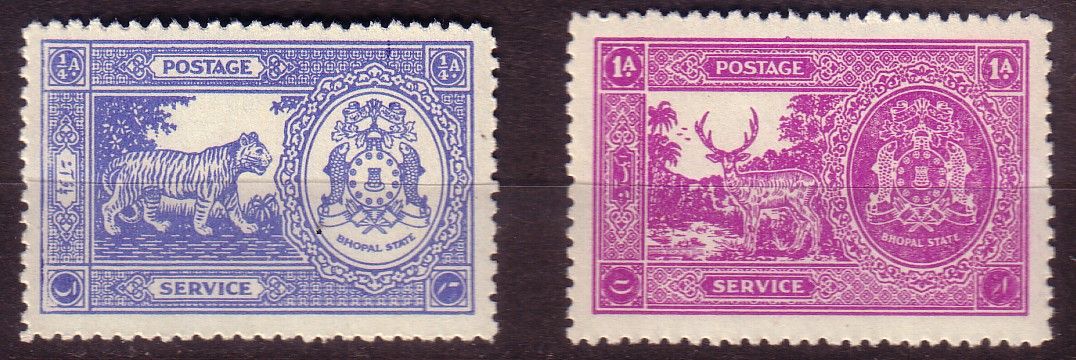 (SG 344-345) The choice of subject has always amused me: the tiger and its lunch. In 1944, Bhopal began to imitate the contemporary Indian War economy stamps, with the good old coat of arms again. I struggle, I really do, to find something nice to say about this set. It's usually badly centred and indifferently printed. Assembling a set in A1 condition would be a bit of a challenge.  I suppose some of the colours were OK. At the end of its philatelic life, Bhopal issued a couple more surcharges, both of 2 Annas. This  (SG O356) is the cheap one. Only buy this one  (SG O357) with a BPA Certificate. (In fact, BPA Certificates are the gold standard for the Indian States.) So that's Bhopal. Well worth a closer look, I think. And if you intend to give it that closer look, do try to find a copy of the India Study Circle Bhopal Handbook. It shows sheets of the old litho types, and describes the forgeries and reprints. (The old Gibbons Part 1 used to list, and price, the reprints and imitations. My 1941 version still has them. Some priced rather handsomely too: several at £1.) |
|
Send note to Staff
|
|
|
Pillar Of The Community
2664 Posts |
|
|
Pillar Of The Community
Australia
3547 Posts |
|
|
OK Spock ... Bhor  Yes, well, now we've got that out of the way, Bhor looks fairly straightforward. Only three stamps, and two of them handstamped from a single die, and in 1905 voted amongst the ugliest stamps ever issued. You just can't be indifferent to them. You'll either love them or hate them. I love them, and I don't care what anyone else says   SG 1, and  SG 2 There now! Sneer away if you like. Switch off, and come back when I reach Bijawar next. Or stay, and see a little more. These stamps are quite common used, but the used are usually CTO, like this:  Postally used, with village postmarks like this one  are hen's teeth. Then there's this strange thing  cancelled with a British Indian postmark of Poona, the nearest large town to Bhor in British India. Perhaps it came from a cover sent from Bhor to Poona. If it did, the vandal who took it off the cover destroyed an item that would have easily reached four figures in pounds at auction. This last one is odd in another way. Bhor SG 1 and 2 are usually printed on what Gibbons refers to as 'native' paper: a rather rough, locally-made paper, with bits of bark or wood often visible, and rough laid lines. This stamp seems to be on a European laid paper of quite a different quality. I've seen others on the same paper. They aren't listed by Gibbons. The last stamp of Bhor is a bit controversial. Noone seems to be quite sure when the Bhor Post Office was closed. This stamp, SG 3  appeared in 1901, but there are suggestions that the State PO was closed in the 1890s. This would then be a posthumous issue, something not entirely unknown among the Indian States. (If the crazy collectors would pay good money for bits of paper, State post offices, even officially defunct ones, were willing to meet the demand.) Whatever its status, it exists with charming vanity cancels 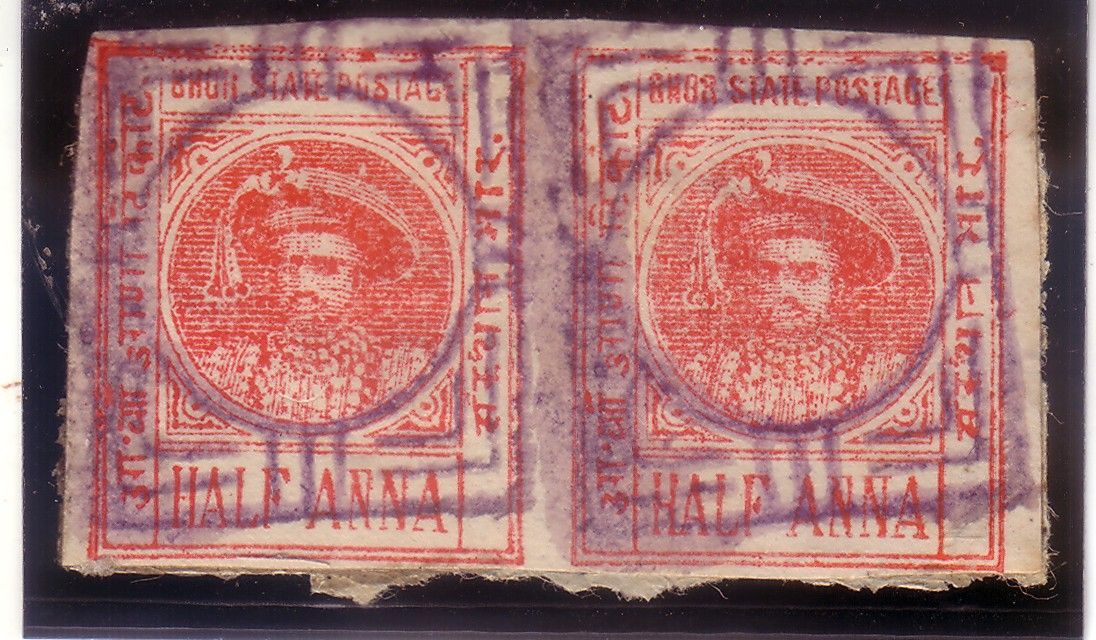 which make me hope it's all above board. |
|
Send note to Staff
|
|
|
Pillar Of The Community
2664 Posts |
|
|
ok so 3 will finsih bhor. how much for the set of 3 in mnh. and please continue. we have 500 states to cover so :) |
|
Send note to Staff
|
|
|
Pillar Of The Community
Australia
3547 Posts |
|
|
I admit frankly I have very little time for Bijawar, a small State in Central India, which first issued stamps in 1935 and stopped in 1941. This is what the stamps of Bijawar looked like  They can also be found in just about every permutation of perforation error, from completely imperf  SG 1a onwards  SG 5b In near 50 years of collecting the Indian States, I only recall seeing one cover from Bijawar - and that was blatantly philatelic. The farthest it travelled was across someone's desk. I will now draw a veil across Bijawar, and move on to another of the big bad Biggies ... |
|
Send note to Staff
|
|
|
Pillar Of The Community
Australia
3547 Posts |
|
|
Quote:
ok so 3 will finsih bhor. how much for the set of 3 in mnh. and please continue. we have 500 states to cover so :) Spock, Spock this fascination with MNH will get you nowhere with Bhor. They were all issued without gum  Of course, I could send some to Germany and have them expertly gummed for you - but you'd have to pay for the cost of the work. Gibbons rates the three at £26.50 mint, but you should be able to do better. Leave out the dubious SG 3, and SG 1 and 2 would only set you back £9.50. |
|
Send note to Staff
|
|
|
Pillar Of The Community
Australia
3547 Posts |
|
|
Bundi is one of the heavyweights of the Indian States. If you're a general collector of the Indian States, you may be able to skip lightly over, say, Bijawar, but you can't ignore Bundi. It started philatelic life in May 1994, and apparently virtually noone noticed. The ½ Anna Bundi SG 1 is valued at £14,000 mint, and a trifling £2500 used. Perhaps not unsurprisingly, I don't have a copy to show. By December 1994, when Bundi's second effort appeared, the world had begun to notice. Here is the ½ Anna SG 2 on cover:  These stamps were hand-drawn onto the litho stone, like early Bhopal. Like early Bhopal, there were some collectable mistakes, like this SG 2a, with the value above and name of the State below, the dagger in the centre:  By the time of Bundi's third stamp, two years later, the world had well and truly woken up. The ½ Anna SG 3 is not scarce:  Stamp collectors are not fools, though  In 1897, Bundi released a set of higher values, from 1 Anna to 1 Rupee (= 16 annas).  SG 4-10 which seems to have been a bit too much. They weren't popular, and are now rather uncommon. There are conflicting reports about printing numbers, but it appears the number printed of the 1 Rupee yellow on blue paper was a few hundred. (Of course, postal need for a stamp 32 times the basic letter rate wouldn't have been huge ...) These were followed by another set, of all values from ½ Anna to 1 Rupee, with the central dagger shaped differently.  SG 12-16a All still individually hand-drawn onto the litho stones, so that each stamp on the sheet can be plated. Be warned though, that the sheets tended to be large! At some point around 1900 Bundi seems to have stopped issuing stamps. Stampless covers exist from this period. |
|
Send note to Staff
|
|
|
Pillar Of The Community
Australia
3547 Posts |
|
|
The Bundi Daggers are popular, and sell well whenever good stuff is offered (which is pretty rarely). The Sacred Cows, though, are one of the great subjects of the Indian States: unrivalled for their complexity. Women faint and strong men weep at thought of them. Well, nearly, anyway. The Sacred Cows  are so called from the design. It commemorates the occasion when a mediaeval ruler of Bundi drew his sword to protect a cow (sacred to Hindus) from a (Muslim) Moghul Emperor of Northern India. The design first appeared in 1914, and by the time it was pensioned off in 1941, it had appeared in 16 face values, from ¼ Anna to 5 Rupees (= 80 annas), in nine different types in 58 different settings of the basic plate of four cliches, and also with three different Service (Official) overprints, which are to be found in black, red or green. Not every value is known in every type, from every setting, with every type of overprint, thank goodness, but the field is still wide enough. The ½ Anna stamp I showed above is found in seven of the nine types, in 17 different settings, ranging from dirt common to very, very rare. The one shown is from the dirt common Setting 3 (and, as it happens, is the very first of the Sacred Cows listed in Gibbons). Gibbons illustrates the face values and the different types. The face values are relatively easy, because they're usually uniquely associated with a colour: black for the ½ Anna and so on. The types can be more tricky, so in the interests of shedding a little light, I'll illustrate them here. The two areas to focus on are the two tablets at the top (reading Raj Bundi - Bundi State) and the bottom, which shows the value. |
|
Send note to Staff
|
|
|
Pillar Of The Community
Australia
3547 Posts |
|
|
Type A has the dot and semicircle over the second word in the top tablet:  Only one other type has the semicircle, and in that type, there is no separation between the words. They appear as one word only, and in more spidery type. As the other type is also fairly unusual, if you see the dot and semicircle (representing the letter 'N', by the way), like this, it's probably Type A. Types B and C will cause the most confusion. Here, you need to focus on the little worm-like thing below the first letter of the second word. (It represents the letter 'U'.)  If it's small and without an 'eye', and it's firmly attached to the vertical line above it, it's a Type B. Type C is similar to Type B  but the 'worm' is larger, it has an 'eye', and it's usually loosely attached to, or detached from, the vertical line. This sounds fine in theory; in practice, it can sometimes be rather hard to distinguish a heavily inked copy. Don't despair! Others have been there before you ... and most of us have survived the experience  Type D is similar to Type A, with the semicircle and dot, but the two words are run together  The semicircle is faint in this copy, but it is there, if you squint It's only found on four values, and none of them is particularly common. Up to now, we've been focusing on the top tablet. For the next types, we need to look at the bottom tablet, and particularly the first letter of the second word ('A'). So far, that letter has appeared this way  Just to make things interesting for everybody, the Bundi printers now decided to use an alternative form of the letter  In Type E, the top tablet is as Type C but the bottom tablet uses the alternative letter 'A' In Type F, the top tablet is as Type B but the bottom tablet is the alternative form For the last three types  we have to go back to the top tablet again. Here, the dot has been replaced by an alternative way of writing the letter 'N'. I'm afraid I can't show an example of the Type G tablets, but they are similar to, but smaller than, Type H This is the top tablet in Type H. Note the different form of 'N'  and this is the bottom value tablet, still with the variant 'A', but in large, heavy letters  Lastly, Type I. This is only found perforated (Types A to G are only found rouletted). It's a hybrid of Types of G and H, with the large letters in the top tablet and the smaller letters in the lower tablet. This is an example of the 2 Anna used as a fiscal  |
|
Send note to Staff
|
|
|
Valued Member
Canada
45 Posts |
|
|
Pillar Of The Community
Australia
3547 Posts |
|
|
Pillar Of The Community
2664 Posts |
|
|
dear tony I can assure you that bndi didnt start in 1994 :)
there are 2 kinds of stamps
mnh with gum
and mnh without gum
and no we are not sending anything to germany to doctor stamps.
if you have any stamps that you want t sell you should also add a note so we know :) |
|
Send note to Staff
|
|
|
Replies: 920 / Views: 197,975 |
|
|
To participate in the forum you must log in or register. | |
 Charles Shreve Departs Siegel Suddenly Eire Oddity - Changeling? Indian Head Fancy Cancellation? Some Day I'll Get It -Today -I Got It Heritage Back In The Stamp Auction Business Is This Zululand Stamp A Fake? Bare Feet On Stamps ' , ' , ' , ' Astronomy. Outer Space, Planets, Stars Etc Maxicards / Maximum Cards / Maximaphily Bees - Honey Bee Stamps, Beekeeping, Apiculture Cover Calendar For Month And Day -Pics Jim Jung's Ebay Sales Specializing In Canada, Constant Plate Varieties And Efo's Show Your Film And Music Star Stamps Republic Of China (Taiwan) Stamp Engravers Postmarks.day By Day Egyptian And Near Eastern Mythologies Chinese And Far Eastern Mythologies Norse Mythologies On Stamps Going Ape Israel Revenue Stamp Catalogue Information Request WW2 Redirected Cover To A9958 Raf APO 5095 ? Stamps Made Of Cloth, Polymer, Metal, Wood Etc Textile And Weaving Of Cloth Scotts Catalog New Vs Older Questions Pottery, Ceramics, Porcelain, And Other Clayware Charles Shreve Departs Siegel Suddenly Eire Oddity - Changeling? Indian Head Fancy Cancellation? Some Day I'll Get It -Today -I Got It Heritage Back In The Stamp Auction Business Is This Zululand Stamp A Fake? Bare Feet On Stamps ' , ' , ' , ' Astronomy. Outer Space, Planets, Stars Etc Maxicards / Maximum Cards / Maximaphily Bees - Honey Bee Stamps, Beekeeping, Apiculture Cover Calendar For Month And Day -Pics Jim Jung's Ebay Sales Specializing In Canada, Constant Plate Varieties And Efo's Show Your Film And Music Star Stamps Republic Of China (Taiwan) Stamp Engravers Postmarks.day By Day Egyptian And Near Eastern Mythologies Chinese And Far Eastern Mythologies Norse Mythologies On Stamps Going Ape Israel Revenue Stamp Catalogue Information Request WW2 Redirected Cover To A9958 Raf APO 5095 ? Stamps Made Of Cloth, Polymer, Metal, Wood Etc Textile And Weaving Of Cloth Scotts Catalog New Vs Older Questions Pottery, Ceramics, Porcelain, And Other Clayware
Disclaimer: While a tremendous amount of effort goes into ensuring the accuracy of the information contained in this site, Stamp Community assumes no liability for errors. Copyright 2005 - 2026 Stamp Community Family - All rights reserved worldwide. Use of any images or content on this website without prior written permission of Stamp Community or the original lender is strictly prohibited.
Privacy Policy / Terms of Use Advertise Here |
| Stamp Community Forum |
© 2007 - 2026 Stamp Community Forums |
| It took 0.23 seconds to lick this stamp. |
 |
|
|
|


 Posted 04/02/2010 12:33 am


