| Author |
 Replies: 20 / Views: 2,728 Replies: 20 / Views: 2,728 |
|
Valued Member
Israel
53 Posts |
|
|
|
I've seen a number of articles and posts on forums that deal with the subject of stamp affixing machines and how they work - but a subtle issue I haven't found an answer to is this: what was the affect of such a machine on the stamp being affixed?
For example would an affixer apply more force in applying the stamp than a human or would a stamp be damaged in any way by the affixation?
Would there be any signs of the gum/glue or water around the stamp as a result of the machine applying the stamp?
|
|
Send note to Staff
|
|
|
|
|
Pillar Of The Community
United States
4458 Posts |
|
|
Quote:
would a stamp be damaged in any way by the affixation? The most visible and common effect is poor centering of the separation cut between stamps. |
Send note to Staff 
|
| Edited by Parcelpostguy - 05/30/2021 3:46 pm |
|
|
Moderator

United States
12330 Posts |
|
|
Pillar Of The Community
United States
672 Posts |
|
|
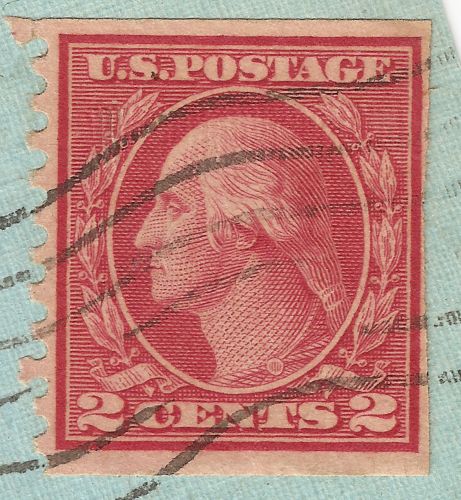
Here is a copy of a stamp that has passed through a Schermack Mailing Machine.  Many collectors assume that the slots are what moved the stamp through the machine. They are not. The stamps were moved my 4 steel fingers. The slots were used to locate the stamp prior to the knive severing it from the coil. As with this stamp, evidence of the 4 steel fingers may be left on the right hand side of the stamp. |
|
Send note to Staff
|
|
|
Valued Member
Israel
53 Posts |
|
|
My apologies for acknowledging late! I'm just now reviewing the replies - thank you! You provided me with very important information. I'd never seen these kinds of physical signs on stamps |
|
Send note to Staff
|
|
|
Valued Member
Israel
53 Posts |
|
|
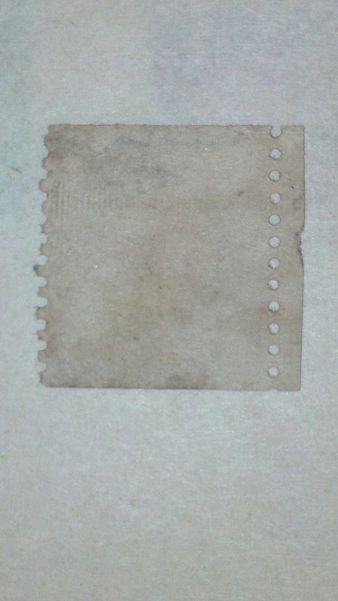
What's your impression of this stamp? Are those vertical perforation "imperfections" the result of an affixer or possibly a horizontal vending machine dispenser?  |
|
Send note to Staff
|
|
|
Pillar Of The Community
United States
8956 Posts |
|
|
Gumside, I think you answered your own question. That stamp looks like it has been badly affected by a mechanical affixer or vending machine
Peter |
|
Send note to Staff
|
|
|
Valued Member
Israel
53 Posts |
|
|
Do you have any sense if it's one or the other? For us in the Mandate community the answer could be ground-breaking in our research |
|
Send note to Staff
|
|
|
Pillar Of The Community
United States
1497 Posts |
|
|
Here is my two cents worth. If the stamp was affixed or dispensed by a machine, I would expect the top and bottom horizontal perforations to show evidence of mechanical separation, i.e., the perforation teeth would be more uniform in shape than what is seen above (even cuts or tears across the length). The machine would have been loaded with horizontal strips or roll of stamps. Now, if the stamps were separated into strips by hand before loading into the machine, then my expectation is wrong.
Robert |
|
Send note to Staff
|
|
|
Pillar Of The Community
6363 Posts |
|
|
I sense there are two similar things being mixed here. Each will (may?) display different evidence on the stamp. Consider:
1. Vending machines: Insert a coin or two, turn the crank, and get a strip of stamps. These I believe are the ones with the short vertical scratch marks across Washington's head. Knife-cut every 5 stamps or so, then torn by the customer to apply them. I have seen these most frequently seen on individual's mail (rather than business mail). Note all 4 examples Don shows in the early post. They are knife-cut on one side, torn on the other.
2. Affixing machines: typically used by business to affix large numbers of (usually) single stamps quickly. Identical knife-cuts on both sides, and often at a slight angle or arc. Note the same diagonal slice to BOTH sides of the Mail-O-Meter test coil above.
Palestine stamp: too irregular for any affixing device. I suspect the user tore the sheet into horizontal strips, then licked, stuck, and then tore off the balance - and repeated the manual process. The "pull" wasn't quite along the perforation row and thus thinned consistently into each stamp. It would be fairly easy to reproduce the effect. |
|
Send note to Staff
|
|
|
Valued Member
Israel
53 Posts |
|
|
Thanks John! That makes sense... the horizontal perfs look naturally detached too. Ironically I rarely see examples of this type of tear but very plausible as you describe |
|
Send note to Staff
|
|
|
Valued Member
Israel
53 Posts |
|
|
...does anyone have an visual example of how a non-US machine-affixed stamp looks? |
|
Send note to Staff
|
|
|
Pillar Of The Community
United States
1497 Posts |
|
|
Here is a modern Germany stamp with serrations caused by a dispensing machine.  Not sure if this will help being a modern stamp. Robert |
|
Send note to Staff
|
|
|
Valued Member
Israel
53 Posts |
|
|
Thanks Robert! The value in these images is seeing first-hand how things look, and learning from them what they mean. Stamp perforations and detachments is a language of its own...
Another question - specifically for John, but open to anyone who may know: is there a difference between the appearance of a stamp cut by scissors versus by guillotine (or a machine's knife)? I'm under the impression that a scissor's cut would leave some kind of pressure mark on paper or stamp teeth. In a separate post about affixers John had described how they would cut stamps from end to end and not in one motion, so I though he may know if there is a difference also in the end appearance of the severed paper. |
|
Send note to Staff
|
|
|
Pillar Of The Community
6363 Posts |
|
|
Two cuts made by scissors will not be identical to one another in angle. And users typically don't cut coils into single stamps with scissors.
The point of the cutting motion in affixers or vending machines is like the trick of feathering a telephone book before tearing it in half. Like a scissor motion, cutting from one end to the other or make a puncture in the center and go toward each end in two cuts.
(It would be easier to show and discuss specific examples rather than the theoretical.)
|
|
Send note to Staff
|
|
|
Valued Member
Israel
53 Posts |
|
|
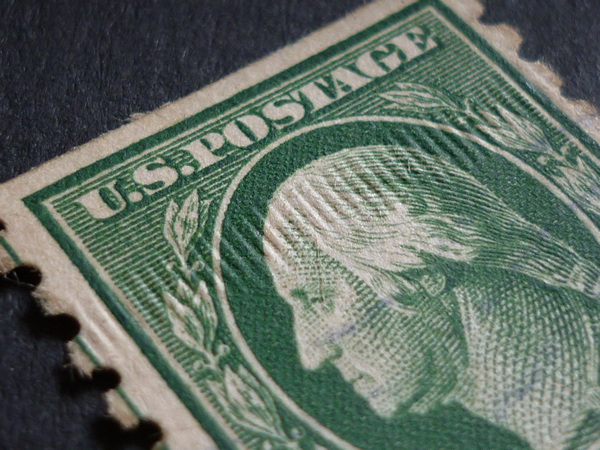
Thanks John! Every explanation in a valuable insight unto understanding how things work and why. If you have a moment, can you tell me what this perforation mark might be? I see these 'crimp' looking marks from time to time on (Mandate) stamps but can't imagine why they might be there. Usually I see them (as here) right across a horizontal axis. The image is upside down because I had to try to get the lighting right to make the crimp mark visible:  |
|
Send note to Staff
|
|
|
Replies: 20 / Views: 2,728 |
|



 Posted 05/30/2021 11:25 am