| Author |
 Replies: 9 / Views: 1,717 Replies: 9 / Views: 1,717 |
|
|
Pillar Of The Community
3860 Posts |
|
|
Here are pictures of the seldom seen Canada Scott 197e which is a Die II unique mint block of four imperforate sheet stamps.   This stamp block is described as flat plate (dry) printed. However, the back gum side shows small vertical gum lines which are found on rotary press wet printed sheet stamps.   Canada Scott 197c (Die II) rotary press wet printed sheet stamps with small vertical gum lines.   Canada Scott 197 (Die I) rotary press dry printed sheet stamp variety with embossing on gum side.   Canada Scott 197d (Die II) flat plate dry printed stamp booklet pane with embossing on gum side. |
|
Send note to Staff
|
| Edited by jogil - 06/29/2021 11:09 am |
|
|
|
|
Rest in Peace
7742 Posts |
|
|
Very nice find Jogil on that imperf block... Shows small vertical gum lines...excellent. Wish I could afford that block...I am jealous. Guess my single and block are rotary press wet printed stamps. ..?? Robert 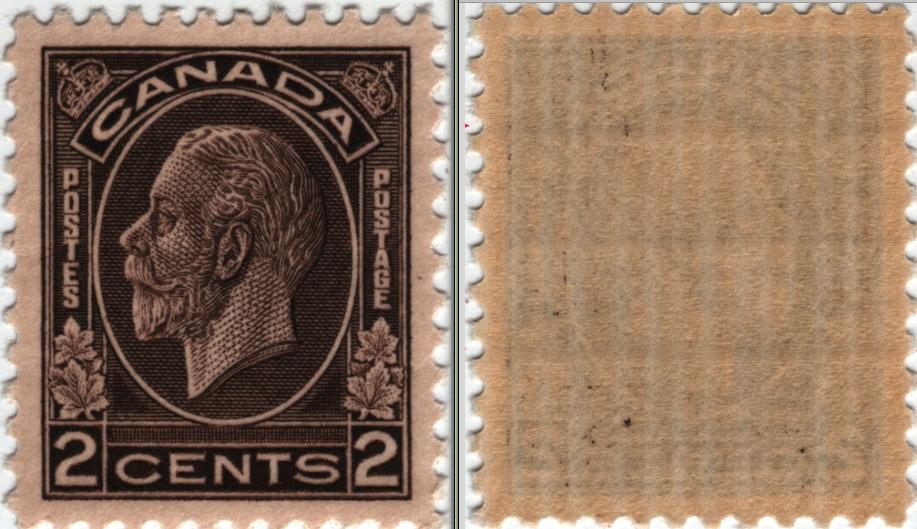 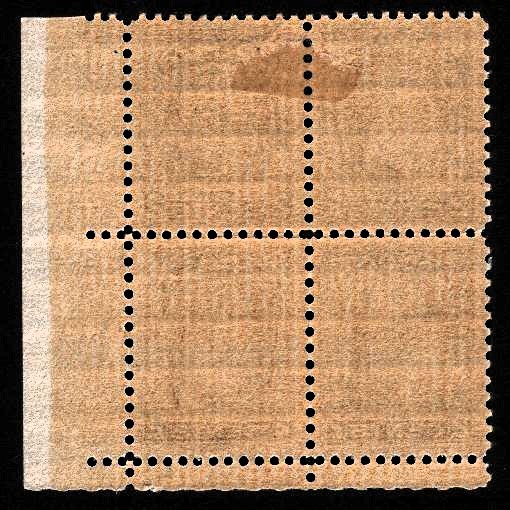 |
Send note to Staff 
|
|
|
Pillar Of The Community
3860 Posts |
|
|
wert: I do not own the 197e imperforate stamp block. Yes, your stamps are 196 and not the 196i variety. 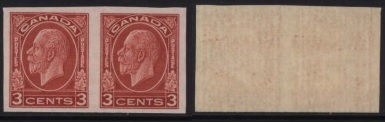 Canada Scott 197b imperforate rotary press wet printed stamp pair. The 197e stamps are similar to the 197b imperforate wet printed sheet stamps except that 197b is Die I and 197e is Die II. |
|
Send note to Staff
|
| Edited by jogil - 06/29/2021 12:44 pm |
|
|
Pillar Of The Community
Canada
1462 Posts |
|
|
Definitely looks like wet printing - thanks for sharing, great block. Really like the imperforates of the KGV period, may start collecting them. |
|
Send note to Staff
|
|
|
Pillar Of The Community
3860 Posts |
|
|
Pillar Of The Community
Canada
1462 Posts |
|
|
Thanks Jogil - that's a little rich for my blood :). I'll start with the cheaper ones |
|
Send note to Staff
|
|
|
Pillar Of The Community
3860 Posts |
|
|
gmot: I don't own the 197e block which is considered a Medallion stamp rarity.
Here is how it was described in its 2016 auction catalogue:
"THE ONLY KNOWN IMPERFORATE DIE II OF THE THREE CENT MEDALLION
82 * 197e, 1932 3c Deep Brown Red Medallion, Flat Press, Die II
Mint imperforate block of four, some gum wrinkling and small thin mostly confined to top margin, nevertheless the ONLY KNOWN EXAMPLE of the imperforate Three cent Medallion, Die II in existence - last sold in September 1981 and since then kept in the family collection, VF OG Est. 7,500.00+
(PR 8,500.00)
It has been previously reported that this block came from a regularly issued sheet, partially imperforate and discovered in a Winnipeg post office. However, we feel this is unlikely. This block is flat press and all issued sheets were rotary press. Only the booklet panes and coil stamps were printed by flat press.
More research needs to be done.
AN IMPORTANT AND UNIQUE BLOCK -
THE RAREST ITEM OF THE MEDALLION SERIES AND AT PAR WITH THE GREATEST RARITIES OF THE ENTIRE KING GEORGE V ERA." |
|
Send note to Staff
|
| Edited by jogil - 06/30/2021 07:43 am |
|
|
Pillar Of The Community
3860 Posts |
|
|
Regarding the aforementioned quoted from the above:
"This block is flat press and all issued sheets were rotary press. Only the booklet panes and coil stamps were printed by flat press."
All Medallion booklet panes were flat plate dry printed (195a, 195b, 196a, 196b, 197d) [11 x 11].
All Medallion coil stamps were rotary press wet printed (205, 206, 207) [8.75 vertically].
Some Medallion sheet stamps were rotary press wet printed (195, 196, 197, 197c) [11.25 x 11].
Some Medallion sheet stamps were rotary press dry printed (195d, 196i) [11.25 x 11].
Some Medallion sheet stamps were flat plate dry printed (198, 199, 200, 201) [11 x 11]. |
|
Send note to Staff
|
| Edited by jogil - 06/30/2021 9:26 pm |
|
|
Pillar Of The Community
Canada
1462 Posts |
|
|
Thank you jogil for the catalogue link and additional info. I read the catalogue with interest, some absolutely stunning imperforates were on offer in that sale.
~Greg |
|
Send note to Staff
|
|
|
Pillar Of The Community
3860 Posts |
|
|
197e does not appear to show embossing/debossing on the gum side which is a characteristic of dry printed stamps. Also, the vertical gum lines were made by the Stickney rotary press gum roller that gummed stamps after wet printing. Thus, it may be up to Scott first rather than Unitrade to correct their description first due to the "e" being a Scott variety. See the following: https://goscf.com/t/72825 |
|
Send note to Staff
|
| Edited by jogil - 11/05/2021 10:18 am |
|
| |
Replies: 9 / Views: 1,717 |
|




 Posted 06/29/2021 10:23 am


