Hopefully this will help someone considering UV lamps.
Review of Ultraviolet-Tools' Model m12, Enhanced 4-watt Shortwave/Longwave UV Lamp (filtered shortwave 254nm UV)
Recently I became interested in UV lamps, mainly to help in identification of some stamps. I am by no means a tagging expert – not yet anyway. But not being able to inspect stamps for tagging, (or other things like paper, and repairs), means certain aspects of identification must be ignored. The Lighthouse L81 seemed like a good starter lamp, although at around $50-$70, it's a bit overpriced. After researching on this forum, asking questions, and doing other research, I settled on the m12 by Ultraviolet-Tools (
https://www.ultraviolet-tools.com/), a company mentioned on the forum a number of times. I decided to post this review. First, here is UV-Tools' copy for the m12:
"Our beginners shortwave and longwave ultraviolet lamp. The shortwave UV is a enhanced four watt fluorescent tube emits the shortwave UV (254nm) specifically tuned to put out 40% more UV than other lamps of the same size. The longwave UV is emitted by a 375nm led putting longwave UV light.
Did you know 90% of fluorescent minerals require a filtered shortwave UV light? The optical filter is a specialized piece of glass on top of the lamp. DO NOT buy a lamp with just the bulb. You need the optical filter to block out the visible light generated by the bulb. The filter glass is the most expensive part of a shortwave UV lamp. Among fluorescent minerals other uses for this handy little lamp include stamp collecting, science experiments, counterfeit detection, and more.
Note: While the most affordable lamp on the market this lamp is not designed to be a field lamp. Our other shortwave lamps that are larger can be used out in the field. This lamp works well with rocks held in your hand within 12 inches.
Lamp Size: 6-1/2" x 2-1/4" x 3/4"
Wattage: Enhanced 4W
Bulb: Filtered Shortwave 254nm UV
Batteries Required: 4 AA (not included)
Weight: 5 ounces
Warranty: 90 Days
100% Satisfaction Guarantee!"
While the copy for this lamp mentions "stamp collecting," UV-Tools stock-in-trade is minerals and lamps for the geology enthusiast. The m12 appears to be identical to the Lighthouse L81, at least as pictured. The price of the m12 at the time of this writing is $39.99. I've seen the L81 selling for significantly more. At this price point, I wasn't expecting perfect fit and finish, and accordingly, didn't get it. As a "beginner" model, and low power lamp, this would probably meet the needs of most people. I expect that tagging specialists might want to up their UV-lamp game though. I also picked up a pair of their UV protective glasses for $8.00. These are Pyramex brand "Intruder" S11040S. (The glasses are included with the 11 watt m100HO. To me the 11 watt seemed like overkill in terms of power.) I figured safety glasses would not hurt, and may help. UV is dangerous if misused. Note that these glasses do not fit over existing spectacles, but over-the-spectacles designs exist. No one should be looking directly into a UV lamp. In the paper "Stamps That Glow," (
https://stamps.org/Portals/0/adam/N...volution.pdf Henry I Jehan Jr. put it this way:
"WARNING
Never look directly into the light emitted by a UV lamp!
Direct exposure to UV light, particularly short wave UV light (UV-B),
will do permanent damage to your eyes.
When working with UV light source, you should always wear glasses
containing a UV blocker.
#9679; The light emitted by the stamps when illuminated with UV
light is eye-safe.
#9679; It is the UV light source used to illuminate the stamps
that is not eye-safe.
#9679; Do not look into the UV light source, or allow it to be
reflected into your eyes
by stamp mounts or other mirror surfaces.
#9679; With eye protection, working with tagged stamps is
perfectly safe.
If you work extensively with the UV light for long periods
of time, you should
consider wearing gloves and long sleeve shirts to limit
skin exposure and
prevent sunburn and related ill effects."
The m12 sports a small kick-stand in the back which allows it to stand on its own (see fig. 1). However, the shortwave UV would now be facing upwards. I'm more in favor of moving the lamp to the stamp with the lamp facing downwards, thereby helping to eliminate the chance of looking into the UV source. This lamp also has a wrist strap. This might come in handy when on a show floor, but I doubt I would walk around with this lamp dangling from my wrist.
 Fig. 1
The switch seems to be a weak point in the whole design. The switch operates by moving to one side for shortwave, and the other side for longwave. The center position is OFF. The problem encountered was that the shortwave can turn on with a little more than a touch. This means the user must slide the switch back towards longwave to ensure that the lamp is really off. I expect that at the very least, it would run the batteries down, and subject the bulb to unnecessary wear. Even worse, if it's on and facing the user, they may not realize they are looking into the source. I saw at least one buyer's review who remarked on this same issue. Yet, that was a review for the Lighthouse L81. Hmmm. So far, I decided to use extra care to make sure the lamp is off, and then slide it back into its cardboard box when not in use. The switch problem may be fixable but would require disassembly of the unit. In the meantime, it works. (One idea would be to ditch the wrist strap and that could help fund a better switch.)
For this review, I'm reviewing the shortwave tagging only. There are some uses of longwave, such as detecting certain papers, or repairs. I decided on the dual-wave model so I'd have longwave if I need it.
The m12 in use:The m12 is easy to use. In her article "Turn on the glowing stamp magic with an ultraviolet lamp," (
https://www.linns.com/news/postal-u...t-lamp.html) Janet Klug provides a good basic technique for checking luminescence:
"To check luminescence with a UV lamp, set out the stamps you want to check in a work area that can be darkened.
Once the stamps are arranged on the work surface, turn off all the lights in the room and, if daylight is a problem, draw the drapes. Turn on the UV lamp. Make your observations quickly, and jot them down. Little sticky notes work perfectly because they will stick to the work surface rather than float to the floor on an errant breeze.
When the observations have been made and noted, switch off the UV lamp and turn on the ordinary lights. Working in short spurts is better for your eyes and will help keep the UV lamp in good operating order for a longer period."
Turning off the lights is a key step. I'm not sure if it's the relative low power of the m12 (4 watts), but with the room lights on, it's difficult to see anything. However, the examples I'm providing were made with the room lights off but with ambient daylight coming through the window, so it was by no means completely dark. I thought the results were more than adequate.
Ultraviolet-Tools included a couple of minerals, and also Scott 3274 to let you start checking luminescence immediately. Figure 2 shows 3274 under shortwave. This (as with the other pictures) was done in a room with the lights off during the day. The room was dark, but not completely. For my purposes, this result is fine.
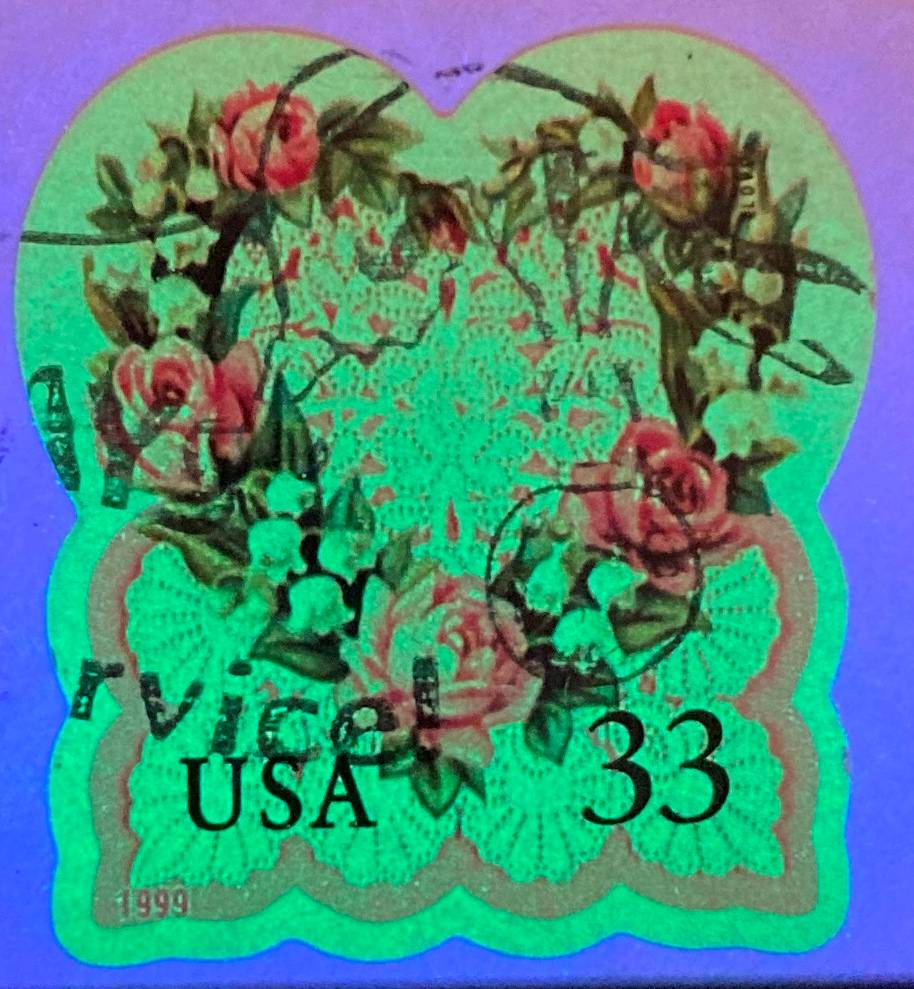 Fig. 2
Below are figs. 3, and 3a which show the included mineral in normal light, and then under shortwave UV. The result is striking.
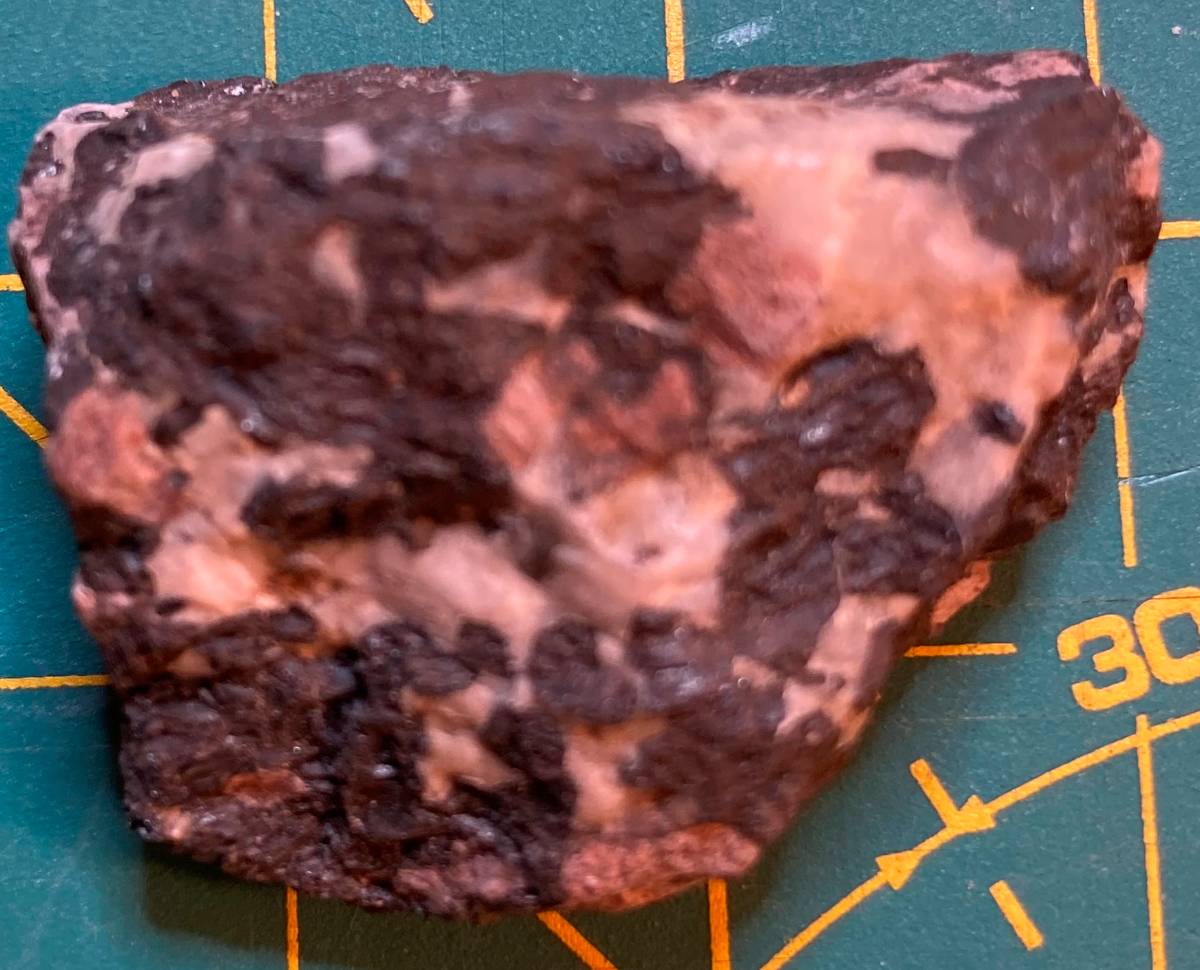 Fig. 3
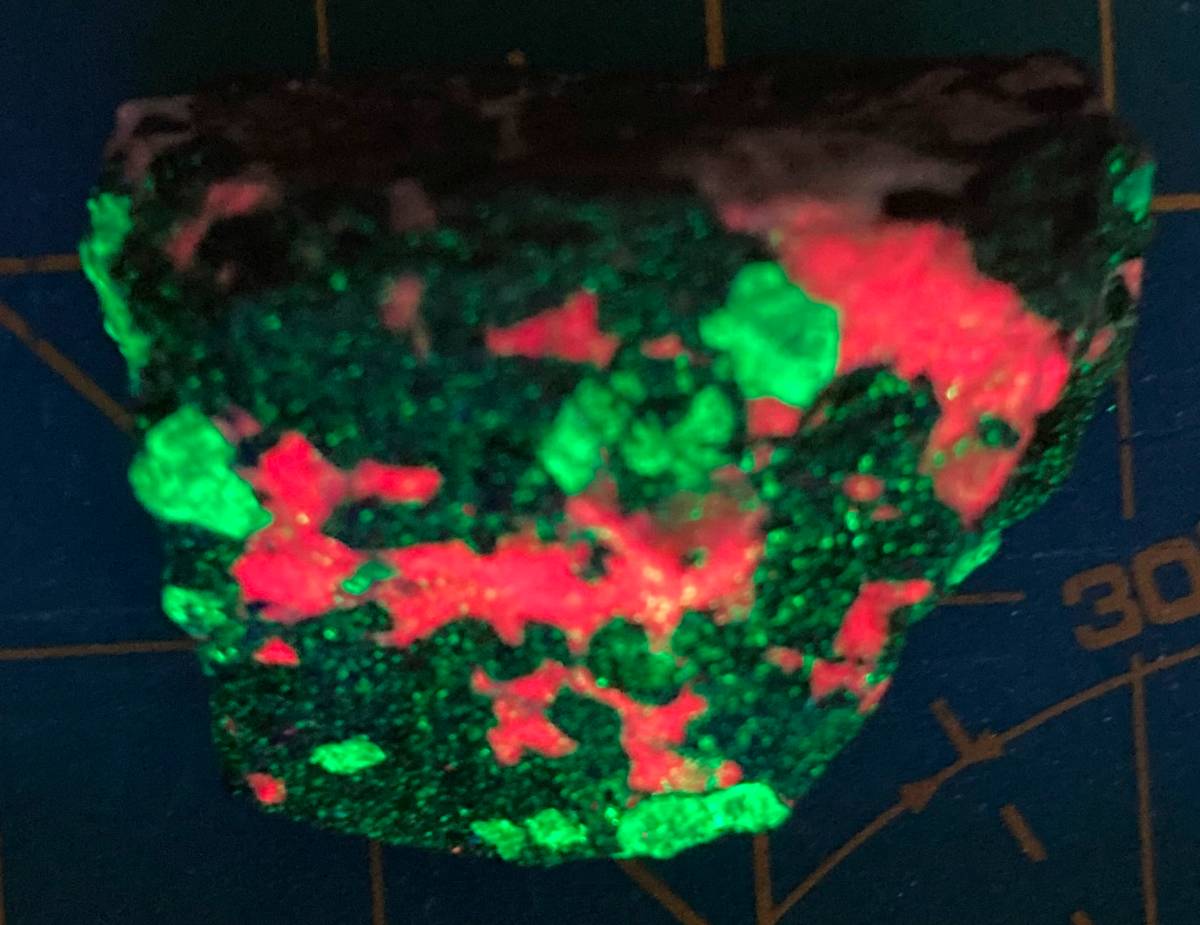 Fig. 3a
Next up, fig. 4, Scott 1689a. Very good result. Bonus: I can imagine that I'm surveilling Washington's party with night vision goggles.
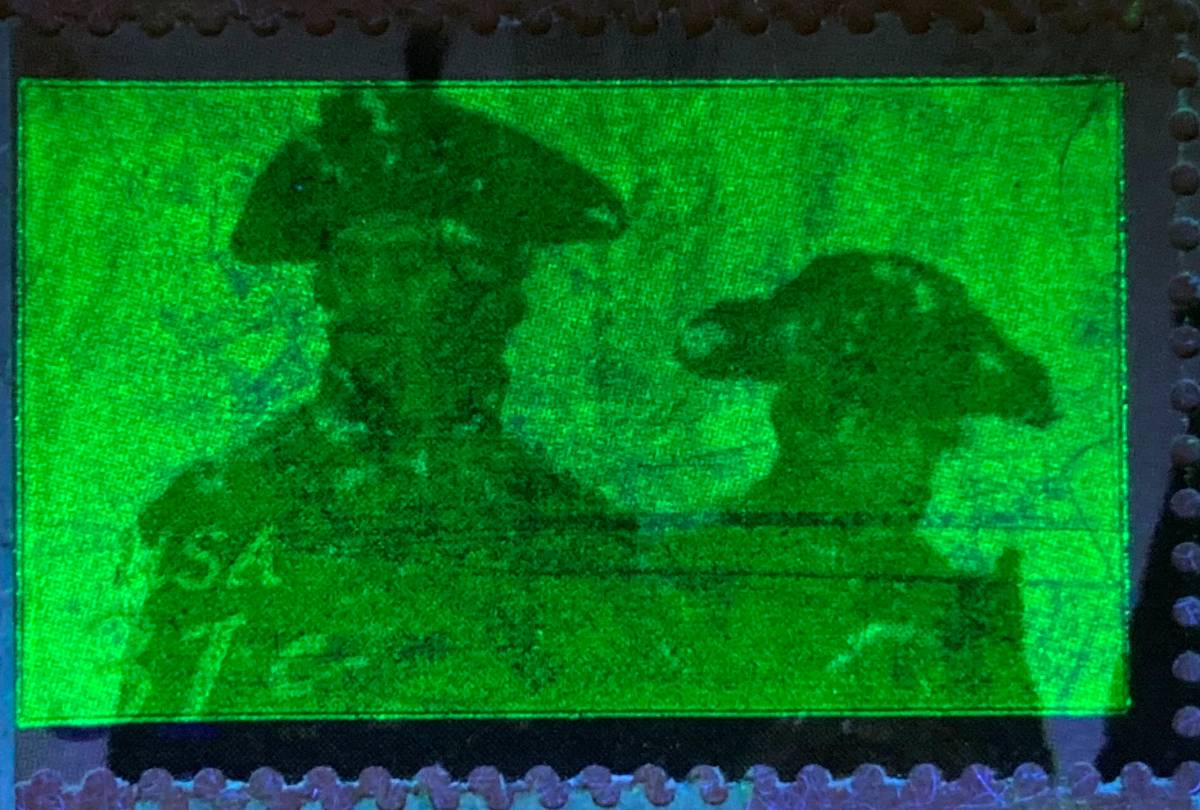 Fig. 4
Klug mentioned a few aspects of tagging in non-US stamps, and called out Canadian stamps in particular for their bright edge-tagging. The result in fig. 5 does not disappoint.
 Fig. 5
Finally, fig. 6, Scott 2281. I was casting around randomly looking for good examples, and found this $0.25 bee stamp with what looks to me like a tagging shift. Some tagging "oddities" may have value, but I suspect many shifts like this are fairly common. I don't believe that a shift would interfere with the taggant's function. Yet, tagging varieties provide a good opportunity for a specialized collection.
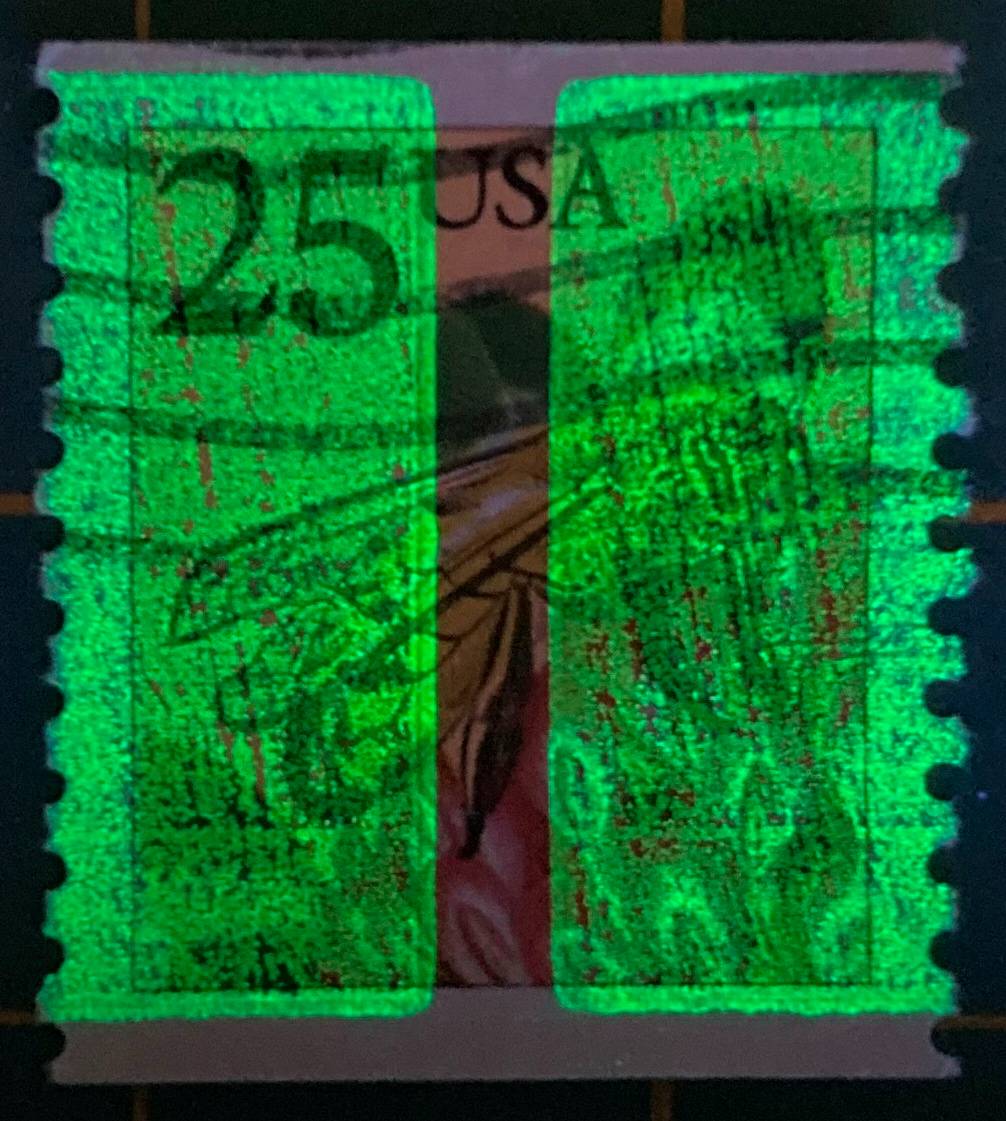 Fig. 6 Verdict on the m12:
Since I just received this lamp, I can't remark on the durability of the components. The fit and finish is just OK, but it's a low-end lamp. The switch needs a re-design to make sure this component works properly. The shortwave results are more than acceptable. I have no practical experience with other lamps, but I can't see how the results could be better. For an inexpensive dual-lamp, so far, I'm happy with the Ultraviolet-Tools model m12.





 Posted 08/19/2021 6:28 pm


