Quote:
We all make mistakes, hopefully we learn from them and educate ourselves more and develop.
There was no judgment in the reply. If you are happy with your purchase, that is good.
It pays to look around for Queen Victoria issues. If you want prime quality you will pay for it, or you must be lucky. Most of what is around suffers from "quality" issues. Sellers will use a catalogue and determine their price. But the catalogue rarely is applicable to most of what is around.
SG prices the imperforate stamps as having four margins that have approximately the width of the margin between two stamps. Postal clerks were not interested in stamp collections of the 21st century. Cutting the label so it was valid to prepay for carriage of mail was what they were paid to do. These were issued in the many millions. The scarcity is in the "catalogue quality" margins.
We speak of cancels, but these were obliterators. They were not intended to cancel a stamp with a nice date. They were intended to stamp the labels into oblivion. The GPO was concerned with forgery. When in 1881 stamps could be used for revenue payment, the inland revenue added to the paranoia. With many millions sold, the pricing, again, is for those that are much better than regular (or rare, identifiable) cancels.
With classic British stamps, you will notice that stamps are priced to (the lack of) rarity, unless the condition is above average and then they are priced as artefacts. SG prints the most important catalogue for this field. Their catalogues are catalogues and not general trade prices. They reflect the policy of trading in the high-quality range with collectors interested in those items. They do not reflect what is paid on
ebay for the normal quality of stamps cut by post-office clerks working in bad lighting, not interested in collecting stamps, and told to obliterate stamps.
Quote:
A "new discovery"
Risking a similar reaction. There is a caveat to what is "new." It is very much determined by the database consulted and the contributions made to that database. If you do not report it and your neighbour finds the same cancellation for the same date, that will again be a new discovery.
As Rod says: "positive" as it adds to knowledge. If it is indeed rare, that is very positive.
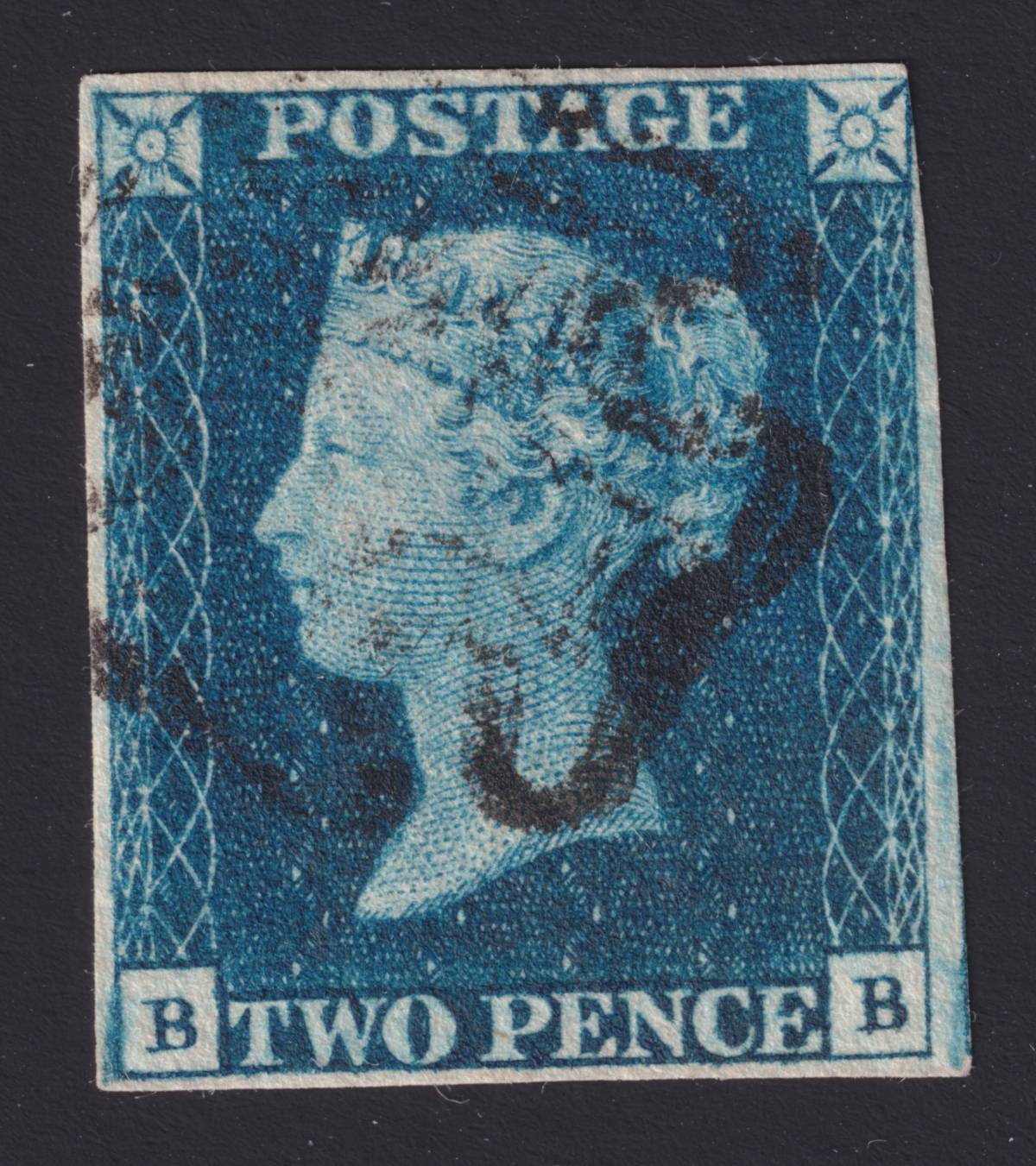
Another positive: these high values often were used for registration fees or to pay duties on imports. This appears a postal cancellation. That is very good.
Quote:
You like this seahorse better?
From the pic, it looks stunning. Great cancel. It appears to be a postal cancellation and not fiscal or registered. So, excellent.
Quote:
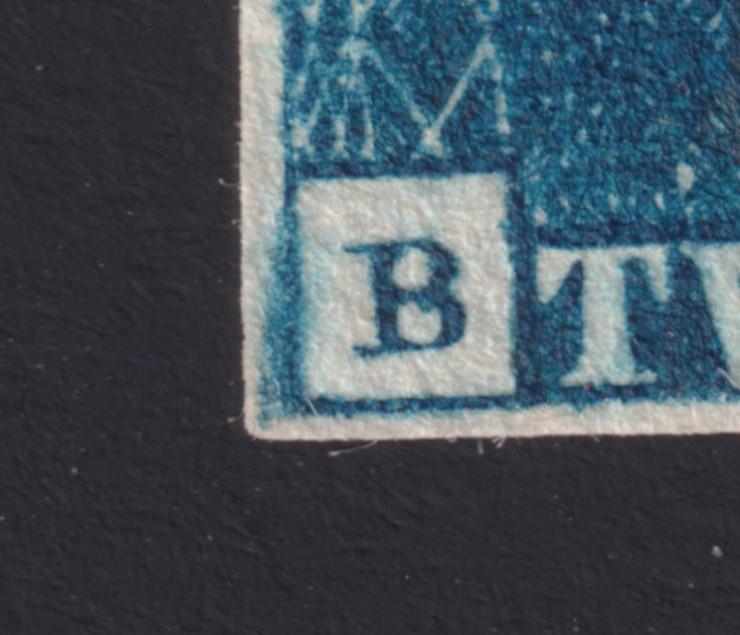
What do you mean with "inverted B"?
If you look at the "B" in the lower left corner, the top loop appears bigger and wider than the bottom one. It looks like an inverted and reversed "B." That would make it very recognisable. The Nissen examples, however, show no example of the BA (position row two, stamp 1) with this characteristic. Ignoring the outer end of the top loop (as a speck perhaps not sure from the picture) makes plate 4 – I think that is a much better fit than plate 1 - a suspect: The "B" is well-centred, maybe slightly below the vertical centre, strong serifs, slanting slightly upward. The box has strong lines as far as visible (that is why cutting into the design is an issue).
The A – and this is why I now think plate four – is also well-centred, the foot lining up with the top of the foot to the "Y" in "PENNY." But what is better in 4 than 1B: the quite long diagonal right leg of the A and the apparent slight nick in the middle of the left leg. The lack of strength in the bottom line of the box is more a 1B-feature than 4-feature. However, the shape of the "A" does not really fit plate 1B.
http://maltesex.com/cgi-bin/doctarr...0947.JPG~~~~





 Posted 12/20/2021 06:11 am