| Author |
 Replies: 13 / Views: 1,880 Replies: 13 / Views: 1,880 |
|
|
Pillar Of The Community
750 Posts |
|
|
|
Is there a bulb that would be better for looking at stamps for best color reproduction when using a USB scope?
Thanks,
pat
|
|
Send note to Staff
|
|
|
|
|
Moderator

United States
5106 Posts |
|
|
Pillar Of The Community
501 Posts |
|
|
My new LED desk lamp has 5 different colour temperatures. I flick through them while I am looking for watermarks. Made by JUKSTG. |
Send note to Staff 
|
|
|
Moderator

United States
12330 Posts |
|
|
Good question, ambient light is critical to accurate color identification. (Obviously, since we see color as a function of light waves reflecting off the surface of the stamp.) I am not sure about the size/type of light that your USB scope uses (I assume a LED bulb?), but a good setup for someone who knows color ID would be something like the Pantone light booth https://www.pantone.com/pantone-light-boothThis link gives you some specs on the color temperatures the bulbs they use... Don Edit: Here is a simple example of how ambient light temperatures can change the colors we see 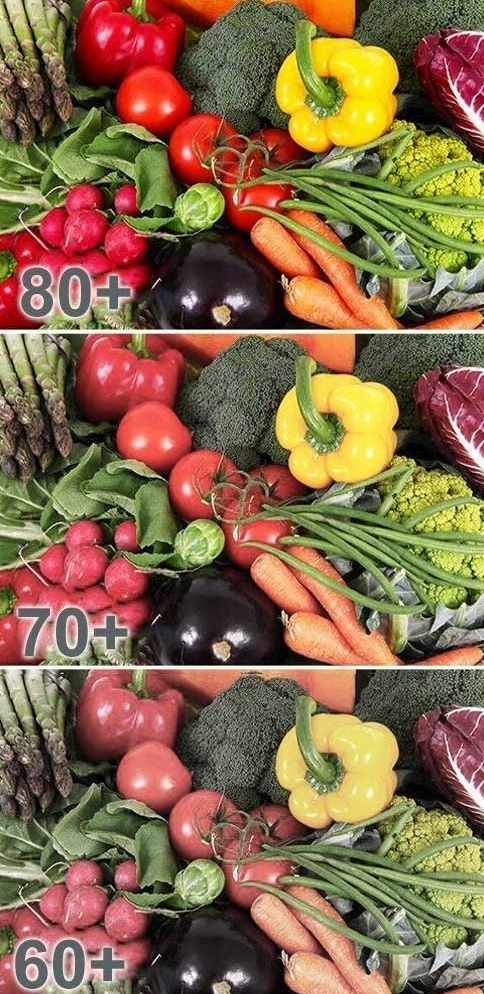 This is why the veggies and produce look better in the store than in your kitchen, this is why the paint store has a light box used to properly ID colors. Ambient light is critical in IDing correct color/hue (NOT shade or tint). Shade (which is a color/hue PLUS black) and tint (color/hue PLUS white) is not greatly impacted by ambient light temperature. But stamp collectors should only care about color/hue of a stamp. Shades and tints are impacted by thickness/thinness of inking (allowing the whiteness of the paper to show through and not an ink formula difference). 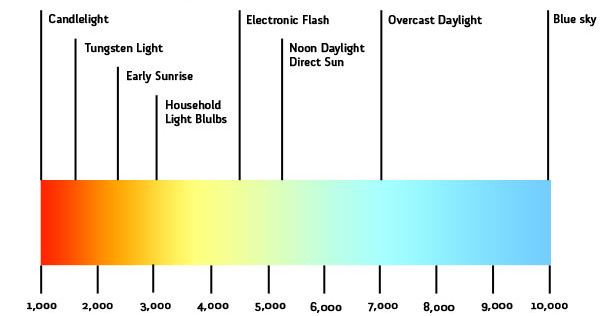 If I look at a stamp under a 9000K daylight bulb (blue wave) and someone else looks at the same stamp under a 3000K incandescent (yellow wave), the hue/color of the stamp will look very different. But for some reason, our hobby largely ignores ambient lighting when discussing stamp colors. I have no idea how certification experts make color IDs without defining ambient lighting. 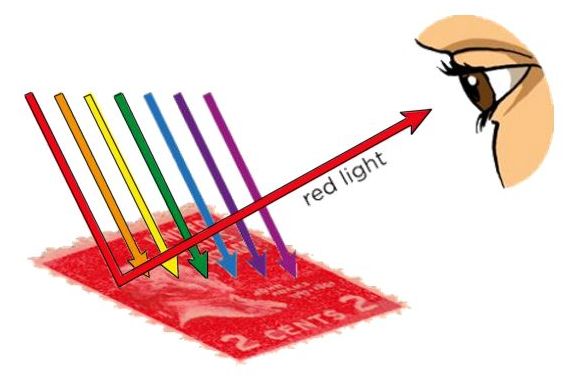 When looking at a red stamp, the red wavelengths are reflected, and the other color wave lengths are absorbed. So understanding, defining, and controlling ambient light is paramount when IDing stamp colors. |
|
Send note to Staff
|
|
|
Pillar Of The Community
United States
1434 Posts |
|
|
Quote:
I have no idea how certification experts make color IDs without defining ambient lighting. Perhaps it doesn't matter. Suppose an expert is given a stamp, and needs to identify the color variety. Said expert uses a color key, and attempts to match the stamp to that key. So long as both (stamp and key) are under the same light (color temperature), the light will affect both the same way, adding equal amounts of blue, or whatever. Both are being viewed at the same time with the same light source, so that particular light is a constant. The problem would be, if you are viewing under 3K and see red-orange, while someone else uses 5K and sees orange, and neither of you is using a color key. You two will always disagree because you're each using a different bulb. But if you each use the same color key, you will arrive at the same answer, since while the bulbs are different, their respective impact on the stamp and the keys will be constant for you, and constant for them. You will both say the stamp is orange, because while your orange looks more red (because of your warm bulb), it will match the orange of the color key (which will also be objectively too red, because of that same bulb). |
|
Send note to Staff
|
|
|
Moderator
United States
12330 Posts |
|
|
Professional's use light box and keep them calibrated, typically replacing the bulbs frequently since once you use a meter to check you will find the bulbs start changing over a few months of use. If color matching, then you have to be sure that your color chips are fresh (replaced every year or two depending upon the type of color chips) AND that you have a calibrated light box. Don Edit: If expert IDs a stamp color with a chip in 2020 and then same expert IDs the same stamp in 2022, you cannot assume that the chip has changed in the same way as the stamp over the two years (especially if the stamp and chip were kept in different environments. Color temperature light meters are not that costly, a basic one for hobbyist use is around $30 (see ebay 144307894220 ). A person who is studying stamp colors should do their color IDs with the color temperature recorded so they have at least a minimum amount of info on the ambient lighting. Here is the same stamp with different color temperature lighting 4200k fluorescent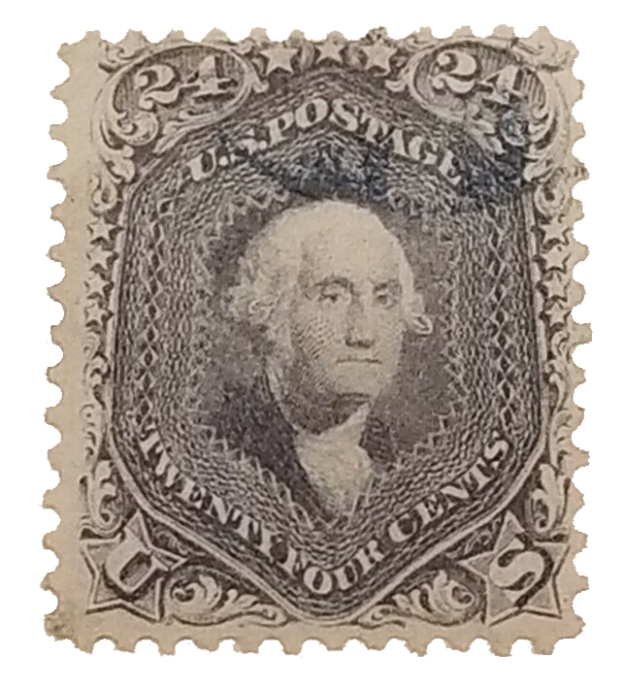 2500k incandescent 2500k incandescent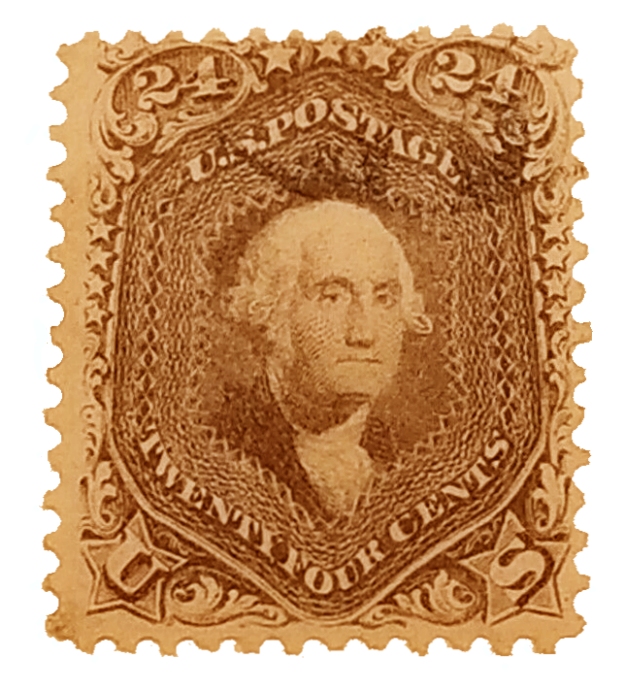 9300k LED 9300k LED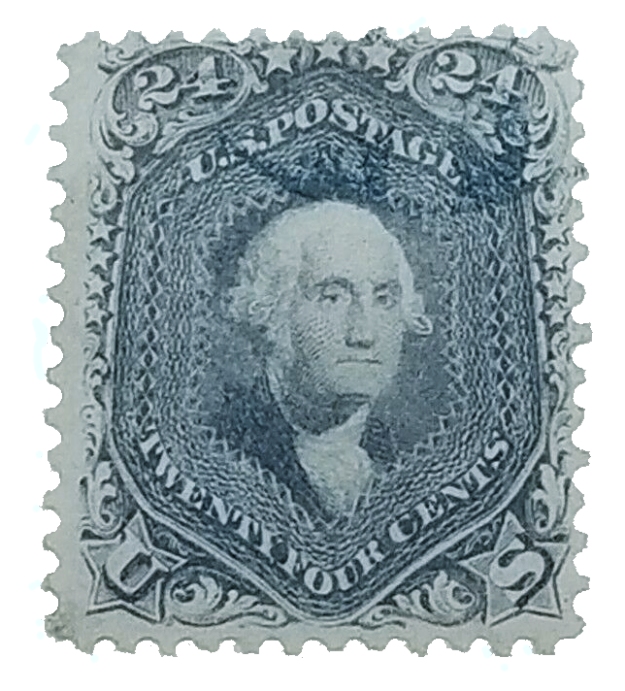 This is why patg23's question is such a good one, we have seen so many threads and posts about color but virtually never see anything discussed about ambient lighting. |
|
Send note to Staff
|
|
|
Pillar Of The Community
United States
1162 Posts |
|
|
I agree that this aspect of the hobby could be, and should be, better defined. Whatever bulb that can 'duplicate' indirect sunlight would be best. When I was an auction lot describer, I worked in an office with another describer and the room was WELL lit with many overhead fluorescent bulbs (1980's era lighting). Our desks were located adjacent to large windows - we were on the north side of the building, so we never got direct sunlight, but I doubt that was part of the design requirements. We also had multiple desk lamps and those large magnifiers with lighting around the lens. Stamps looked different whether we were on one side of the room (the inner part of the room was dominated by the fluorescent lights), or the other (near the windows). For the most part, we didn't have problems with identifying colors - maybe our desks were close enough to the natural lighting, or perhaps our brains simply compensated for small differences in lighting. I don't know. If there ever WAS a problem with identifying color, we definitely went over to the window to have that light predominate.
I do believe the hobby would benefit from some authority (PF? APS?) identifying the optimal lighting conditions.
And let's not forget - it is best to minimize exposure to light. We need it when we need it, but stamps shouldn't be exposed more than that. ESPECIALLY direct sunlight. |
|
Send note to Staff
|
|
|
Pillar Of The Community
United States
1124 Posts |
|
|
Fluorescents can still be used successfully today, as long as they're 'color corrected,' which mimics natural light. |
|
Send note to Staff
|
|
|
Pillar Of The Community
United States
1162 Posts |
|
|
Quote:
Fluorescents can still be used successfully today, as long as they're 'color corrected,' which mimics natural light. Whenever we had to replace burnt out (or, God forbid, flickering) light fluorescent bulbs, we had a specific make and model #. We wouldn't use any other. You could go to Home Depot to get it, but you had to get THAT one and not the one next to it on the shelf. And, yes, it was all about the color/temperature for viewing stamps. |
|
Send note to Staff
|
|
|
Moderator
United States
12330 Posts |
|
|
Fluorescent was a popular choice for many years in office lighting because it was cheap (bulbs 'last' longer and use less electricity). But 'lasting' typically meant until the bulb failed to light (you've seen blacken bulbs that still light up).
But what we care mostly about is color temperature and how this might change over time (intensity is also a factor). Bulbs change over time and this is largely ignored by bulb manufacturers. In general and in terms of usable life; fluorescent bulbs are better than incandescent bulbs and LED bulbs are better than fluorescent bulbs. Also in general power on/off cycles are what has the greatest negative impact on bulb life.
But regardless of what type/color temperature bulbs are use is the importance of measuring your ambient lighting. Using a meter is how you measure and understand your ambient lighting. (Keep in mind that ambient lighting in a room is impacted by MANY things including indirect lighting sources. This is why using a light box is preferred over room lighting.)
Developing a good color eye in our hobby is made exponentially harder if you are working in unmonitored ambient lighting conditions. It is like cooking without knowing the actual temperature of your oven. Sure, you can just 'wing it' and use the smoke detector as an oven timer but few people would consider themselves a good cook using this approach. Eliminating as many variables as you can reduces mistakes and increases confidence when making subtle color identifications.
Hobbyists typically are not trying to decide between red and blue or brown and green but rather working with very subtle hues and colors. Luckily buying a light meter and controlling ambient lighting (you can build a light box yourself) is cheap and simple to do. It is a no-brainer for anyone wanting to be consistent in their color judgments and decisions.
Don |
|
Send note to Staff
|
|
|
Pillar Of The Community
United States
4489 Posts |
|
|
Valued Member
United States
8 Posts |
|
|
It also depends on the color of the stamp, so it would be better to have lights of different colors/intensity. |
|
Send note to Staff
|
|
|
Pillar Of The Community
United States
1124 Posts |
|
|
Quote:
Hobbyists typically are not trying to decide between red and blue or brown and green but rather working with very subtle hues and colors. Luckily buying a light meter and controlling ambient lighting (you can build a light box yourself) is cheap and simple to do. It is a no-brainer for anyone wanting to be consistent in their color judgments and decisions. As a retired dentist, I can assure you, you haven't lived hue-wise until you've tried to match a single porcelain crown to be placed on a front tooth to the adjacent teeth. We'd use color-corrected fluorescents overhead, but always had a smaller unit with a high rendition value to use close-up. As you say, consistency is a huge factor. As an aside, female colour perception is much advanced over males (its a cone thing), so I'd always have an assistant, office manager, or whomever possessing XX chromosomes to back up my calls. Female collectors have a clear advantage over us male collectors when it comes to colour perception, but fortunately, many of us have spouses we can call upon for help. https://www.harborfreight.com/profe...ce8b816c8ab5 |
|
Send note to Staff
|
|
|
Valued Member
United States
8 Posts |
|
|
Of course, nothing can be better than the sun for the plants, but some lamps almost make no difference, it is of course, but very small and you won't even notice it. I have a room where I grow the flowers for my house, and I can say that using a smart bulb https://www.amazon.com/smart-light-.../B0922Q43LY/ and applying different colors during the night, might give you a very good result. |
|
Send note to Staff
|
|
| |
Replies: 13 / Views: 1,880 |
|




 Posted 01/29/2022 12:18 pm


