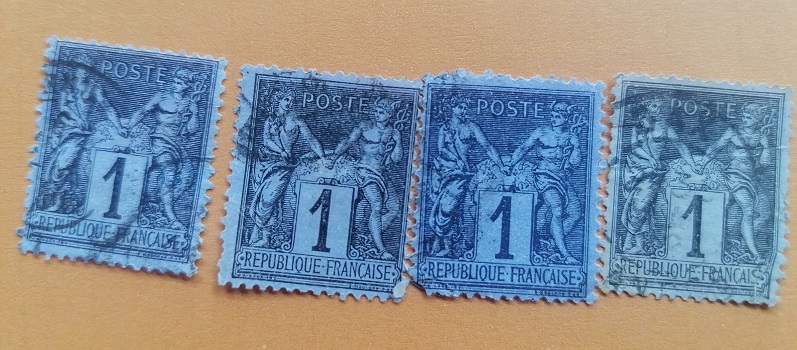
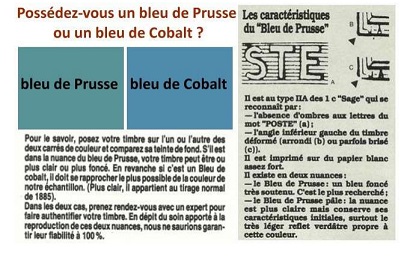
These come in dozens of shades.From a moniter it is impossible to attribute a color for most of them. black on azure 1880 Type IIA 83 83 IIA a slate on blue 1877 Type IIA 83 a black on blue 83 IIA b black on blue 1880 Type IIA 83b black on gray 83 IIA c grey-black on blue-grey 1882 Type IIA 83 83 IIA d intense black on dark blue 1884 Type IIA 83c black on cobalt 83 IIA e black on cobalt 1885 Type IIA 83 83 IIA f intense black on grey-blue 1887 Type IIB 83 83 II B black on azure 1896 Type IIB 83 83 II B a grey-black on grey-blue 1890 Type IIB 83 83 II B b black on blue-grey 1891 Type IIB 83 83 II B c light gray on pale blue 1893 Type IIB 83 83 II B d black on dull gray-yellow 1898 Type IIC 83 83 II C black on azure 1900 Type IIC 83 83 II C a black on whitish 1900 Type IIC 83 83 II Cb intense black on blue 1900 Type IIA 84 84 (Type II A) black on Prussian blue August 1880 Type IIA 84 84 a (Type II A) black on pale Prussian blue August 1880
You will find many discussions about the identification of colour hues (shades as most collectors call them). Both your camera and the other person's screen can change the perception of the colour.
Showing the stamps together helps for relative identifications, but exact identification will remain impossible. Furthermore, British and American catalogues do not always recognise the same colours. Sometimes they even use different names. European catalogues are in other languages and not all colours that appear obvious are so obvious in translation. So also say which catalogue you use.
That makes perfect sense to me, considering you are referring to French stamps and are from a country with strong French connections.
The majority of people on this site is from the USA or Canada. They use Scott. Scott is very uncommonly used in Europe and by non-American collectors of those areas. The Australians appear a bit split between Scott and Stanley Gibbons.
The use of catalogues, still, depends much on where someone lives. French people, people from French colonies and southwest Europeans tend to use Yvert & Tellier. Most of continental Europe outside France and southwest Europe use Michel. The British and Irish and people from English colonies tend to use Stanley Gibbons.
It, always, is a good idea to quote the catalogue publisher. Often I see people ask a question about European stamps referring to a Scott catalogue number without mentioning that for the stamp or watermark the more specialised collectors of European countries and colonies or protectorates do not use.
Disclaimer: While a tremendous amount of effort goes into ensuring the accuracy of the information contained in this site, Stamp Community assumes no liability for errors. Copyright 2005 - 2026 Stamp Community Family - All rights reserved worldwide. Use of any images or content on this website without prior written permission of Stamp Community or the original lender is strictly prohibited. Privacy Policy / Terms of UseAdvertise Here





 Posted 02/20/2022 4:46 pm