|
This page may contain links that result in small commissions to keep this free site up and running.

Welcome Guest! Registering and/or logging in will remove the anchor (bottom) ads. It's Free!
To participate in the forum you must log in or register.
| Author |
 Replies: 25 / Views: 4,631 Replies: 25 / Views: 4,631 |
|
Valued Member
United States
126 Posts |
|
|
|
I'm trying to figure out how to display my very small collection of covers.
What are the options? I'd like to do an album or have a way to display them with my stamps.
I have stock books and stock refile pages. Do they make products for cover displays? I've had a hard to finding products and information.
Thanks!
|
|
Send note to Staff
|
|
|
|
|
Pillar Of The Community
United Kingdom
8627 Posts |
|
|
Pillar Of The Community

United States
890 Posts |
|
|
The way I do it is by using 2s Vario stock sheets (black background). One page will hold 2 on the front and 2 on the back, so 4 in total. Then I use Vario-F or Vario-G binders to hold the stock sheets. You could, however, use any 3 ring binder to hold the Vario stock sheets.
For larger covers, you can use the 1s Vario stock sheets, which will hold one on the front and one on the back.
You could also use the clear sheets, but I use the black backed sheets just because of personal preference.
John |
Send note to Staff 
|
|
|
Pillar Of The Community
United States
1434 Posts |
|
|
Every major publisher (Amos, Lighthouse, SAFE, Lindner, etc) offers pages that can be used to store and display covers. Just explore their sites. |
|
Send note to Staff
|
|
|
Bedrock Of The Community
12713 Posts |
|
|
Quote:
The way I do it is by using 2s Vario stock sheets (black background). Exactly what I do. I will use a clear page if the cover back has something of interest. |
|
Send note to Staff
|
|
|
Valued Member
United States
192 Posts |
|
|
I am not a dedicated collector of FDC's but if a particular stamp has my interest because of its topic or design I may also look to acquire the FDC, souvenir sheet, full sheet or booklet, in an older era the plate block, even all four corners if I can find them.
While some collectors like separate "display systems" for different kinds of material (mint, used, FDC's, plate blocks, etc.) I like to keep things together. If I have multiple formats of a particular stamp I'll add an additional page (blank or one I designed and printed) directly after the album page that has the single of that stamp, and mount the additional formats there.
Showgard and others have mounts for many different sizes of material. Showgard mounts for FDC's are item 165/94 (black) and 165/94C (clear).
Lighthouse stock pages are another option and come in different page sizes, as well as different number of pockets per page. I have Harris albums which have a 9" x 12" page size. I will use the Lighthouse Grande sheet (9-1/2" x 12-1/4"), use a guillotine style paper cutter to trim the top and right edges to 9" x 12", and punch new holes on the left edge to fit the two post spacing of the Harris album.
|
|
Send note to Staff
|
|
|
Pillar Of The Community
United States
4443 Posts |
|
|
The smaller sizes have been covered well. But if you have #10 (legal size) covers if you don't have a larger two pocket apge that allows the cover to sit horizontally, then you will need a one pock (1S) for the cover to sit vertically with room for two. Yes black is good except clear is better if there are markings on the reverse of the cover which need to be displayed. If your covers are all #6, this type of album allows one or two covers per flip pocket. 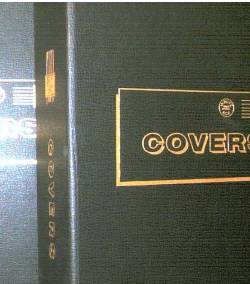 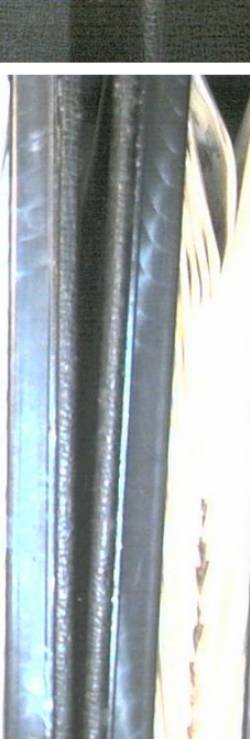 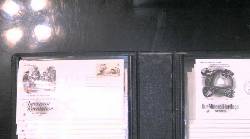 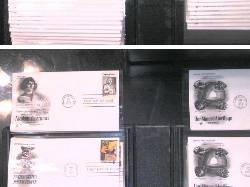 Edit: Images, as well as English, added. |
|
Send note to Staff
|
| Edited by Parcelpostguy - 03/10/2022 5:02 pm |
|
|
Pillar Of The Community
United States
6667 Posts |
|
|
I too like the 2 pocket black pages either Vario or Hagner. I use the top for the cover and the bottom for the write up. Of course this is for my "better" covers. Or I'll do a cover in each section.  |
|
Send note to Staff
|
|
|
Pillar Of The Community
1363 Posts |
|
|
There are, as you can see, many different options for storing and displaying covers. I have a large collection of Japanese wood-block cacheted FDC's that I needed to store in a way that would allow me to look at them from time to time and present them in at least a slightly elegant way (compared to being in boxes, I mean). I put my covers in three-pocket black-backed double-sided (whew!) Vario pages mounted in 22-ring Prinz binders in slipcases. I bought the binders from Prinz in the UK since this kind of binder isn't available in the U.S. They've got a website. Shipping adds to the cost, but it wasn't too bad, and I've ended up with about 20 of these binders. Each holds about 12 or 13 Vario stock sheets. That's 3 covers per side, so 6 covers per sheet. Each binder holds maybe 72 covers. I needed 12 binders to hold all my covers. I tried the 2-pocket Vario sheets which you'd think would be best, but . . . they just seemed to waste a lot of space with the small-size standard covers. And they only held 4 covers per sheet. If I were mounting lager European-sized covers, I'd use the 2-pocket sheets for sure but I found that I could mount 3 covers per side on the three-pocket sheets by alternating them with each cover slightly farther over than the one above. Some of each cover gets covered, it's true, but on most FDC's there's not a lot to see besides the stamp, cancellation, and the cachet, these are perfectly visible. It works pretty well and allows me to have far more covers per binder that way, 72 in a binder instead of maybe 48. I usually stagger the covers with the middle one at the far right of its pocket and the other two at the far left. It works. I looked at all the popular FDC albums, most of which come nowadays in three-ring binders. But I don't like three-ring binders. I think they look kind of cheap -- and the rings also sometimes grab pages you're trying to turn. It think this happens because of cheap build quality (the rings don't align very well where they meet). Also, most ring binders have rings which are made of round metal. I don't mean the rings themselves are round in shape, but the actual metal is round. This may contribute to the way the rings tear at pages as you turn them past the jagged edges. In any case, I've had much better luck with European flat rings of the type that are often used on 22-ring binders. You have to buy these from the UK since they don't seem to be sold in the U.S. very often. Prinz binders are made this way. The catch is that Vario pages aren't punched for 22-ring binders. So what to do? After a bit of looking, I found a good used 22-ring hole punch (apparently used to punch certain kinds of invoices) on ebay. Believe it or not, if you hole punch the Vario pages with all their existing holes, the new 22-ring pages look pretty much like they were made that way. A lot of the existing holes seem to line up with the new holes. It's not even noticeable. Years ago, I used the flip-type binders mentioned by Parcelpostguy. I liked them, but I didn't find the flip-page presentation quite what I wanted for my Japanese covers. Each does hold up to 100 covers, though, if I remember correctly. Vario pages are about $1 per page, but a little cheaper if you buy larger quantities. ebay is good for this. The 22-ring Prinz binders cost maybe $18-20 with shipping from Prinz in the UK. Seems reasonable to me for mounting a lifelong collection. I ended up needing 12 binders to mount about 800 covers. Turning the pages is much easier with 22-ring binders, and they don't have the three-ring school binder look that I don't like. Prinz also had very inexpensive slipcases for them, though I'm not sure they still sell those. Somehow I've also ended up with hundreds of U.S. FDC's. I know they're not worth much, but I think I'll give them the Vario-Prinz binder treatment as well. A ahelf of those would be fun to look at along with my Japanese wood-block cachet FDC's. |
|
Send note to Staff
|
| Edited by DrewM - 03/10/2022 03:12 am |
|
|
Valued Member
United States
192 Posts |
|
|
I'm going off topic but I always fine DrewM's description and analysis of albums both helpful and interesting, even when I'm using something different.
I use Harris Citation's. I do find the two post system annoying but my U.S. collection was already in Harris Liberty's and I picked up the Citation's used at little cost, = more money to invest in stamps.
I defiantly agree with Drew about the advantage of binders with more than three rings. Back in the 1990's I worked in direct commission business to business sales and needed good customer relation, prospect tracking, expense accounting, and inventory control record systems. I was not an early adaptor of handheld devices, using Day-Timer desktop software and print outs. While any 3 ring binder could be used I had a Day-Timer folio with SEVEN rings and I have a seven ring punch so any paper can be used / any form inserted. There was a huge advantage in "page turning performance" with the seven rings over three rings, in my experienced opinion. I would have looked at the seven ring system for stamp album binders but the Day-Timer binders are all over $100. When Drew wrote about the multiple ring (i.e. more than three rings) European binders I went to look for a paper punch for one of them but couldn't find one at the time, so I stayed with the 2 post Harris binders.
|
|
Send note to Staff
|
| Edited by moneil - 03/10/2022 1:51 pm |
|
|
Moderator

United States
12330 Posts |
|
|
In my opinion, the vast majority of ring binders which grab pages were not due to poor manufacturing but rather users who grab the rings to open them. This absolutely ruins the rings, most good binders have mechanisms that are supposed to be used to open and close the rings. But many users insist on simply grabbing the rings to open them and then wonder why the rings are no longer aligned.
Don |
|
Send note to Staff
|
|
|
Valued Member
Ireland
292 Posts |
|
|
I am not a big fan of First Day Covers as they are philatelic "souvenirs" and not authentic. I do however have about six Gibbons FDC albums for Irish FDCs which I liked.
I do however like authentic mail with Irish surface rate stamps and I put these in mounts in my stamp albums.
I feel this completes an album page...mint, used and a stamp on a "cover".
The envelope often tells a story.
From 1929 to 1960, there were around 30 stamp sets issued and I am only missing about four on "cover".
I also store some duplicate covers in a box and every so often I change the display in the stamp albums.
One pleasant surprise was a 1934 cover with a note "do you like the new stamp??" ...I bought this cover for 50p and had it for three years before I realised it was a FDC worth about £200....my one and only good luck story. |
|
Send note to Staff
|
|
|
Valued Member
United States
303 Posts |
|
|
Below is an example of a page I made for a client. What I do is place the cover in a "SAFE Publications" cover sleeve, label the sleeve with a reference number, cost / value and then make a 300 dpi scan of the cover. I then use the scan image in a word-processing program to make a page like the one below. And store the actual item in a box, or a safe deposit box if similar to this cover. Or, if client prefers, I can mount the cover directly on 85 pound, acid free stock using a Kanguru mount (closed on bottom and at left and enclosed in a Atlantic Protective pouch page protector. 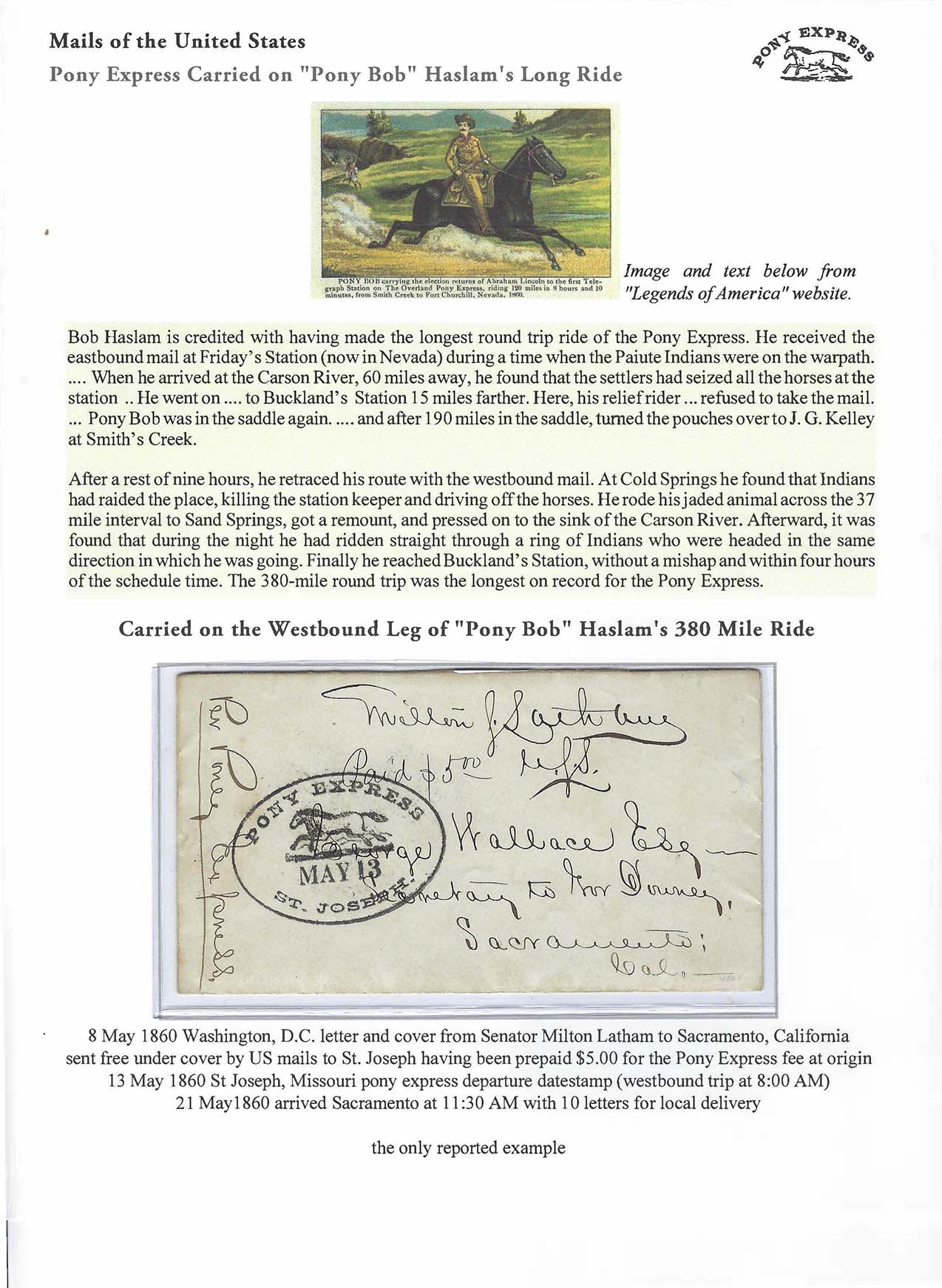 |
|
Send note to Staff
|
|
|
Pillar Of The Community
United States
4443 Posts |
|
|
The above comments well discuss the possibilities for most covers of the size #10 and below. That discussion applies to post cards and postal cards as well. The non-mentioned addendum I would add is for mailing tags. They can be fit three to a page thus a 3s, clear or black page works. Some smaller tags and small covers can even fit a four row page. Now for other size covers and wrappers. Lighthouse and other makers have many size pages. With Lighthouse, the pages fit various album systems. Maxima is their largest can handle 329 x 327 mm (13" x 13" or so) covers. The larger sized pages are four ring rather than 3. But you can generally put smaller pages into large albums when desired. One of the larger sizes I like allow for me to slip in an entire Hagner stock page. This allows me to mix different size covers in the 1S (one pocket) pages. While Hagner makes all the usual 1, 2, 3 etc strip pages, it make one other. The is a page for a cover at the bottom, blocks of four in the middle and singles at the top. In short it is a three strip sheet with three different size mounting strip. Not all covers worth collecting are small. See: https://goscf.com/t/75555&whichpage=2 for a Christmas package (the wrapper is larger than shown in the illustrations). I published an article about the package wrapper. To summarize, the Christmas package was sent parcel post with Special Handling (to speed fourth class transit) from Los Anglese to San Fransisco in September, 1944 constant with the Christmas mailing deadlines. How far west the package was carried from San Francisco is unknown, but from that point it returned east to Washington, DC for sending to the surviving family members of the service man, J.P. Goggins CBM, killed in action. In this case also the sender. The intended recipient was Chief Boatswain's Mate J.P. Goggins. Boatswain's mate duties are to keep the ship neatly painted, in repair and seaworthy; in short, upright and operational under any conditions. These are rather continuous but not highly challenging activities normally, except when they aren't. The CBM oversees and directs the ship's BMs. October 25, 1944 was however when the job was most challenging. J.P. Goggins, CBM was onboard the USS Hoel on the morning of October 25, 1944 when the small group of ships in Taffy 3 (escort carrier task group) stumbled upon the main battle force (Central Force) of the Japanese Imperial Navy with Vice Admiral Takeo Kurita on his flag ship the super battleship Yamato. This, the largest battleship made, had a greater displacement than all of the Taffy 3 ships combined. The Japanese Center Force besides the Yamato, consisted of the battleships Nagato, Kong#333;, and Haruna; heavy cruisers Ch#333;kai, Haguro, Kumano, Suzuya, Chikuma, Tone; light cruisers Yahagi, and Noshiro; and 11 Kager#333;-, Y#363;gumo- and Shimakaze-class destroyers. All were armored to withstand the largest guns of the Taffy 3 ships. Destroyers Johnson and Hoel with the smaller destroyer escort Samuel B. Roberts, all charged and directly attacked the Japanese fleet. Hoel was the first of the three lost. Hoel both fired at the Yamato causing it to turn and was hit one of the only ship ever struck by shells of the Yamato. Commander Kintberger described the courageous devotion to duty of the men of the Hoel as "Fully cognizant of the inevitable result of engaging such vastly superior forces, these men performed their assigned duties coolly and efficiently until their ship was shot from under them." Taffy 3 received a Presidential Unit Citation which read, "For extraordinary heroism in action against powerful units of the Japanese Fleet during the Battle off Samar, Philippines, October 25, 1944. ... the gallant ships of the Task Unit waged battle fiercely against the superior speed and fire power of the advancing enemy, ... two of the Unit's valiant destroyers and one destroyer escort charged the battleships point-blank and, expending their last torpedoes in desperate defense of the entire group, went down under the enemy's heavy shells as a climax to two and one half hours of sustained and furious combat. The courageous determination and the superb teamwork of the officers and men who fought the embarked planes and who manned the ships of Task Unit 77.4.3 were instrumental in effecting the retirement of a hostile force threatening our Leyte invasion operations and were in keeping with the highest traditions of the United States Naval Service." Naval historians considered this battle, the Battle off Samar between Taffy 3 and the Imperial Japanese navy Central Force one if not the most lopsided battles and greatest last stand battle in the history of naval warfare. After that day, the Imperial Navy was never the same. Taffy 3 attacked so fiercely, that the Japanese though they had stumbled upon a main carrier battle task force. |
|
Send note to Staff
|
|
|
Valued Member
United States
46 Posts |
|
|
Hi Lady Grace, there are so many ways of storing covers and most are mention in this thread. I should mention that I am a worldwide collector and have a lot of covers/stamps by country albums. I used to keep covers by country in a picture box with dividers between each country. I would end up with 20-30 boxes of covers. It was very painful to keep track of the covers that way. I then moved to cover albums. I labeled the album by country name and put the cover album with the country album of stamps. I am about half way done with that project. I usually buy the cover albums at my local stamp club auction or at stamp shows. I stay away from the albums that were issued from postal commemorative societies because the covers tend to sweat and stick in the pouch. |
|
Send note to Staff
|
|
|
Bedrock Of The Community
Australia
38679 Posts |
|
|
Quote:
Below is an example of a page I made for a client.
Thank you very much !  First time in 20 odd years, I have seen such a post. It is both informative, and fascinating, to see and learn how those whom we respect, do it. Quote:
I can mount the cover directly on 85 pound, acid free stock using a Kanguru mount How would this be done? Are Kanguru mounts self adhesive? Google failed to show the Kanguru text string. |
|
Send note to Staff
|
| Edited by rod222 - 03/24/2022 4:02 pm |
|
|
Replies: 25 / Views: 4,631 |
|
|
To participate in the forum you must log in or register. | |
 1c Franklin Archive Website New Book: "masterpieces Of The Mail, 1775-1875" Trying To Determine What Canadian King Edward Pre-Stamped Envelope I Have 2c Gun Apparent Harvey Ill Precancel With Additional Lettering Loyd's Penny Post Genuine Or Forgery 1c Franklin Imperf - Help Please Kem Playing Cards Still Sealed, Year? Help With 3 Cent Queen Victoria Stamp Type/Color? Nashville Philatelic Society-Your Invitation To Our Auction Night Meeting Monday, September 28, 2026 Serbia 2025 - Second Half Of The Year: The Strand Stamp Fair Closes After 57 Years Don't Use Magic Photo Albums For Stamps Egyptian And Near Eastern Mythologies Norse Mythologies On Stamps Last Of My Australian Recent Charity Kiloware Has Happened Foreign Exchange Control Board Indypex 2026, September 18, 19, And 20, 2026 Value Question: Full Sheet, Austria Scott # 840A-H, Issued 5'24'1969. Wanted: On-Cover Solo Uses Of United States 14¢ American Indian Stamp Portuguese 1910 Overprinted "republica" Forgeries Stamp Data On The Internet Or Elsewhere Looking To Change My Avatar Slovakia 2025 Year Issue: Help With 10 Cent Daniel Webster Stamp Germany Michel #110 Color 1c Franklin Archive Website New Book: "masterpieces Of The Mail, 1775-1875" Trying To Determine What Canadian King Edward Pre-Stamped Envelope I Have 2c Gun Apparent Harvey Ill Precancel With Additional Lettering Loyd's Penny Post Genuine Or Forgery 1c Franklin Imperf - Help Please Kem Playing Cards Still Sealed, Year? Help With 3 Cent Queen Victoria Stamp Type/Color? Nashville Philatelic Society-Your Invitation To Our Auction Night Meeting Monday, September 28, 2026 Serbia 2025 - Second Half Of The Year: The Strand Stamp Fair Closes After 57 Years Don't Use Magic Photo Albums For Stamps Egyptian And Near Eastern Mythologies Norse Mythologies On Stamps Last Of My Australian Recent Charity Kiloware Has Happened Foreign Exchange Control Board Indypex 2026, September 18, 19, And 20, 2026 Value Question: Full Sheet, Austria Scott # 840A-H, Issued 5'24'1969. Wanted: On-Cover Solo Uses Of United States 14¢ American Indian Stamp Portuguese 1910 Overprinted "republica" Forgeries Stamp Data On The Internet Or Elsewhere Looking To Change My Avatar Slovakia 2025 Year Issue: Help With 10 Cent Daniel Webster Stamp Germany Michel #110 Color
Journey To The West - The Adventures Of Monkey King What Did You Do Philatelically: Today Or Recently? Pushing 330,000 All Different Worldwide Stamps In One Collection . Loyd's Penny Post Genuine Or Forgery Trying To Determine What Canadian King Edward Pre-Stamped Envelope I Have Serbia 2025 - Second Half Of The Year: 1c Franklin Archive Website New Rule - Postmark Doesn't Necessarily Reflect The Date USPS First Accepted Possession Of The Mail Sweden Stamp Engravers Do You Have Any Earth Day Or Conservation Stamps? Odd Shapes On Stamps (Including Hexagons) New Book: "masterpieces Of The Mail, 1775-1875" Pottery, Ceramics, Porcelain, And Other Clayware Spain Stamp Engravers Cover Calendar For Month And Day -Pics Postmarks.day By Day One Cent Franklin Perf. Vertically W/ 5 Holes - St Louis MO 2c Gun Apparent Harvey Ill Precancel With Additional Lettering Computers, Electronic Devices, Software, Information Technology, And Internet On Stamps Joint Or Multiple Country Issues Bats On Stamps? What Are Some Red Cross Stamps That You Have?? A Horse Is A Horse, Of Course, Of Course... (Part 2) Gotta Love Those Dogs! What A Doll!
Disclaimer: While a tremendous amount of effort goes into ensuring the accuracy of the information contained in this site, Stamp Community assumes no liability for errors. Copyright 2005 - 2026 Stamp Community Family - All rights reserved worldwide. Use of any images or content on this website without prior written permission of Stamp Community or the original lender is strictly prohibited.
Privacy Policy / Terms of Use Advertise Here |
| Stamp Community Forum |
© 2007 - 2026 Stamp Community Forums |
| It took 0.27 seconds to lick this stamp. |
 |
|
|
|


 Posted 03/08/2022 6:02 pm


