Per a request from Rod in
this thread, here's a bit more on the Atoll Post of the German Marshall Islands. Most of this comes directly from Albert Friedemann's master work,
Die Postwertzeichen und Entwertungen der deutschen Postanstalten in den Schutzgebieten und im Ausland (The Postage Stamps and Cancellations of the German Postal Authorities in the Colonies and Post Offices Abroad), 4th and final edition, 1988, English translation by the German Colonies Collectors Group.
On 15 October 1885, the Marshall Islands were declared a German protectorate (Marshall-Inseln) with Jaluit as the capital. The administration of the colony, however, was largely left to private German trading companies within the islands, with only an Imperial Commissioner, or Landeshauptmann, appointed by the German government. The costs of administering the territory soon became a burden on the trading companies, and in 1887, the Jaluit Company was founded to centralize the administration under a single commercial entity. The Marshalls would remain under the administration of the Jaluit Company until 1 April 1906, when the German government formally took over.
During this period, there was a single post office within the colony, at the capital of Jaluit (opened 29 March 1889, closed upon capture on 29 September 1914).
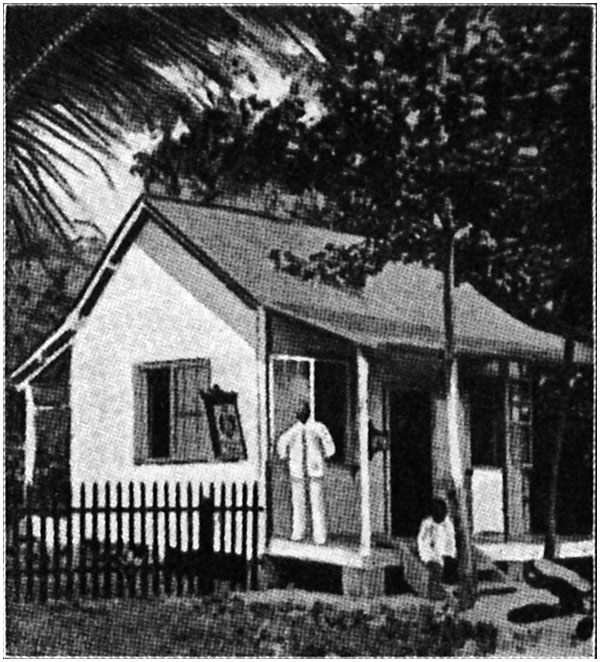 Jaluit PO
A second would eventually open at Nauru (opened 14 July 1908, closed upon capture on 6 November 1914), but that is after the events of this little story.
When the Jaluit postal agency was opened on 29 March 1889, there was no formal policy for the handling of mail from the other islands within the colony. Mail that made it to Jaluit was franked and cancelled appropriately and placed on ships departing Jaluit, but mail service within the atolls and islands was informal. Items were routinely carried by intra-island shipping traffic with no franking, no cancellations, and without ever entering a proper postal system.
On 25 June 1902, the Imperial Commissioner issued a new directive governing the mail service within the colony. By the terms of this directive, Jaluit was to be the only point of departure for mail leaving the colony, to ensure that mail was properly franked, cancelled, and controlled.
Additionally, and more importantly for this post, the captain of each ship operating within the colony was now obligated to receive and transport mail at all atolls within the colony. An additional directive of the same date directed the procedures to be followed:
Quote:
Mail received shall have a legible address and correct franking. When possible the sender will be required to correct any noticeable deficiency. For each registered article of mail the sender will be given a receipt. It must be legibly made out without alteration and signed by the captain or his representative. Forms of registered mail receipts are to be safeguarded, so that they do not fall into the hands of unauthorised persons.
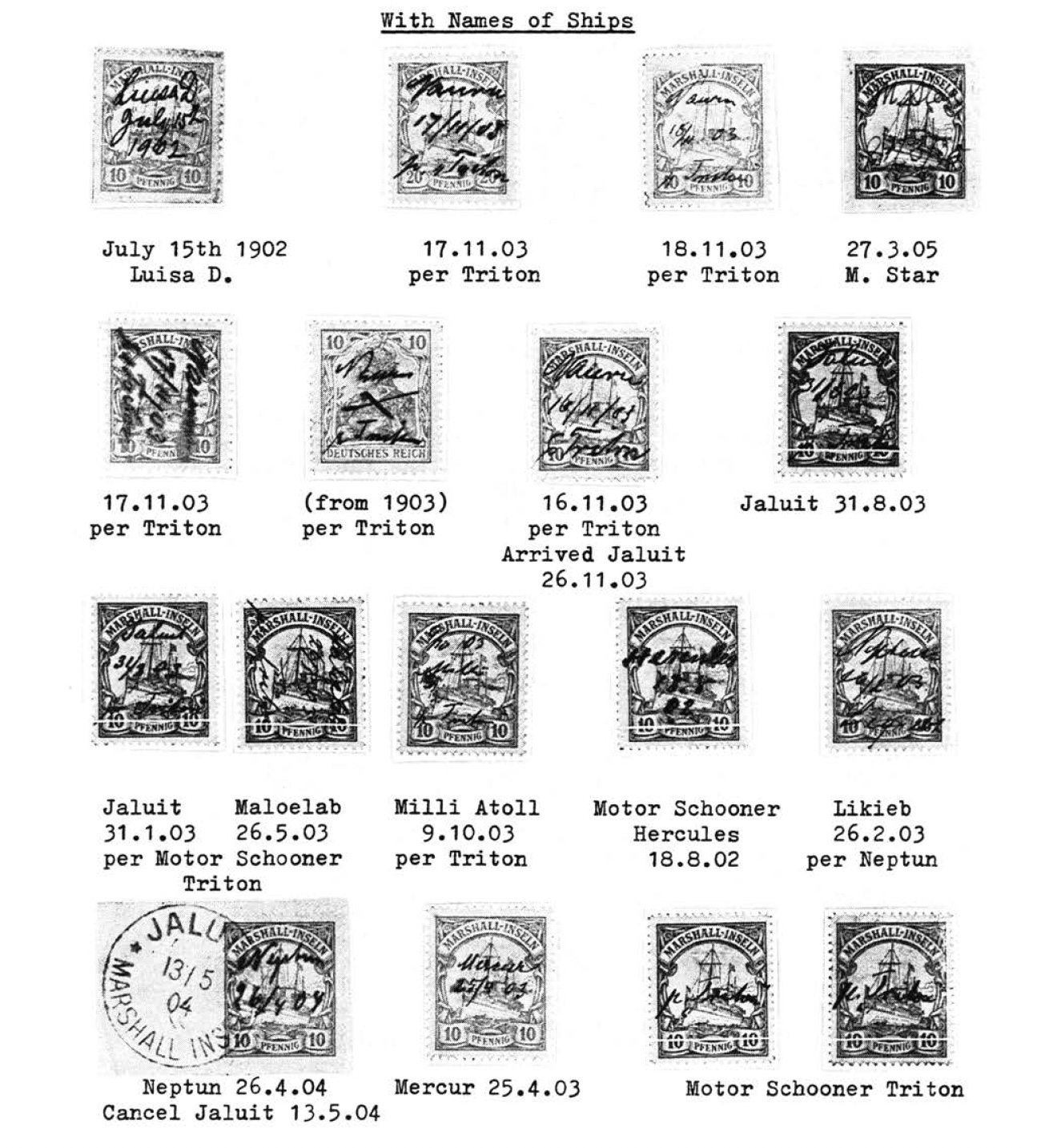
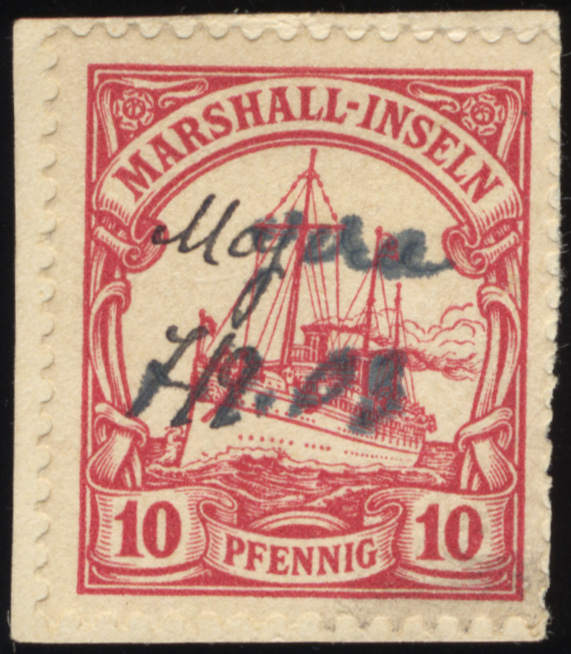
All letter mail is to be marked with the acceptance date and the name of the ship, preferably on the postage stamp. An example would be
Merkur
25.6
02
If more stamps are to be used for franking the additional ones may be written over by an ink cross.
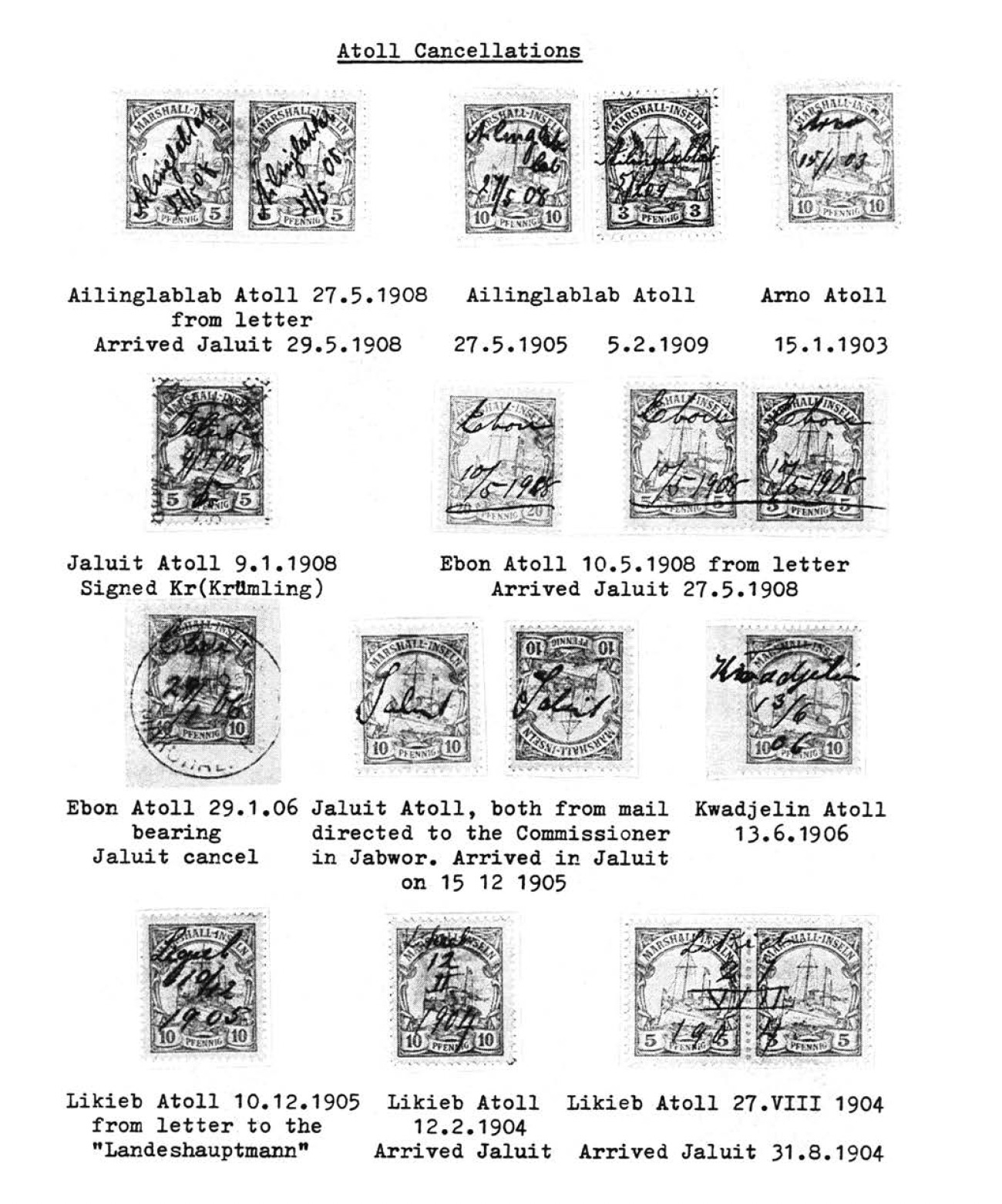
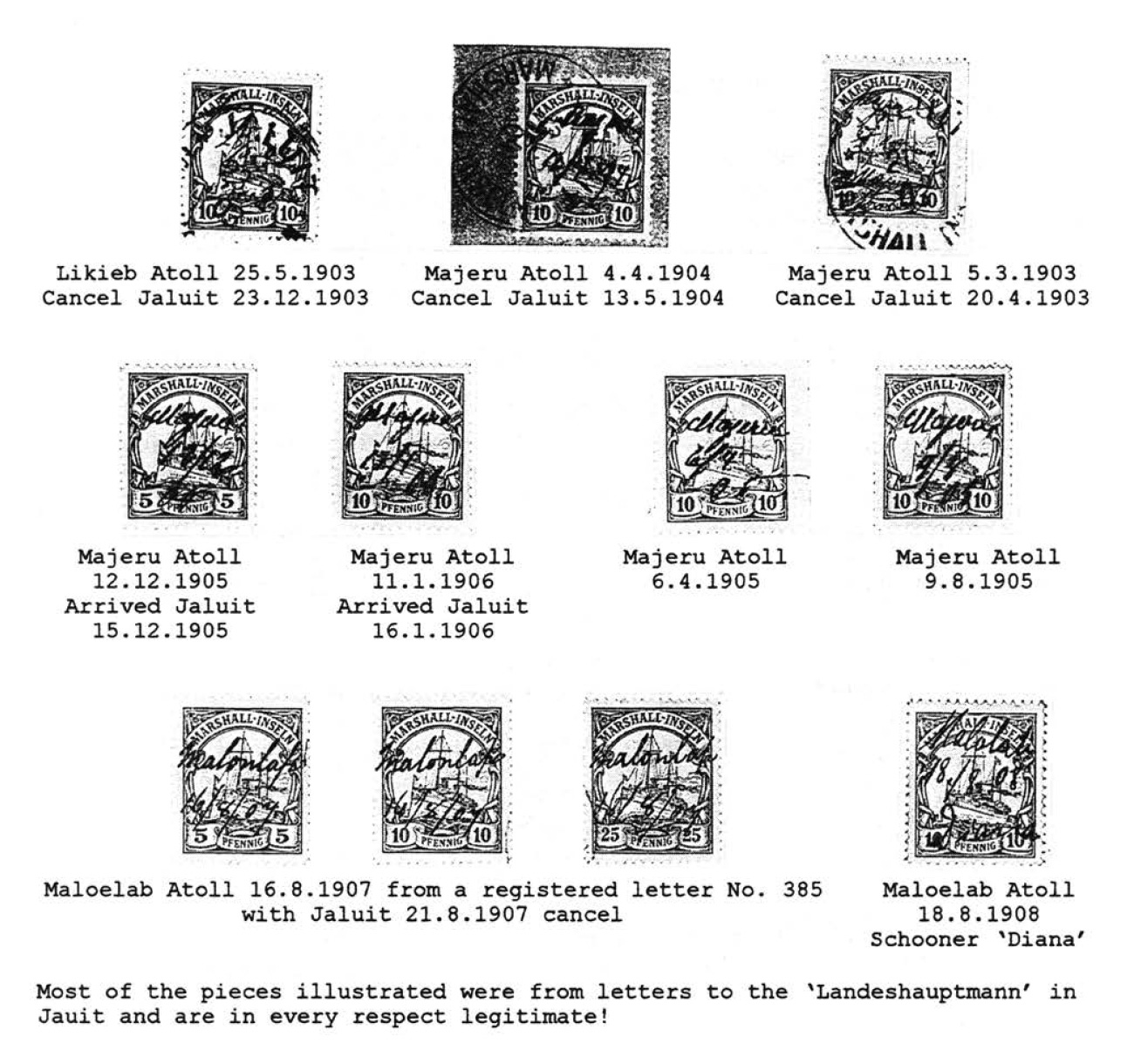
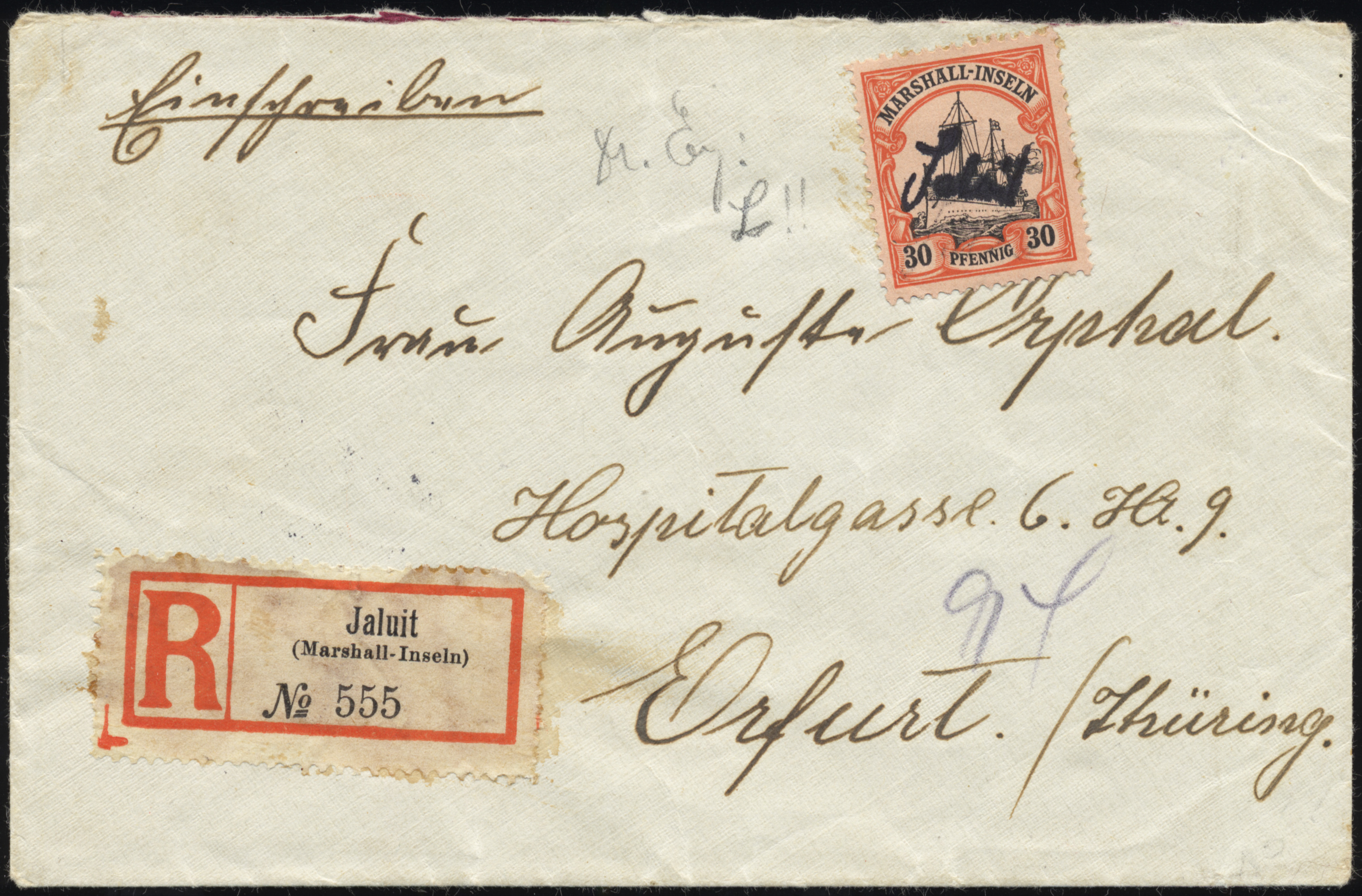
Thus began the "Atoll Post." Ships traveling within the atolls/islands of the colony would pickup and drop-off mail as they had before, but now from officially designated agents, and with proper franking and cancellation. Though the directive stated that the manuscript cancels should include the ship's name, the name of the atoll was often substituted. Mail that was strictly intra-atoll rarely received a proper circular cancel, unless directed to Jaluit or routed through Jaluit on its way to a destination outside the colony.
The Atoll Post system remained in place until the fall of the colony at the outbreak of WWI. However, most cancellations from late 1907 onward are difficult to certify as being legitimate due to outright abuse of the system beginning in late 1907.
Friedemann characterizes all Atoll Post items into one of five categories:
1. Legitimate pieces — these occur almost exclusively until early 1907. Certain vessels made limited trips, and only during the early period, so stamps with cancellations from these vessels are presumed legitimate. These vessels are the steamers
Hercules (until 15 Dec 1905),
Neptun (about 1906),
Luisa D. (only 1902),
Merkur (903), and the American missionary ship
Morning Star (1905). These items are primarily 5- and 10-Pfennig stamps, as those were the proper rates, with an occasional 20 Pf. Senders and recipients were officials, missionaries, trading firms, and the occasional private person. From early 1907, legitimacy can generally only be determined for those stamps on pieces or full postcards/letters with enough information to verify dates, ships, and parties.
2. Philatelic pieces — beginning in mid/late 1907, the philatelic abuse of the Atoll Post began, and these items are the result. They are mostly from 1908 and 1909. Stamps of values other than 5-, 10-, and 20 Pfennig are always philatelic or worse. Because the names of those involved in the large-scale philatelic creation of these items are largely known, philatelic items on full cards/letters are easy to identify.
3. Wholesale forgeries — these originate from 1908 on the ship
Diana with the name of the atoll written by Captain Jeschke of the
Diana, and from 1909 on the ship
Eanijen Rakijen by Captain Krümling. The
Diana cancellations are often in red ink, though colored inks were not legitimately used. These ships did call on the atolls, but the stamps and cancellations they created were never actually passed through the mail.
4. "Objectionable" cancellations — cancellations applied by ship captains in Jaluit with names of atolls from which the mail never originated and the ships didn't service.
5. Forgeries — cancellations created in Jaluit by persons with no authority to do so, primarily in 1908 and 1909.
In general, if you see a manuscript cancellation from mid/late 1907 onward, it probably wasn't a legitimate Atoll Post usage.
There were 33 atolls in total that were serviced with mail traffic during the period. Manuscript cancellations are known from the following, in addition to those cancelled with the ship name instead:
Ailinglablab, Ailuk, Arno, Aur, Ebon, Jaluit, Kwadjelin, Lae, Likieb, Majeru, Maloelab, Medjit, Mille, Namerik, Nauru, Providence Island, Udjae, Udjrik, Wodje
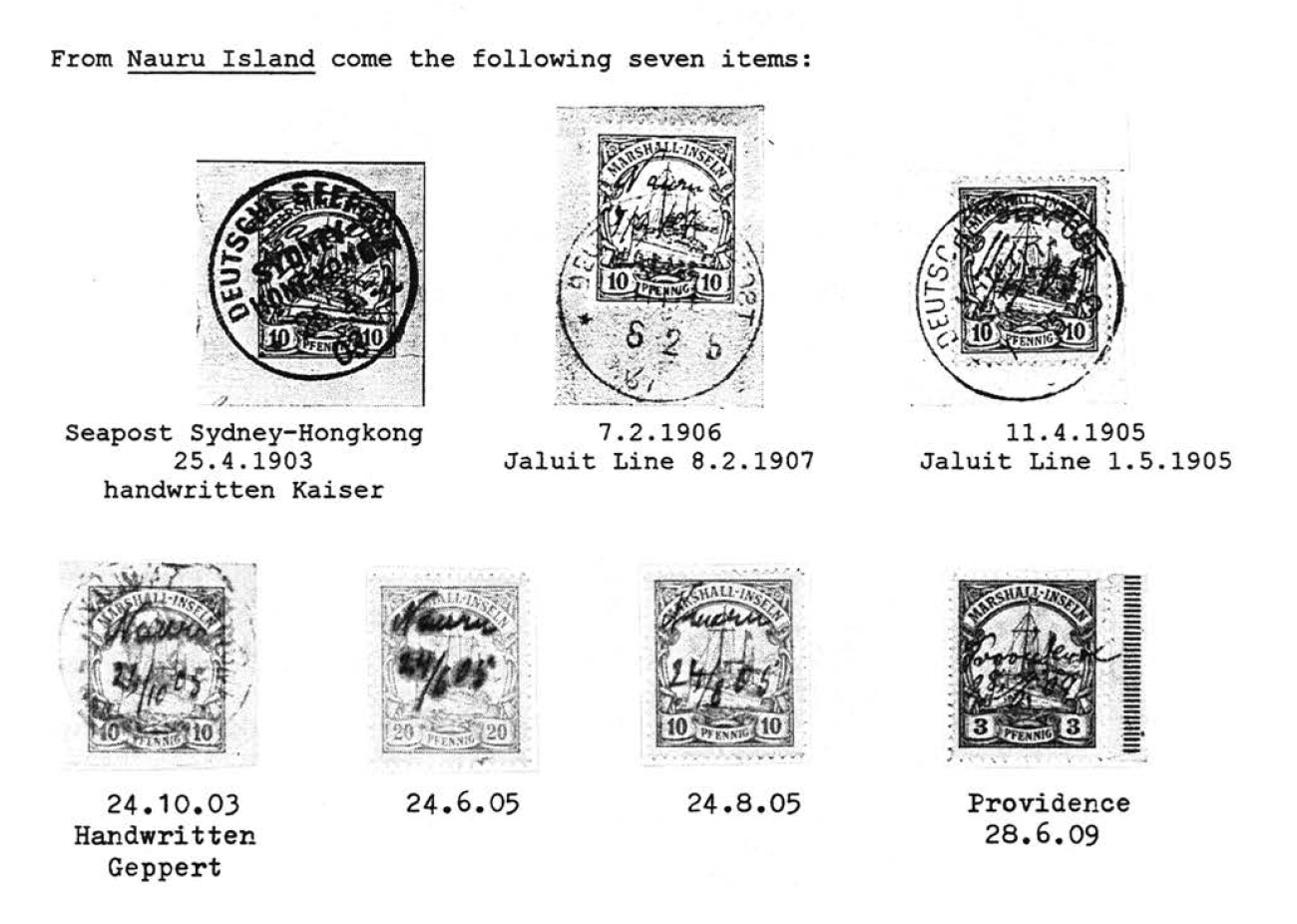
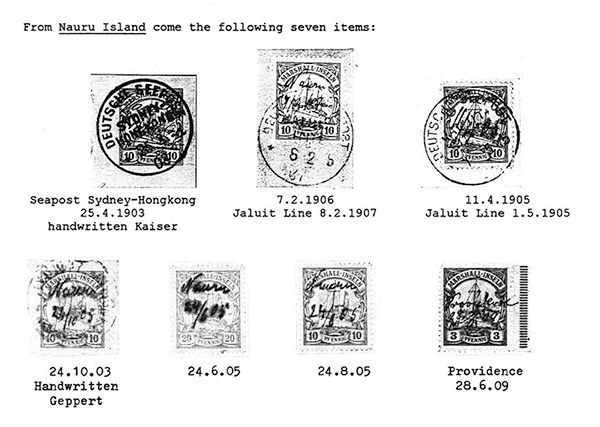
Friedemann then gives a large number of examples of items known to be legitimate and known to be forgeries.
Legitimate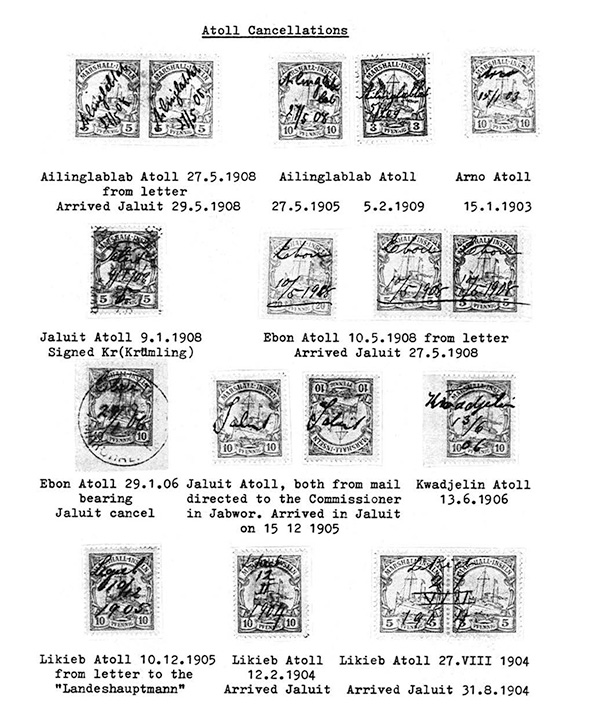
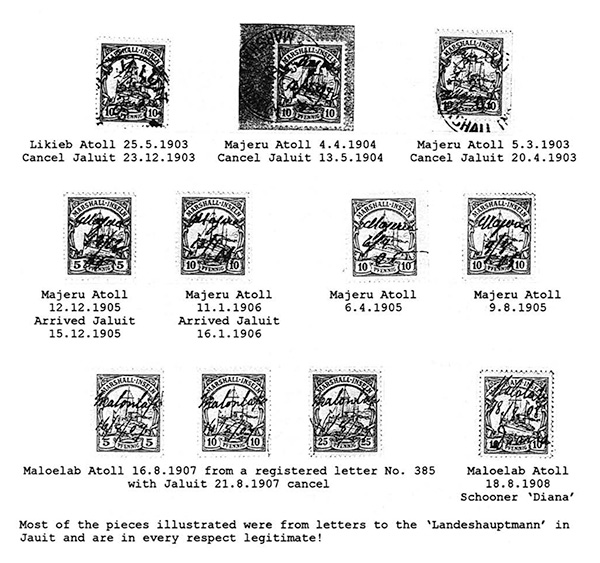
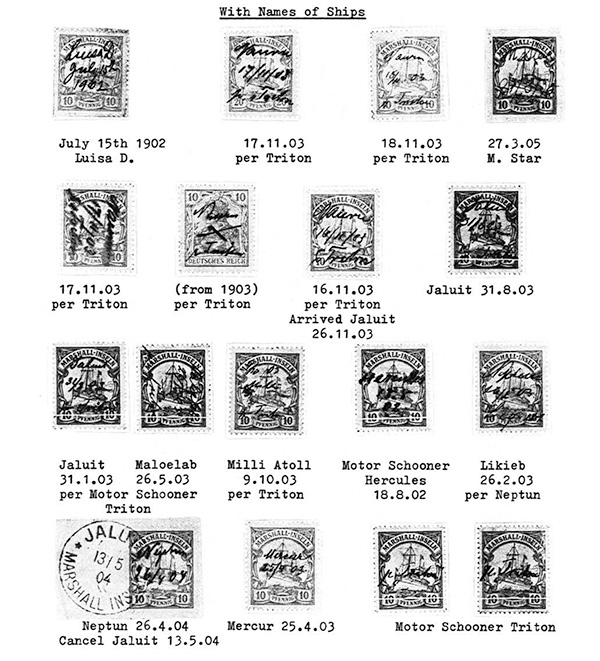
Forgeries are known from
Eanijen Rakijen from the following:
Arno (27 Mar 09)
Milli (1 Apr 09)
Majeru (4 Apr 09)
Aurh (7 Apr 09)
Wotje (9 Apr 09)
Likieb (11 Apr 09)
Kwadjelin (13 Apr 09)
Wottho (7 Apr 09)
Ujaie (18 Apr 09)
Lai (20 Apr 09)
Lib (23 Apr 09)
Namu (24 Apr 09)
Ailinglaplap (26 Apr 09)
And from the
Diana:
Majeru (4 Aug 08)
Arno (8 Aug 08)
Maloelab (18 Aug 08)
Aurh (19 Aug 08)
Milli (2 Sep 08)
Ebon (6 Sep 08)
Namoril (8 Sep 08)
I have two legitimate copies in my collection.
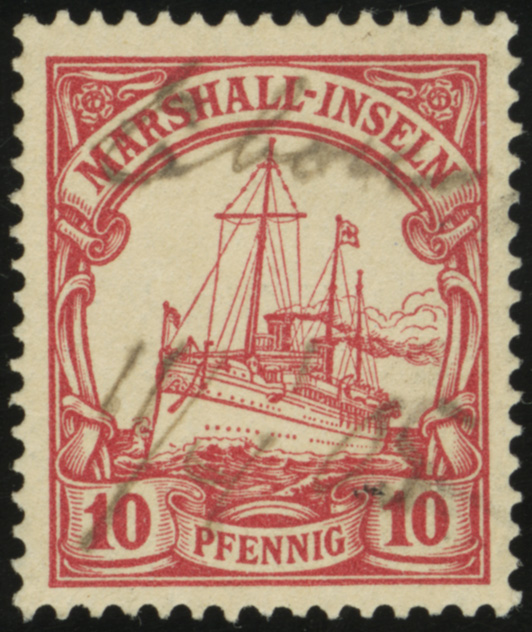
This one is from Ebon, 11 Apr 1905.
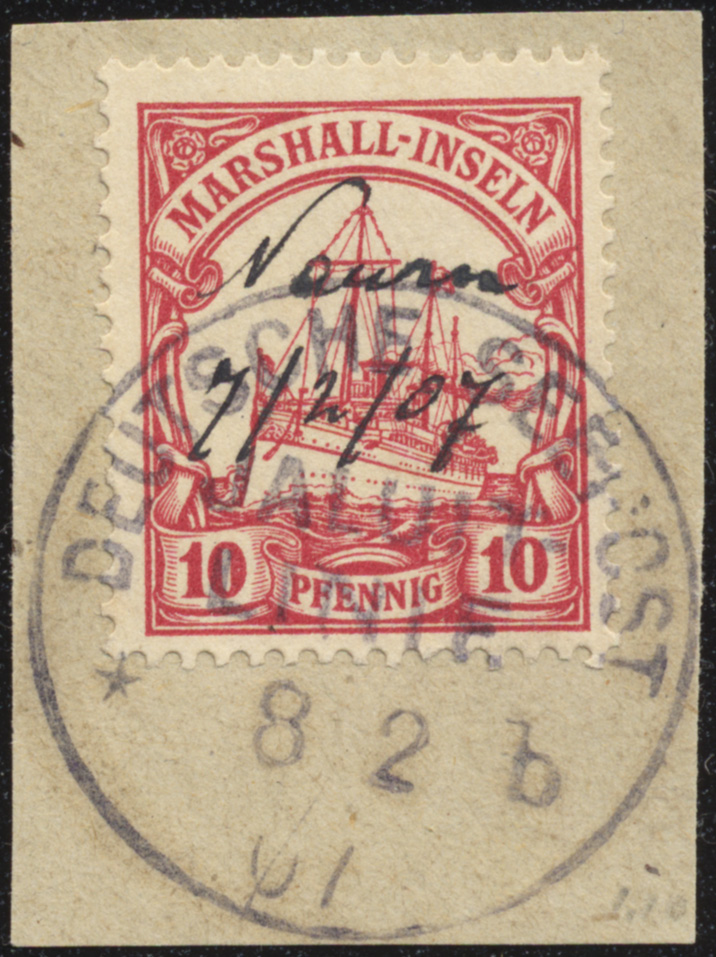
And this one is from Nauru (7 Feb 07), transiting to the Jaluit Linie (8 Feb 07). This copy is also from the same date and location as one of those illustrated by Friedemann in his original work (see above in the Nauru example, top row, middle stamp).
Also, for anyone particularly interested in this topic, please consider supporting or joining the German Colonies Collectors Group.





 Posted 04/10/2022 10:15 am