|
This page may contain links that result in small commissions to keep this free site up and running.

Welcome Guest! Registering and/or logging in will remove the anchor (bottom) ads. It's Free!
To participate in the forum you must log in or register.
| Author |
 Replies: 79 / Views: 7,011 Replies: 79 / Views: 7,011 |
|
|
|
Valued Member
Japan
385 Posts |
|
|
Quote:
...and is rendered semi-transparent by the resins used in the manufacturing of the paper. Thank you for confirming that, essayk! Since we know that a resin was used, it gives us a better idea of how the paper sits, reacts to ---, feels, etc. in difference to an otherwise ordinary piece of 'very thin paper'. This is what I mentioned before instinctually and not knowing the facts.. I think that if an angled picture were taken of your essay it would look similar to this: 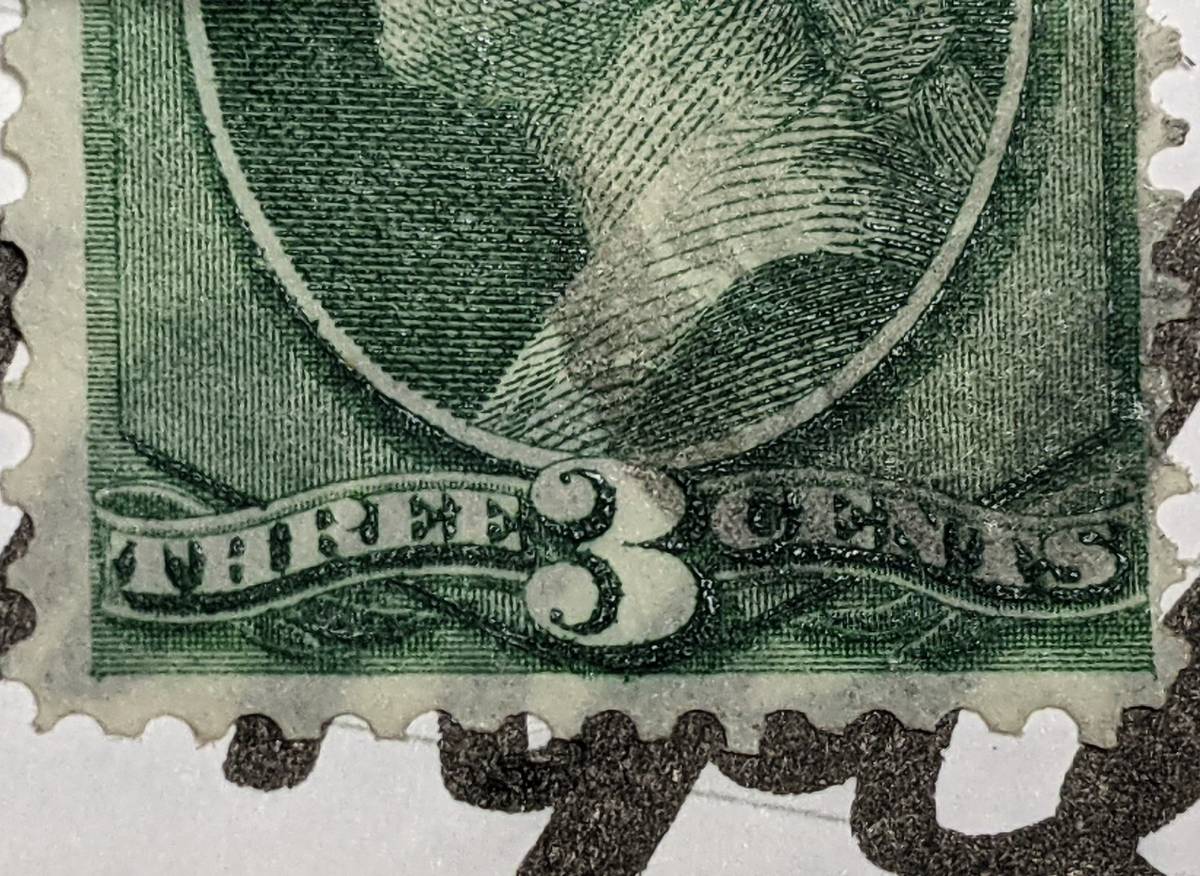 Scans are nice, but they don't pick up the potential glossiness of the paper or apparent 'wetness' of ink that a camera is able to provide. This is because a scan encompasses it in light rather than letting the light bounce around. Quote:
I think that in the case of papers a feel is at times worth a thousand words. I think you're 100% right, Roger. It can especially be challenging to explain on a forum. |
Send note to Staff 
|
|
|
Pillar Of The Community
United States
1946 Posts |
|
|
Stephen-P you have shown us essentially the same pics over and over, and we get it that you are convinced this is pelure paper. But you have not shown us your credentials as a paper chemist, and until you do you need to have it analytically tested with instrumentation like the VSC-6000 so your intuitive impressions can be analytically tested and verified. That has already been done for the papers associated with the Bowlsbly essays so we have those results for confirmation.
If sending it to the PF is out of the question, then submit it to a lab in Japan under the advice of someone local who knows the ropes. Technical testing of this kind has been done at the PF for quite some time, and there is a paper institute in Tokyo that might be able to help, or direct you locally.
Guess work is no substitute and in the face of available alternatives just doesn't cut it. We have been hinting at that all along, but you don't seem to get it. Tell the lab what you need and see if they can accommodate.
Remember that "philately" is the scientific pursuit of stamp collecting. |
|
Send note to Staff
|
|
|
Valued Member
Japan
385 Posts |
|
|
Oh! I thought for the time being you wanted me to compare the ones you posted. I was very appreciative of you doing that, and is why I purchased the same scanner as yours. Sorry, I'm a little slowww  I've found one grading service called Mizuhara Philatelic Foundation, and they claim that Quote:
The Committee, when applicant agrees, can request the expertising service of expert organization in foreign countries, etc, when necessary. So maybe there's hope there. There's also a philately study group called the JPS braving 30,000 members in Japan alone. I'll probably start there in asking what steps I should take before I throw money in random directions. Thanks for the help! |
|
Send note to Staff
|
|
|
Bedrock Of The Community
12776 Posts |
|
|
Valued Member
Japan
385 Posts |
|
|
Most Japanese banks (particularly mine) discontinued their relationship with PayPal!
This country was one of the hardest hit from online phishing scams, and has essentially been replaced by a company called "PayPay", which unfortunately is only accepted within Japan. |
|
Send note to Staff
|
| Edited by Stephen-P - 04/15/2023 09:23 am |
|
|
Pillar Of The Community
United States
1946 Posts |
|
|
Stephen-P there is a tool that I highly recommend for you that will prove most useful in the kind of stamp study you seem inclined to do. It is a particular type of paper micrometer called a "dial thickness gauge." This is a spring loaded device that delivers a more uniform pressure on the calipers than you can usually get from a gauge you set by hand. Mine is a Mitutoyo unit made by a company in Tokyo which I have used for over 20 years. You might check with them for up to date options. I checked on currency exchange, and learned that WISE is recommended for yen to dollar conversion for shipping money out of Japan. Probably not as cheap as Paypal may have been, but apparently still in operation after the name change (from Transfer Wise). You might look into it. The fact that the PF has a VSC6000 unit and personnel trained in its use gives them a bit of an edge. (However, I have heard rumors that PSE now has one as well.) This is needed to help isolate special characteristics in the detailed examination of documents. Here is an info link: https://fosterfreeman.com/questione...examination/. At present you are not going to be able to distinguish between pelure paper and very thin paper with a distinct matrix. This machine will get around that non-destructively. |
|
Send note to Staff
|
| Edited by essayk - 04/15/2023 2:25 pm |
|
|
Pillar Of The Community
United States
1946 Posts |
|
|
Back in 2002 the late Calvet Hahn wrote this about pelure paper in his long discussion about paper: Quote:
Pelure paper is generally a misused term in classic U.S. philately. The true pelure papers are found on the Hawaiian missionary stamps, a thin, crisp, hard, transparent paper with a bluish or grayish tinge that is quite brittle. What are normally termed 'pelure' papers in U.S. classic philately are 'thin' sheets of paper, created deliberately to make up the correct weight of a ream of paper, the measure by which it is normally sold.
For example in the first American Letter Mail stamp these thin papers (called erroneously pelure) ranged from 1.8 to 2.2 mils in thickness compared with a normal stamp paper range of 3.2 to 3.7 mils. About fifty sheets of this thin paper were used in the production of the New York provisional adhesive. The thin papers are not brittle or as transparent as true pelure paper. Extra thick paper is also made and can be found among some of the U. S. independent mail adhesives. In the case of the American Letter Mail stamps these ranged from 4 to 4.5 mils in thickness, or about 20% thicker than normal. see the full article here: http://www.nystamp.org/postal-histo...ic-is-paper/His comments targeted the thin papers used in regular production, but do not apply to the specialty "pelure" paper used in proofing, such as shown here for the Bowlsby and PBNCo essay items. |
|
Send note to Staff
|
|
|
Valued Member
Japan
385 Posts |
|
|
Wow, this is a gold mine of information!! Thank you essayK! So much to comment on here...
1- I'll look into getting a dial thickness gauge from Mitutoyo. It will undoubtedly help with my double papers as well.
2- As for Pelure, correct me if I'm wrong but the article by Calvet Hahn mentions a brittleness that sets it apart from being considered what is basically 'thin paper'. This means that a particular resin must be found for expertization, probably with a machine like the VSC(8000?) as well as measuring the thickness.
That machine is incredible btw. The quotes for obtaining one are quite secretive (as they are used by the FBI and other national security entities), but I found where Indonesia recently paid $250,000 for one unit.
I think the PF would indeed be the best choice if they have such a device, I only wish they would confirm that they'll even use it in this instance and actually take such a far-fetched claim seriously enough.
The piece by Hahn was extremely fascinating (I read about 80% through), but it does not detail specifics of material used in Pelure paper as it does with the other paper types.
Do you know of any literature stating the exact formula?
An alternative may be as you stated earlier to find a lab that can provide analytical data, or possibly a company that offers the services of an VSC8000, but I may need to request what to test for specifically seeing as how the device covers a wide range of functionality.
3- WISE looks very promising, and with unbelievable rates! I pray that the PF accepts their service as payment.
If they do, I'll most certainly use them for varieties already catalogued in Scott, but may save the supposed pelure for a lab more dedicated to the paper itself... Does that sound logical? |
|
Send note to Staff
|
|
|
Bedrock Of The Community
12776 Posts |
|
|
PF, PSE and Greene (BNA stamps) have the VSC6000. Foster + Freeman no longer makes the 6000 but now manufacture the 8000. Unless you are in LE it probably makes little difference.
There is no government agency authorized use requirement to purchase a VSC8000 and in fact F+F loaned one to the Royal Philatelic Society for Stockholmia 2019. |
|
Send note to Staff
|
|
|
Pillar Of The Community
United States
1946 Posts |
|
|
Thanks to rogdcam for the confirmation and update on the VSC machines. Part of the reason I would lean toward the PF for US material in matters like this is that they have had the machine long enough to have several staff members trained in its use. But in addition they have what started out as the Luff reference collection and have expanded it in the years since they first came into possession of it. I suspect that they have examples of the various kinds of pelure paper used with US material to use for machine calibration and matching. Perhaps Bill Crowe could comment on that. I have a call out to Larry Lyons on another matter but will ask him about WISE acceptance when I get the chance. As for the question about the "formula" for pelure paper, I have already mentioned that there are different kinds. Pelure is a paper type classed by its appearance and performance. Paper manufacturers no doubt contrived their own versions which were marketed competitively. As I had said earlier, the pelure paper of the Philadelphia Bank Note Company essays is not identical to that used for the Bowlsby tests from an earlier time. For that reason, comparisons must be made type to type as much as possible. This is where things get sticky for the issued stamps of Continental. Since we have no record that pelure paper was officially sanctioned for regular production use by Continental, we must first determine whether or not issued paper samples from used stamps on a more translucent paper are made from the same material as normal stamps (preferably without destroying the samples in the process).  This is where the machine testing becomes critical, along with the results from earlier testing of similar subjects. This is why getting the stamps in question into the hands of the PF is so important, since they have the equipment and the experienced staff and the records and the sample material for the widest range of comparison possibilities. Unfortunately, in the present situation the owner can show us some exceptionally translucent material, but cannot even tell us how thick (or thin) it is, let alone how it is put together. There's not much anyone can say about the material until the right measurements can be made. Until then we can't even speculate that it might be pelure paper since we have no record of such a thing being authorized for public issuance. Unlike simple collecting, philately is the scientific study of stamps. Intuition is great for helping to generate hypotheses, but in scientific study that is also its limit. In this case we have reached the point where we need better tools to settle the question. |
|
Send note to Staff
|
|
|
Bedrock Of The Community
12776 Posts |
|
|
Moderator

United States
12330 Posts |
|
|
I think a VSC basically emulates what an experienced specialist does; controls the ambient lighting and utilizes a reference collection.
A VSC uses a number of ambient lights, some even in the non-visible range. And it is a comparator and totally relies upon other samples that are in its database. (As such, the standard database saying applies, 'garbage in, garbage out'.) I assume that the paper experts at the certification organizations already have years of experience in determining paper types and would rely upon a VSC for verification purposes.
In my experience, hand measuring the thickness of paper is often quite subjective but can get you in the ballpark. I have previously given the same handheld micrometer to ten different people (in an engineering/QA department where 'close enough' doesn't work) and gotten 10 different values. The issue is how hard they close the micrometer down on the paper (some barely touch the paper surface while other squeeze the paper too tight). There are much less subjective approaches in measuring thickness of paper such as laser thickness gauges.
My opinion for our hobby is that a casual collector has one of two choices when it comes to accurately IDing paper;
- Develop our own experience over time by handling large numbers of similar stamps
- Have someone else who has this experience handle the stamp
I think that for those who want to become a paper (or color) specialist, you will have to educate yourself for a significant amount of time. While you build your experience and reference collection, you will ultimately need to verify some of your findings with others (who have your stamps in hand) to make sure you are building accurate experience.
Don
|
|
Send note to Staff
|
|
|
|
Pillar Of The Community
United States
1946 Posts |
|
|
51studebaker wrote: Quote:
In my experience, hand measuring the thickness of paper is often quite subjective but can get you in the ballpark. ... The issue is how hard they close the micrometer down on the paper A similar kind of variability can exist for a single user doing measurements over spans of time. It is precisely for this reason that I prefer, and have recommended, the use of a spring loaded dial thickness gauge instead of a machinists micrometer. There is less variation of force in closing down around the object being measured. The model with a dial costs about $140, and a digital version can be had for about $250. I would not recommend trying to buy a used one with an unknown usage history. 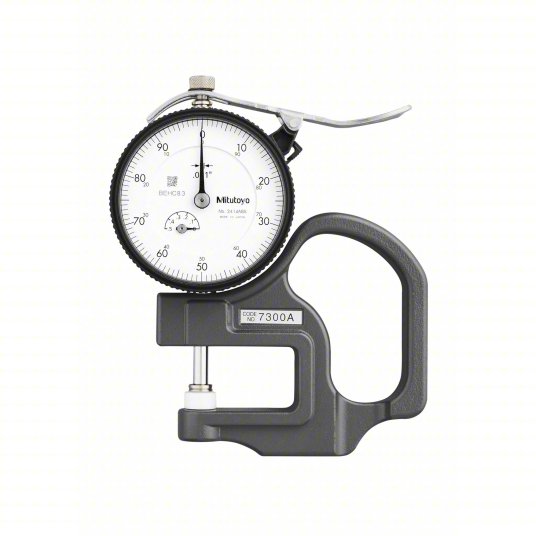 In the model illustrated here the knob at the top allows you to "zero set" the unit if it drifts over time. The key is to keep safe a particular metal blank of measured thickness for use in resetting the measurement standard if the unit has drifted. It is also imperative to clear any particulate debris from the caliper pad faces and check for zero prior to any use session. One thing I should mention is that the caliper pads have a diameter of 1 cm. which is quite broad. Since stamp measurements of paper-only must be made from the edges, such as the measurements John Barwis made for the article rogdcam referenced, the caliper pads must be entirely rigid (metal is best). On another front: I spoke with the PF today and at present the only method for online payment is Paypal. However, I mentioned to them the problem with Paypal in Japan and suggested the WISE workaround, and they are going to look into it. That, however, is not official just yet. |
|
Send note to Staff
|
|
|
Moderator
United States
12330 Posts |
|
|
I agree that a spring loaded dial indicator would be a good investment for anyone who wanted to become a specialist in paper ID paper thickness. I assume the vast majority of collectors do not a have spring loaded dial indicator and would grab the far more common micrometer.
A casual collector could send in 10 stamps for commercial opinions (certs) for the same cost which would get them a fair distance down the road towards verifying their IDs. Additionally, they would then have a cert to accompany the item in event of eventual disposition. Given this, my opinion is that until a person has firmly decided that they are going to dive into the deep end of the paper type specialist swimming pool, they begin by figuring out a way to get some 'stamp in hand' expert opinions. Be friend an existing specialist, go to shows, build relationships with experienced dealers, send in for certs, and spend money on building your own reference collection.
Don
|
|
Send note to Staff
|
|
|
|
Bedrock Of The Community
12776 Posts |
|
|
Unfortunately, I don't think that many, if any, certificates are going to give you any details/information on paper type unless the patient happens to be a Scott listed variety i.e., "very thin paper". |
|
Send note to Staff
|
|
|
Replies: 79 / Views: 7,011 |
|
|
To participate in the forum you must log in or register. | |
 Avatar Change Request 2023 Freedem Stamp. Is This Stamp Fake? Transvaal Postal History Help Earliest Stamp With In-Design Date? My First Stamps Help Newbie.help With Stamp Identification (J29) Inherited These Stamps, Are They Genuine? APS Membership Discount Metropex Stamp Show: Roseville, Minnesota October 23-24 Weird Covers, 1885,1886, And 1982 For Users Of Two-Post Blue International Albums What Is Your Experience With Binders. New Member Posting Image Of Avatar, Front And Back Of U2 Cut Square, Market Value Or References? Working On An Offline Collection George Washington 3 Cent 1861 With Print On The Back Hello From The Netherlands - New Member Then And Now, From Old Postcards New Member Wanting To Add An Avatar Sparks Auction Fees? 163 VF Nyfm Vertically Ribbed 163 XF Quartered Cork, Labeled Jumbo 136 VF Quadruple Split H Grill Nashville Philatelic Society-Your Invitation To Our Auction Night Meeting Monday, October 26, 2026 Nashville Philatelic Society-Your Invitation To Our Meeting Monday, October 19, 2026 Christmas Around The World 2026 C.e. In The Large Queen Cancel Avatar Change Request 2023 Freedem Stamp. Is This Stamp Fake? Transvaal Postal History Help Earliest Stamp With In-Design Date? My First Stamps Help Newbie.help With Stamp Identification (J29) Inherited These Stamps, Are They Genuine? APS Membership Discount Metropex Stamp Show: Roseville, Minnesota October 23-24 Weird Covers, 1885,1886, And 1982 For Users Of Two-Post Blue International Albums What Is Your Experience With Binders. New Member Posting Image Of Avatar, Front And Back Of U2 Cut Square, Market Value Or References? Working On An Offline Collection George Washington 3 Cent 1861 With Print On The Back Hello From The Netherlands - New Member Then And Now, From Old Postcards New Member Wanting To Add An Avatar Sparks Auction Fees? 163 VF Nyfm Vertically Ribbed 163 XF Quartered Cork, Labeled Jumbo 136 VF Quadruple Split H Grill Nashville Philatelic Society-Your Invitation To Our Auction Night Meeting Monday, October 26, 2026 Nashville Philatelic Society-Your Invitation To Our Meeting Monday, October 19, 2026 Christmas Around The World 2026 C.e. In The Large Queen Cancel
Disclaimer: While a tremendous amount of effort goes into ensuring the accuracy of the information contained in this site, Stamp Community assumes no liability for errors. Copyright 2005 - 2026 Stamp Community Family - All rights reserved worldwide. Use of any images or content on this website without prior written permission of Stamp Community or the original lender is strictly prohibited.
Privacy Policy / Terms of Use Advertise Here |
| Stamp Community Forum |
© 2007 - 2026 Stamp Community Forums |
| It took 0.23 seconds to lick this stamp. |
 |
|
|
|


 Posted 04/13/2023 1:21 pm


