Stamp Community Family of Web Sites
Thousands of stamps, consistently graded, competitively priced and hundreds of in-depth blog posts to read


Stamp Community Forum
 
Username:
Password:
Save Password
Forgot your Password?

This page may contain links that result in small commissions to keep this free site up and running.

Welcome Guest! Registering and/or logging in will remove the anchor (bottom) ads. It's Free!

Danish West Indies 3 Cents

Previous Page | Next Page    
 
To participate in the forum you must log in or register.
Author Previous TopicReplies: 34 / Views: 2,742Next Topic
Page: of 3
Pillar Of The Community
Netherlands
6526 Posts
Posted 05/06/2023   09:02 am  Show Profile Bookmark this reply Add NSK to your friends list  Get a Link to this Reply
It might be the watermark and not a cancellation.
Send note to Staff  Go to Top of Page
Pillar Of The Community
Learn More...
United States
5460 Posts
Posted 05/06/2023   11:44 am  Show Profile Bookmark this reply Add redwoodrandy to your friends list  Get a Link to this Reply
Thank you for the "brown" gum. My first yellow and brown viewing for DWI.
Send note to Staff  Go to Top of Page
Pillar Of The Community
558 Posts
Posted 05/07/2023   10:41 am  Show Profile Bookmark this reply Add Sorsh to your friends list  Get a Link to this Reply
first stamp is the 1866 version, the one with the brown gum is the 1856 one...
Send note to Staff  Go to Top of Page
Pillar Of The Community
558 Posts
Posted 05/07/2023   11:19 am  Show Profile Bookmark this reply Add Sorsh to your friends list  Get a Link to this Reply


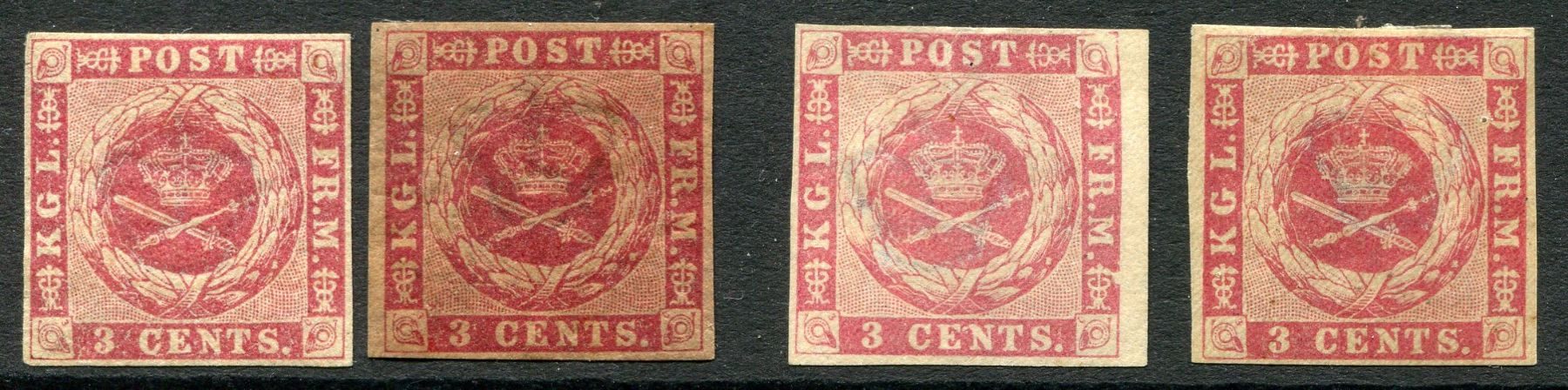
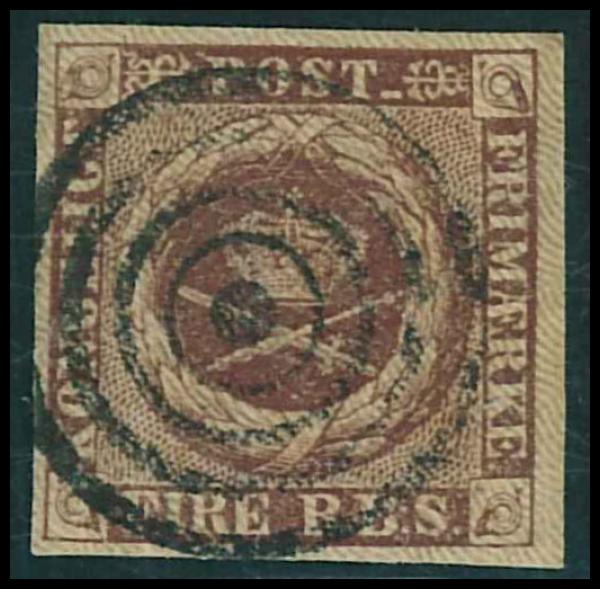
4 more copies to get an idea from, the reason that the 1856 one is with 3 kinds of gum is the shipping from denmark to tropical climate caused the sheets to get stuck together.. and different gum were used on the virgin islands to regum the stamps after soaking the sheets (to seperate them)

St Croix regummed with a brownish gum and St Thomas regummed with a yellowish. White gum is from the original production in Denmark and unlikely to have made it to the virgin islands and thus quite rare since only a few sheets were kept.

the 1866 versions are often without gum altogether, if still intact it will be a yellowish gum, so only way to know if it's an 1856 or 1866 is from the burlage.
1866 versions are often much more faint in the burlage.


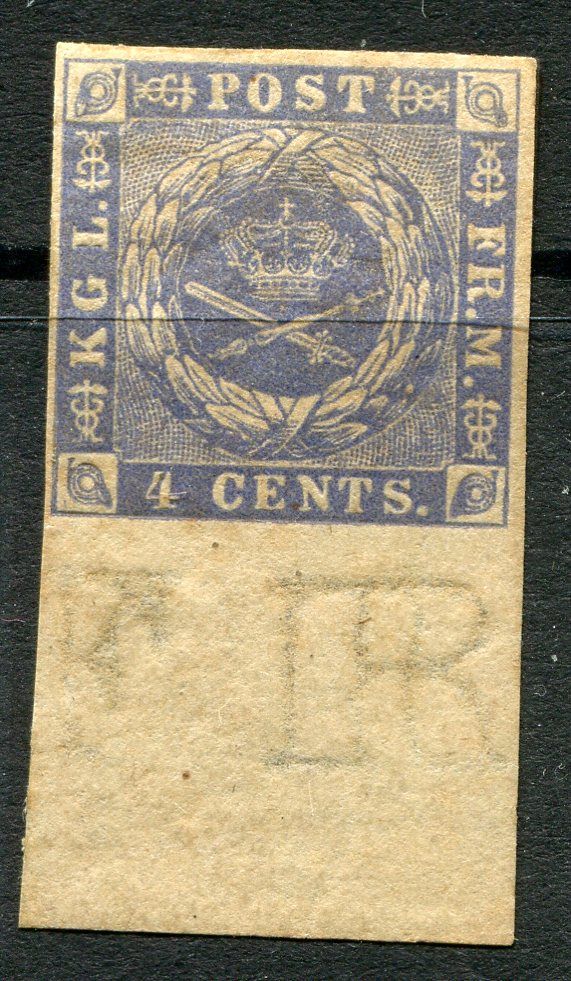
just showing off this bad boy :)
Send note to Staff  Go to Top of Page
Pillar Of The Community
Learn More...
United States
5460 Posts
Posted 05/07/2023   12:05 pm  Show Profile Bookmark this reply Add redwoodrandy to your friends list  Get a Link to this Reply
Sorsh very helpful and enlightening. Thank you so much. Wow on that #4. Huge!
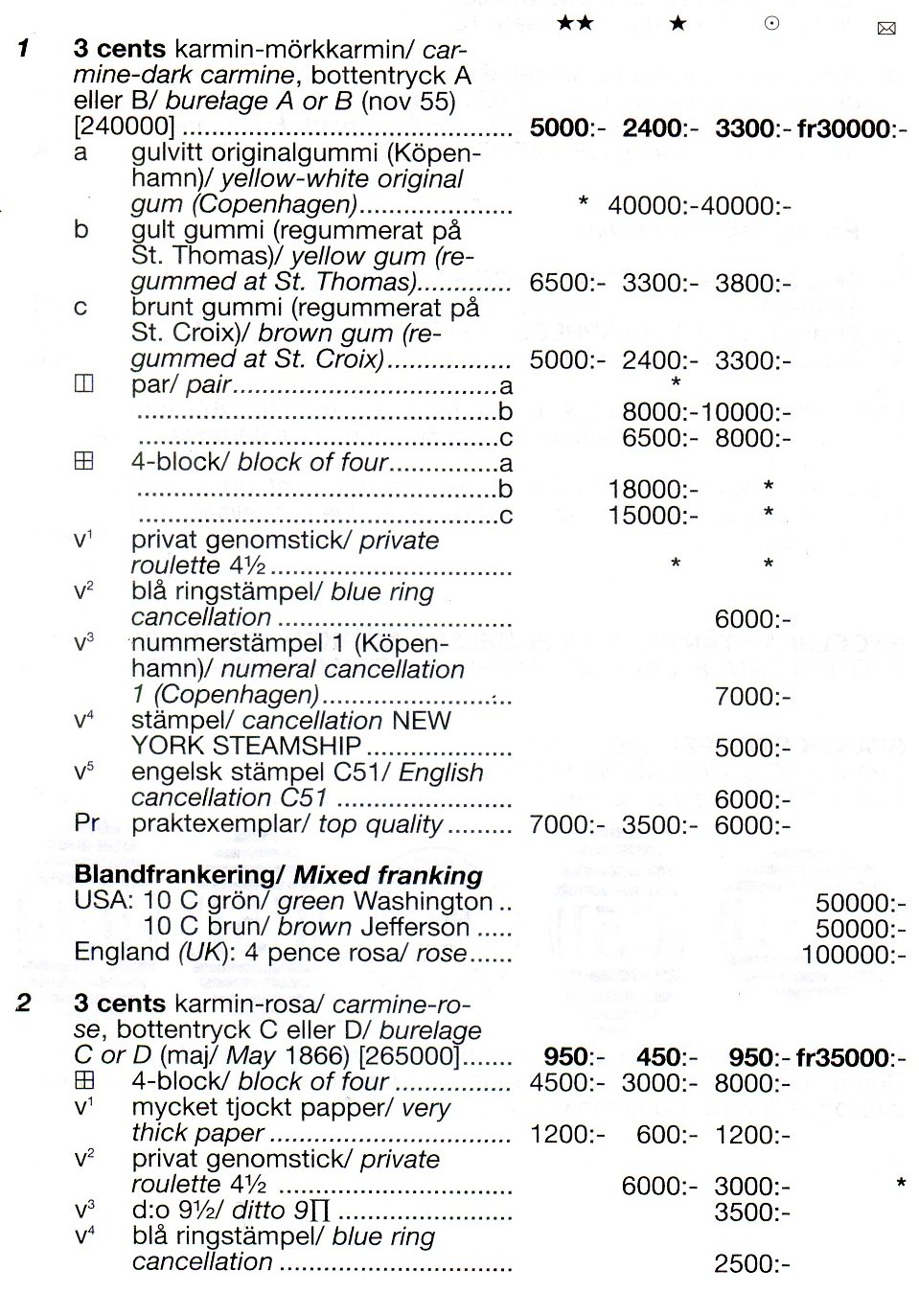
It would help me so much about the burelage if you could picture the Facit catalogue where it leaves off at the #1a. I see the four types of burelage but am confused to how it relates to #2.
Send note to Staff  Go to Top of Page
Edited by redwoodrandy - 05/07/2023 12:18 pm
Pillar Of The Community
558 Posts
Posted 05/07/2023   12:56 pm  Show Profile Bookmark this reply Add Sorsh to your friends list  Get a Link to this Reply

Quote:
It would help me so much about the burelage if you could picture the Facit catalogue where it leaves off at the #1a. I see the four types of burelage but am confused to how it relates to #2.


it's quite simple, it's a normal issue where a catalogue from a different country pass on faulty information.

#1 has burlage A
#2 has burlage C

danish catalogue list those as type Ia and type IIa.

B and D wasn't used on these issues, only on Danish stamps.
Send note to Staff  Go to Top of Page
Pillar Of The Community
Learn More...
United States
5460 Posts
Posted 05/07/2023   1:18 pm  Show Profile Bookmark this reply Add redwoodrandy to your friends list  Get a Link to this Reply
Scott and Facit have the confusing information. Thank you so much again for clarifying.
Please help again with burelage (French) verses burlage (Spanish)? Your thoughts on usage.
Same with origin of your name Sorsh. Confused North American on international matters.


Send note to Staff  Go to Top of Page
Valued Member
France
32 Posts
Posted 05/07/2023   1:52 pm  Show Profile Bookmark this reply Add antoin to your friends list  Get a Link to this Reply
Bonsoir
By the end I see that all these stamps are pointilled.
I think that Facit show a shematic burelage with continuous line?


Send note to Staff  Go to Top of Page
Pillar Of The Community
Learn More...
United States
5460 Posts
Posted 05/07/2023   2:13 pm  Show Profile Bookmark this reply Add redwoodrandy to your friends list  Get a Link to this Reply
Facit states first issue date November 1855. Other sources state April 1, 1856?
Send note to Staff  Go to Top of Page
Valued Member
France
32 Posts
Posted 05/07/2023   2:22 pm  Show Profile Bookmark this reply Add antoin to your friends list  Get a Link to this Reply
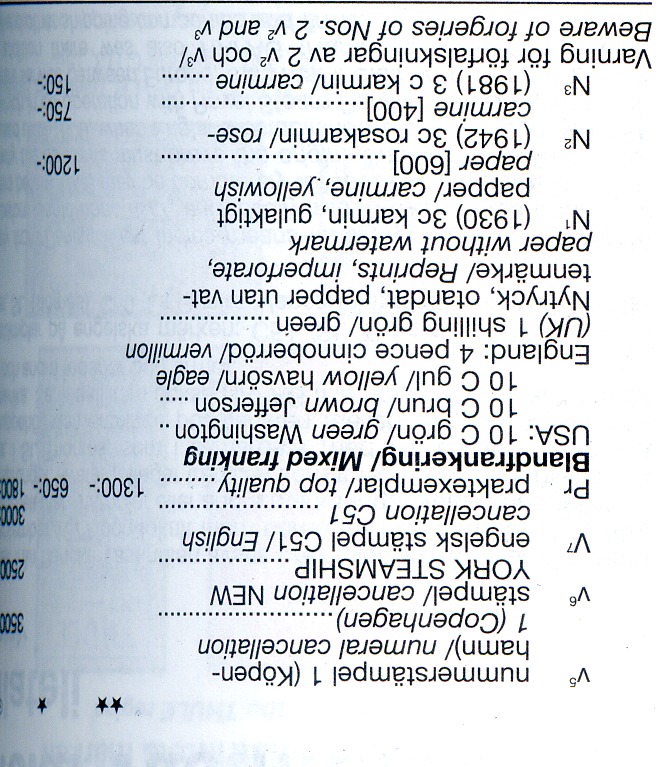
I send the end of facit description of stanmps 1 and 2


Send note to Staff  Go to Top of Page
Pillar Of The Community
Learn More...
United States
5460 Posts
Posted 05/07/2023   2:59 pm  Show Profile Bookmark this reply Add redwoodrandy to your friends list  Get a Link to this Reply
Helpful. Thank you for the catalogue page.
Send note to Staff  Go to Top of Page
Pillar Of The Community
558 Posts
Posted 05/07/2023   3:20 pm  Show Profile Bookmark this reply Add Sorsh to your friends list  Get a Link to this Reply

Quote:
Please help again with burelage (French) verses burlage (Spanish)? Your thoughts on usage.
Same with origin of your name Sorsh. Confused North American on international matters.


Origin of my name is just a nickname, from computergames, it doesn't mean anything, real name is Brian.

Burlage is the wavy lines - a background print made to prevent forgeries of stamps..

they can be hard to see, but can react with chemicals to oxidize them, that makes it very easy to see, but also reduce the stamps value.

this link to a danish auction house shows an example that is easy to see.

https://www.vf-auktion.dk/lot/15100005?pageNr=1.

not sure if links work from here, if not, i'll make some scans next time.
Send note to Staff  Go to Top of Page
Pillar Of The Community
United States
1017 Posts
Posted 05/09/2023   4:27 pm  Show Profile Bookmark this reply Add billsey to your friends list  Get a Link to this Reply
They printed the burelage before printing the stamps, and the burelage on the left panes and right panes were opposite each other in direction. I don't know if that means they printed one side, then turned the sheet to print the other side or if the burelage plate just had the two sides rotated from each other. That's why they state burelage A and B for the first issue and C and D for the second. There are just as many with A as with B and just as many with C as with D. The inking of the burelage is really light, so can be tough to see unless you have really wide margins, and sometimes even then.
Here's that image from above:

Send note to Staff  Go to Top of Page
Pillar Of The Community
Learn More...
United States
5460 Posts
Posted 05/09/2023   5:26 pm  Show Profile Bookmark this reply Add redwoodrandy to your friends list  Get a Link to this Reply
Great to hear from you billsey and you rinformative explanation of the burelage. So a #1 with burelage B.
Send note to Staff  Go to Top of Page
Pillar Of The Community
558 Posts
Posted 05/10/2023   1:05 pm  Show Profile Bookmark this reply Add Sorsh to your friends list  Get a Link to this Reply

Quote:
Great to hear from you billsey and you rinformative explanation of the burelage. So a #1 with burelage B.


or A, depends if they are from plate I or plate II.

#2 will have type C or D, depending if they are from plate I or II as well.

even with that information I still often can't tell which burlage a stamp has.. but

not sure which number the linieperforated 3cent is, but all 3 issues have exactly the same setting

if you look at the 4 examples of my 3 cents, the third one has a notch in the right frame... that is position 80 in plate II, and the same notch can be found in the other 2 issues.
and it should have burlage type B although it's very faint and I can't really tell myself.

#2 is often more rose than carmine, but listed as rose to carmine, and most commonly unused without gum.
#1 is carmine, and the white and yellow gum if washed can easily be mistaken for a #2 carmine
the only one that can't be mistaken is #1 with brown gum, it's hard to wash off, and will usually have tainted the stamp making it darker.

so, there's plenty of opportunities for headaches on these issues.

have fun :)
#1
Send note to Staff  Go to Top of Page
Page: of 3 Previous TopicReplies: 34 / Views: 2,742Next Topic  
Previous Page | Next Page
 
To participate in the forum you must log in or register.

Go to Top of Page

Disclaimer: While a tremendous amount of effort goes into ensuring the accuracy of the information contained in this site, Stamp Community assumes no liability for errors. Copyright 2005 - 2026 Stamp Community Family - All rights reserved worldwide. Use of any images or content on this website without prior written permission of Stamp Community or the original lender is strictly prohibited.
Privacy Policy / Terms of Use    Advertise Here
Stamp Community Forum © 2007 - 2026 Stamp Community Forums
It took 0.2 seconds to lick this stamp. Powered By: Snitz Forums 2000 Version 3.4.05