| Author |
 Replies: 15 / Views: 1,060 Replies: 15 / Views: 1,060 |
|
|
Valued Member
United States
194 Posts |
|
|
|
I am a retired master pressman from the. Unired States Treasury Bureau of Engraving and Printing. I retired after 40 years of service. I printing just about everything the government used. If I can be of help to anyone in regards to stamps, currency, bonds, ect that was printed by the United States or the vendors you only have to ask. It would be my pleasure to help identify items in question. You only have to post a picture of item in question. I can help identify as to color, printing process, errors encountered. perferations and so on. I look forward to sharing and learning from my fellow members.
|
|
Send note to Staff
|
|
|
|
|
Pillar Of The Community
United States
4474 Posts |
|
|
Pillar Of The Community
United States
3532 Posts |
|
|
Valued Member
United States
424 Posts |
|
|
Pillar Of The Community
Canada
5821 Posts |
|
|
I also would like to welcome you to this wonderful stamp forum and will have many questions for you. When you have time perhaps you can look over a couple of previous threads about stamps printed by the BEP and comment. https://goscf.com/t/39442For example how did the Giori press print this stamp in one pass using only 3 inks?  The link below is about the Andreotti gravure press https://goscf.com/t/37440&whichpage=1I realize those were printed before you worked at the BEP but maybe you could add something that was discussed. |
Send note to Staff 
|
|
|
Forum Dad

USA
2059 Posts |
|
|
Pillar Of The Community
3865 Posts |
|
|
Pillar Of The Community
United States
7113 Posts |
|
|
Pillar Of The Community
United States
716 Posts |
|
|
 Uknjay, Enjoy having fun with stamps! That is the name of this game. Wonderful you are carrying on your father's collection. You are the next steward of a family treasure you can pass on to future generations. Its value as a family heirloom wil always surpass it monetary value. Collecting for the enjoyment of collecting, whatever that might be, is the name of the game. Don't hesitate to ask questions especially if you need basic information and especially more advanced sources of information for any possible topic. You should be able to find folks on this board a little further along on their collecting journey glad to share experiences. My personal bias is a used stamp loses the story of its journey in the postal service when it is removed from the cover it transported to its destination. Collecting postal history adds a whole new aspect to your journey in our hobby. Wishing you many enjoyable future days in our hobby. Russ |
|
Send note to Staff
|
|
|
Valued Member
United States
194 Posts |
|
|
The Giora printing process is similar to tagalog printing. The press uses only one Engraving plate. The ink rollers themself are cut perfectly to ink those parts of the Engraving plate. The over lapping of the primary colors ( black, magenta, canyon and yellow) to make different colors. This part is similar to the offset printing process. The press may have as many as 10 unit rollers. The giori press uses rollers instead of printing units. This making the press much more compact and economical to run.
The foot print of the press takes up considerably less floor space than a unit station press. The BEP had a five roller giori press. As this only used one Engraving plate this saved time and money. In the case of the 1207 4c stamp using three colors one roller was disengaged. When the ink is applied by the ink roller to the plate another ink roller then applies another color once mixed on the plate to make a different color. You may run the press by sheet feed meaning one sheet at a time or by web meaning a roll of paper for a continuous run. In a sheet feed the sheets are stacked at the end of the press on a cart. In a web press the same it stacks at the end but first goes threw a rotating cutter. This producing sheet to the size required. In fact the 1207 was produced my roll to sheet. This enabled the roll paper to enter the gum application process the dried quickly.
Once gummed and dry it would proceed to a perforating unit then cut into press sheet ( four sheets of stamps ). All this done in one movement. Once produced into press sheets they would them be moved to a paper cutter. This machine trimmed the sides ( four cuts ) and made two cuts to form stamp sheets. They would be stacked back on carts to counting and packaging. At this point a last inspections would be made to ensure print quality. The ones found not to meet printing standards would be removed. One fact is the 1207 was not the first stamp to be printed on the giori press. The first stamp was the 1193 4c stamp. The press was small enough to me moved to a secure location ( an locked room with in the BEP currency production area). The 1193 was produced secretly with as few of employees needed for production. This is an interesting story about the 1193 4c. When the printing of the 1193 was completed the giori press was moved back to the postal production floor. |
|
Send note to Staff
|
|
|
Valued Member
United States
194 Posts |
|
|
Cjd,
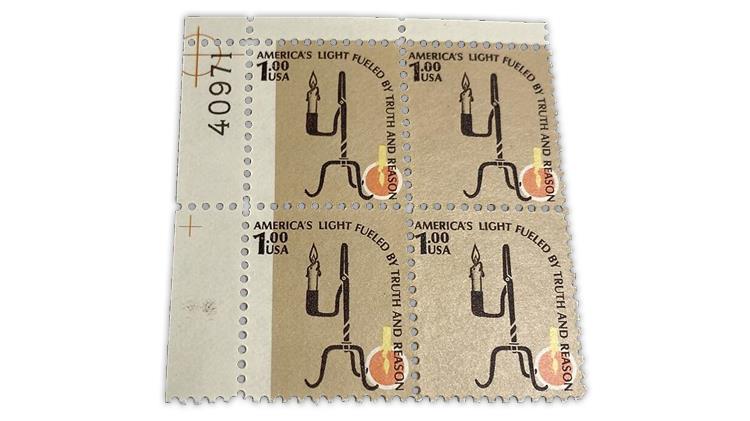
The plate blook in question of the invert $1 1610a is counterfit. The print is not BEP quality and no plate block of this stamp is know to exist. The press sheet produced four sheets of 100 stamps. Only one sheet of the 1610a was released for public consumption. It is unsure what happened to the other three sheets. It is believed they were intercepted and destroyed. Which would follow guidelines in place to prevent such inverts release. It is my belief not all the 100 stamps from the only know sheet even exists. No plate block of this sheet exists as a small number of stamps were sold at the post office prior to the sell of the remaining sheet remnant. The plate number as being on the corner was the first stamps to be distributed.
The 1610 was produced on two different printing presses. In the last printing a the brown printing was applied. In the 1610a a press sheet was removed to check printing quality and registration. When the sheet was inspected is was replaced on the production cart inadvertantly upside down. In the case of the 1609, 1610, 1611 and 1612 the sheets were loaded with gum side up. This prevention the pressman in noticing it was turned 180 degrees. The press sheet was produced in four stamp sheets of 100 each. Only one press sheet was produced due to the lack of a notched corner sheet not being used in production. Notched sheet were to be used in production of stamp requiring multiple colors. The non notched sheets were used in single color production stamps. |
|
Send note to Staff
|
|
|
Pillar Of The Community
Israel
1242 Posts |
|
|
Thank you for the thorough and detailed explanations.
lithograving, Cjd and others, such questions will be better served if posted in the engraving thread, so others can find it in the future. |
|
Send note to Staff
|
|
|
Pillar Of The Community
United States
2830 Posts |
|
|
I am very stoked about this thread- for me it will be a virtually infinite learning opportunity. With the first few posts Uknjay has made, I find that I will have to do some outside research to fully appreciate the info he has provided before I can even think of questions. |
|
Send note to Staff
|
| Edited by shermae - 05/27/2023 2:29 pm |
|
|
Pillar Of The Community
Canada
5821 Posts |
|
|
Uknjay, I have started a thread in the Stamp Production Process Forum
titled Questions For Uknjay
Perhaps we could continue there. |
|
Send note to Staff
|
|
|
Pillar Of The Community
United States
4474 Posts |
|
|
Quote:
The plate blook in question of the invert $1 1610a is counterfit. I alerted Wayne Youngblood to this thread. |
|
Send note to Staff
|
|
|
Valued Member
195 Posts |
|
| |
Replies: 15 / Views: 1,060 |
|




 Posted 05/26/2023 10:33 am