| Author |
 Replies: 16 / Views: 1,425 Replies: 16 / Views: 1,425 |
|
Pillar Of The Community
Australia
1692 Posts |
|
|
Rare 1940 A.I.F. 2d affected by dry ink.  |
|
Send note to Staff
|
| Edited by Rob041256 - 06/17/2023 03:37 am |
|
|
|
|
Moderator

United States
5109 Posts |
|
|
I always have a problem with Dry Ink and overall underinked. I assume this is a known variety? Are any used versions known, or would those be difficult to certify based on soaking off an envelope? Thanks for posting. |
Send note to Staff 
|
|
|
Pillar Of The Community
Australia
1692 Posts |
|
|
Hi Partime Quote:
I always have a problem with Dry Ink and overall underinked Good question, I'll speak to the person I bought this rarity from tomorrow and will post the answer. I've never seen one on cover but that does not mean one does not exist; and yes, if one of these stamps was soaked off an envelope it would be hard to tell unless someone with a good eye for detail and a magnifier will be able to identify a used one. |
|
Send note to Staff
|
| Edited by Rob041256 - 06/17/2023 1:15 pm |
|
|
Pillar Of The Community
Israel
1242 Posts |
|
|
Pillar Of The Community
Australia
1692 Posts |
|
|
Hi Rob Roy
What I understand of dry inking is where the ink was not flowing to the plate in an optimal manner, most likely in very hot weather, where there was not much ventilation in the printing room, where the ink flows too slowly and does not run as freely or evenly as expected, therefore the print impression is not well inked and looks "dry" and the impression of being worn, it can also be identified as being under-inked. A worn stamp faded by wear can be misidentified by collectors who believe they have such a variety, the best way to identify dry inking is to have a mint unhinged stamp with the variety. I'll be speaking to a stamp dealer who may be able to give the information as to how to identify a dry inking if used, and if dry inking is the same as under-inking.
|
|
Send note to Staff
|
| Edited by Rob041256 - 06/17/2023 4:01 pm |
|
|
Pillar Of The Community
6366 Posts |
|
|
Rob041256,
When you warm a liquid, it flows more freely. Want to try another theory? |
|
Send note to Staff
|
|
|
Pillar Of The Community
Israel
1242 Posts |
|
|
The image here looks to me like the image in stampworld, so how was dry ink identified? |
|
Send note to Staff
|
|
|
Pillar Of The Community
Israel
1242 Posts |
|
|
Quote:
When you warm a liquid, it flows more freely. Want to try another theory? If the ink mixture contains volatile components, heat can cause them to evaporate, turning the remaining mixture more viscous. |
|
Send note to Staff
|
|
|
Pillar Of The Community
Australia
1692 Posts |
|
|
I stand corrected, it was 5am when I wrote it, a bit weary. I'll start over - The dry Ink is where the ink was not flowing to the plate in an optimum manner, most likely in very hot conditions where the viscosity starts to move slowly and does not run as freely or evenly as intended. Therefore the print impression is not well inked and looks dry and under-inked. It is not common for such a problem to occur with the KGVI printing, though it was a common problem during the reign of KGV where adequate ventilation was a problem. |
|
Send note to Staff
|
|
|
Moderator
United States
5109 Posts |
|
|
Neil's book on "The 1d King George V Australian Commonwealth Stamps" has this small comment concerning inking: 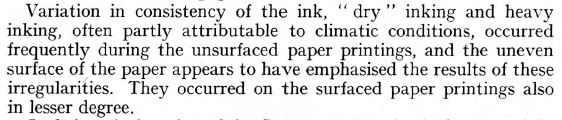 I don't know if it is helpful for this item, but thought I would add it as additional discussions will probably ensue. |
|
Send note to Staff
|
|
|
Bedrock Of The Community
12784 Posts |
|
|
Pillar Of The Community
Australia
1692 Posts |
|
|
Hi Rob Roy Quote:
The image here looks to me like the image in stampworld, so how was dry ink identified? I can assure you the image I displayed is from my collection, here is the cert for it. 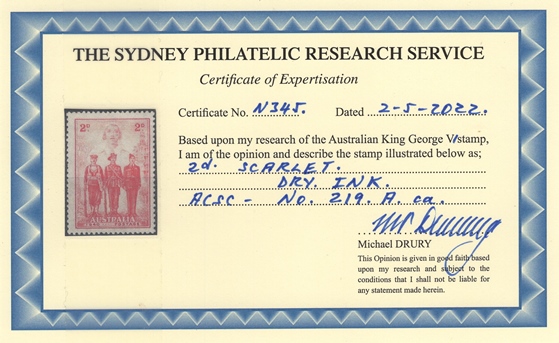 |
|
Send note to Staff
|
|
|
Pillar Of The Community
Israel
1242 Posts |
|
|
Thanks for the article, it was enlighting to read.
First, I don't know much about stamp production, were those microchannels used in the technology of producing the OP's stamp?
Second, the article focused on the non-Newtonian hydraulics aspect. I'm missing the chemical aspect, how the heat affected the ink mixture ingredients, and as a result, the "dry ink" phenomena. |
|
Send note to Staff
|
|
|
Pillar Of The Community
Israel
1242 Posts |
|
|
Rob041256, I never questioned your stamp validity. I'm trying to learn how to identify the "dry ink" phenomenon. |
|
Send note to Staff
|
|
|
Bedrock Of The Community
12784 Posts |
|
|
This may be simpler: Quote:
Colder ink needs more solvent to bring it to target
viscosity, but as temperature rises, the solvents in solvent-based inks evaporate faster and require more solvent to maintain viscosity (Sosa, 1999).
Quote:
Warmer inks evaporate faster, which can cause a Print Quality — Reflection Density
wettability problem and screening. Screening is a
print defect caused by uneven flow of inks between
cells (GAA, 1991). In the WMU study, as ink temperature rose to 92oF the ink dried before spreading adequately on the substrate, thus reducing the
overall printed solid area and the reflection density
(Sosa, 1999). |
|
Send note to Staff
|
|
|
Pillar Of The Community
Israel
1242 Posts |
|
|
rogdcam, that's what I was talking about, the chemical aspect, evaporation of the volatile solvents. Once some of the solvents are gone, the hydraulics rules kick in and you get all those artifacts. |
|
Send note to Staff
|
|
|
Replies: 16 / Views: 1,425 |
|




 Posted 06/17/2023 03:36 am


