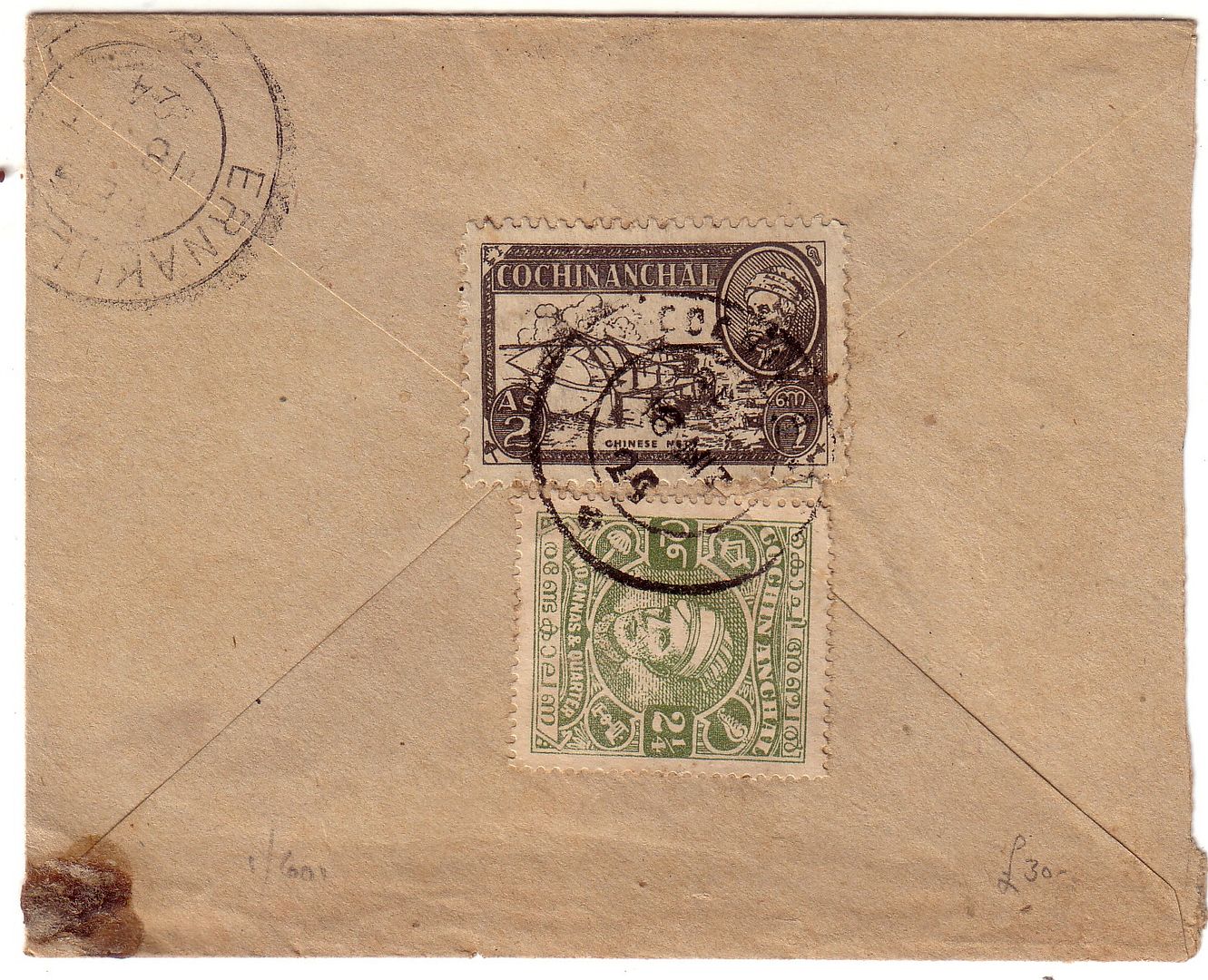
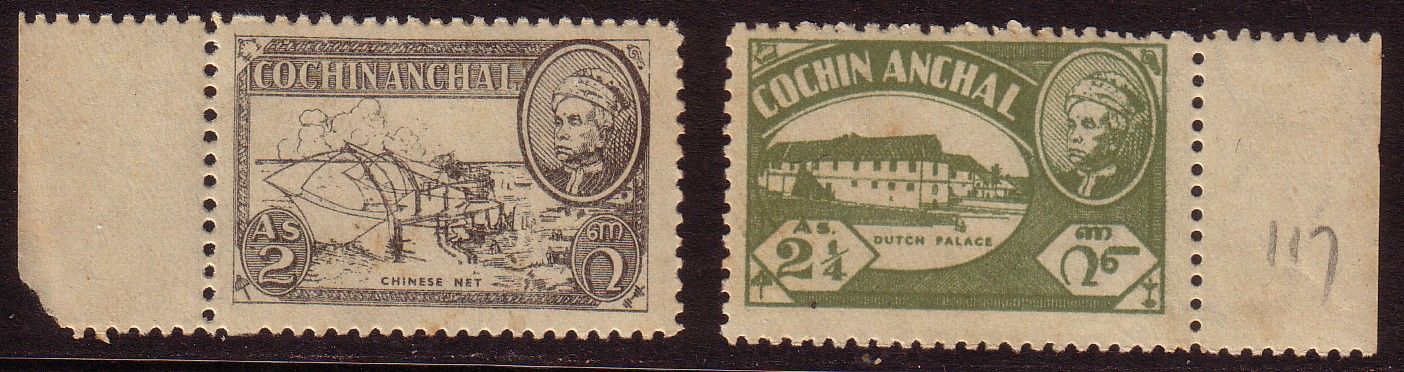
It is good news that Cochin has at last issued pictorial stamps. New 2 and 2.25 annas stamps are the forerunners of
a pictorial series which the Government of Cochin had announced some time ago. However, political changes in
India created acute problems in native States and Cochin, engulfed in the whirlpool of political turmoil, had to
delay the issue of the new series for some time. Two values of the series have now appeared and others should
issue in the near future.
The 2 annas stamp is rectangular and grey black in colour with the Raja's head in the top right-hand corner and the
Chinese net depicted in the centre. The Chinese net is symbolical of one of the important occupations of the
people— fishing—for which the Arabian sea coast of Cochin, with its back waters, has been famous from time
immemorial. Fishing is a thriving industry of the State, which has a separate Department of Fisheries to care for
these. The large quantities of fish exported speak volumes for the importance of the fish trade. Hence the fish
depicted on the stamp can be considered appropriate.
The 2.25 annas stamp is sage green in colour and the Dutch Palace of Cochin is depicted in the
centre. This palace was built by the Dutch in the 16th century. The Dutch helped the Raja of Cochin against
Zamorin, the Raja of Calicut The real object of the Dutch in supporting the Raja of Cochin was to oust the
Portuguese from the Malabar coast and thus to secure for themselves the undisputed monopoly of trade with the
west coast. They succeeded in their aim after inflicting a series of defeats on the latter. Having thus secured their
monopoly, the Dutch began to interfere in the affairs of the native rulerss resulting in the Rajas being made puppets
in the hands of the Dutch.
The Dutch Palace depicted on the stamp was built for the Raja of Cochin by the Dutch, hence its name. It is in this
Palace that the Cochin Rajas are crowned even today. The Dutch supremacy on the Malabar coast, already on the
wane, completely collapsed with the subjugation of Holland by Napoleon Bonaparte. Then came the turn of the
British, who, as we all know, quitted India on August 15, 1947. To conclude, the new pictorial series, whatever
their shortcomings, may be hailed as a new epoch in the philatelic history of Cochin. We shall, therefore, hope that
Cochin, as the most advanced State in India, will bear the torch of advancement by issuing attractive stamps with
new designs in future.





 Posted 06/29/2010 03:03 am


 .
.


 if it is - right?
 - with one O62 (used) and one O65 (used) in the lot....