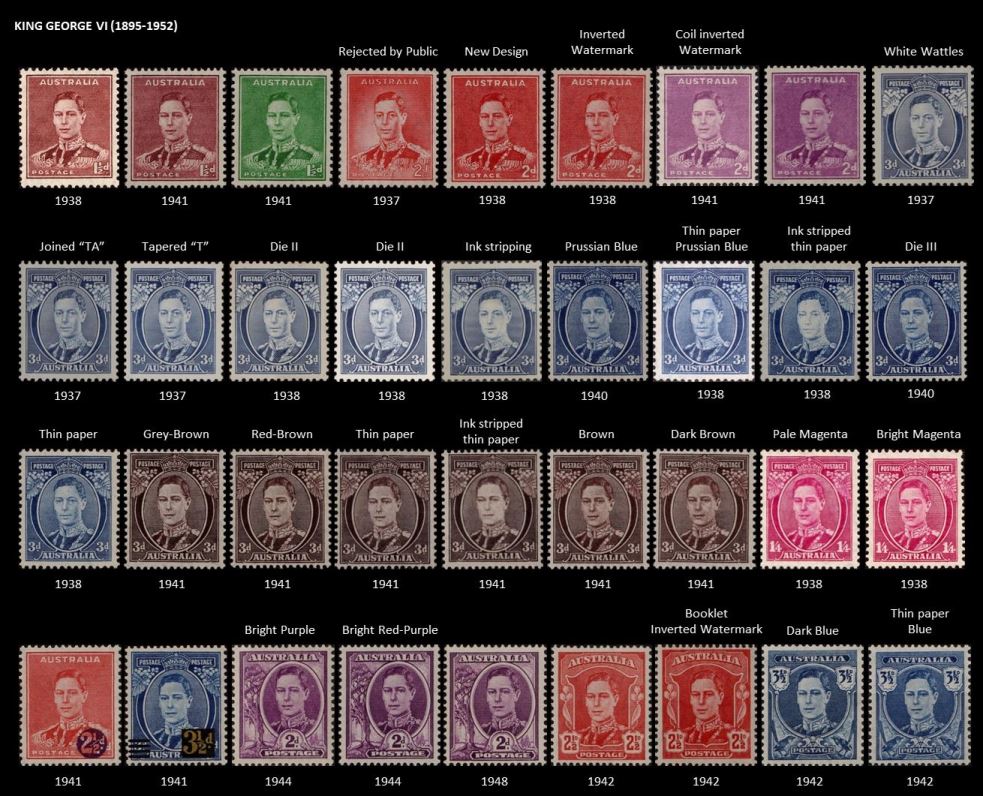
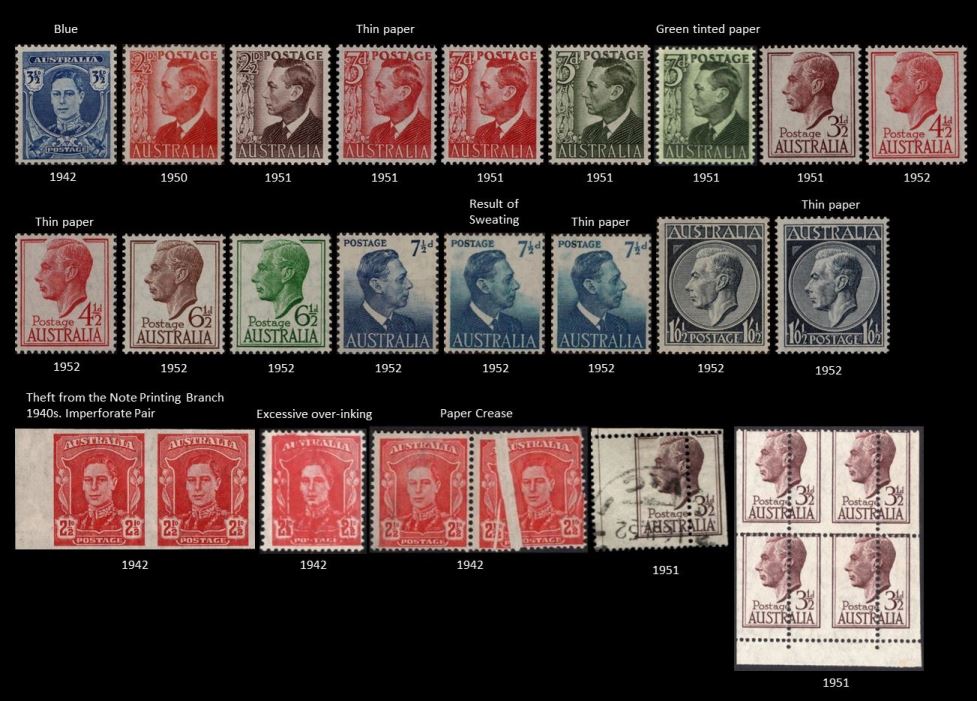
The complete KGVI series of portrait stamps from 1937 – 1952, including all the blue varieties and Dies I, II and III. Ink stripped (white face) and major varieties.
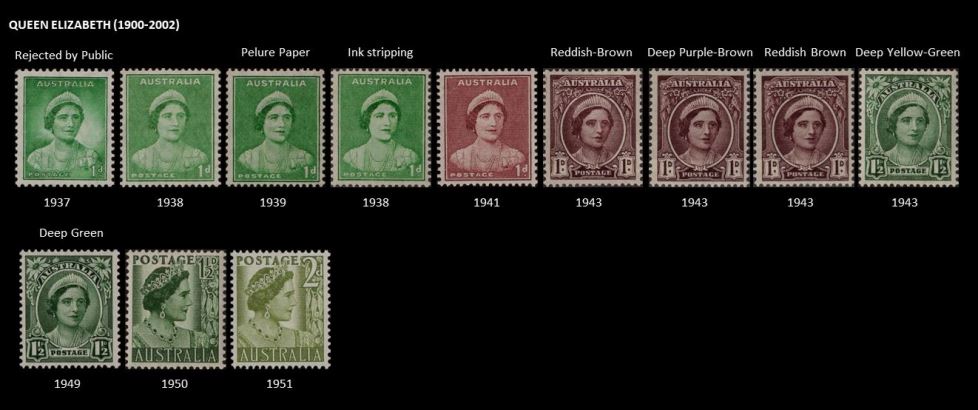
The 1938 green 1d Queen Elizabeth Die II showing a "halo" in the foreground drew public criticism, as a result the design was modified (shown as "new design") to remove the "halo" behind the portrait and strengthen the weak lettering and denomination, and a new die was engraved. The new issue of the Die II coincided with the introduction of new perforating machines gauging 14.75 x 14 (15 x 14). Further shades, errors and varieties may be added in the future.
a. Pelure paper also known as onion skin paper is a very thin, lightweight, strong, though brittle in appearance and often translucent paper.
b. The KGVI 1951 7½ blue showing "sweating" was originally described as having aniline ink, this stamp is now considered that the greenish-blue "aniline" appearance is now the result of the sheets sweating after the sheets were stored prior to distribution to the post offices.
c. The 1951 3d dark green stamp of KGVI on green tinted paper had originally been described as an experimental printing, but has been found to be more likely the result of interrupted printing, the ink used for the first sheets once printing was resumed not being sufficiently thinned to be completely removed from the surface of the plate by the action of the wiper. The National Philatelic Centre commented no more than 30 of these green tinted stamps existed and seldom come on the market, the NPC further commented that this is a truly rare stamp. In the Brusden Wide Catalogue 2019 page 6/143, the stamp is valued at $1250.
d. The 1942 pair showing two white vertical lines was caused by the paper folding during the printing process, this stamp was most likely part of the Note Printing Branch theft of the 1940s, it is very scarce and is certified as being of exhibition quality.
e. 1951 3½d showing the perforations misplaced horizontally by 8-9mm. Only 2 panes of 80 were discovered. Of 448,000,000 printed, only 160 of these stamps exist. And only one has been recorded and catalogue used, this used stamp is the same recorded and is certified extremely rare and unique.





 Posted 08/05/2023 12:49 am


