| Author |
 Replies: 16 / Views: 1,754 Replies: 16 / Views: 1,754 |
|
Valued Member
Greece
8 Posts |
|
|
Good day! I am new in the community, so recently I just started extracting stamps from thousand of envelops my grandpa had kept, I follow the known procedure: 1) cutting the envelops (except the first day covers ofcourse, he had over 500 of them.) 2) getting ready a bowl of cool waterto sink the cutted pieces with the stamps 3) waiting until the stamps seperated or at least loosen enough to get them without damaging, also using finger to clean the back in the water off tge glue 4) placing them face down on paper towl and wait to drying completely 5) placing them between papers and putting them on books to flaten them and wait for 8 or more hours. 6) placing them on album. The only problem that I had is the ink stamp is somewhat getting erased, is it loosing any value if tge ink stamp removed or faded? And how to avoid that? Thanks for any help regarding my question ! Here the example of the ink stamp that got faded 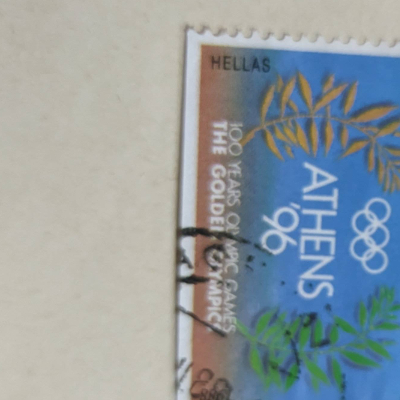 |
|
Send note to Staff
|
| Edited by s0llie - 10/29/2023 07:28 am |
|
|
|
|
Pillar Of The Community
United Kingdom
8641 Posts |
|
|
Beware of removing stamps from covers before establishing whether the cover has any interest - stamps on covers will generally attract more interest than those cut from them. Soaking stamps shouldn't affect the postmarks, although, in a small number of cases, stamp colours may run depending on the inks used in production. |
Send note to Staff 
|
|
|
Valued Member
Greece
8 Posts |
|
|
Pillar Of The Community
United States
4194 Posts |
|
|
Thousands of envelopes (we call them covers) take up a lot of space, but before you cut up more of them, pause to determine if you should keep any on cover. [there will be some who tell you every cover is precious and you should keep them all on cover, but you have to decide what works for you]
The one you picture is from 1996 from Greece where you are from. How old is the oldest? Are they all from Greece. Are they all ordinary mail, or are some registered or other unusual uses? |
|
Send note to Staff
|
|
|
Valued Member
Greece
8 Posts |
|
|
The oldest is from 40's but the majority is from 60's 70's 80's 90's 2000 and tge newest is from 2016 there not only from Greece some are from Helvetia, Untined kindom, USA, Italia, RSA, and the albums that I already have from my grandpa 10 or more are from around the world, Iraq Afganistan soviet union syria canada usa spain uk etc.
Also I dont cut the first day covers, are over 500 of them maybe more many are on albums and many are on boxes.
I upload an example page photo of the stamps shortly |
|
Send note to Staff
|
| Edited by s0llie - 10/29/2023 2:34 pm |
|
|
Moderator

United States
12330 Posts |
|
|
In my opinion, there is a good chance that the postally used covers have more value than the First Day of Issue covers.
Don |
|
Send note to Staff
|
|
|
Valued Member
Greece
8 Posts |
|
|
Pillar Of The Community
Netherlands
6650 Posts |
|
|
@s0llie Precious is not the same as Quote:
there is a good chance that the postally used covers have more value than the First Day of Issue covers. Considering the period you talk about, the FDCs, likely, will hold very little value. You might be lucky and have that exception to the rule. But FDCs are very much philatelic products. Most will have been sent in an envelope and not have gone through the mail properly. Some, even, may have been cancelled on another than the day of issue of the stamps, but with the date of issue. Today's collectors do not like that. Most FDCs are sold by the hundreds for few euros. Since it remains unclear what your FDCs are, it is difficult to say this is the case for your FDCs. Covers, normally, have gone through the mail and have stamps and cancellations that show the postal history of the period. Mass use of the postal system in the 1950s, 1970s, and 1980s mean most are highly common and not hold much value. Still, collectors of postal history value them more than FDCs. And there are collectors of such items. Any cover that, truly, was used in a way that it becomes 'postal history' will have been used to carry a letter or something else. It will have been opened. If it has not been opened, it, likely, was a philatelic cover. Most of those are not worth much. So, yes, an opened cover is a sign it is an item of postal history. That makes it more interesting for collectors. That is exactly when Quote:
there is a good chance that the postally used covers have more value than the First Day of Issue covers. |
|
Send note to Staff
|
|
|
Moderator
United States
12330 Posts |
|
|
Yes, being opened is fine.
A stamp tells a story, but a cover is a novel. In other words, many people are interested in history and a full cover is typically a 'bigger' piece of history than a stamp. As others have mentioned, a good approach is to begin slowly before making decisions which are not reversible. Once you are familiar with the hobby you will be better position to make decisions.
I would think about this is in the same way I might about a piece of antique furniture. I may ultimately end up refinishing it to suit my needs but not before I am sure that I am not doing something that I may regret later.
If you can post some representative images the material that you have, the folks here will be better able to offer you opinions on how to proceed.
Don |
|
Send note to Staff
|
|
|
|
Valued Member
Greece
8 Posts |
|
|
i dont know how to make them 300kb cause my phone get pictures of 15MB and more |
|
Send note to Staff
|
|
|
Pillar Of The Community
Netherlands
6650 Posts |
|
|
Valued Member
Greece
8 Posts |
|
|
this is an example of a cover my fater cutted does it contain any value as it is or I am ok to soak it on water ? he did not knew and he cut some portion of the covers 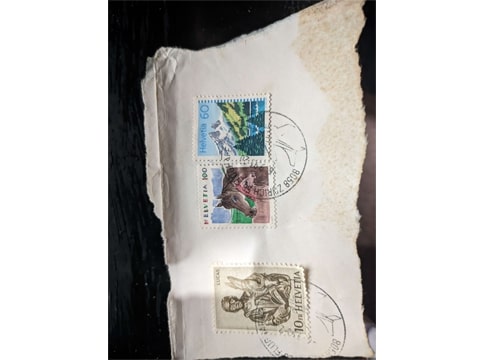 |
|
Send note to Staff
|
|
|
Pillar Of The Community
Netherlands
6650 Posts |
|
|
We call this 'on piece.' 'On cover' is when the stamps, still, are on the whole cover. This only seems to be part of a cover. For postal histporian, this is not of interest. Collectors of cancellations might prefer the whole cancellation. If you like it, cut it in a rectangular shape, so the whole cancellation remains visible. Otherwise, just soak the stamps of the piece to save space. |
|
Send note to Staff
|
|
|
Valued Member
Greece
8 Posts |
|
|
Pillar Of The Community
Netherlands
6650 Posts |
|
|
That one may be of interest to postal history collectors.
Do not expect it to be worth much (actually maybe a few cents).
If you would decide not to keep the cover (that is what you should decide), know that if you soak stamps from such coloured envelopes, the colour of the envelope might colour the water and turn the stamp reddish. If the colour of the stamp changes, it, actually, would be a damaged stamp. |
|
Send note to Staff
|
|
|
Pillar Of The Community
United States
1168 Posts |
|
|
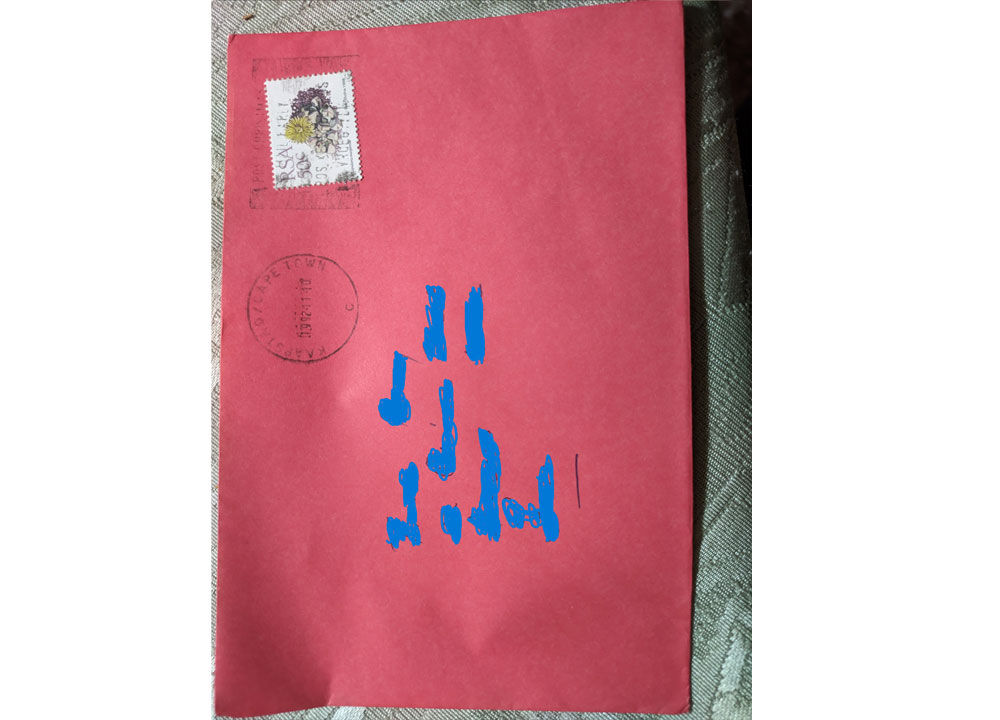
I think the domestic postal rate in South Africa was 35c in 1992 so that 50c RSA letter may be international, or maybe the letter was overweight. Either way, yes there are people who collect these. They are not going to earn you a fortune, but at a local stamp show a dealer might put a cover like this in a box of covers he sells for 25 cents each, while the same stamp soaked off cover would be in the 5 cent box.
(Expect that same dealer to pay maybe 5 cents per cover, or one cent per stamp in bulk. He needs to make a profit, and it may take a long time to sell them all).
Commemorative stamps postally used on cover are collectible, common definitives not as much, unless there is something else going on, such as special services like registered, postage due, or the stamp has a plate number, or a nice cancellation.
There are also people who collect covers postmarked on their birthday or other special date (any year) no matter what the stamp is.
But the question is, what is your goal? If you are soaking the stamps so that you can mount them in an album and start collecting them, then continue with your process and go for it. The steps that you outlined are great. Occasionally you will get a stamp or cancel whose ink will run, but not very often. As NSK mentioned, the ink from colored paper may run, so you should separate those and soak them individually (or in smaller groups) to be safe. Also you may get some stamps that wont come off paper when soaked in water, mostly modern self-adhesive ones. Those are often collected while kept still on paper.
On the other hand, if your ultimate goal is to organize these stamps and covers to sell to a fellow collector, maybe you should find that collector or dealer first and see if there is any interest in the covers or just in the stamps. Maybe the time that you invest in soaking them will be helpful to the next collector, or maybe it will work against you, depending on what you have, and who you are trying to sell/give these to.
The point is, don't rush into cutting up and soaking the covers until you know what you have and what you want to do with them. |
|
Send note to Staff
|
|
|
Replies: 16 / Views: 1,754 |
|




 Posted 10/29/2023 06:49 am