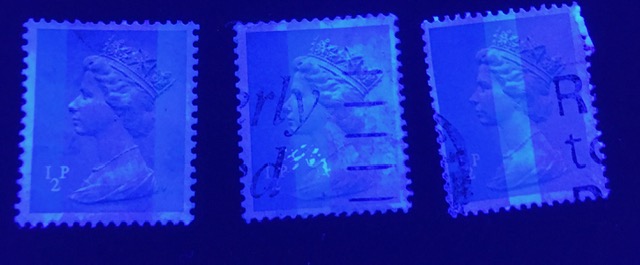
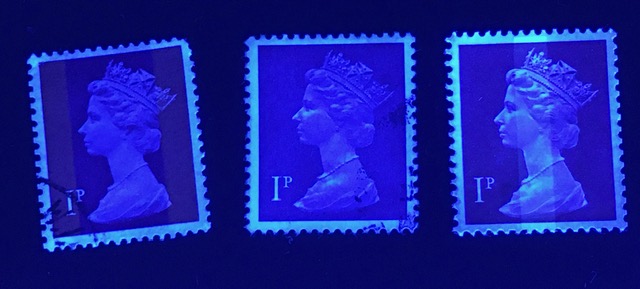
Since the 1960s, British stamps had phosphor bars applied. The afterglow could be recognised by optical scanners that would then know where the stamp was. Also, it could count the number of light signals per time unit. That allowed the scanner to identify items of mail that had a stamp with a single bar (paying second class carriage) from other stamps.
Locating the stamp allowed for the automatic letter sorting machine to turn the cover so the stamp would appear in one of two quarters (no one considered the clown sticking it in the centre of the cover) before passing it through the canceller.
Counting the signals allowed the automatic letter sorter to sort out second class mail from other mail (originally it was printed matter from letters).
Two phosphor applications exist:
1. Printing phosphor ink. The bars were applied by a printing cylinder as phosphor ink that contained a phosphor and an activator. A couple of stamps, basically, had one stamp-wide bar applied (all-over phosphor). But in most cases 8, 9, or 9.5 mm (in the 2000s other formats occurred with self-adhesives) wide bars were applied over two adjoining stamps, or 4, 4.5, or 4.75 mm wide bars were applied over the centre of a stamp.
2. Phosphor was mixed into the paper coating: phosphor-coated paper or advanced-coated paper. (By that time, the scanners could distinguish between a single bar and a coated stamp).
Quote:
What is missing phosphor? Is it a stamp that does not shine nothing (like 1958) or a stamp without bars?
Strictly speaking, missing phosphor means the stamp has no phosphor applied. However, it is used to indicated that the phosphor ink was not printed onto the stamp. So, yes, without bars. In the case of an all-over phosphor stamp (but no way to differentiate from its double-barred sibbling) the all-over phosphor was not printed.
For stamps that should be printed on phosphor-coated or advanced-coated paper, it should be easy to realise that a missing phosphor implies the phosphor was not mixed into the coating (I am not aware this happened), or the coating is missing. The latter makes it an 'uncoated' stamp.
So, effectively, missing phosphor = no phosphor bars were printed onto the stamp.
From 1972 until the 1990s, the coating had an optical brightener mixed in. If the phosphor is missing, the stamp might still show 'fluorescence' and 'shine.'
Phosphor emits an afterglow, that is not the bright 'shine' you see under longwave uv light.





 Posted 02/13/2024 12:14 pm