|
This page may contain links that result in small commissions to keep this free site up and running.

Welcome Guest! Registering and/or logging in will remove the anchor (bottom) ads. It's Free!
To participate in the forum you must log in or register.
| Author |
 Replies: 14 / Views: 1,482 Replies: 14 / Views: 1,482 |
|
|
Valued Member
15 Posts |
|
|
|
Hello everyone. I'm new to postcard collecting but I am a long-time collector of other things. I like to be very organized with my collections and I track as much information about each item as I can. It's much easier to do detailed tracking if you start when your collection is small and I'd like to make sure I'm getting all the important info. So far, my postcard collection database includes:
- Front Image
- Back Image
- Country of Origin
- Year (may be an estimate if I can't find an exact year)
- Artist/Photographer (if known)
- Publisher (if known)
- Reference (a link or other reference info if I find the postcard in a library or museum collection, etc.)
- Receipt Scan or Purchase Screenshot (when buying online)
- Additional Notes
- Purchase Place
- Purchase Date
- Purchase Price
Additionally, I tag each item with keywords that relate to what the image on the postcard is about. For example, if it's an image of a train in Osaka from 1905, I might tag it with: "train, locomotive, osaka, meiji".
Things I'm considering tracking and could use some advice on:
- Postcard size (either exact measurements or categories. Are there postcard size categories?)
- Print method (I'm too inexperienced to know what to put in this field. There seem to be several "main" categories and then many sub-categories. I'm not sure what makes sense to include. For example, I know "linen" is a type of card... but I don't think that would qualify as a print method?
Given all of that, is there anything I'm missing? Any recommendations are appreciated.
|
|
Send note to Staff
|
|
|
|
|
Pillar Of The Community
United Kingdom
8636 Posts |
|
|
Bear in mind that "country of origin" covers two things - publishing and printing. For example, before WWI, substantial numbers of GB-published postcards were printed in Germany. |
Send note to Staff 
|
|
|
Valued Member
15 Posts |
|
|
Pillar Of The Community
United States
1434 Posts |
|
|
Is the collection for unused, or also used? If so, you're missing: mailing/cancelation date, destination (city, country, whatever), and postage amount. |
|
Send note to Staff
|
|
|
Valued Member
15 Posts |
|
|
Both used and unused. If I'm tracking cancellation dates and destinations, would you also track cancellation location or cancellation type? For example, here's one I own that includes a pictorial cancellation. 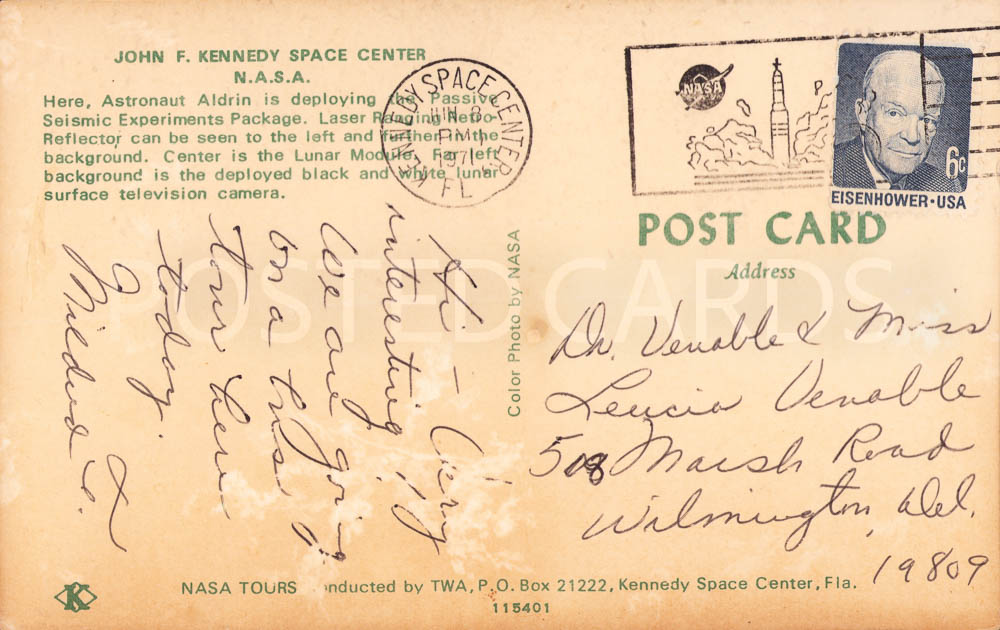 In addition to the fields mentioned in my original post, would you include something like this?: Cancellation Location: Kennedy Space Center, FL, USA Cancellation Date: 1971-06-08 Cancellation Type(s): Machine, Pictorial Destination: Wilmington, DE, USA Postage Amount: $0.06 |
|
Send note to Staff
|
|
|
Pillar Of The Community

United States
1159 Posts |
|
|
I love that Kennedy Center pictorial cancel, and it is great to have it on a matching card.
Yes, I would include Origin and Destination in the database, but instead of a text string "Wilmington, DE, USA", these should be separate database fields (City, State/Province, Country) for easier sorting and tabulation.
For US postcards, common postcard types (and eras) are:
Real Photo Post Card (RPPC) (1900-1920)
Undivided Back (<= 1907)
Divided back (1907-1915)
White Border (1915-1930)
Linen (1930-1944)
Chrome (1940+)
Continental (4"x6") (1960s-1970s+)
In addition to specific Keywords, you may want a separate and more general Category field for major groupings (City Views, Scenic, Roadside, Greetings From, People, Animals, Art, Space, Holiday, Cartoon, National Parks, Expos, etc.)
Have fun!
Edit: the "less than or equal" symbol got mangled so I had to change it to "<=" |
|
Send note to Staff
|
| Edited by ZebraMan - 04/04/2024 12:21 pm |
|
|
Pillar Of The Community

United States
945 Posts |
|
|
From a pragmatic viewpoint, what information you define and collect in your data fields today should be a direct function of how you intend to make use of the information in the future. Plus, you have to keep in mind that what you think your plans or intentions are today just might not be what you will want to do with this information in 1-2-10 years in the future. Once your "database" has on the order of say, 1,000 entries, it is often difficult to force the self-discipline to go back and bring all the entries up to date when you finally decide that you want to add new fields that you thought about in the beginning, but discarded since you thought you would never have a use for that data. Also, you can ask yourself "How much time am I willing to spend entering information for one postcard", then translate that into how many data fields, then select those that you think are the most likely ones you might want to use as a search/retrieval criteria. If you start with too many fields, its a simple task to eliminate a few of the fields for future post cards (although selecting which fields to eliminate can be a painful decision process). Another thing you might consider is how could someone else want to use your database should you offer to assist them with one of their own? From your initial post, it sounds like you are not familiar with some of the standard terms (size, type of printing, etc.) Review the postcard collecting literature that is on the internet, or in guide books. Some of the data fields you mention have standard terminology that experienced collectors use. You should identify these and use the proper terminology, not your words to define the fields. In the "database world" using a "controlled vocabulary" for the entries in some fields is a standard practice. For example, in a state field for a US post card, you would want to limit the entries to some standards like the USPS state abbreviations. I always include a "comments" or "notes" field to include unusual characteristics. Perhaps you might want to record unusual or uncommon postal markings, even if your primary focus is unused cards. You can always include a simple note "Postage due" or "air mail" for that one in a thousand occurrence. Don't be afraid to make mistakes. It's a rare exercise like this that does not encounter a revision in the design. Quote:
As Yogi Berra is reported to observe:
"It's tough to make predictions, especially about the future." Good luck with this. It sounds like a lot of fun (and work)! Mike |
|
Send note to Staff
|
|
|
Valued Member
United States
67 Posts |
|
|
Don't overlook postcard databases that may be available on the internet. Even if you don't use them you may be able to glean the types of data they include and include it in your own. |
|
Send note to Staff
|
|
|
Valued Member
15 Posts |
|
|
Thanks for all the feedback so far, everyone! Based on what you've said so far, this is what a page in the database looks like (I've covered a couple of items for privacy): 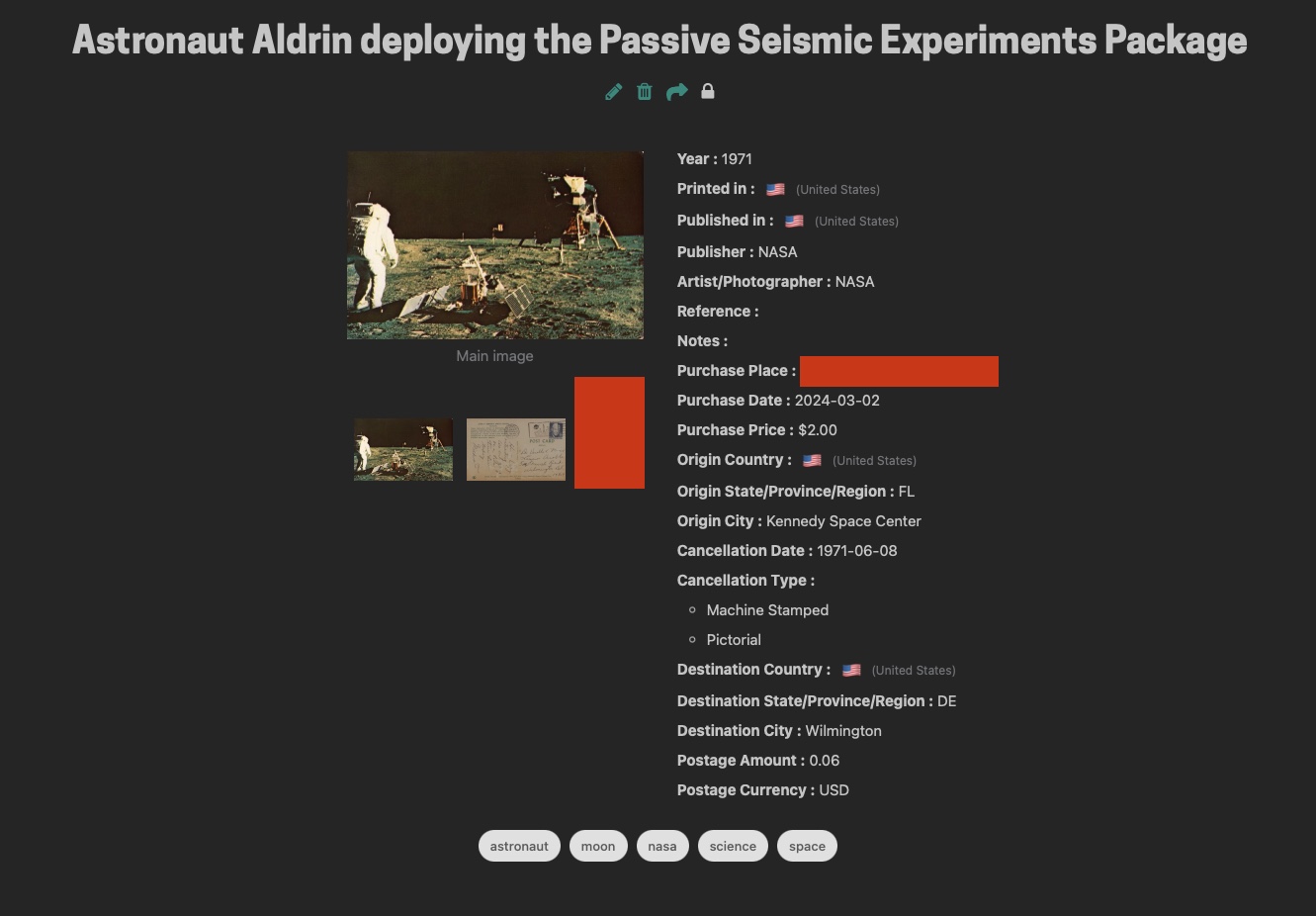 (Obviously "Kennedy Space Center" is not a city, but this is a bit of a special case.) mml1942, you are correct that I'm just starting out and not fully versed on the standard terms. :) I'll definitely do more research into it. Having a shared vocabulary is essential in all types of collecting. It makes research easier and avoids confusion/misunderstandings. Again, thank you all. This has already been very helpful. |
|
Send note to Staff
|
| Edited by smithereens - 04/04/2024 1:38 pm |
|
|
Pillar Of The Community
United States
1159 Posts |
|
|
Here is an example of an unusual postage due or auxiliary marking like Mike had mentioned.  When you care enough to send a greeting postcard, but not enough to pay for the postage. When you care enough to send a greeting postcard, but not enough to pay for the postage.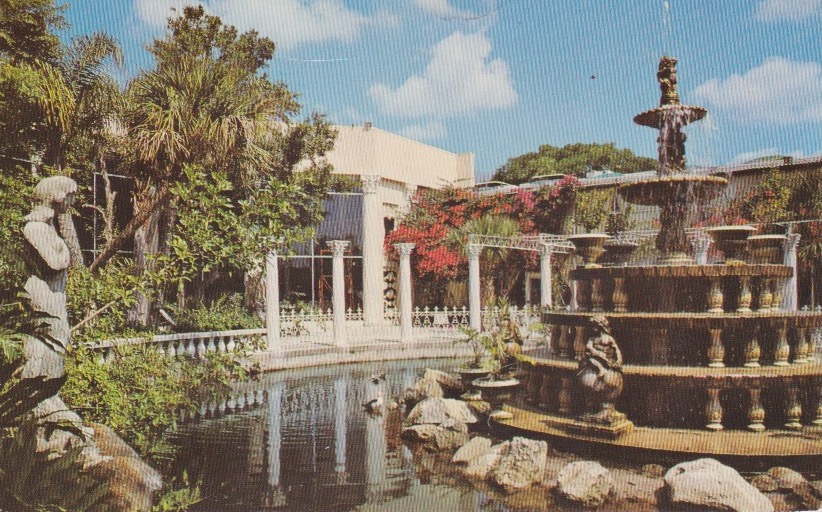 A database field you may want to add is one for Location or Album Number or Inventory Number. When you have an RPPC of a black cat in front of a church that was mailed from Yellowstone National Park on July 4th, can you remember whether you filed it under cats, Halloween, churches, national parks, or Independence Day. Also comes to mind, an important (?) cancellation type for postcards is RPO (or RMS) for Railway Post Office. A lot of travelers write postcards and mail them on trains or in train stations and these cancellations are popular among a group of collectors. |
|
Send note to Staff
|
|
|
Valued Member
15 Posts |
|
|
Quote:
Here is an example of an unusual postage due or auxiliary marking like Mike had mentioned. Thanks very much for the example! Quote:
A database field you may want to add is one for Location or Album Number or Inventory Number. They do all have a unique identifier/inventory number (not shown in the screenshot). In my first version of this I had included a "Storage Location" field to be used with a box number (or however I end up storing them). But, I forgot to add that field back in when I started over from scratch. Thanks for pointing it out. :) Quote:
Also comes to mind, an important (?) cancellation type for postcards is RPO (or RMS) for Railway Post Office. The Cancellation Type field is a multi-select, drop-down menu when adding a new postcard. I've used the 'Types of cancellations' section on this Wikipedia page: https://en.wikipedia.org/wiki/Cancellation_(mail) to determine what options should be available for that field. So, RPO is already there. :) |
|
Send note to Staff
|
|
|
Pillar Of The Community
6366 Posts |
|
|
I would echo the general direction which mml takes ... what data fields do you really need to have for data sorting and retreival? What is the primary theme/topic for the collection? What is the end product of the collection? Fun? Exhibit? Publication?
There is almost no end to the parameters which could be measured, observed or recorded.(So let's add: Weight in millgrams under ASTM standard #xxx.) At some point it looks more like a data record for the Smithsonian than a personal hobby collection. Or in other words, the purpose seems to be the generation of the computer record more than actually enjoying the collection. Less may be better.
What would you do if you were suddenly given a box of 1000 cards? |
|
Send note to Staff
|
|
|
Pillar Of The Community
United Kingdom
8636 Posts |
|
|
Indeed. Back in the '80s, I developed an impressively complex, handwritten catalogue of my LPs and 45s. So complex, in fact, that adding and subtracting to it became a chore and I abandoned it. And a few years later, I had to sell my collection to pay bills, so it really did come to nothing. On the other hand, I spent happy hours putting it together. Hobbies are ways of wasting time - if you enjoy wasting your time in this way, that's good enough.  |
|
Send note to Staff
|
|
|
Valued Member
15 Posts |
|
|
I'm an archivist at heart. More years ago than I care to say, I earned a BA in History with every intention of continuing into an advanced degree program related to either archival studies generally or preservation/conservation specifically. Life took me another way... but I still manage to scratch that itch through my collections. Many/most people probably find the data entry portion of collecting complete drudgery (if they do it at all). That's never been the case for me. Obviously there is a tipping point, even for a weirdo like me. For example, I don't *think* I'll be weighing my postcards. :) Quote:
Hobbies are ways of wasting time - if you enjoy wasting your time in this way, that's good enough. I'd argue that if you're enjoying yourself, it's not a waste of time. :) Plus... working with computers, programming, etc... were hobbies of mine until they became my career. |
|
Send note to Staff
|
|
|
Valued Member
United States
22 Posts |
|
|
I may be late to the party, but I have a few categories you may want to add.
Distributor - sometimes listed, different from publisher & printer
Printer - some printers appear in multiple countries, Dexter Press for one
Catalog Number - Dexter Press & Curt Teich are 2 printers that can have their postcards dated by catalog number; there may be more |
|
Send note to Staff
|
|
| |
Replies: 14 / Views: 1,482 |
|
|
To participate in the forum you must log in or register. | |
 Finally Found This R88A Plate Variety. Been Looking For One For Years Can USPS Imperforate Stamps Be Used For Postage? Hello From Albany, Oregom US Scott #rb11 Fake Or Facsimile? Scott #498 (1917-1919) Avatar Change Request 2023 Freedem Stamp. Is This Stamp Fake? Transvaal Postal History Help Earliest Stamp With In-Design Date? My First Stamps Help Newbie.help With Stamp Identification (J29) Inherited These Stamps, Are They Genuine? APS Membership Discount Metropex Stamp Show: Roseville, Minnesota October 23-24 Weird Covers, 1885,1886, And 1982 For Users Of Two-Post Blue International Albums What Is Your Experience With Binders. New Member Posting Image Of Avatar, Front And Back Of U2 Cut Square, Market Value Or References? Working On An Offline Collection George Washington 3 Cent 1861 With Print On The Back Hello From The Netherlands - New Member Then And Now, From Old Postcards New Member Wanting To Add An Avatar Sparks Auction Fees? 163 VF Nyfm Vertically Ribbed 163 XF Quartered Cork, Labeled Jumbo Finally Found This R88A Plate Variety. Been Looking For One For Years Can USPS Imperforate Stamps Be Used For Postage? Hello From Albany, Oregom US Scott #rb11 Fake Or Facsimile? Scott #498 (1917-1919) Avatar Change Request 2023 Freedem Stamp. Is This Stamp Fake? Transvaal Postal History Help Earliest Stamp With In-Design Date? My First Stamps Help Newbie.help With Stamp Identification (J29) Inherited These Stamps, Are They Genuine? APS Membership Discount Metropex Stamp Show: Roseville, Minnesota October 23-24 Weird Covers, 1885,1886, And 1982 For Users Of Two-Post Blue International Albums What Is Your Experience With Binders. New Member Posting Image Of Avatar, Front And Back Of U2 Cut Square, Market Value Or References? Working On An Offline Collection George Washington 3 Cent 1861 With Print On The Back Hello From The Netherlands - New Member Then And Now, From Old Postcards New Member Wanting To Add An Avatar Sparks Auction Fees? 163 VF Nyfm Vertically Ribbed 163 XF Quartered Cork, Labeled Jumbo
Disclaimer: While a tremendous amount of effort goes into ensuring the accuracy of the information contained in this site, Stamp Community assumes no liability for errors. Copyright 2005 - 2026 Stamp Community Family - All rights reserved worldwide. Use of any images or content on this website without prior written permission of Stamp Community or the original lender is strictly prohibited.
Privacy Policy / Terms of Use Advertise Here |
| Stamp Community Forum |
© 2007 - 2026 Stamp Community Forums |
| It took 0.33 seconds to lick this stamp. |
 |
|
|
|


 Posted 04/04/2024 10:44 am


