| Author |
 Replies: 11 / Views: 1,695 Replies: 11 / Views: 1,695 |
|
|
Pillar Of The Community

1323 Posts |
|
|
So I've been going back and forth between scroll lines, hair, etc... And im no closer to seeing what type this is. Some excellent sites for guidance , but as a beginner I need help!!! Any help from the experts in ID'ing Type I vs Type II here appreciated. I just cant tell.... Thanks. Wm. 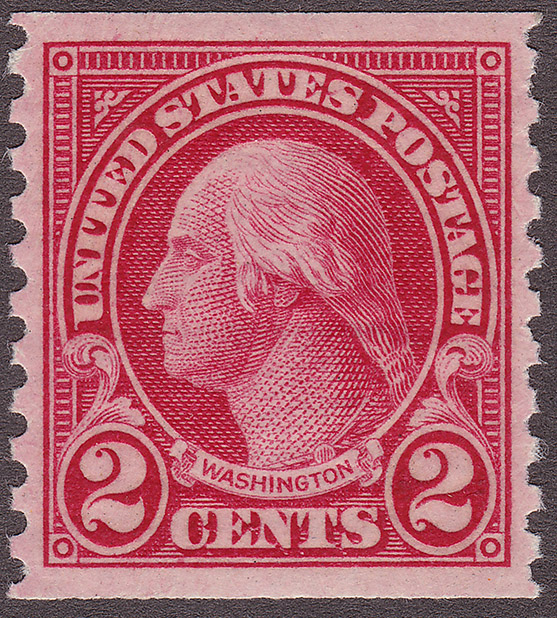 |
|
Send note to Staff
|
|
|
|
|
Pillar Of The Community
United States
1273 Posts |
|
|
Pillar Of The Community
1323 Posts |
|
|
Yes, thanks. I've looked there and other places and I can't tell which mine is. Lack of experience I'm sure and looking for some help. |
Send note to Staff 
|
|
|
Bedrock Of The Community
United States
10882 Posts |
|
|
Pillar Of The Community
1323 Posts |
|
|
Quote:
This is type I. Thanks much. Now that I know for sure I can go back and review some of the charts to see what Im missing!! Thanks again! |
|
Send note to Staff
|
|
|
Pillar Of The Community

United States
1162 Posts |
|
|
From the pictures on the StampSmarter link, the 3 hairs circled are much heavier/thicker in the type II. 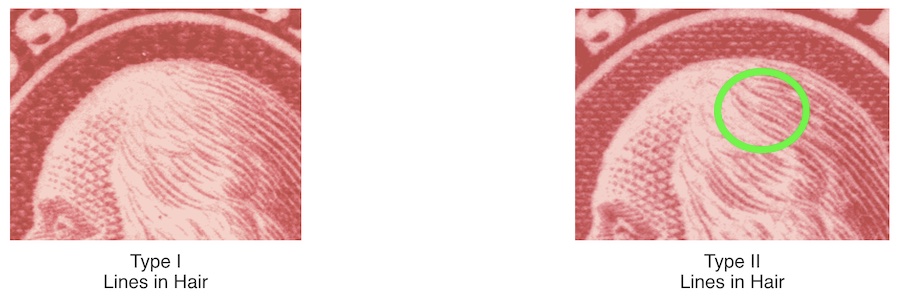 Some stamps may have lighter or heavier inking making them harder to identify individually. Here is a pair showing the type II on the left and type I on the right. 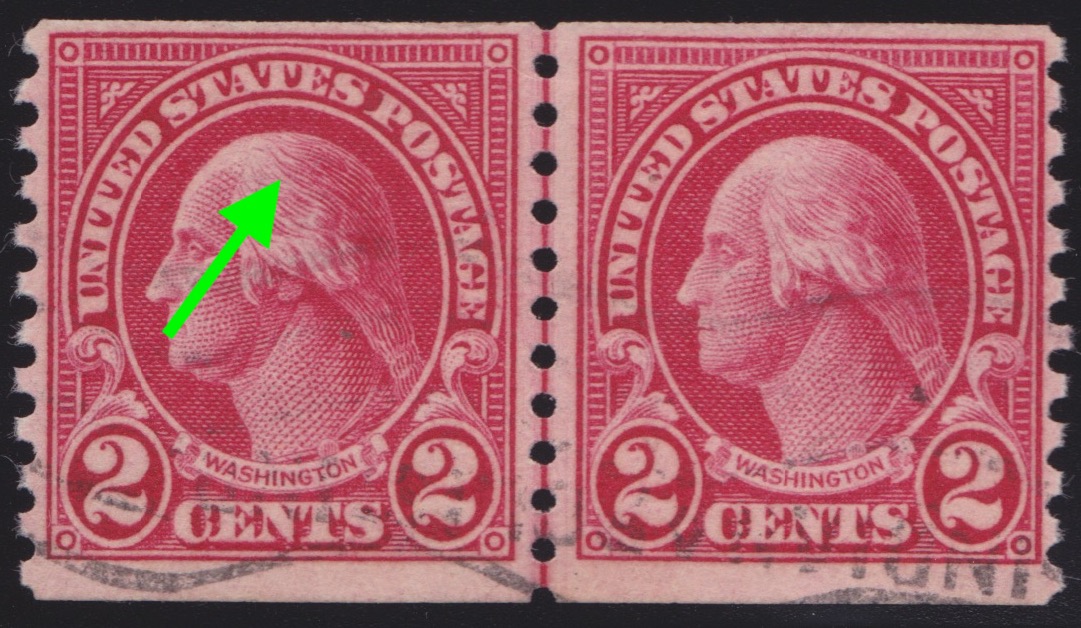 |
|
Send note to Staff
|
|
|
Bedrock Of The Community
United States
10882 Posts |
|
|
Pillar Of The Community
1323 Posts |
|
|
Very nice - thank you. I never had thought about having different Types as a pair - one Type next to another. Interesting. So are there less Type II's vs Typer I's ?? |
|
Send note to Staff
|
|
|
Pillar Of The Community
1323 Posts |
|
|
Pillar Of The Community
3865 Posts |
|
|
The line pair showing the two different Types (I and II) side by side is very interesting. This shows that this Type II variety comes from a different printing plate than the regular Type I since the vertical line indicates the space in between two different printing plates where some ink had been deposited into. |
|
Send note to Staff
|
| Edited by jogil - 06/01/2024 4:35 pm |
|
|
Pillar Of The Community
United States
1162 Posts |
|
|
From Martin Armstrong's "US Definitive Series 1922-1938"
The rotary press had a cylinder which held two 170 subject plates. Therefore one 170 subject plate would fill one half of the printing cylinder. Where the two plates meet on either end, a small crack or joint would fill up with ink during the actual printing, thus creating the Joint Line Pair.
At one point in time a Type-II coil plate #19748 was placed in combination with a Type-I plate #19515.
Since the Type-II plates were first used in combination with a Type-I plate, it is possible to obtain a Joint Coil Line Pair with a combination Type-I & Type-II on either side of the line. This variety was discovered in the 1940s, and has remained the rarest form of the Type-II.
From Durland:
There were 685 plates for #599 Type I and plate number 19515 is one the last 10 'top' plate numbers of Type I. There were just 9 plates of #599A Type II, and plate number 19748 is the first (lowest numbered) 'top and bottom' plate number of Type II.
Durland also mentions the 19515 and 19748 and being the only known combination of plates creating the Type I/II guide line pairs (ordinary pairs of combination Type I/II cannot exist). |
|
Send note to Staff
|
|
|
Pillar Of The Community
1323 Posts |
|
|
Quote:
guide line pairs (ordinary pairs of combination Type I/II cannot exist). 'Ordinary pair' , -> a pair type I type II being located anywhere else besides where 2 plates join ? Thank you for the detailed follow up. Very interesting & helpful. |
|
Send note to Staff
|
All the best… |
|
| |
Replies: 11 / Views: 1,695 |
|




 Posted 05/31/2024 11:29 pm