|
This page may contain links that result in small commissions to keep this free site up and running.

Welcome Guest! Registering and/or logging in will remove the anchor (bottom) ads. It's Free!
To participate in the forum you must log in or register.
| Author |
 Replies: 30 / Views: 2,086 Replies: 30 / Views: 2,086 |
|
|
|
Pillar Of The Community
Netherlands
6639 Posts |
|
|
Ah, now I get the "normal" thing. This is frequent when a stamp is more common as variety than normal. Of course, if your intention is to have a rational listing, why continue this and not assign a main number to the normal stamp and give the variety a 'variety' listing? 'Rational' listings should not compromise. |
Send note to Staff 
|
| Edited by NSK - 07/14/2024 02:52 am |
|
|
Pillar Of The Community
Netherlands
6639 Posts |
|
|
Quote:
I don't think that different configurations like horizontal and vertical pairs need suffixes. I agree but can think of cases where there might be a good reason for this. Some catalogues have a symbol (box with a cross in it, looking like a 2x2 block). In Spain, collecting blocks is popular and local album publishers print pages for blocks. I have certain Spanish stamps and collect those in blocks. Listing block prices would make sense when there is a large collector base. Some catalogs just add a line below the listing of a series for popular multiples that command a premium. They do not add a number, because you can add the format to the number and everyone knows what you are talking about. However, most blocks go at a discount to four singles. So, it does not add much. There, however, might be cases in which assigning numbers would make sense for errors or varieties that, commonly, are collected in pairs. You, always, can think of examples for which it makes sense to have numbers for pairs, and even the orientation might make sense if there is more demand for one or the other. Hibernian (Ireland) provides an example for its stamps T69-T71. These are pairs that, if you split them up, may be difficult to discern from T66-T68 and T72-T74. T69-T71 are numbers for pairs and come with suffixes v and h for the vertical and horizontal pairs, respectively.  Hibernian T70h Hibernian T70h |
|
Send note to Staff
|
| Edited by NSK - 07/14/2024 02:51 am |
|
|
Pillar Of The Community

United States
1124 Posts |
|
|
Quote:
Hibernian (Ireland) provides an example for its stamps T69-T71. These are pairs that, if you split them up, may be difficult to discern from T66-T68 and T72-T74. T69-T71 are numbers for pairs and come with suffixes v and h for the vertical and horizontal pairs, respectively. OK, that makes sense. Come to think of it, Scott often gives a suffix for se-tenant pairs and blocks, like US 2243a is a block of 4 including #2240-2243. But it is annoying that the lettering is not consistent. The block right before this one including stamps 2235-2238 is called 2238 b (because 2238a was already used for the single 2238 error with black color omitted, and then 2238c is the block of 4 with missing color on all 4 stamps. Impossible to remember which is which without looking at the catalog. Next look at 1415-1418, the suffixes run from a through I with permutations of { black omitted, tagging omitted, and precanceled}, in singles or blocks of 4. In fact the suffixes for the singles with tagging omitted are 1415c, 1416d, 1417c, and 1418i. Very inconsistent. Then right after it, 1421-1422 is only listed as a pair with tagging omitted (1422b for $90). What if I have just a single #1421 with tagging omitted, why doesn't it get a catalog number (suffix) like all the others in this section with tagging omitted. But I digress). As someone discussed earlier, some sheets with all-different stamps get individual numbers (50 state flags 1633-1682 and 1682a for the sheet), but in many recent examples, the full sheet gets one full catalog number, and the individual stamps are listed separately with a-z suffixes. For example Classic American Aircraft, the full sheet is #3142 and the individual singles are 3142a, 3142b, up to 3142t. So, yeah, Scott isn't perfect, far from it. Just saying when designing new system let's make sure we don't introduce many more new inconsistencies than are being solved. |
|
Send note to Staff
|
|
|
Pillar Of The Community
United States
2830 Posts |
|
|
Almost done with the next iteration of suffixes, but would like to respond to some of the commentary. These next several response pertain to parcelpostguy's very thorough and thoughtful post and I will continue to respond to other's comments in subsequent posts. Quote:
How would you list:
US Scott # 505 and its brothers?
In reviewing the catalog, there seem to be standard varieties such as perfs, shades, horizontal pairs, and errors. There may be a few others but everything seems to be of a nature that is covered by the standard suffixes I have proposed. All that said, I am not knowledgeable regarding US philately, so please assist me in understanding if I missed something. I have been working from a standard Scott 2009 catalog set. Do I need to review the Classic Specialized for more varieties?
Inverts not printed in error but by design, especially in the proof versions, e.g.1869 issue?
My assumption is that Scott provides notes covering the nature of such issues (I can't find them in my standard Scott's. A catalog adapting a more helpful prefix system should be satisfactory
JPJ perfs, 12, 11x12 and 11 as well as the current 1289BL
Perfs would be numbered- p1, p2, p3, etc. This way users would know these are perf varieties, and the catalog would provide detail in the same way it does currently.
Color missing errors, will the missing color(s) be accounted for?
Yes. These would be listed as errors, or "e" numbers, and the catalog would list details on which is/are missing. If there is more than one error listed, they would be e1, e2, etc. How nice would it be to be able to look for only "e" numbers if that's what you collect?
US 1341 is not listed as air in Scott but is listed as such in other catalogs. How long must the stamp be "special" before being general? !341, two weeks; Q1-12, JQ1-5 were just 6 months, so what is the break? Or all of the now valid Airmail stamps no longer restricted to airmail service usage?
A bit beyond my knowledge- for stronger philatelists than myself.
That said, all stamps should only be listed one way, forever, in my opinion.
What about a document tax stamp R which is repurposed to collect non-document taxes on US postage and value of incoming foreign parcel post matter separate from delivery fee, custom clearance fee and duty fee? In such usage it was to collect a 'postage tax due' your "RAJ" prefix.
Very complex but your analysis makes sense to me.
With your NG (No Gum) do you mean NGAI or Gummed as issued but now not gummed. What about gum errors where a stamps is fully ungummed when the issue was intended to be gummed--this is only demonstrated by multiples of ungummed stamps with attached fully gummed stamps.
Excellent catch - ng is removed in my next iteration as it serves no purpose for cataloging minor varities.
"f" listing would require what level of plate flaw? Will that include a flaw caused by a flawed transfer roll.
High enough level to be catalogued. A topic beyond my knowledge as I don't collect plate flaws. SG does a good job with plate flaws- needs to be obvious when the stamp is observed casually. Bermuda plate flaws, as an example, which have been covered in great detail by DIckgeisser (in the book you sold me) are exceptionally voluminous and so most can't or shouldn't be catalogued.
Watermarks you list, "w" and "wi" but there are reversed and sideways (both left and right) watermarks, with some such by error and some printed without regard to the watermark's position on the paper in reference to the finished printed stamp design. There also watermark errors such as the "USIR" US examples on postage stamps.
You found another defect in my system. I will think about how to correct this so it's simple and useful.
Bisect, "b" is that for authorized examples only, unauthorized but accepted examples and what about unauthorized and rejected bisect examples. Then there are the trisected stamps.
Scott's currently lists these stamps as "a & b" varieties, so I included bi in this proposed system. The level of detail you're exploring is deep. Perhaps there is a need for a trisect suffix? I need guidance.
Your, "AIR POST SPECIAL DELIVERY CE" would than include the current airmail only listed stamps, e.g. US C3 which included the SD service fee as part of the face value? What about when US Special Handling stamps where expanded from paying for Special Handling (a service between post offices) to include for the same price, Special Handling and Special Delivery ( a service between a post office and addressee)? There, the initial printings (QE1-4) were made when only SH was provided but later printing (QE1-3 and QE1a-3a; QE4a was produced before the service expansion but without checking detailed records I cannot say now that it also went to press after the service expansion) over decades paid for both SH and SD. Of course while still valid after 1997, the SD service was no longer provided as part of the SH fee collected.
Not trying to reinvent the wheel, just simplify and enhance existing systems. Decisions on what goes where is an editorial one, well above my pay grade (and knowledge for that matter).
So while the general majority of items in any nomenclature system will fall into place, it is the minority items which will cause the head aches. Eventually, one gets to a point that one often just concedes, "this is good enough" and moves on. Of course just because a new system make 100% complete and logical sense, how many folks would remount their collections into the newly purchased albums which reflect the new 100% complete and logical listing method. Those who do not make the change will continue to use the old catalog system as the new would provide them little usefulness.
So when you need a break for thinking about the new identifying system for stamps; think about what you call that thing on the floor of your car, gas pedal, go pedal, semi-gas pedal or semi-go pedal? Yet on a cycle with pedals, the pedal is the pedal when you must pedal even with "go" assistance; yet they are still called pedals when attached but not needed because you have a "go-throttle" on your pedal machine whether it has one, two or three wheels. Electric cars are motor vehicles but electric cycles (those with throttles) are neither motor vehicles nor motor cycles.
Now that sheds light, I trust, on why 100% complete and logical never exists --- HUMAN POLITICS, the thoughts and commentary. You are correct of course; I am just having fun and seeking to both learn from others and stimulate conversation. Changes in philately are good but it doesn't mean people have to change how they collect. Thanks again for a very detailed and thoughtful post. |
|
Send note to Staff
|
|
|
Pillar Of The Community
United States
2830 Posts |
|
|
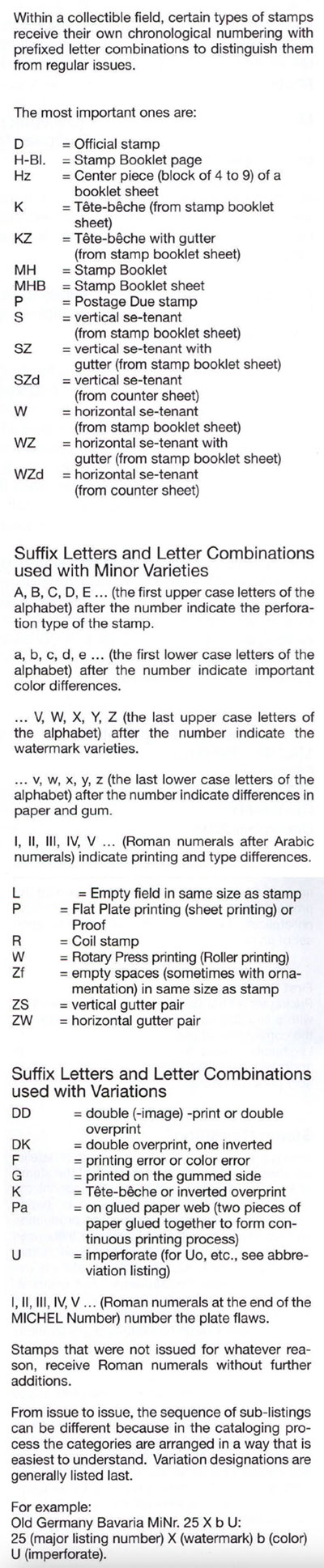
I will be commenting on all posts in this thread, will just take a little bit of time. Below is my latest iteration of a suffix system; still actively working on a prefix system for major numbers. The following have been removed based on both continued revisions and comments in the thread: invert (simply one type of error) ng (for pricing guidance but not used or needed for a minor number. NGAI stamps are covered by catalog notes above the listings) printed both sides (simply one type of error) watermark inverted (would be listed as a "w" suffix with the qualifier of "inverted." This helps to provide simple coverage for all types of watermarks including side, upright, and inverted. If more than one watermark variety is listed for a given issue, then the suffix would be w1, w2, w3, etc. (thanks to parcelpostguy).  |
|
Send note to Staff
|
| Edited by shermae - 07/15/2024 3:37 pm |
|
|
Pillar Of The Community
United States
2830 Posts |
|
|
Seeking to address more posts and wasn't sure if I responded to this one: Quote:
How would you differentiate shades other than with an "s" suffix, since there may be numerous shades for a single issue? They would be s1, s2, s3, etc.Here's another: Quote:
Ah, now I get the "normal" thing. This is frequent when a stamp is more common as variety than normal. Of course, if your intention is to have a rational listing, why continue this and not assign a main number to the normal stamp and give the variety a 'variety' listing? 'Rational' listings should not compromise. Will give this some thought. |
|
Send note to Staff
|
|
|
Pillar Of The Community
United States
2830 Posts |
|
|
Quote:
DISCLAIMER: I'm a Michel homer, and I love their system of prefixes and suffixes.
I personally think attempting to get specific within things like paper varieties (thick, thin, chalky, etc.), would quickly become unworkable on a worldwide scale. I do like Michel in terms of certain elements being very simple (though I struggle with the German meanings so I haven't carefully examined whether the prefixes and suffixes are "meaningful."
My concern with the system used by Michel is that there are a lot of "I's" and "II's" as well as "a's" and "b's," none of which convey useful into to sellers and collectors.
As it pertains to paper, I came to agree with you and added only a single suffix for paper. In such a system, the catalog just needs to qualify with terms like ordinary, chalky, thin, thick, pelure, etc. |
|
Send note to Staff
|
|
|
Pillar Of The Community
United States
2830 Posts |
|
|
Quote:
For example, the 1 cent blue Franklin, Scott numbers 5 through 9, is just a single number. Michel uses suffixes to denote all the varieties listed in Scott. I can hear the howls from the well-heeled collectors already. If it's not a major number the price will probably drop precipitously. There are third graders in this forum who know more than me about US philately. I am seeking to come up with a new system of cataloging, not make decisions on how to organize the information behind how things get cataloged. A project for much greater minds than mine, at least as it pertains to USA. |
|
Send note to Staff
|
| Edited by shermae - 07/16/2024 4:09 pm |
|
|
Pillar Of The Community
United States
2830 Posts |
|
|
Quote:
I need more examples to understand what you are trying to propose here. Let me try to see if I understand...
USA Scott 554 design A157 perf 11x11 flat plate.
Would your new catalog number be something like this?
157.p11x11
Then the same design A157 Scott 634A die II perf 11x10.5 rotary press,
157.dII.p11x10.5
and 634b die I carmine lake shade,
157.dI.p11x10.5.s2
Seems awfully complicated, please clarify my misunderstandings. The first two, Scott 554 and 634A would not change at all since they are major, front-of-the-book catalog numbers and easy to find.
Scott 634b would become 634s so we know it's a shade.
Edit- I am using a standard Scott Volume 1. If there are other varieties for these 3 stamps in Scott classic specialized I would need to look them up. I moved not too long ago with a plan to buy a new home soon so many things are still boxed up. If there are additional varieties of these 3 stamps if would help greatly to see images of the Scott listings. |
|
Send note to Staff
|
| Edited by shermae - 07/16/2024 4:35 pm |
|
|
Pillar Of The Community
United States
2941 Posts |
|
|
Quote:
My concern with the system used by Michel is that there are a lot of "I's" and "II's" as well as "a's" and "b's," none of which convey useful into to sellers and collectors. The "I" and "II" indicate printing and type varieties. They are usually used to show when there has been some minor change across the printings of an issue – peacetime vs. wartime printings resulting in different quality of print, minor changes in overprint font, size, or placement, etc. The lowercase letters from the beginning of the alphabet indicate color varieties, so they are the equivalent of s1, s2, etc., in your system. |
|
Send note to Staff
|
|
| Edited by PostmasterGS - 07/16/2024 6:59 pm |
|
|
Pillar Of The Community
United States
2830 Posts |
|
|
Thanks for the clarification Postmaster. I have a Michel for a few European areas but don't use it very often. Would make for a good study as I play around with this idea. |
|
Send note to Staff
|
|
|
Pillar Of The Community
United States
2941 Posts |
|
|
Pillar Of The Community
United States
2830 Posts |
|
|
Imaged below is the final version of suffixes that seem necessary, along with a nomenclature that makes them more intuitive. Since they so commonly appear as a and b numbers in Scott's, I added miniature sheets as "ms" prefixes. An argument could easily be made that these should a Prefix rather than a suffix, and even an argument for sheets being listed in certain cases. Some sheets have all or some values of a set of all-different denominations. How to list these, if not a major number? I'm not sure. I am very open to additional comments as to the adequacy of the choices made. In the meantime, I am putting the finishing touches on the prefix system. My only trepidation is about some prefixes that necessarily have 4 characters, for example "OCSD" for occupation special delivery stamps. A 4 character configuration only happens twice, fortunately. I will post the prefix system soon.  |
|
Send note to Staff
|
|
|
Pillar Of The Community
United States
2830 Posts |
|
|
Below is my final revision of a rational prefix system for major numbers in stamp catalogs. I have some trepidation regarding 4-letter prefixes however these are only seen in 2 places in the system (specialized military stamps). Both of these types of designations are very rarely used so for now I can live with them having 4 letters. Scott does not seem to have a prefix for unexploded booklets, so I added "B" for booklets. All comments are welcome and encouraged!  |
|
Send note to Staff
|
|
|
Pillar Of The Community
United States
1124 Posts |
|
|
Not criticisms, just questions to spur the conversation...
What factors determine the primary listing prefix versus sub-categories? For example, there is:
Air Post Special Delivery
Occupation Special Delivery
Semi-Postal Special Delivery
but then
Special Delivery Official.
Why not Official Special Delivery?
Instead of listing every single combination (with some missed), why not just list the main categories with rules for how to combine the usages.
For example, there are prefixes for:
Parcel Post
Parcel Post Authorized Delivery
Military Parcel Post
but not
Parcel Post Postage Due (JQ)
yet there are prefixes for Occupation Postage Due and Military Postage Due. The number of combinations seems limitless, so any list will be incomplete and one will need rules for knowing how to build new prefixes in the future for those that are missing.
Similarly, there are prefixes listed for:
Air Post
Air Post Semi-Postal
Air Post Semi-Postal Official
Air Post Special Delivery
Occupation Air Post
but not
Air Post Stamped Envelopes (UC)
and/or
Stamped Envelopes Air Post
Also off the top of my head, I don't see:
Postal Cards (UX)
Aerogramme
Carriers and Locals (L, LO)
|
|
Send note to Staff
|
|
|
Replies: 30 / Views: 2,086 |
|
|
To participate in the forum you must log in or register. | |
Disclaimer: While a tremendous amount of effort goes into ensuring the accuracy of the information contained in this site, Stamp Community assumes no liability for errors. Copyright 2005 - 2026 Stamp Community Family - All rights reserved worldwide. Use of any images or content on this website without prior written permission of Stamp Community or the original lender is strictly prohibited.
Privacy Policy / Terms of Use Advertise Here |
| Stamp Community Forum |
© 2007 - 2026 Stamp Community Forums |
| It took 0.24 seconds to lick this stamp. |
 |
|
|
|


 Posted 07/14/2024 01:42 am