|
This page may contain links that result in small commissions to keep this free site up and running.

Welcome Guest! Registering and/or logging in will remove the anchor (bottom) ads. It's Free!
To participate in the forum you must log in or register.
| Author |
 Replies: 30 / Views: 2,085 Replies: 30 / Views: 2,085 |
|
Pillar Of The Community
United States
2830 Posts |
|
|
|
I've commented a few times here in SCF that much of how Scott (and frankly other catalog publishers) numbers items is irrational. I don't mean the numbers themselves, but the prefixes and suffixes that are used to number types of stamps and varieties of stamps respectively. In the first pass at a rationalization of these catalog designations that I will present, I have not changed any of the Scott prefixes for major types of stamps as can be seen below. These are very familiar to collectors regardless of catalog used and as such have some equity and buy-in with collectors.
That said, the problem with many current Scott listings of varieties is they offer no insight as to what the variety is. For example, C3a is well-know in the USA listings as the Inverted Jenny, however the same exact numerical listing for a different country could be anything from a perf variety, paper variety, shade, die, watermark variety, etc. There is no way to know as Scott mixes and matches "a, b, c, etc" listings among many different varieties.
Let's say you collect perf varieties but not shades or watermarks. Wouldn't it be nice to communicate with sellers that as a perf collector, there would be only one type of Scott number you'd be looking for? Or better yet, when you see a listing you'd know immediately on first glance if it's a stamp for you or not.
So below is my attempt at rationalizing Scott suffixes to make things easier to find. One area I feel may need tweaking is papers- I made designations for chalky and ordinary, thick and thin, but there are many other paper varieties listed in Scott such as granite and pelure, for example. Perhaps my system needs a "pa" suffix for paper varieties not covered by chalky, ordinary, thick, and thin.
What's missing? What would you change? I would be very interested in any comments or ideas. Down the road a little bit I would like to present another version that also revisits the prefixes, though I feel this is less important.
EXISTING
STAMP TYPE CATALOG PREFIX
AIR POST C
AIR POST SEMI-POSTAL CB
AIR POST SEMI-POSTAL OFFICIAL CBO
AIR POST SPECIAL DELIVERY CE
AUTHORIZED DELIVERY EY
FISCAL R
FRANCHISE S
INSURED LETTER G
MARINE INSURANCE GY
MILITARY M
MILITARY AIR POST MC
MILITARY PARCEL POST MQ
MILITARY POSTAGE DUE MJ
NEWSPAPER P
OCCUPATION N
OCCUPATION - AIR POST NC
OCCUPATION - OFFICIAL NO
OCCUPATION - POSTAGE DUE NJ
OCCUPATION - POSTAL TAX NRA
OCCUPATION - SEMI-POSTAL NB
OCCUPATION - SPECIAL DELIVERY E
OFFICIAL O
PARCEL POST Q
PARCEL AUTHORIZED DELIVERY QY
POSTAGE DUE J
POSTAL TAX RA
POSTAL TAX DUE RAJ
POSTAL TAX SEMI-POSTAL RAB
POSTAL-FISCAL AR
REGISTRATION F
REVENUE R
SEMI POSTAL B
SEMI-POSTAL SPECIAL DELIVERY EB
SPECIAL DELIVERY E
SPECIAL DELIVERY OFFICIAL EO
SPECIAL HANDLING QE
STAMP ENVELOPES & WRAPPERS U
WAR TAX MR
PROPOSED
VARIETY TYPE SUFFIXES
BISECT b
CHALKY PAPER cp
DIE d
PLATE FLAW f
FIRST DAY COVER fdc
HORIZONTAL PAIR h
INVERTED i
INVERTED WATERMARK iv
NO GUM ng
NORMAL no
ON COVER oc
ORDINARY PAPER op
PERF p
PRINTED BOTH SIDES pbs
SHADE s
SPECIMEN sp
SOUNVENIR SHEET ss
THIN PAPER thp
THICK PAPER tkp
USED ON COVER uoc
VERTICAL PAIR vp
WATERMARK w
Edit- I painstakingly added spaces to each line so everything would be in columns, but the final version does not have the clean columns. Not sure the editor allows for this?
|
|
Send note to Staff
|
| Edited by shermae - 07/12/2024 3:56 pm |
|
|
|
|
Pillar Of The Community
United States
2941 Posts |
|
|
DISCLAIMER: I'm a Michel homer, and I love their system of prefixes and suffixes.
I personally think attempting to get specific within things like paper varieties (thick, thin, chalky, etc.), would quickly become unworkable on a worldwide scale.
How would you differentiate shades other than with an "s" suffix, since there may be numerous shades for a single issue? |
Send note to Staff 
|
|
|
|
Pillar Of The Community
Netherlands
6639 Posts |
|
|
To start with, there is nothing semi about semi-postal stamps. It says more about who came up with this terminology than the use of the stamps.
Interesting you leave non-informative prefixes like 'Postage Due - J' unchanged.
Why have a separate letter for used on cover but not for used?
Why have letters for perforated and watermarked stamp if that is the standard?
Why have a need for a suffix for 'normal' and not asign the basic number to that?
What do you suggest if there are several watermarks, shades, or perforations?
The logic behind thick and thin paper escapes me. Thp would fit both. tnp and tkp would not.
Not all miniature sheets are souvenir sheets (SG uses the prefix MS). |
|
Send note to Staff
|
| Edited by NSK - 07/12/2024 4:15 pm |
|
|
Pillar Of The Community
United States
2830 Posts |
|
|
Quote:
How would you differentiate shades other than with an "s" suffix, since there may be numerous shades for a single issue? Great question, which I forgot to address in my original post. Numbers would follow if there is more than 1 of a type. In this case, s1, s2, etc. Same would be true for things like perfs. |
|
Send note to Staff
|
|
|
Pillar Of The Community
United States
2830 Posts |
|
|
Quote:
Interesting you leave non-informative prefixes like 'Postage Due - J' unchanged.
Why have a separate letter for used on cover but not for used?
Why have letters for perforated and watermarked stamp if that is the standard?
Why have a need for a suffix for 'normal' and not asign the basic number to that?
What do you suggest if there are several watermarks, shades, or perforations?
The logic behind thick and thin paper escapes me. Thp would fit both. tnp and tkp would not.
Not all miniature sheets are souvenir sheets (SG uses the prefix MS). As it relates to prefixes, note in my original post that for this pass I did not address prefixes. I agree with you that something like "J" is pretty useless. Separate suffix for used - there is a column of pricing already dedicated to used stamps. "Used on cover" is a separate category for which Scott uses suffixes at times. Perforations and watermarks are already receiving "a" and "b" sufflixes so I saw a need for a more usable suffix for each. I have seen the term "normal" used in Scott's as a description for a suffix, so I added it. I will double check to see if it's actually superfluous. Multiple perfs, shades, etc would have a number after the suffix, such as s1, s2, s3, etc. Your comments regarding paper are well taken. I may have complicated the issue of paper unnecessarily. Based on your comments I am considering using a single suffix for any paper varieties which would then have a qualifier after, such as: "P1 Ordinary paper" "P2 Granite paper" |
|
Send note to Staff
|
| Edited by shermae - 07/12/2024 4:51 pm |
|
|
Pillar Of The Community
Netherlands
6639 Posts |
|
|
Quote:
Separate suffix for used - there is a column of pricing already dedicated to used stamps. "Used on cover" is a separate category for which Scott uses suffixes at times. Most catalogues I know either add a column for used on cover as well or they just add an extra line without a suffix, just like for FDCs. |
|
Send note to Staff
|
|
|
Pillar Of The Community
United States
775 Posts |
|
|
I agree that the Scott listings for USA are a mess. I occasionally think about creating my own catalog arranged the way I think would be rational. But then I remember that this has already been done. It's called the Michel Specialized USA catalog. The only thing preventing it being the catalog of choice is that the Scott numbering system is so thoroughly entrenched in the collecting psyche. For example, the 1 cent blue Franklin, Scott numbers 5 through 9, is just a single number. Michel uses suffixes to denote all the varieties listed in Scott. I can hear the howls from the well-heeled collectors already. If it's not a major number the price will probably drop precipitously. My USA albums are arranged according to Scott and have plenty of empty spaces. But according to Michel I have a nearly complete collection of the major numbers.  |
|
Send note to Staff
|
|
|
Pillar Of The Community
United States
2941 Posts |
|
|
Quote:
But then I remember that this has already been done. It's called the Michel Specialized USA catalog. I was hesitant to suggest that, since that's my suggestion anytime there's a discussion of catalog "systems", but yeah. Quote:
For example, the 1 cent blue Franklin, Scott numbers 5 through 9, is just a single number. Michel uses suffixes to denote all the varieties listed in Scott. I can hear the howls from the well-heeled collectors already. If it's not a major number the price will probably drop precipitously. For example, from an old thread of mine: 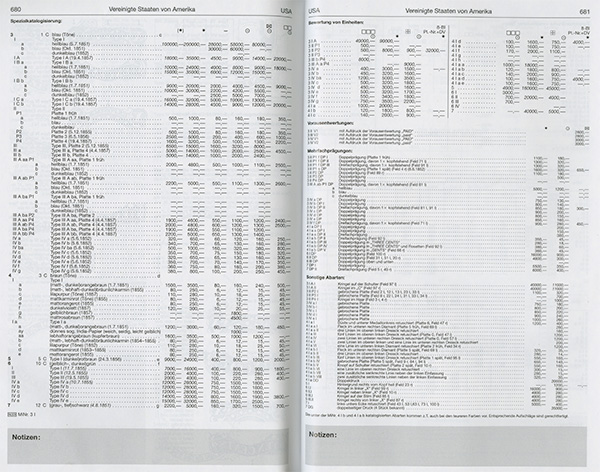 |
|
Send note to Staff
|
|
| Edited by PostmasterGS - 07/12/2024 5:25 pm |
|
|
Pillar Of The Community
United States
2830 Posts |
|
|
Keep in mind that I don't collect USA. I am strictly a WW collector but feel this is a useful discussion, even if only erudite, as the same concerns affect WW collecting. Michel does a great job in pulling data together in tabular form. That said, the image provided by Postmaster seems to show a confused and difficult-to-navigate system of suffixes. Suffixes should provide info that helps everyone navigate more easily. |
|
Send note to Staff
|
| Edited by shermae - 07/12/2024 5:48 pm |
|
|
Pillar Of The Community
United States
2941 Posts |
|
|
To be fair, that image isn't an accurate representation of Michel's general WW listings. The early US listings are a mess because early US is a mess.
For general WW, I find Michel's suffix system to be the perfect balance – general enough to know the category of a variety (watermark, paper, color, etc.), but not so specific in identifying that variety as to be cumbersome. |
|
Send note to Staff
|
|
|
|
Pillar Of The Community
United States
2830 Posts |
|
|
Based on the excellent feedback received so far, I have modified the suffixes for variety type and used a screenshot below so everything is more easy on the eye. Agree that I got too deep into the weeds on papers so now there is only 1 paper modifier. Below the table, I provide an image from Scott's to show why I have a modifier for items described as "normal," a term Scott has currently in use. Appreciate additional feedback on misses, mistakes, and misappropriations! 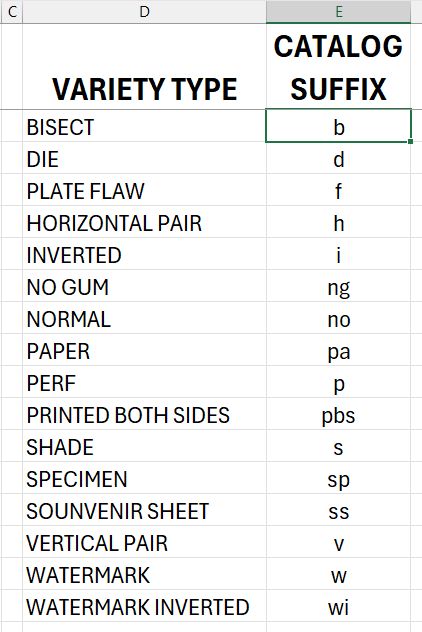 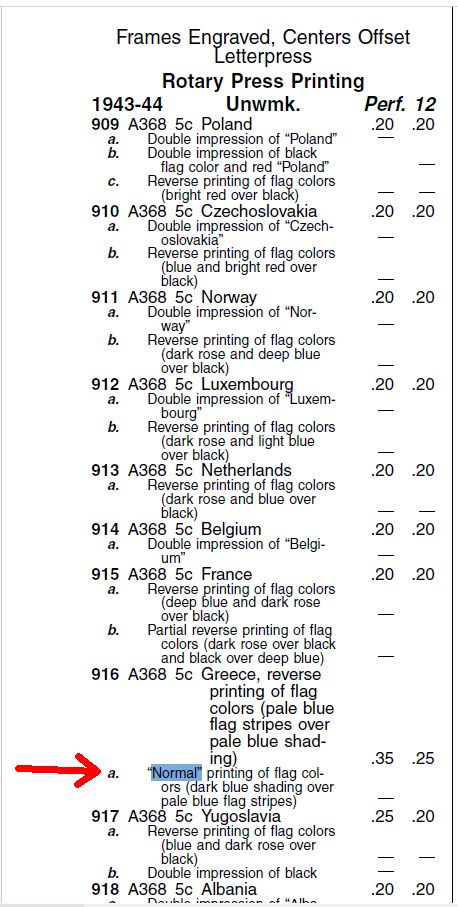 |
|
Send note to Staff
|
|
|
Pillar Of The Community
United States
2830 Posts |
|
|
My next thought is regarding the need to have "e" for any/all errors. The only major errors called out specifically are inverts; there is no general term for any/all errors which would then default to the useless "a, b, etc."
Starting work on rationalizing prefixes... |
|
Send note to Staff
|
|
|
Pillar Of The Community
United States
4441 Posts |
|
|
How would you list:
US Scott # 505 and its brothers?
Inverts not printed in error but by design, especially in the proof versions, e.g.1869 issue?
JPJ perfs, 12, 11x12 and 11 as well as the current 1289BL
Color missing errors, will the missing color(s) be accounted for?
US 1341 is not listed as air in Scott but is listed as such in other catalogs. How long must the stamp be "special" before being general? !341, two weeks; Q1-12, JQ1-5 were just 6 months, so what is the break? Or all of the now valid Airmail stamps no longer restricted to airmail service usage?
What about a document tax stamp R which is repurposed to collect non-document taxes on US postage and value of incoming foreign parcel post matter separate from delivery fee, custom clearance fee and duty fee? In such usage it was to collect a 'postage tax due' your "RAJ" prefix.
With your NG (No Gum) do you mean NGAI or Gummed as issued but now not gummed. What about gum errors where a stamps is fully ungummed when the issue was intended to be gummed--this is only demonstrated by multiples of ungummed stamps with attached fully gummed stamps.
"f" listing would require what level of plate flaw? Will that include a flaw caused by a flawed transfer roll.
Watermarks you list, "w" and "wi" but there are reversed and sideways (both left and right) watermarks, with some such by error and some printed without regard to the watermark's position on the paper in reference to the finished printed stamp design. There also watermark errors such as the "USIR" US examples on postage stamps.
Bisect, "b" is that for authorized examples only, unauthorized but accepted examples and what about unauthorized and rejected bisect examples. Then there are the trisected stamps.
Your, "AIR POST SPECIAL DELIVERY CE" would than include the current airmail only listed stamps, e.g. US C3 which included the SD service fee as part of the face value? What about when US Special Handling stamps where expanded from paying for Special Handling (a service between post offices) to include for the same price, Special Handling and Special Delivery ( a service between a post office and addressee)? There, the initial printings (QE1-4) were made when only SH was provided but later printing (QE1-3 and QE1a-3a; QE4a was produced before the service expansion but without checking detailed records I cannot say now that it also went to press after the service expansion) over decades paid for both SH and SD. Of course while still valid after 1997, the SD service was no longer provided as part of the SH fee collected.
So while the general majority of items in any nomenclature system will fall into place, it is the minority items which will cause the head aches. Eventually, one gets to a point that one often just concedes, "this is good enough" and moves on. Of course just because a new system make 100% complete and logical sense, how many folks would remount their collections into the newly purchased albums which reflect the new 100% complete and logical listing method. Those who do not make the change will continue to use the old catalog system as the new would provide them little usefulness.
So when you need a break for thinking about the new identifying system for stamps; think about what you call that thing on the floor of your car, gas pedal, go pedal, semi-gas pedal or semi-go pedal? Yet on a cycle with pedals, the pedal is the pedal when you must pedal even with "go" assistance; yet they are still called pedals when attached but not needed because you have a "go-throttle" on your pedal machine whether it has one, two or three wheels. Electric cars are motor vehicles but electric cycles (those with throttles) are neither motor vehicles nor motor cycles.
Now that sheds light, I trust, on why 100% complete and logical never exists --- HUMAN POLITICS, |
|
Send note to Staff
|
|
|
Pillar Of The Community

United States
1123 Posts |
|
|
I need more examples to understand what you are trying to propose here. Let me try to see if I understand...
USA Scott 554 design A157 perf 11x11 flat plate.
Would your new catalog number be something like this?
157.p11x11
Then the same design A157 Scott 634A die II perf 11x10.5 rotary press,
157.dII.p11x10.5
and 634b die I carmine lake shade,
157.dI.p11x10.5.s2
Seems awfully complicated, please clarify my misunderstandings.
From this exercise, I see a couple of missing elements from your table. Some stamps with different Scott numbers are identifiable only by their printing method (Flat, Rotary, Offset, Typography, Lithography, Photogravure, etc.) so you may want a suffix for that.
Also what about coil stamps or booklets? Or does that get covered by (p)erf? For example a line pair of 599A would be -
157.dII.p10V.hlp
I don't see how that is better or easier than simply "599A" except for if someone wants to do a database search for all "p10V" stamps around the world.
I think far better would be a mapping of existing catalog numbers (pick your favorite) in a database with all of each stamps metadata (perfs, shades, watermarks, etc) to do said queries. And of course database mappings to other brands of catalog numbers.
Back to the 599A example, how about a horizontal coil line pair with die I on the left and die II on the right, would that be
157.p10V.hlp.dI.dII ? |
|
Send note to Staff
|
|
|
Pillar Of The Community
United States
1123 Posts |
|
|
I don't think that different configurations like horizontal and vertical pairs need suffixes. If so, what about blocks? or blocks of 6 or 9? Would that be a .b6 or .b9 suffix?
Same with No Gum, On Cover, or Bisect. Those are different formats or states of the same stamp. Maybe a rule like, once the stamp leaves the post office its catalog number is set in stone. How the stamp is used or separated, while valuable information to a collector, does not require a suffix. Simply an abbreviation, like condition (NH, reperf, torn, jumbo, etc.), can be applied after the catalog number. |
|
Send note to Staff
|
|
|
Pillar Of The Community
United States
811 Posts |
|
|
I like how the Facit catalog works. It covers Scandinavian stamps. The major varieties get a catalog number. Like Scott, perforation, watermarks, and the like get their own number. Every major variant gets a letter: different printings, colors ("shades"), etc. More subtle differences like notable platings get a "var1", "var2", etc. Just the number covers all the variants, not just one, like in Scott. If you see a Facit number without a letter, you know the collector is not bothered with the varieties. |
|
Send note to Staff
|
|
|
Replies: 30 / Views: 2,085 |
|
|
To participate in the forum you must log in or register. | |
Disclaimer: While a tremendous amount of effort goes into ensuring the accuracy of the information contained in this site, Stamp Community assumes no liability for errors. Copyright 2005 - 2026 Stamp Community Family - All rights reserved worldwide. Use of any images or content on this website without prior written permission of Stamp Community or the original lender is strictly prohibited.
Privacy Policy / Terms of Use Advertise Here |
| Stamp Community Forum |
© 2007 - 2026 Stamp Community Forums |
| It took 0.25 seconds to lick this stamp. |
 |
|
|
|


 Posted 07/12/2024 3:53 pm