| Author |
 Replies: 13 / Views: 734 Replies: 13 / Views: 734 |
|
|
Pillar Of The Community
United States
1124 Posts |
|
|
The cover shown was mailed from Hudson, to Spencertown, NY in 1865, and then forwarded to Manhattan where the recipient couldn't be found as per the 'Cannot be Found' handstamp. The cover was then advertised as indicated by the oval handstamp with no further clues added to how the letter was handled. Even though a nicely embossed circular corner card was applied by the sender (a law firm), no instructions along the lines of 'If not delivered within 5-days, return to...' was included. Was the NY cds verso applied by the DLO or is it simply a marking applied at NY after a month's worth of the cover having been advertised as it was returned to sender? I'm not sure, on the face of things, if the DLO needed to be involved at all since the sender was obvious thanks to the corner card, BUT... I have a vague memory of reading somewhere that before some time in 1868, non-request return addresses did not allow return of undeliverable mail directly to the writer. Because of this, in 1867 when addressee 'CANNOT BE FOUND' (Undeliverable) and then was 'ADVERTISED' without success, it then had to be sent to the DLO where it was opened and only then returned to sender for free. Admittedly, this "memory" of mine could be my imagination... I wonder if there is some way to substantiate (or not) this "memory" via the PL&R but have no clue how to go about doing this. Ideas? Thoughts? Thanks for any insights! 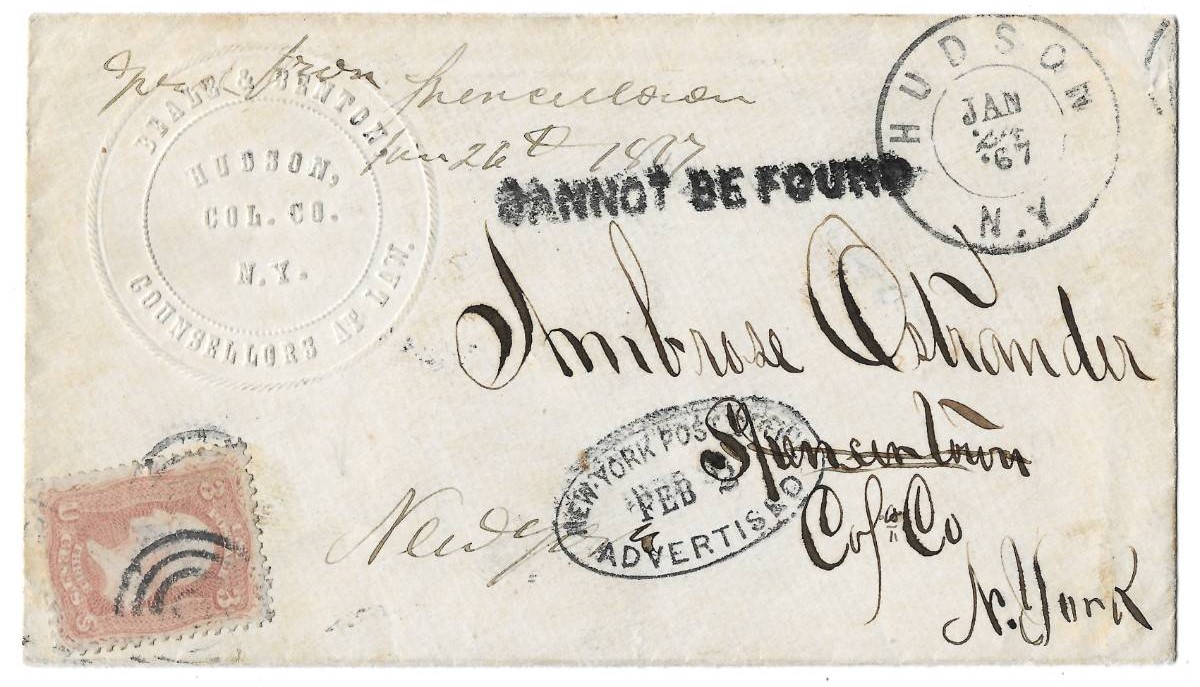 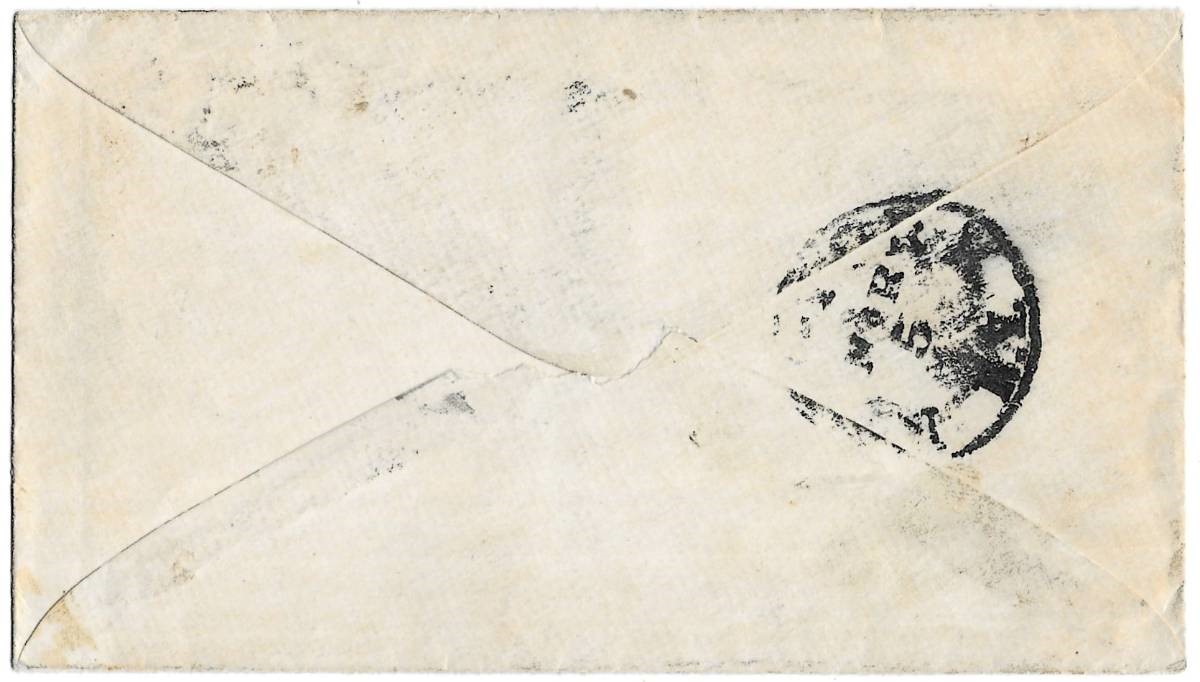 |
|
Send note to Staff
|
|
|
|
|
Valued Member
United States
81 Posts |
|
|
Valued Member
United States
81 Posts |
|
|
Pillar Of The Community
6352 Posts |
|
|
This cover has no connection to the dead letter office. The "cannot be found" and the backstamp were the last marks added (and at the same time), when the letter was removed from the file of advertised covers which had been held their allotted time period. The NYC post office was able to return the letter to the sender using the return address, which meant there was no need for an extra trip through the dead letter office for them to open it to look for a sender's address or other clues to get it to a proper disposition. |
Send note to Staff 
|
|
|
Valued Member
United States
81 Posts |
|
|
Curious about the path this letter took. Spencertown is located northeast of Hudson in Columbia County, NY. So I'm wondering why the letter would be been routed to NYC, 130 miles away? We see that "Spencertown" is crossed out and "New York" obliquely indicated as the new destination. Or is it? If so, it seems unlikely that the letter would have reached its intended recipient without a street address. Would it have been the postmaster at Spencertown who redirected it? 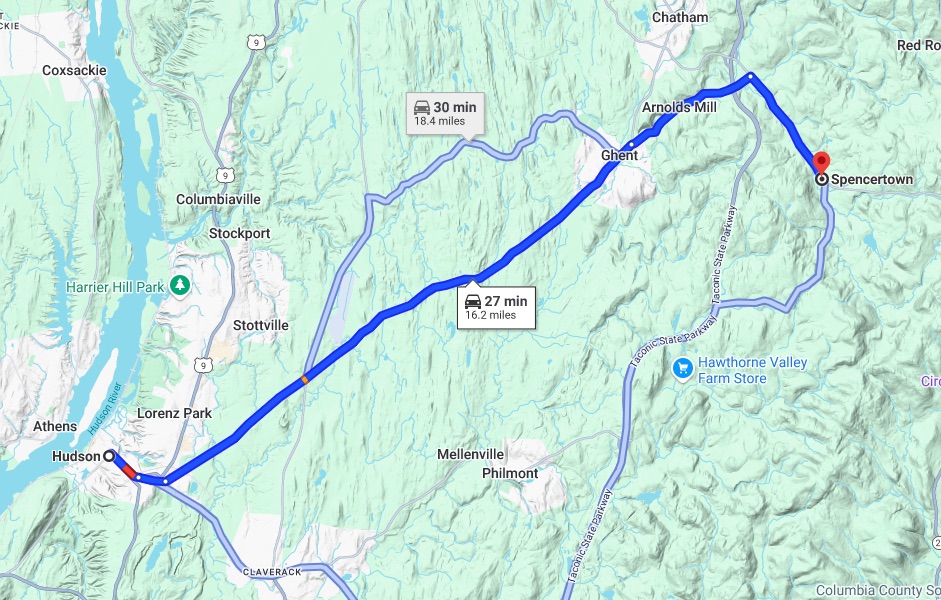 |
|
Send note to Staff
|
|
|
Pillar Of The Community
6352 Posts |
|
|
One must think like 1867, rather than 2024.
City delivery was in its infancy in 1867, and only available in the largest cities. Even in large towns with city delivery, a substantial amount of mail was still handled through the general delivery and picked-up in-person.
The recipient likely told the Spencertown postal employees where to forward his mail as the markings are all in the same hand and pen, thus done by the postal employee. The sending to NYC was not random. |
|
Send note to Staff
|
| Edited by John Becker - 09/14/2024 12:32 pm |
|
|
Valued Member
United States
81 Posts |
|
|
??
My questions were clearly directed towards an understanding of how this letter traveled in the day. Didn't suggest that sending it to NYC was random. Sending to NYC without a street address seems odd. |
|
Send note to Staff
|
|
|
Pillar Of The Community
6352 Posts |
|
|
I saw no indication in your post above about travel method.
The USPOD regularly advertised for bids on mail-carrying and awarded contracts. These would specify the frequency and desired transport method for each route, whether horseback, carriage, rail, water, etc. Your answer would be in the contract bid or award lists. As for the routing, it would have gone through as many towns/villages as possible to make the overall route scheduling efficient. |
|
Send note to Staff
|
| Edited by John Becker - 09/14/2024 1:41 pm |
|
|
Valued Member
United States
81 Posts |
|
|
Thanks for that clarification, John. I used to live in the area. Outside the confines of Hudson it's rural, small towns, routes named "Old Carriage Road" and such. Not far from our house was Ostrander Road. I moved there to be in a place that felt like it was from a bygone era. So I'm imagining what it would have taken for that letter just to be delivered to Spencertown from Hudson and then to parts beyond. It very well could have made its way past where our house was located, on a shortcut to Spencertown. |
|
Send note to Staff
|
|
|
Pillar Of The Community
6352 Posts |
|
|
This reply won't apply directly to the cover here, but below are scans from an 1863 Ohio bid advertisement booklet of 95 pages illustrating the different complexities, lengths, frequencies of routes. I don't see anything here on horseback vs carriage by this time, but rail and steam are clearly noted. Cover page: 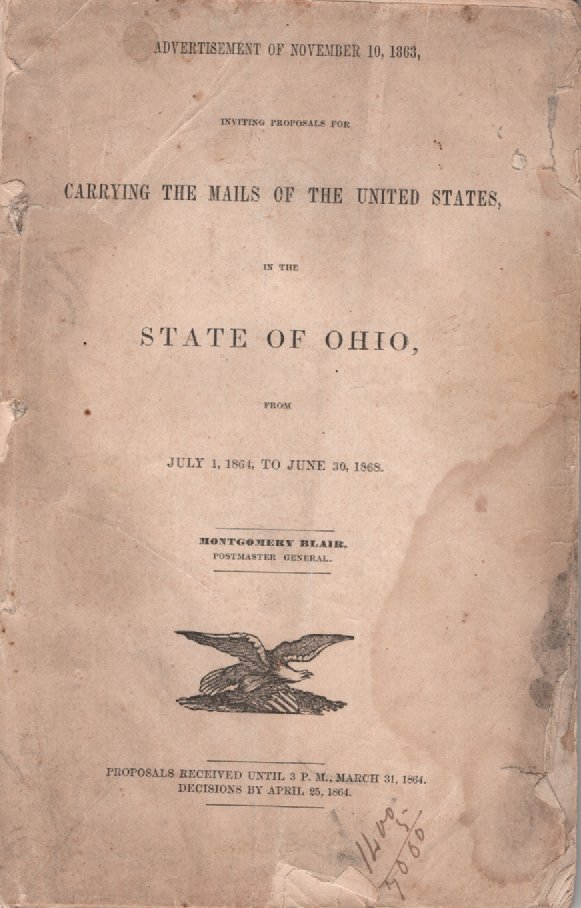 First of several index pages: 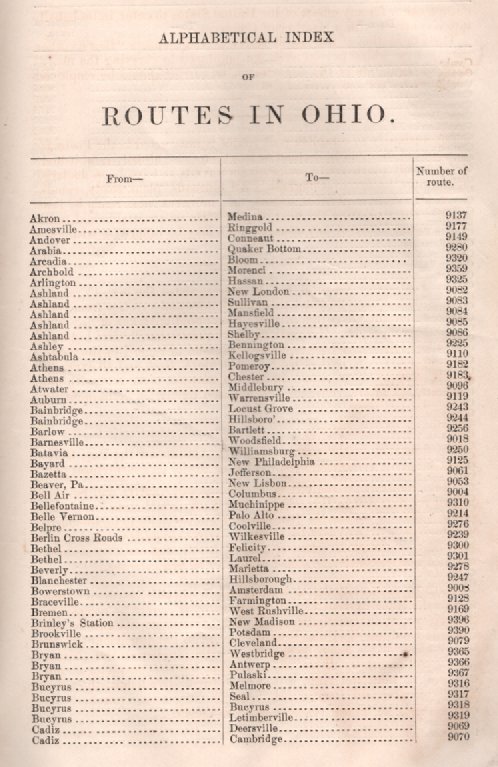 First page of the actual route descriptions: 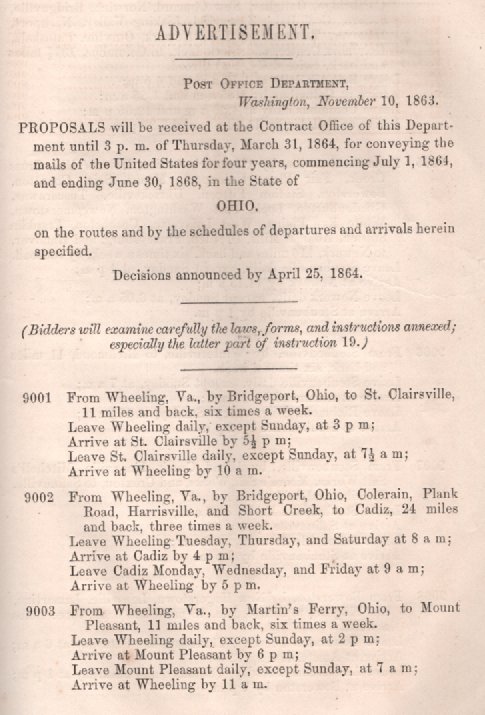 A rather complex rail route at the bottom: 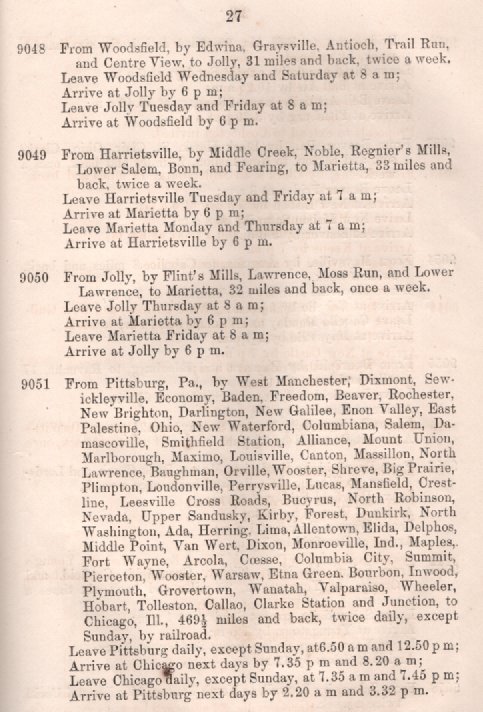 A steamboat route at the bottom: 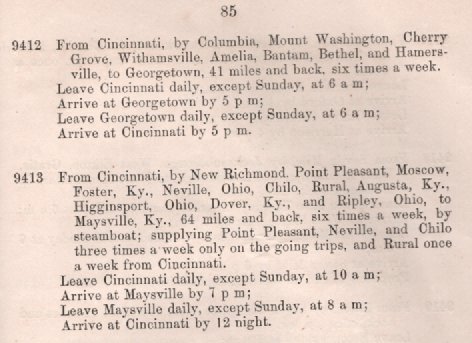 A 1-mile route: 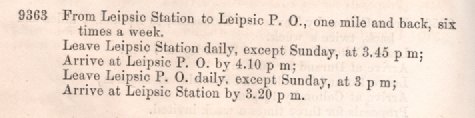 And with digging, one can find lists of approved routes. Here is excerpt from the 1851 Post Office Guide (By Eli Bowen,Arno Press reprint, 1976). I did not read through the many pages of fine print to find the likely route for the cover in question, but it should be there, with a note of caution that routes/connections may have changed between 1851 and 1867. 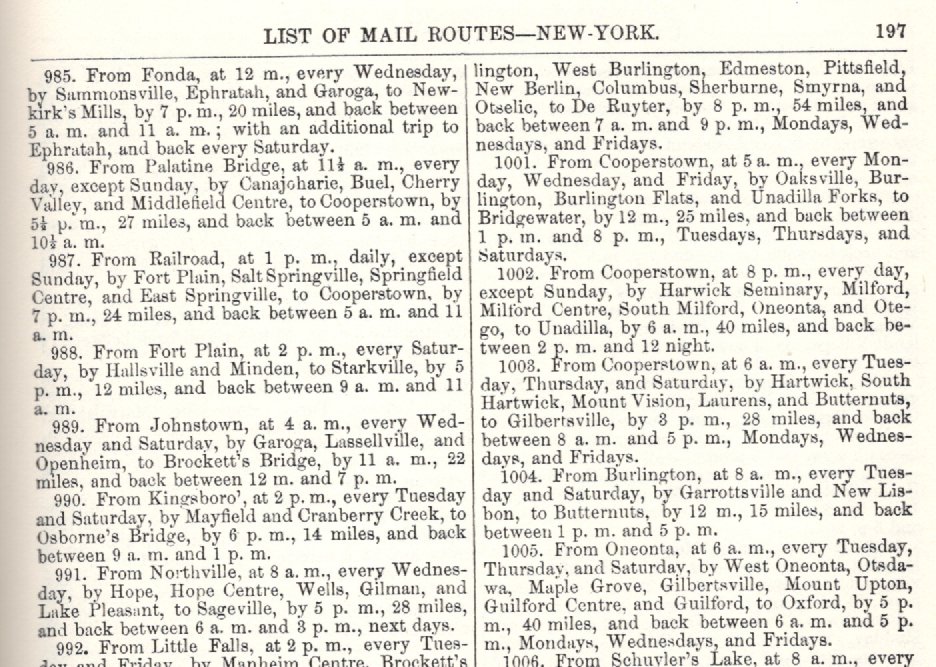 Lastly, I will add a much later example. A bid booklet from 1890 for the mid-1891 to mid-1895 contracts in Indiana, the excerpt ad for Route 33291 (awarded), and a portion of the route report from the contractor for that route noting "Mode of carrying the Mail: Horse Back" 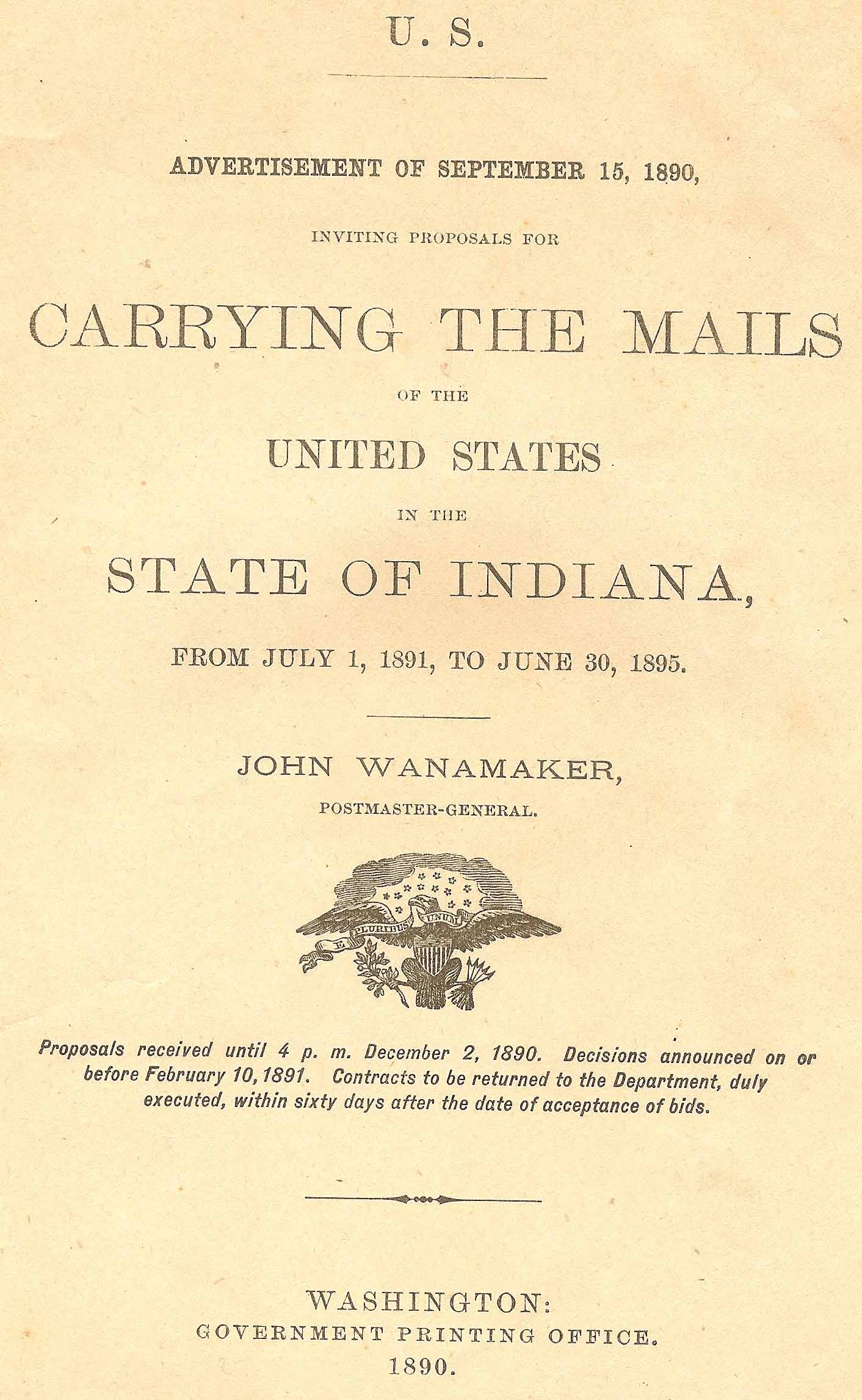 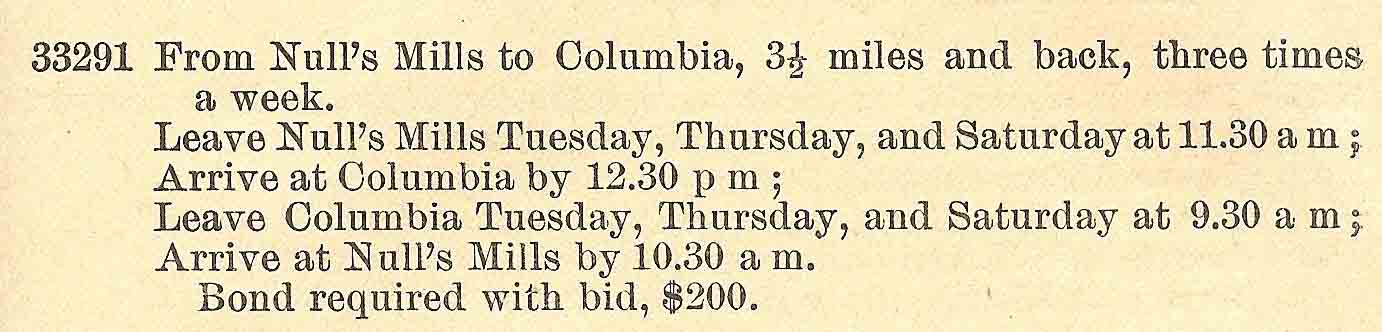 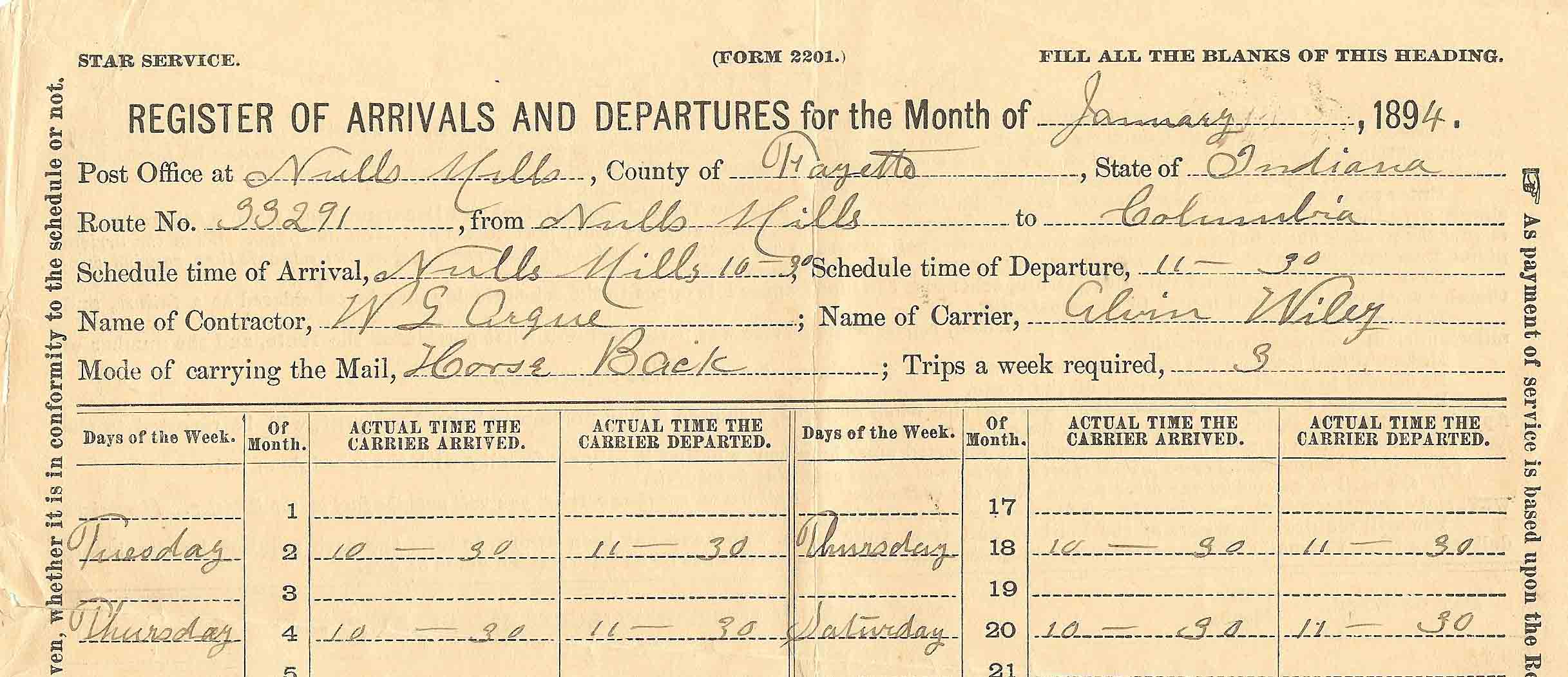 Highly unusual that such trip reports survived, but somehow a large cache of papers from the Nulls Mills, Indiana post office has survived and is in the marketplace. |
|
Send note to Staff
|
| Edited by John Becker - 09/14/2024 3:52 pm |
|
|
Pillar Of The Community
United States
1124 Posts |
|
|
John, If it was returned to sender directly from NYC, wouldn't there have been a fee involved? My understanding is if it went thru the DLO (as there were no 'return to sender' instructions in the corner card) it would have been returned gratis. Thee's no indication of a return fee charged or paid.
PhilaFactor, Whereabouts? I lived in Ancramdale for 30-years. After I retired, the need to downsize and the desire not to pay $24K in property/school taxes anymore moved me to Hobart (Delaware County). |
|
Send note to Staff
|
|
|
Pillar Of The Community
6352 Posts |
|
|
Return addresses are uncommon at this time.
Supplemental return instructions are rare at this time.
I have too many irons in the fire at the moment to even be on here right now, sorry, so you'll have to digest the Postal Law volumes yourself.
Add: Tony Wawrukiewicz's book "The Forwarding of Mail by the U.S. Post Office Department, 1792-2001" will have many of the dates, procedures and other details you seek all in one place in better arrangement them my memory without references at hand. |
|
Send note to Staff
|
| Edited by John Becker - 09/14/2024 10:48 pm |
|
|
Pillar Of The Community
United States
1124 Posts |
|
|
No worries, just trying to wrap my head around what actually happened. From the 1866 version (and thanks PhilaFactor for the link): 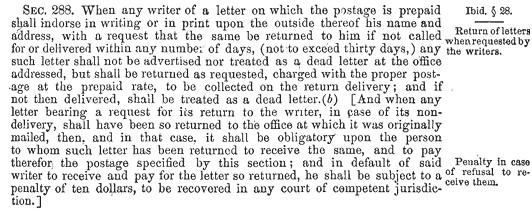 |
|
Send note to Staff
|
|
|
Valued Member
United States
81 Posts |
|
|
Quote:
PhilaFactor, Whereabouts? I lived in Ancramdale for 30-years. After I retired, the need to downsize and the desire not to pay $24K in property/school taxes anymore moved me to Hobart (Delaware County). We lived in Ghent for about 10 years, on Soller Heights Road. So I've been painting a mental picture of the letter carrier going up Route 66, making a right on Soller heading towards Mellenville, Philmont, and over to Spencertown. Ancramdale! Before settling on our home in Ghent we considered purchasing the old opera house in Ancramdale. I had this crazy idea that I'd turn the concert hall into a music studio for my work. But the living quarters were awful, so we passed. And yes, the property taxes in the area were atrocious. |
|
Send note to Staff
|
|
| |
Replies: 13 / Views: 734 |
|




 Posted 09/14/2024 03:44 am


