| Author |
 Replies: 29 / Views: 2,680 Replies: 29 / Views: 2,680 |
|
|
|
Valued Member
United Kingdom
225 Posts |
|
|
I am reluctant to get too involved in this area of collecting Israel for exactly this reason as I find it hard to distinguish genuine from probable forged.There was a well known early collector who forged material, so I always try to check material to see if it was sent from/to him and avoid. |
Send note to Staff 
|
|
|
Pillar Of The Community
United States
775 Posts |
|
|
gum side, what reference are you using that shows the Nahariya stamping device? I have not seen this before. I have used the following book (2nd edition) for collecting this area. It has a lot of useful information but is difficult to use.  You may be interested to know that the Ma'adan Menorah postmark is NOT in the book. I did find this reference to a Menorah Club (site only available in Hebrew). Perhaps the "postmark" was not a postmark but some type of seal. http://www.zionistarchives.org.il/P...rahClub.aspx |
|
Send note to Staff
|
|
|
Valued Member
Israel
53 Posts |
|
|
Germania, The information comes from this book: https://israelstamps.com/product/43...l-ii-part-2/But be aware that all 4 books in that pink series plus basically anything else that's been published on Israel-Holyland is **PACKED** with misinformation. To that end I publish the JerusalemStamps Bulletin (available free here https://jerusalemstamps.com/researc...center.html) and try to redress that problem. Menorah Club won't be in the Bale catalogue you have because that book covers Palestine prior to the Mandate; it's shown in Bale's Israel catalogues |
|
Send note to Staff
|
| Edited by gum side - 11/15/2024 08:59 am |
|
|
Valued Member
Israel
53 Posts |
|
|
Below (left) is a real postmark strike and on the right a forgery of the same postmark; one is an ink-strike and the other is applied to the cover by some method but not by way of a postal-device strike. Following up on my earlier question, can anyone shed some light on the method used to create the forgery? 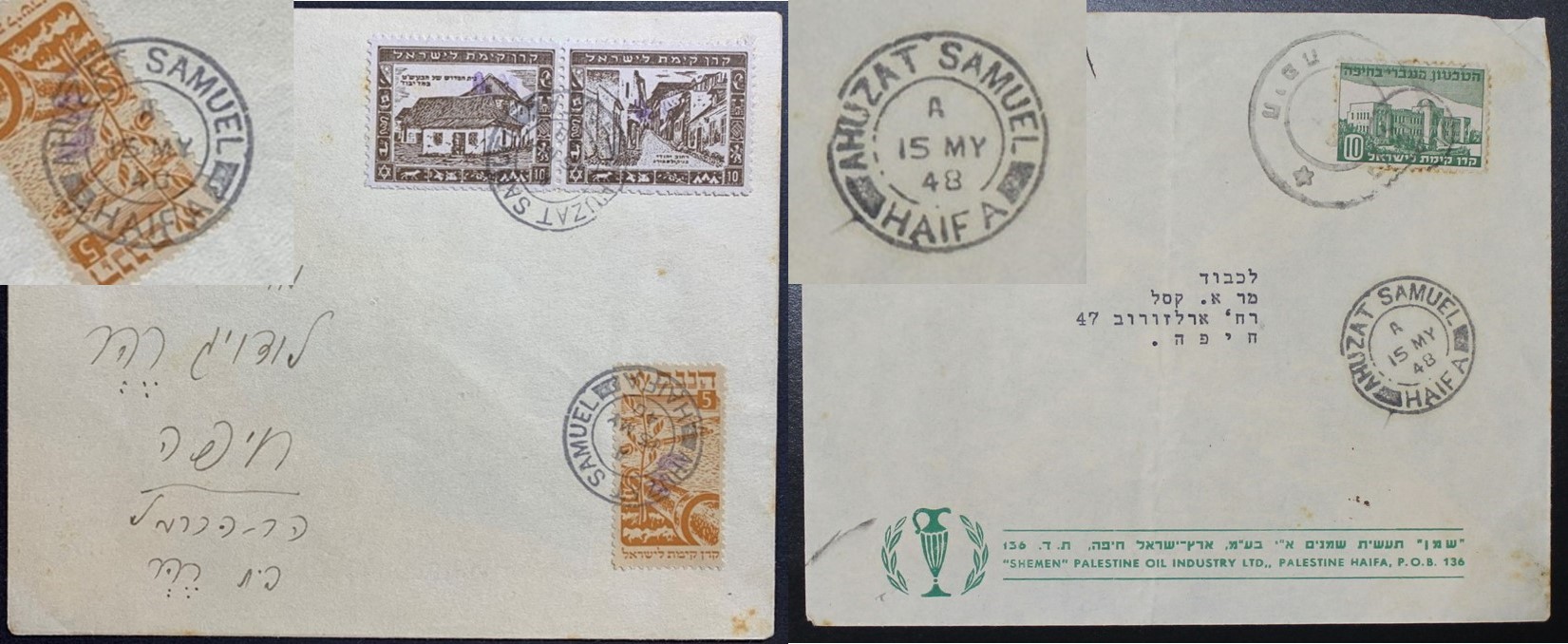 |
|
Send note to Staff
|
|
|
Valued Member
222 Posts |
|
|
Is the goal here to stop forgers in their tracks or be the best one ever? I don't get where this is going. Normal collectors don't have dirty tricks to share on how to fake anything. |
|
Send note to Staff
|
| Edited by paddle_more - 11/17/2024 12:44 pm |
|
|
Valued Member
Israel
53 Posts |
|
|
The goal is here to help collectors identify fakes by accurately calling out the methods used. Why the excessive suspicion? |
|
Send note to Staff
|
|
|
Valued Member
222 Posts |
|
|
I've seen hundreds of other posters come and go, like many others here. If you are collecting data to publish or share then that is great. That is all. |
|
Send note to Staff
|
|
|
Pillar Of The Community
United States
775 Posts |
|
|
gum side, you seem to be all over the place, showing postmarks from different eras. I will discuss just one item, the Ahuzat Samuel postmark. Assuming your two covers were scanned as one item it is possible to compare the two postmarks. Look at the two side by side.The postmark on the cover with the green stamp, shown on the left, is slightly smaller than the right one, has thicker lettering, the lettering is also not as crisp and the "A" of SAMUEL has a defective crossbar. It is probably a forgery. A rubber stamp is likely. The original probably used a metal stamp.  I have a similar cover in my collection which I believe is genuine: 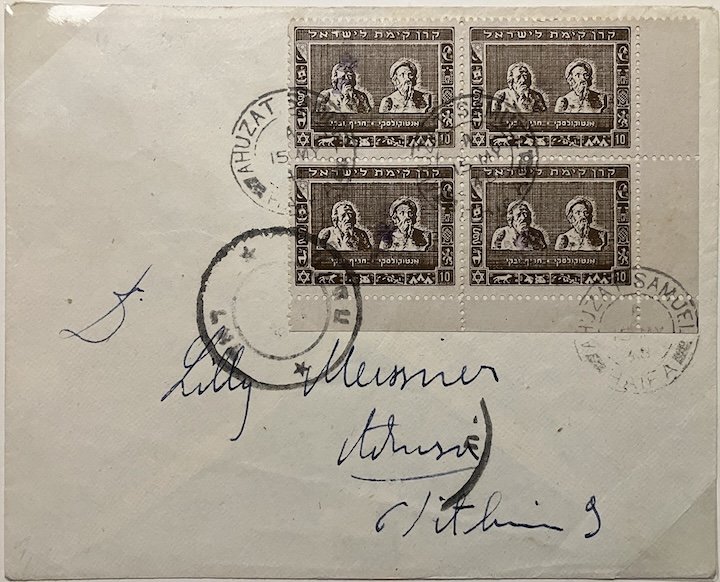 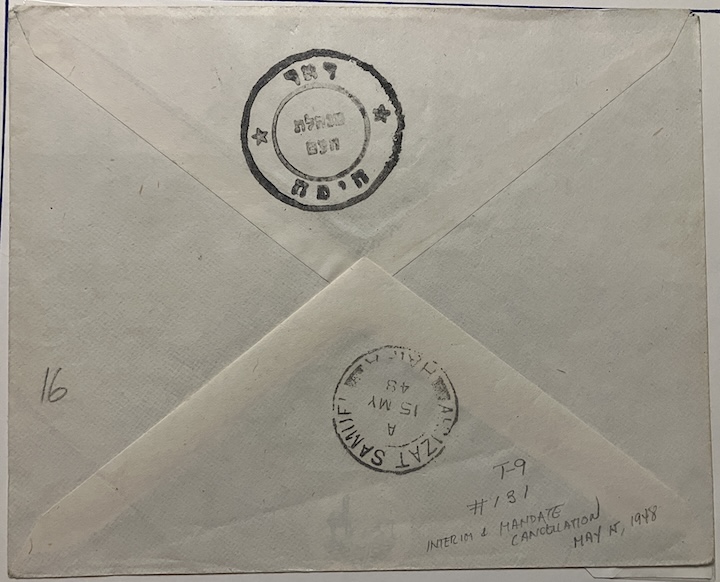 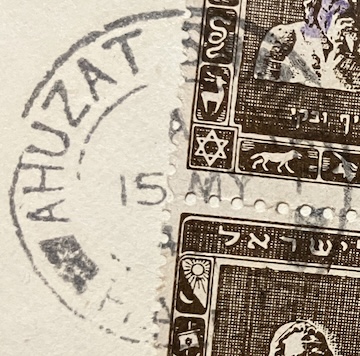 The May 15 1948 date is a slight mystery as that was a Saturday and the Post Office would have been closed. |
|
Send note to Staff
|
|
|
Valued Member
Israel
53 Posts |
|
|
If you pay close attention you'll see the various postal strikes I show are all related insofar as their strange appearance. Yes, where a certain subject of mail is known to be faked, anything related to it will be suspect, but here I'm showing that there is a general pattern across various subjects - albeit mostly from 1948 - where mostly British Mandate type postmarks with double rings appear to be forged on a widespread basis. And my question is, what method might have been used to do that? If we have a name for the problem it might be possible to research it further to a) compile characteristics of such forged strikes, and b) it might even be possible to find out who created these forgeries. So far what I see time and again is a faded grayish strike which might be clear and even full at first glance - but oddly missing details where no "ink" should be missing, or the strike may be uncharacteristically blurry and still missing details. Note by the way that in the images below, the other elements seen are all clear and sharp, even the envelope flap - yet the specific postmark shown is not so crisp. By all appearances strikes of this kind are not created by the application of fresh ink onto a cover directly from a postmarking device (though there may be forgeries based on the use of a device - but not in the examples I show). Indeed ink is used to create these images but how is that ink applied to the cover - is it through a photographic process, and if so what type might it be? (the phenomenon reminds me of the numismatic equivalent of forged coins, based on the "casting" method rather than "die strike" as used on genuinely minted coins) 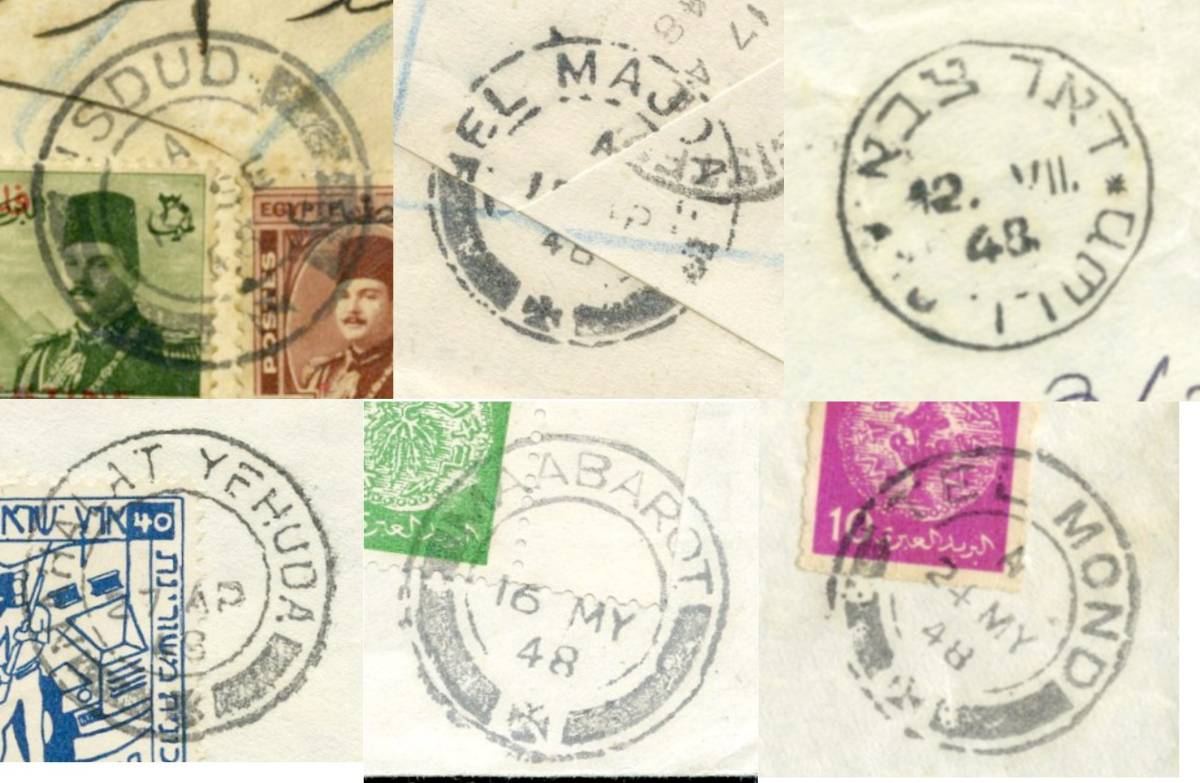 |
|
Send note to Staff
|
| Edited by gum side - 11/20/2024 04:43 am |
|
|
Valued Member
United Kingdom
225 Posts |
|
|
Some of you may know the story, which is in Bale, about Shapira who made the PATCO bogus issue. He was based in Haifa and was active in 1948.The Patco issue is often found cancelled, so may have been a testing ground for postmarks as well.
I have found an Israel military envelope, my area of specialism, sent to/from Shapira with a very unusual military triangle.It may be unique but is probably from a reproduced military handstamp. This could have been used and developed because military mail was free to post, or be part of experimentation in how to reproduce postmarks. Bale warns about Robintel, Korngold and Korniel [in both Hebrew/English] as names used by Shapira, so if the envelope has these names it most probably originates from Shapira. Have you looked at the names on many envelopes? |
|
Send note to Staff
|
|
|
Valued Member
United States
54 Posts |
|
|
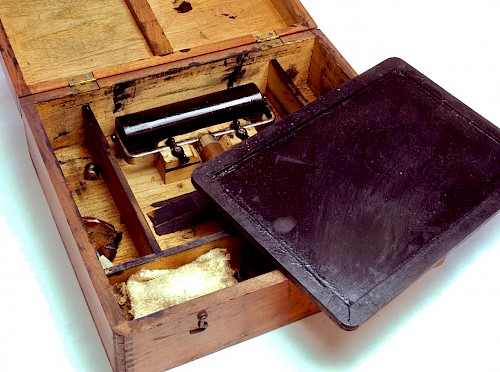
Hey: About that mimeograph device described in that image of a book, I think the device looks a lot like the original Edison-A.B. Dick mimeographs. The earlier ones weren't the drum type like were used in schools up until the 80s or so, but a flat box-type contraption. Each copy was laid in separately. The device in the image looks similar (but not exactly like) those old Edison-A.B. Dick machines.
Josh
|
|
Send note to Staff
|
|
|
Bedrock Of The Community
12741 Posts |
|
|
Valued Member
United States
54 Posts |
|
|
Rogdcam: YES!! Exactly like that. My Cub Scout den had one of these things--the Den Mom used it to make prints, flyers, stuff like that. She ended up getting a used drum-type machine that was much faster and easier (??) to use.
I think she used some modern supplies with her old-model thing. This was the 70s, so I don't remember much about it except that I was interested in printing and such. It was at that time that I was still new to stamp collecting :-}
Josh
|
|
Send note to Staff
|
|
|
Valued Member
Israel
53 Posts |
|
|
Hi Josh, yes what you wrote is exactly what I found as well - researching duplicating devices, the closest thing I found to what the literature describes, is the Edison device from some 50-60 years before the events. My impression is that this was unlikely the method used then in 1948 to apply those 'slogans'. Moreover, when I examine those 'slogans' I don't see the kind of "fresh ink" I would expect to see from an ink-pad; the strike impressions (if that's even the right word) looks more like the mark of a duplicated image rather than ink applied from a roller. |
|
Send note to Staff
|
|
|
Replies: 29 / Views: 2,680 |
|




 Posted 11/14/2024 4:11 pm