| Author |
 Replies: 29 / Views: 2,679 Replies: 29 / Views: 2,679 |
|
Valued Member
Israel
53 Posts |
|
|
|
I'm studying the subject of postmark forgeries and fakes, and wanted to ask if anyone has an idea why a forger would use a stencil rather than some other implement to create a postmark? Is there any benefit to the forger by using a stencil?
Separately, on the same main subject, is there a reason why a forger might use an all-metal postmark device rather than one of rubber?
|
|
Send note to Staff
|
|
|
|
|
Bedrock Of The Community
United States
10855 Posts |
|
|
Depends on what stamp is being cancelled. And stencil cancels are generally scarcer, so there can be a real financial incentive to using one. |
Send note to Staff 
|
|
|
Pillar Of The Community
United States
8599 Posts |
|
|
Early Italy and Colonies have a lot of faked cancels because their catalog value is much higher . The same with German inflation issues . |
|
Send note to Staff
|
|
|
Bedrock Of The Community
12741 Posts |
|
|
Quote:
Separately, on the same main subject, is there a reason why a forger might use an all-metal postmark device rather than one of rubber? If this assumption is true (where does it originate?) I can only speculate that a metal device would produce a crisper cancel and not be affected by application pressure as much. Just a WAG on my part. |
|
Send note to Staff
|
|
|
Valued Member
Israel
53 Posts |
|
|
I'm looking at two separate subjects of Israel/Holyland postal history, where the hallmark of each one is that in one area the postmarks are applied as stencils and in the other, apparently, by metal devices rather than rubber.
My point is, both fields are presently considered legit but I have my doubts. With the first subject, according to accepted narrative, a stenciled postmark was applied to mail. I suspect that the whole subject is fake and I'm curious to know why a postmark should be applied as a stencil rather than using a standard postmarking device; what benefit is served for a forger by applying a postmark using a stencil rather than a handstamp device? The postmark albeit is illustrated and rather large but what advantage is there to applying it using a stencil instead of commissioning a workshop to produce it as a rubber handstamp? According to the accepted narrative there were 7-8 different stencils used because they kept getting worn out (i.e. lots of work involved making these).
By a similar token, in a different subject of Holyland postal history there are postmarks of a certain locale whose strike impressions look suspect and they appear to be applied by an illustrated metal device. Here my question is, why apply a strike with a metal device rather than rubber as is standard on most postmarking devices? |
|
Send note to Staff
|
|
|
Pillar Of The Community
Netherlands
6641 Posts |
|
|
Quote:
Here my question is, why apply a strike with a metal device rather than rubber as is standard on most postmarking devices? Are you telling us metal devices were used where Quote:
there are postmarks of a certain locale that were rubber stamps? Or are you just speculating that cancellation devices in general are rubber stamps? |
|
Send note to Staff
|
| Edited by NSK - 11/13/2024 07:56 am |
|
|
Pillar Of The Community
6363 Posts |
|
|
gum side,
Showing us several examples would be far more helpful to us than anything else. |
|
Send note to Staff
|
|
|
Valued Member
Israel
53 Posts |
|
|
The image may cause more confusion with regards my question but I'll explain what you're looking at and how it relates to my question. I suspect that much of the "Jewish colony" handstamps of the Ottoman period are not genuine - you see 2 strike examples on the left and center of the top row; on the right is an example of what was long thought to be a 1948 era "Menorah Club" handstamp, which looks suspiciously like the other two. (I demonstrated that the whole subject of the Club mail was made-up). All 3 strikes have a "metal" over-inked look to them and I wonder why use metal rather than rubber. On the 2nd row is an example of 1948 era stenciled slogan postmark (of the Nahariya emergency mail service); next to it and below are 2 Ottoman era Jewish colony strikes which look washed out, akin to the stencil's appearance. Here my question is, why use stenciling instead of a proper handstamp? If any of these are forgeries (as I suspect they are - the whole issue of the Nahariya mail is something I'm researching now), why use stenciling as the implement? What advantage does that give either to a forger or even for legitimate use? 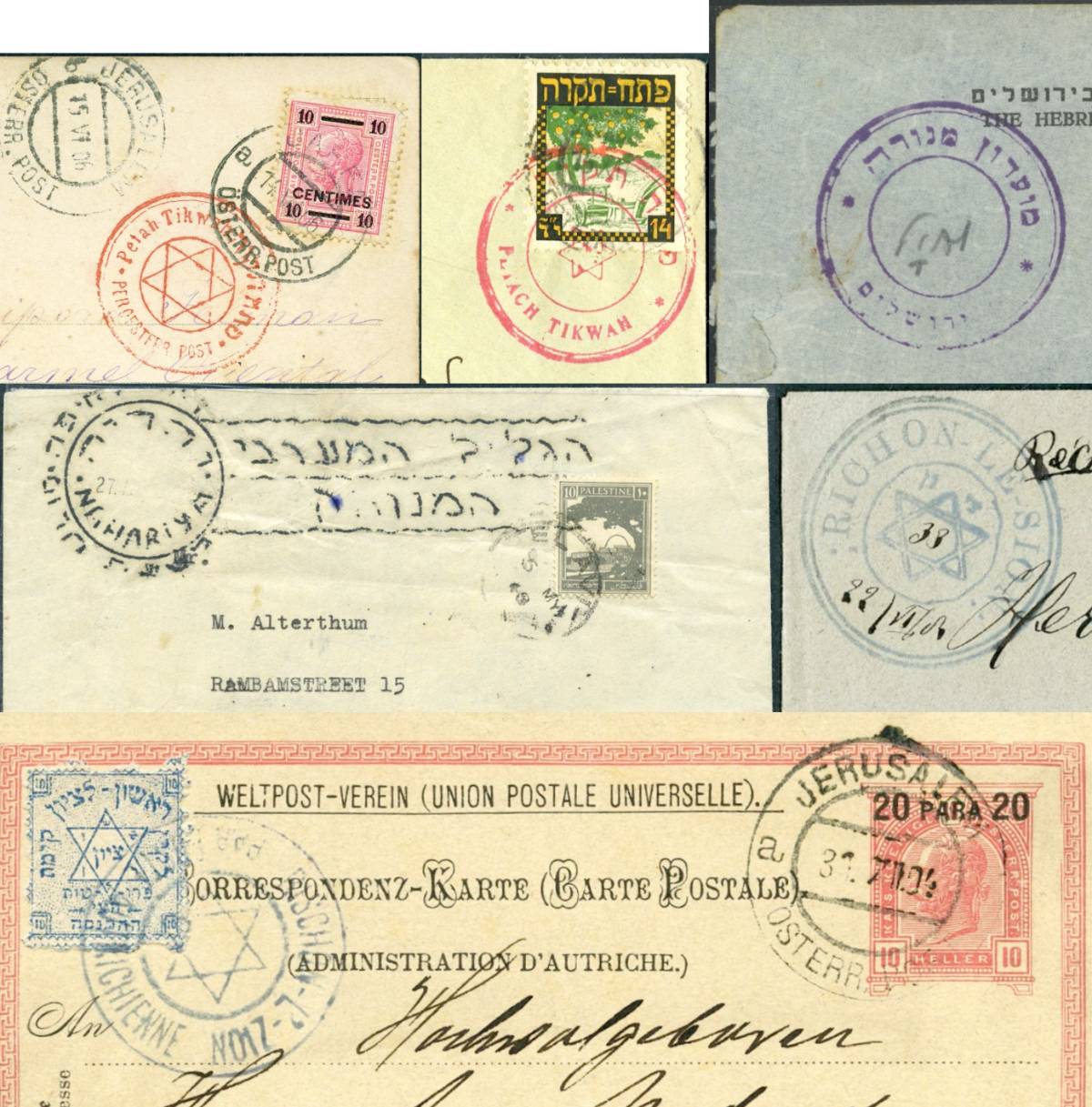 |
|
Send note to Staff
|
|
|
Pillar Of The Community
6363 Posts |
|
|
gum side, Thanks you for the illustrations. It helps clarify the word "stencil", which could have been a metal sheet with letters cut into it and inked with a dauber of some sort (as the early replies are referring to), or a second type of stencil being used with a mimeograph/hectograph or other 20th century office duplicating machine. The example you show midway down the left side appears to be mimeograph technology. Broadly, whether ones uses metal, rubber or mimeograph technology likely depends on supply issues and the skill/resourcefulness of the postal clerk (or forger). What is available at the moment. Each technology/use should be evaluated on its own merits. Add: Here are "first day in commission" covers with 3 different stencils (they can only make so many impressions). I don't know the specfics for the USS Ranger, but it's possible they didn't have a handstamp or machine cancel available yet and this was the best they could do on short notice. 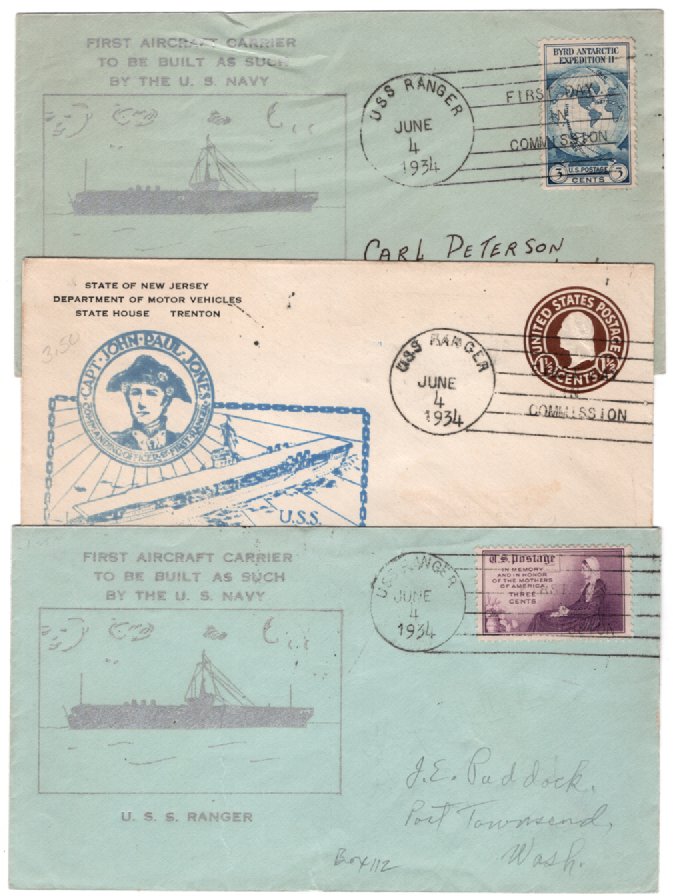 I am also aware of an Addressograph machine being used to cancel mail during a flood emergency. Bottom line, postal workers have been very creative to make the mail move through natural disasters, wars, political changes, etc. |
|
Send note to Staff
|
| Edited by John Becker - 11/13/2024 10:16 am |
|
|
Bedrock Of The Community
United States
10855 Posts |
|
|
Forgers use whatever implements they have available to them at the time. Knowledgeable ones also try to use whatever looks as close to a genuine example as possible. As stated above, genuine cancels were done with whatever was available at that time, so in locations that were less technologically advanced in that time period might use anything handy. |
|
Send note to Staff
|
|
|
Bedrock Of The Community
12741 Posts |
|
|
When we talk about forgers in this topic are we talking about philatelic forgers seeking to create value or are we talking about forgers seeking to cheat the postal service(s)?
I ask because it would seem that anyone going to great lengths to create a valuable item would not be using whatever materials were at laying around. Someone trying to cheat the system on the other hand would not be as concerned about that. |
|
Send note to Staff
|
|
|
Bedrock Of The Community
United States
10855 Posts |
|
|
My experience with "philatelic" forgers, is that in general, they did use whatever they had laying around. That's part of why so many are relatively easy to spot for knowledgeable philatelists. Those people are trying to fleece the collector with limited knowledge, and many were not as knowledgeable as they thought they were. The examples posted here are clearly philatelicly inspired for profit rather than any postal forgeries. Too much work for far too little return versus real money to be made. |
|
Send note to Staff
|
|
|
Valued Member
Israel
53 Posts |
|
|
I had to get images of the known information. What I'm getting at regarding the stenciling is, outwardly the subject is presented to our community as genuinely applied stencil "postmarks" - and I'm wondering, if there is a nefarious motive, why use stenciling rather than a proper (rubber) postmark? The accepted narrative is that due to wartime conditions materials were lacking, even though we do know of normal handstamps being used on mail at this location (Nahariya) at this time. Is it due to the complex design that a stencil had to be used, or can someone think of some other reason? A byproduct of the stenciling is that the design had to be recreated every few days - time consuming and not practical in my opinion. As regards the mechanics, below is the raw information but in summary, wax paper was used to create the stencil which was then applied with ink using a hand-pressure applied ink pad: 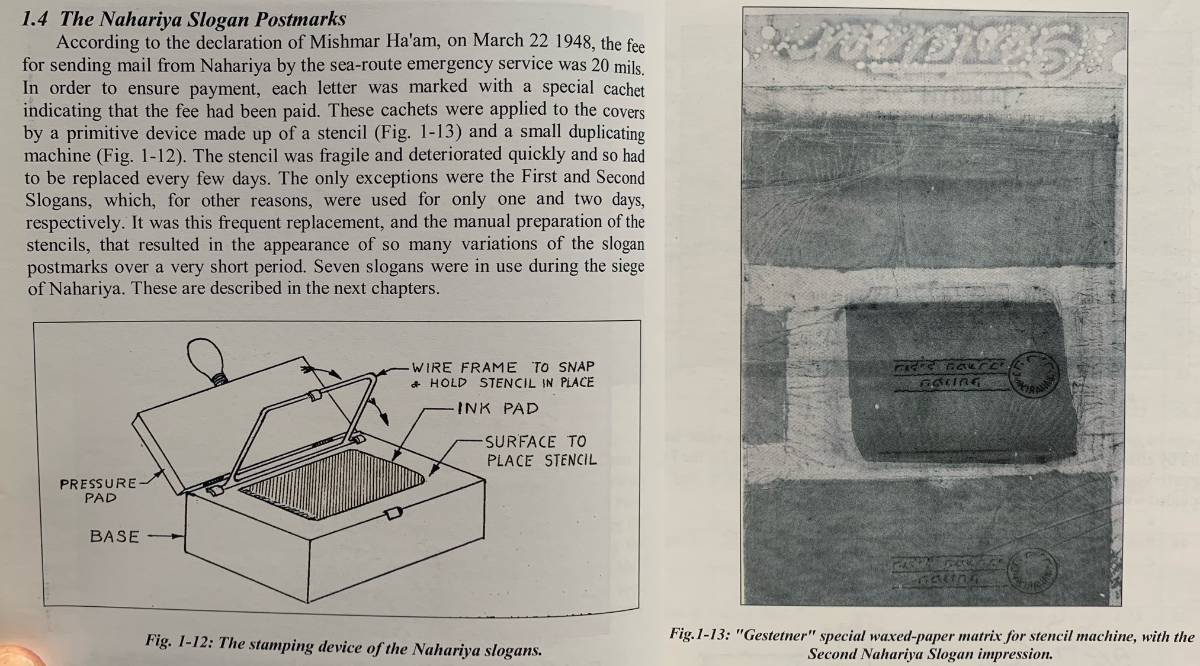 |
|
Send note to Staff
|
| Edited by gum side - 11/14/2024 09:08 am |
|
|
Valued Member
Israel
53 Posts |
|
|
John Becker:
"The example you show midway down the left side appears to be mimeograph technology." - I'm curious by what you mean: are you referring to the long horizontal slogan mark (the "postmark" I'm referring to)? If so, would you say that it does not look like the impression is the result of ink applied from a pad like in the illustration I posted just above? |
|
Send note to Staff
|
|
|
Pillar Of The Community
6363 Posts |
|
|
Yes, we are referring to the same marking My replies here are based on what I am familiar with. That is, one of the various brands of larger "office machines" capable of 8.5 x 11 paper or larger. The process of these larger machines is to "cut a stencil" on a wax-like paper with a stylus and mount it in the mimeograph/hectograph/ditto machine which prints an image with each rotation. I had not seen a stencil device as simple/primitive as the one you show. However, it appears to be similar in technology. Stencil vs rubber stamp: One uses the equipment one has available. The average mid-20th century office had the equipment and any secretary could make a stencil in a few minutes. They could not make their own rubber stamps as easily - certainly not under seige conditions. This may be a tangent, but the Gestetner brand goes back at least to the 1880s, with the stencil of that era cut by a vibrating pen device not dis-similar to a tattoo pen. The result of cursive writing being a series of dots to make the writing, like this close-up from a postal card mailed in 1887: I don't know what their stencil-cutting method was in 1948 for the Gestetner kit shown in the figure above. 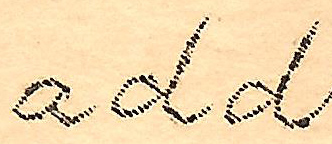 |
|
Send note to Staff
|
| Edited by John Becker - 11/14/2024 10:42 am |
|
|
Valued Member
Israel
53 Posts |
|
|
Thanks John! What you've written veers towards the suspicion I have about our existing narrative. According to that history, the stencils were hand made (without any reference to special tools used like the vibrating pen you mentioned); the reference to the ink pad in the literature is supposed to imply that the strikes should be "inky" - but as you observe (as do I), the impression does not look based on ink from a pad but from some other printing method. I don't know what it is, but your suggestion that it might be "mimeograph technology" is interesting and very possible.
Out of interest, if the markings were produced by the type of machine you described, am I correct to assume that this would leave marks on envelopes - like stretch marks, creases and the like? Because we don't see that on mail of this kind. |
|
Send note to Staff
|
|
|
Replies: 29 / Views: 2,679 |
|



 Posted 11/13/2024 06:07 am


