| Author |
 Replies: 8 / Views: 800 Replies: 8 / Views: 800 |
|
|
Valued Member
United States
54 Posts |
|
|
|
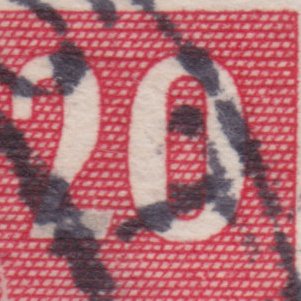
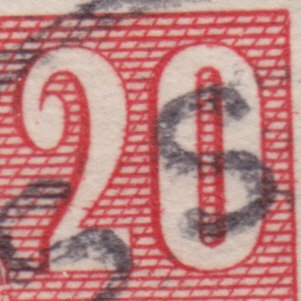
Looking at the King Gustaf issue of 1939 (A55) and 1940 type (A60) has me confused. My album spots for Scott 280, 281, and 289 remain empty although I may (or may not) have these stamps. I just took my pile of assorted Gustaf A55 and A60 out last night to see if I could figure anything out, but I really can't.
The catalog says that "number 300 differs slightly from the original due to deeper engraving," but I can't find any side-by-side comparisons of the two types. An Internet search reveals stamps being offered as A55 types, but they look no different from A60 ones to me.
Do you have both types identified? If so, would you be willing to show side-by-side images and offer suggestions as to how I might discern one from the other? My eyesight isn't as good as it used to be, but with my glasses and a magnifier I can see my stamps fairly well.
I'm SO tired of those empty spaces when I have NO IDEA what I'm trying to find on these stamps :-}
Thanks for reading this!!
Josh
|
|
Send note to Staff
|
|
|
|
|
Pillar Of The Community
Netherlands
6641 Posts |
|
|
You might help specialists help you. They, probably, are using FACIT and may not use Scott. Descriptions or pictures (of the spaces) may be better understood than Scott numbers. |
Send note to Staff 
|
|
|
Valued Member
Canada
395 Posts |
|
|
Hi,
I just had a look at my copies. I see the difference between the two types in the background. In A55 it is a uniform dark colour, while in A60 it varies from very light near the head to dark near the edges of the stamp. If you have a pile of these, the A55 will have a considerably deeper colour than the others.
I don't have my examples scanned, but if nobody steps up, I will do this later.
Jan |
|
Send note to Staff
|
|
|
Valued Member
Canada
58 Posts |
|
|
I use the Facit catalogue for Sweden so I'm not totally sure how they translate to Scott. But the excellent Swedish Definitive blog describes the two types in a bit of detail. Perhaps it will help you? I found this blog invaluable when making sense of early Swedish issues. (well, 1937 - 1970 "early") :) https://swedishdefinitives.blogspot...type-ii.html |
|
Send note to Staff
|
|
|
Valued Member
Canada
58 Posts |
|
|
I just dug out my Scott Catalogue to see if I could find the differences. I *think* Scott splits A55 and A60 based on what Facit calls the 'small numeral' and 'large numeral' sets.
The first (A55) set has smaller numerals denoting the denomination than the later set. They are quite easy to distinguish.
The blog I linked to above has nice photos of each set so take a look, it might be all you need to tell them apart.
PS - Facit lists two die types for the 15 ore large numeral stamp (Facit 275I and 275II) but Scott doesn't list a difference as far as I can tell. Both are Scott 300D.
. |
|
Send note to Staff
|
|
|
Valued Member
Canada
395 Posts |
|
|
Pillar Of The Community
United States
1026 Posts |
|
|
The size of the numerals is a much better indicator than the background... |
|
Send note to Staff
|
|
|
Valued Member
Sweden
136 Posts |
|
|
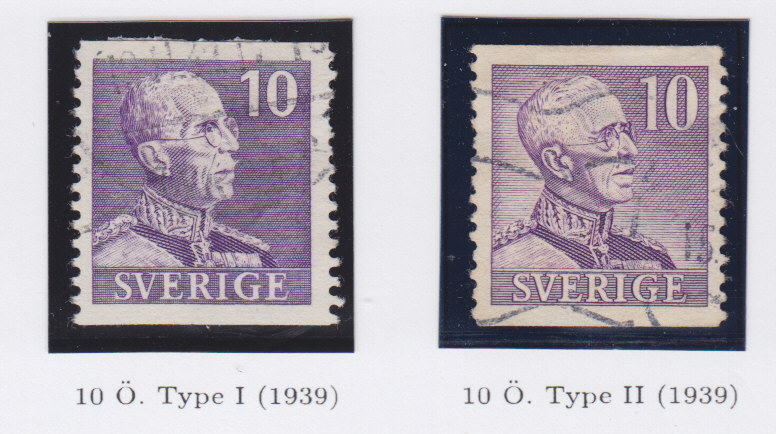
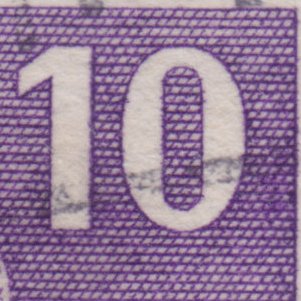
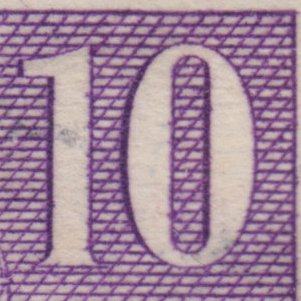
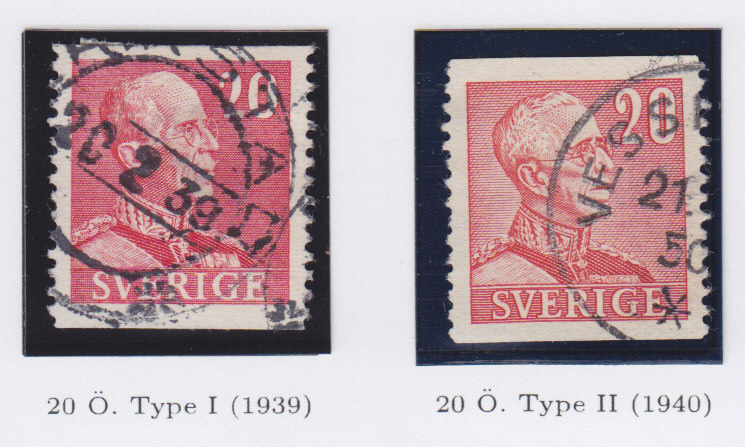
As you can see the difference between A55 and A60 is quite obvious, but even if you have a large number of these they may all be A60. Only 3% of 10öre was A55 and 1% of the 20öre. Most of the A55s are used 1939 or early 1940 so if your stamps comes from kiloware from the mid 1940ies probably all are A60 |
|
Send note to Staff
|
|
|
Valued Member
United States
54 Posts |
|
|
Hey, thanks for all the info!
I located a purple 10o 280 in my accumulation of this type. It's the 1939 kind. The numerals are shorter and different, and I see that the crosshatching in the background is different as well.
I'll post an image of my find (next to a 302 re-engraved example) later.
I really appreciate the help!!
Josh
|
|
Send note to Staff
|
|
| |
Replies: 8 / Views: 800 |
|




 Posted 12/03/2024 04:06 am